A lower camera price can create extra mounting and access work. Compare complete installation tasks and declared maintenance assumptions before approving a substitution.
Section 01
Count the work created by the camera substitution
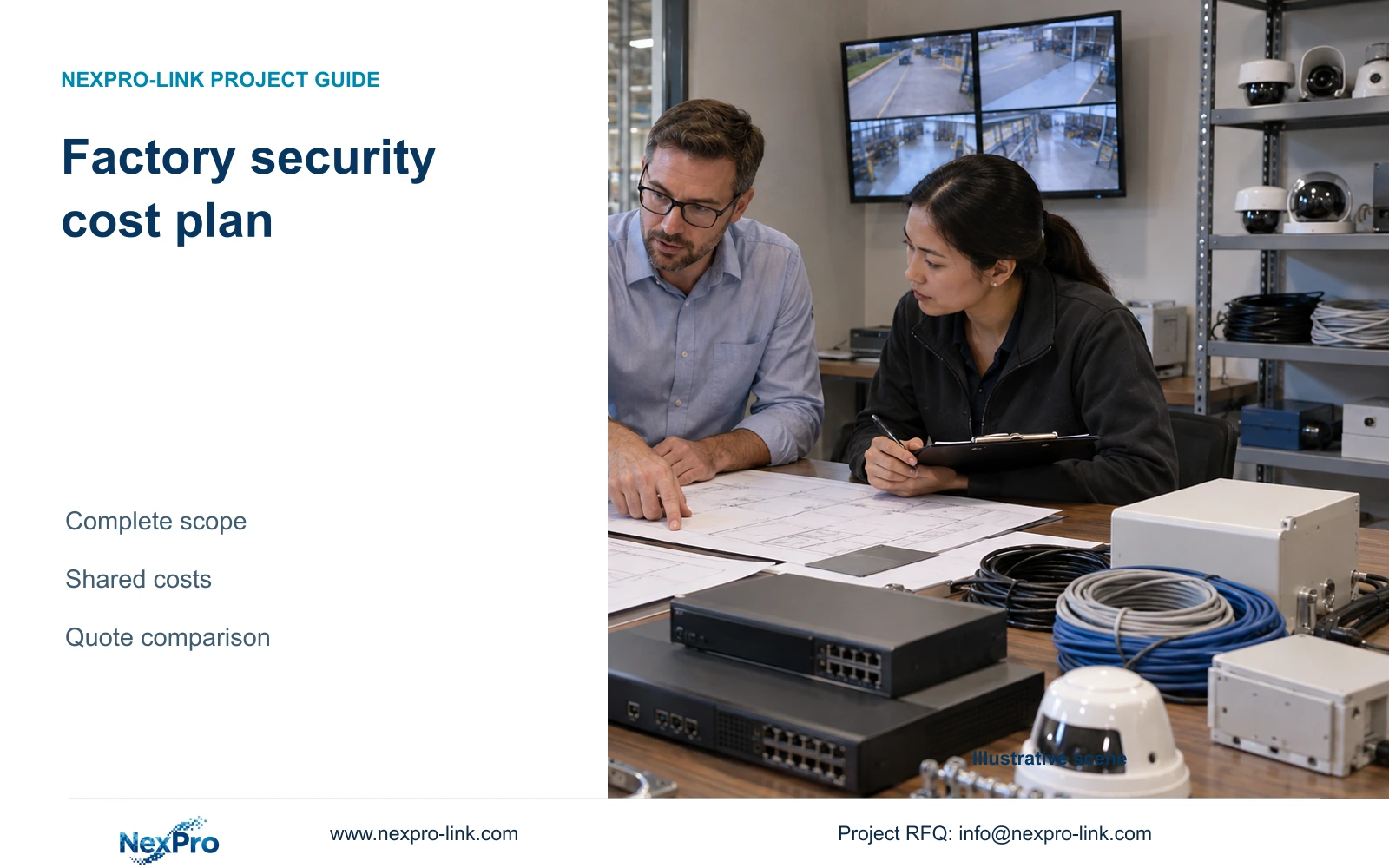
Compare factory CCTV labour versus hardware by pricing the complete installation task affected by a substitution. Include mounts, access equipment, route changes, configuration, testing and any repeated visits. A hardware saving is commercially meaningful only after the additional work is accounted for and the camera still supplies the required recorded evidence.
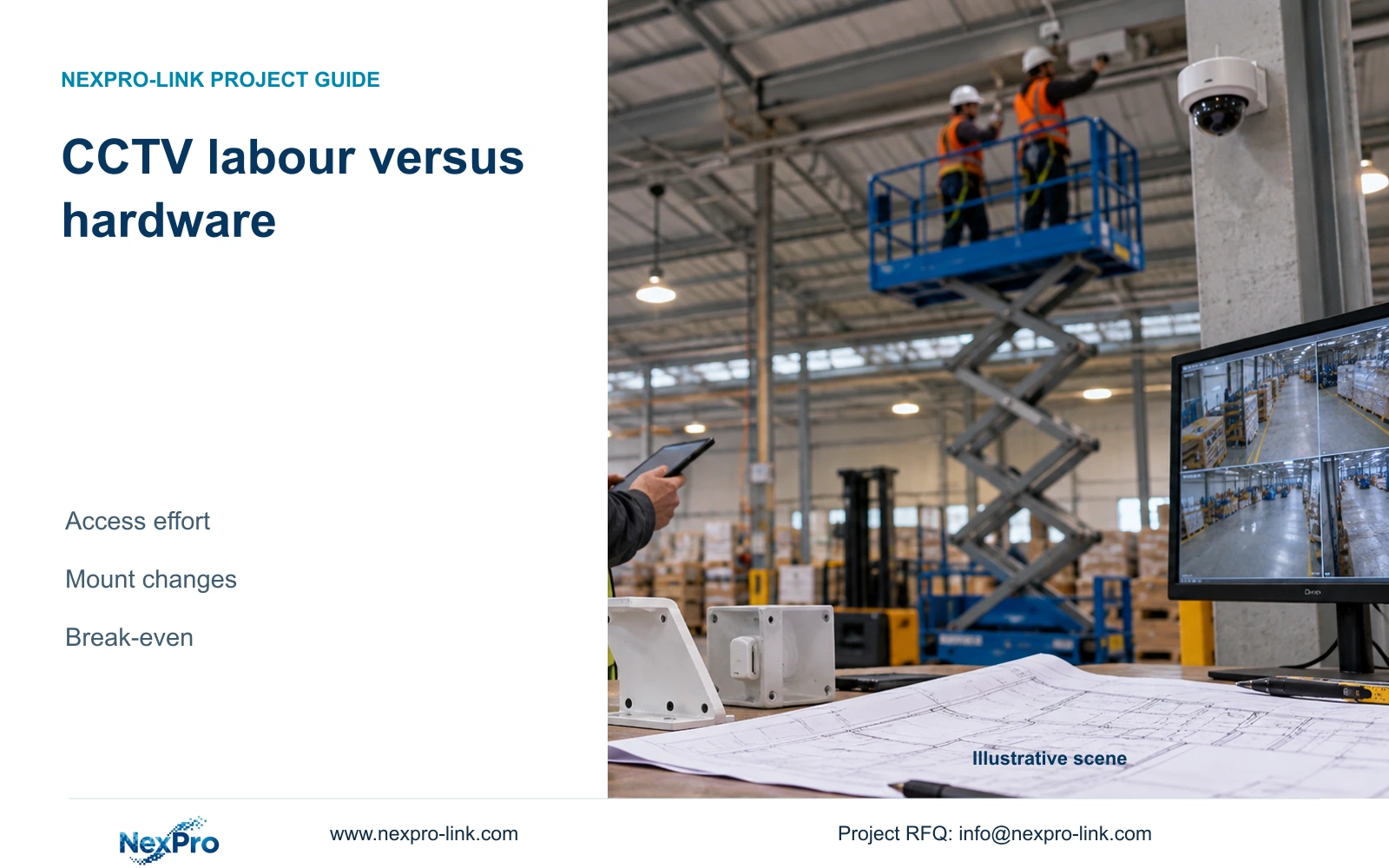
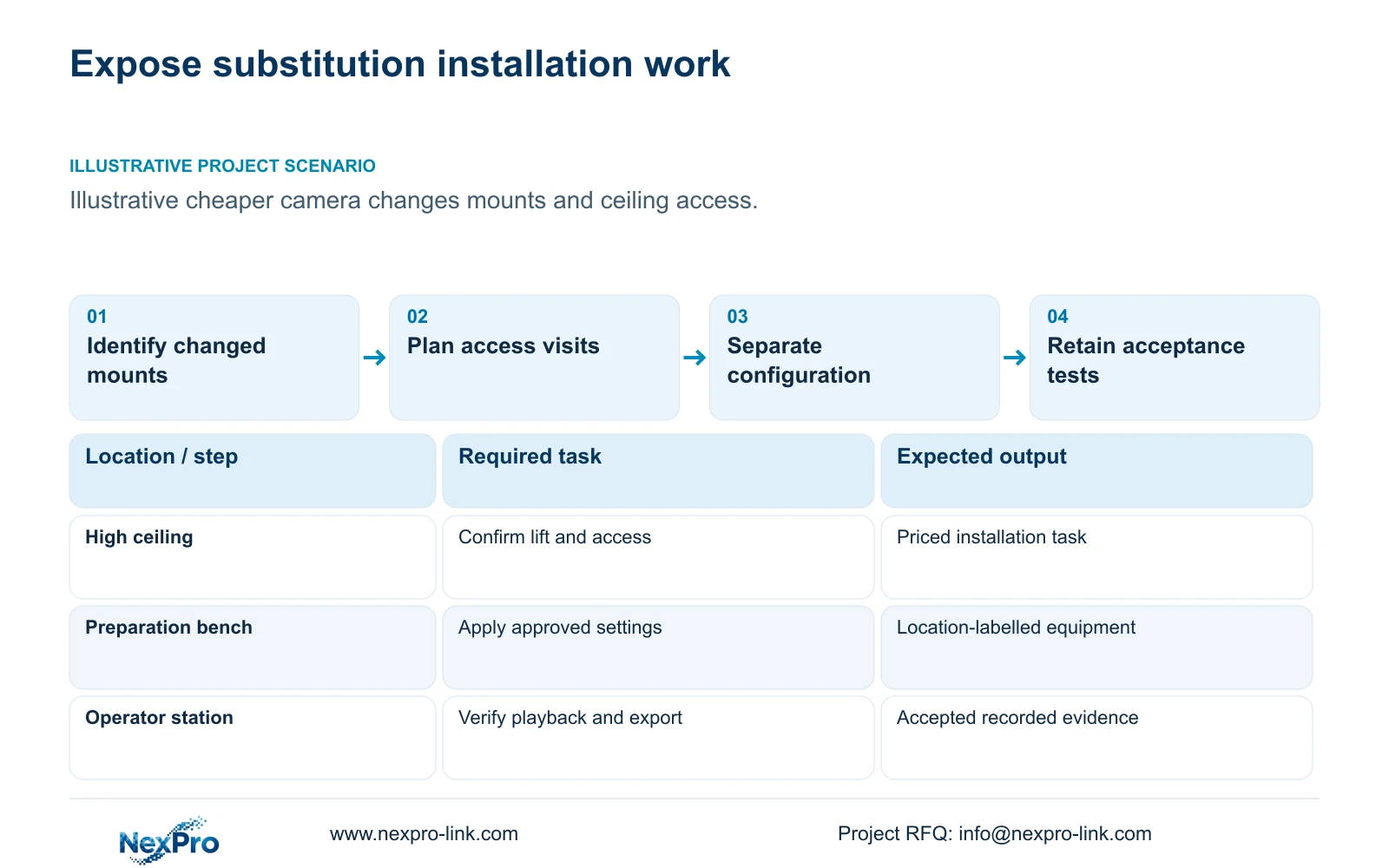
Illustrative project scenario: A lower-priced camera requires different mounts and repeated access to high ceilings. Assume the factory has restricted installation windows around normal production, and the proposed mount needs review before release. These are plausible planning conditions, not observed productivity figures. The quantity surveyor needs task quotations from the installer rather than an assumed percentage of equipment price.
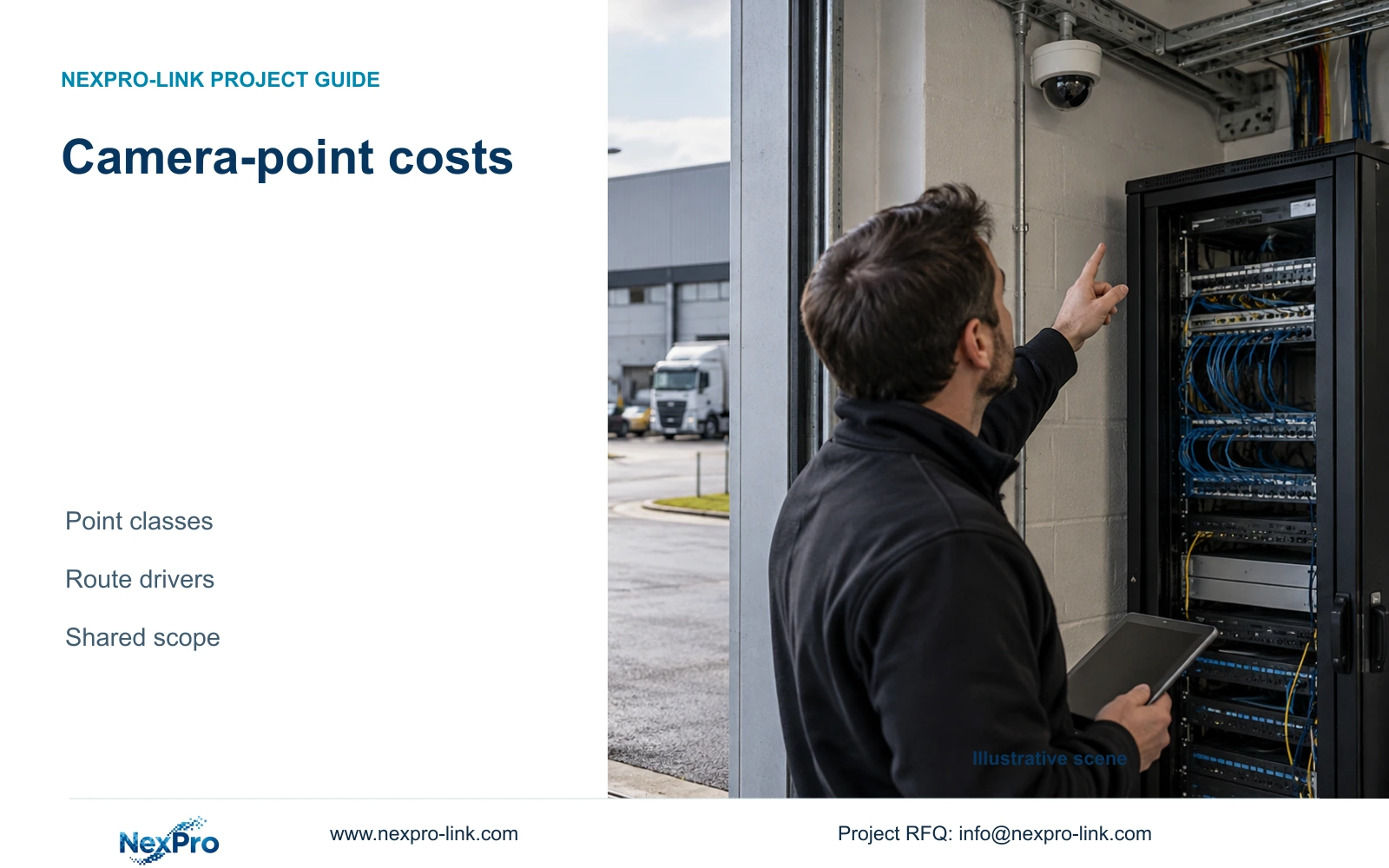
Use CASE01's 32-camera CNC factory as the broader system background, but identify which points the substitution affects. Gates, stores and machine-hall transfer views need different access arrangements. Do not apply a high-ceiling allowance to all 32 locations automatically. The separate 24-camera service calculation later in this article has its own declared boundary.
Section 02
Separate bench preparation from site acceptance
Divide the work schedule into physical installation, configuration and acceptance. Physical work includes mounting, cable connection and required access arrangements. Configuration can include approved stream settings, identifiers and recording assignments. Acceptance verifies the final view, recorded playback and export. A bidder's single installation line should state which of these tasks it includes.
Some preparation can be completed before shipment or before a camera is raised into position. Approved configuration and location labels can make the site schedule clearer, but final framing still depends on the installed scene. Do not remove site acceptance from the BOQ because a supplier provides prepared equipment. Ask the installer how the selected mount and camera allow adjustment and inspection.
The cost team should distinguish a first installation visit from any planned return for tuning or testing. If the revised device requires a different workflow, record the extra task and who performs it. A motorized lens can support lens adjustment where applicable, but it does not establish a universal labour saving or eliminate access for physical maintenance.
Section 03
Obtain site-specific effort instead of assumed productivity
Request the installer's crew basis, access method, work window and exclusions for each affected class of point. Clarify whether an estimate uses elapsed task hours or person-hours. A two-person crew working for one hour creates a different labour quantity from one person working for one hour, even when the site interruption is identical.
Record lifting-equipment mobilization, movement between locations and any required isolation as separate assumptions or priced tasks. The responsible site personnel should define safe access and production coordination. Camera quantity alone cannot determine how many lift sessions are needed, and this article assigns no standard installation speed or universal maintenance interval.
Where the input is uncertain, show a range supported by the contractor's stated work plan. Identify what would move the estimate toward either end, such as grouped access to adjacent points or separate production windows. Keep hardware quotes fixed while changing the labour assumption so the owner can see whether the substitution remains attractive under realistic access conditions.
Section 04
Calculate the effect of access on planned service effort
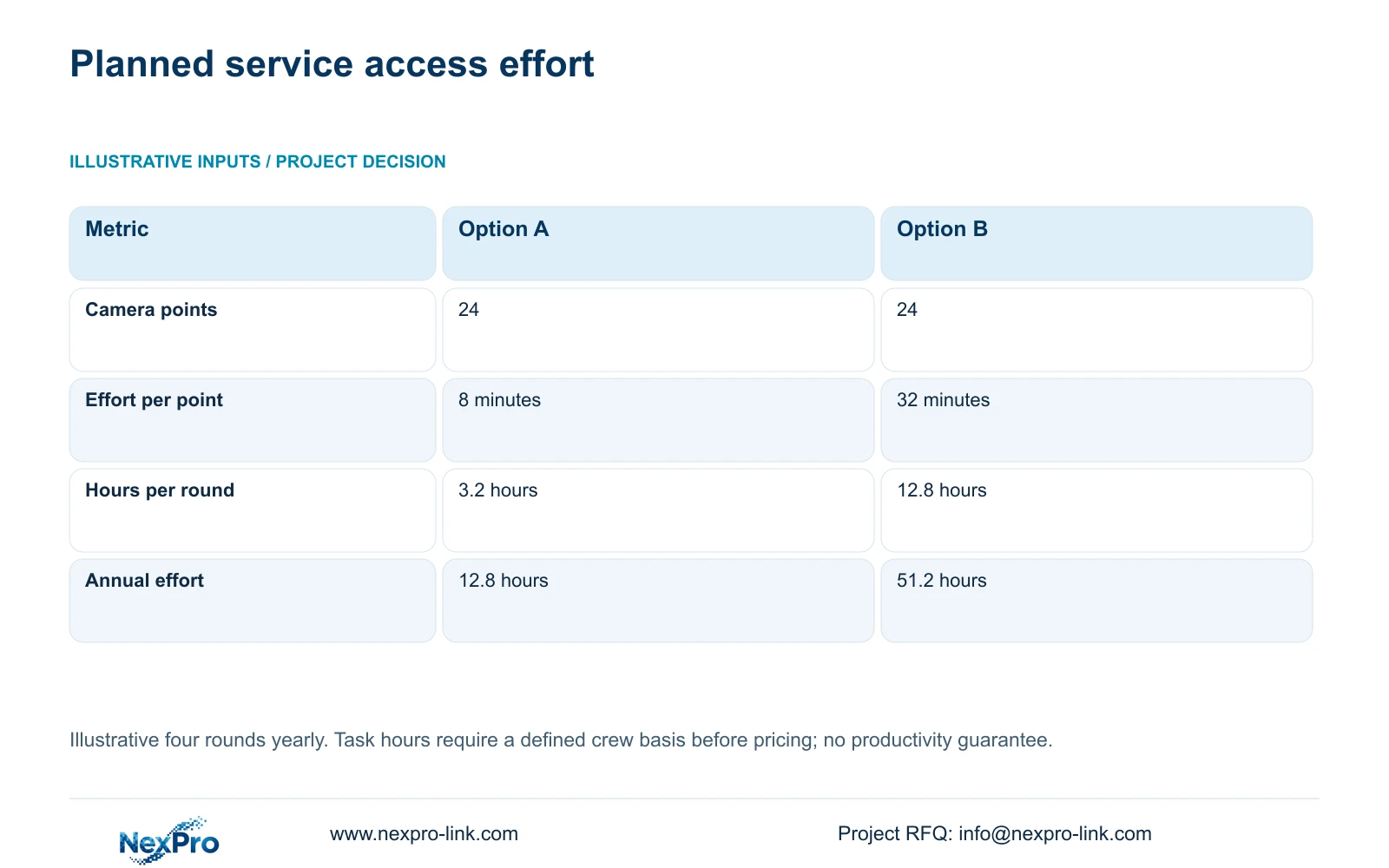
The supplied illustrative service comparison covers 24 cameras. Option A assumes 8 minutes of access and inspection effort per point; Option B assumes 32 minutes. Four rounds per year are a teaching input. Use annual_hours = cameras × minutes_per_point × rounds/60. This model shows the sensitivity to access conditions without asserting actual productivity or failure prevention.
Option A needs 24 × 8/60 = 3.2 hours per round and 12.8 annual hours. Option B needs 24 × 32/60 = 12.8 hours per round and 51.2 annual hours. The difference is 38.4 annual task hours. It arises from the assumed effort at each location, even if the cameras themselves have identical prices.
To turn this into a commercial comparison, replace minutes and frequency with the approved site plan and specify the labour basis. Add access-equipment and mobilization costs where they apply. The table does not price installation or predict breakdown visits. Keep planned service expenditure separate from acquisition so the owner can choose the comparison period and challenge the inputs.
| Metric | Option A | Option B |
|---|---|---|
| Cameras | 24 | 24 |
| Assumed effort per point | 8 minutes | 32 minutes |
| Task hours per round | 3.2 hours | 12.8 hours |
| Rounds per year | 4 | 4 |
| Annual task effort | 12.8 hours | 51.2 hours |
Section 05
Approve a saving only after the added work breaks even
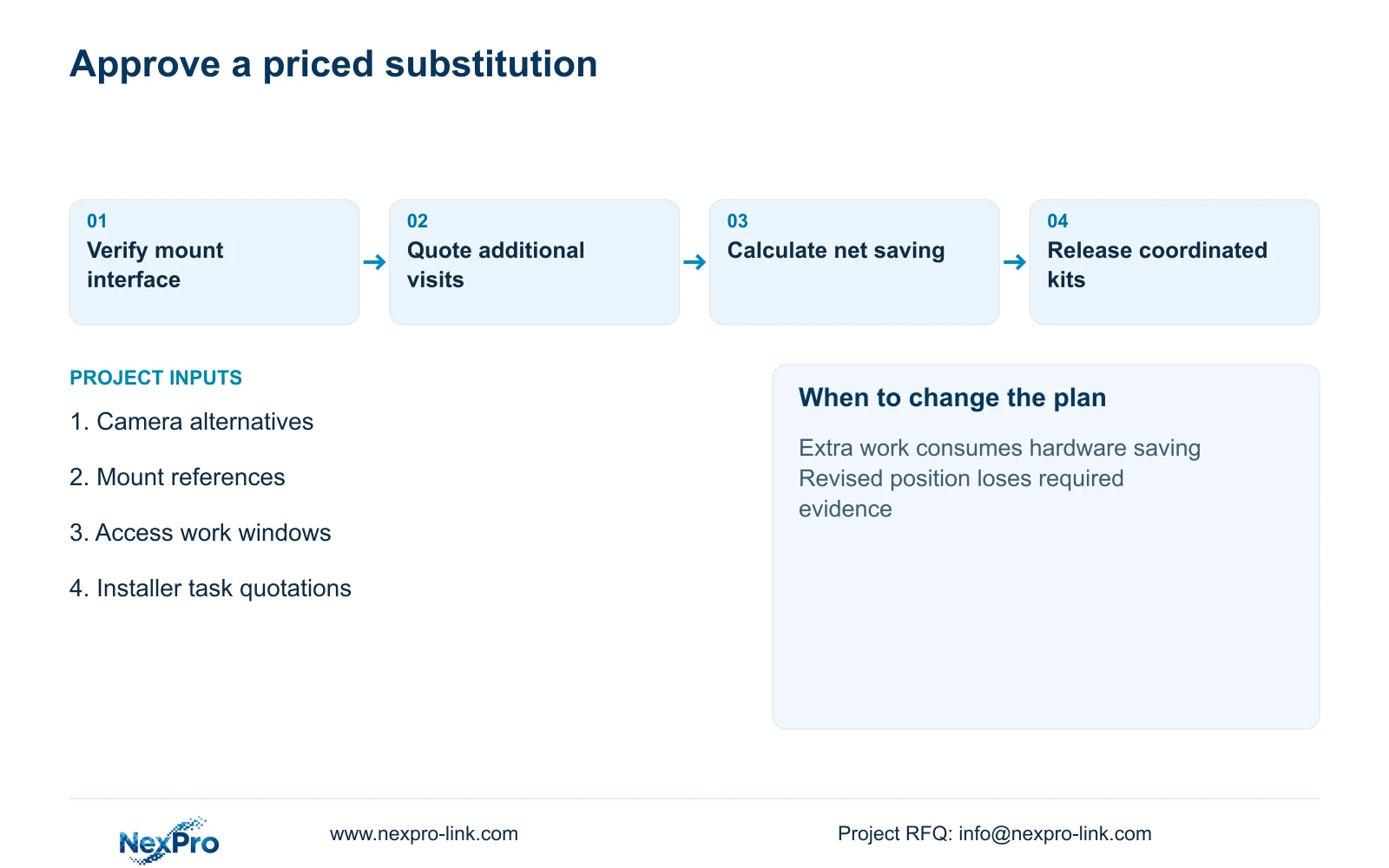
For acquisition, define net_saving = hardware_saving minus additional_mount_cost minus additional_installation_cost minus additional_configuration_and_test_cost. Populate each term from comparable quotations. If the result is positive and technical acceptance is unchanged, the substitution may reduce acquisition expenditure. If the extra work equals the hardware saving, the acquisition advantage has disappeared.
For a declared service period, add the difference in planned maintenance and access cost separately. In the teaching service example, the additional annual effort is 38.4 task hours before crew conversion and equipment charges. Multiplying by a real applicable rate requires agreement on that basis. No labour rate or monetary saving has been supplied here.
Prefer the arrangement with suitable evidence and accessible servicing when its complete cost is justified. Retain a high-level position if the lower alternative creates occlusion or loses the required view. Change the recommendation when mounting, production access or local installation prices change. A cheaper camera is not evidence that the full substitution is cheaper, and an accessible mount is not automatically a qualified view.
Section 06
Release a coordinated equipment and installation package
The procurement package should identify camera and mount references, affected locations, configuration responsibility and required acceptance tasks. Ask for accessory contents to be stated explicitly. A missing adapter or incorrect bracket can create another visit even when the camera specification itself is suitable. Confirm the physical interface before treating a substitution as ready to order.
NexPro-Link's project supply and BOQ support can help coordinate equipment references, technical deviations and project preparation. The local installer supplies the actual access method, labour quotation and site execution. Keep those responsibilities separate while using common point identifiers, so the supplier's packing schedule and installer's work schedule refer to the same locations.
Before approval, reconcile hardware savings against the priced additional tasks and retain the service assumptions beside the recommendation. If a mount or access plan remains unresolved, make that a decision condition. The resulting comparison gives the owner a clear reason to accept or reject the substitution without relying on invented productivity claims.
Section 07
Buyer questions
Should lift hire be divided equally across all camera points? Only if that reflects the agreed work plan. Assign dedicated mobilization or restricted-access costs to the locations that require them, and reconcile any shared allocation to the actual quoted total.
Does factory configuration eliminate commissioning labour? No. Prepared settings can support installation, but final scene framing, recording, playback and export still need verification at the site. Price the retained acceptance work explicitly.
Can annual task hours be multiplied by an hourly labour rate directly? First confirm whether the hours represent one person's effort, a crew task or elapsed access time. Apply the matching crew and rate basis, then add equipment and mobilization charges where required.
Section 08
Compare the complete substitution task
Send the proposed camera and mount alternatives, affected mounting locations, installer access/work-window assumptions and separate hardware/labour quotations to info@nexpro-link.com for equipment-scope coordination.
Engineering references
These sources support the general planning principles. Always use the selected product's current datasheet and applicable project standards for final design.