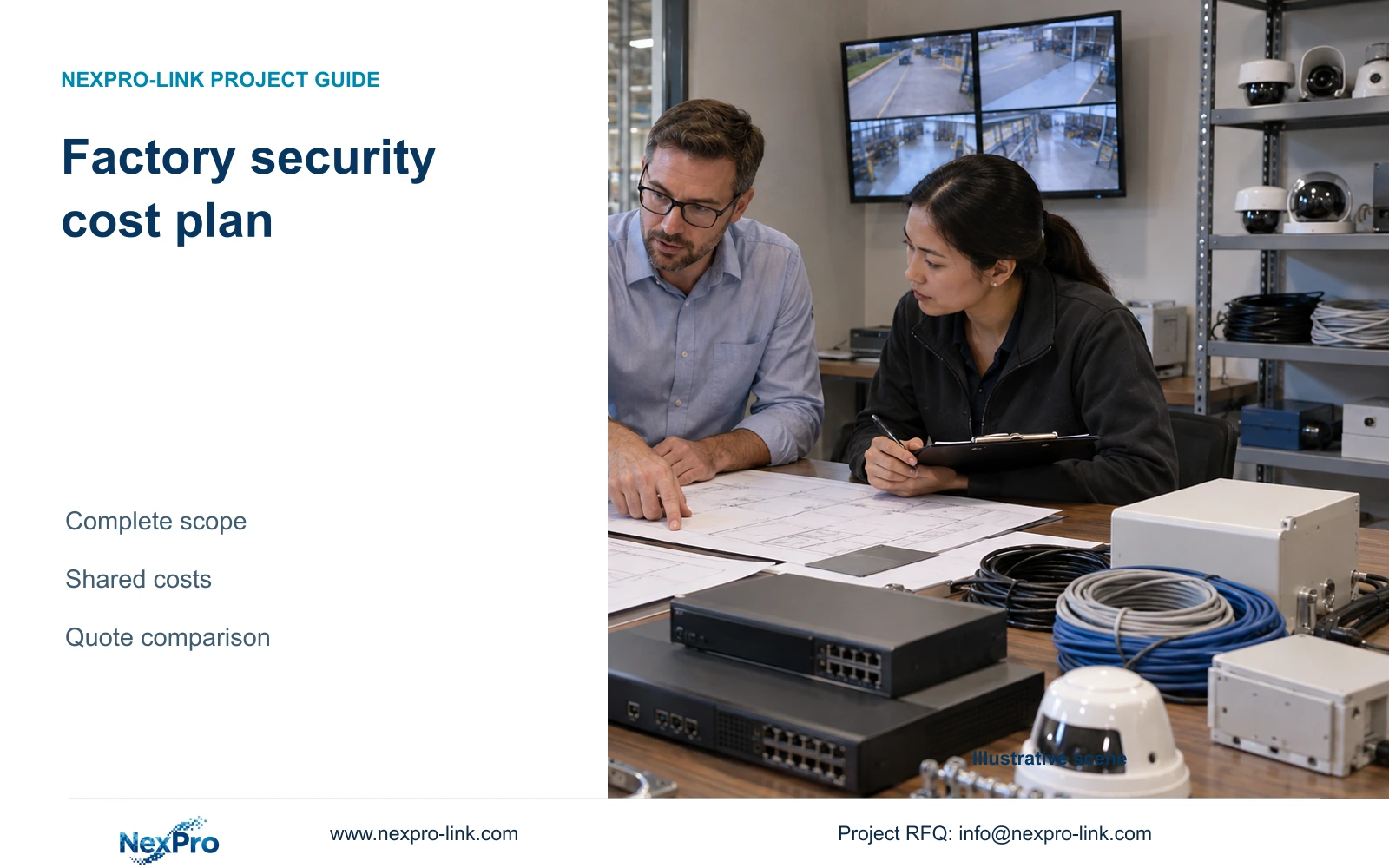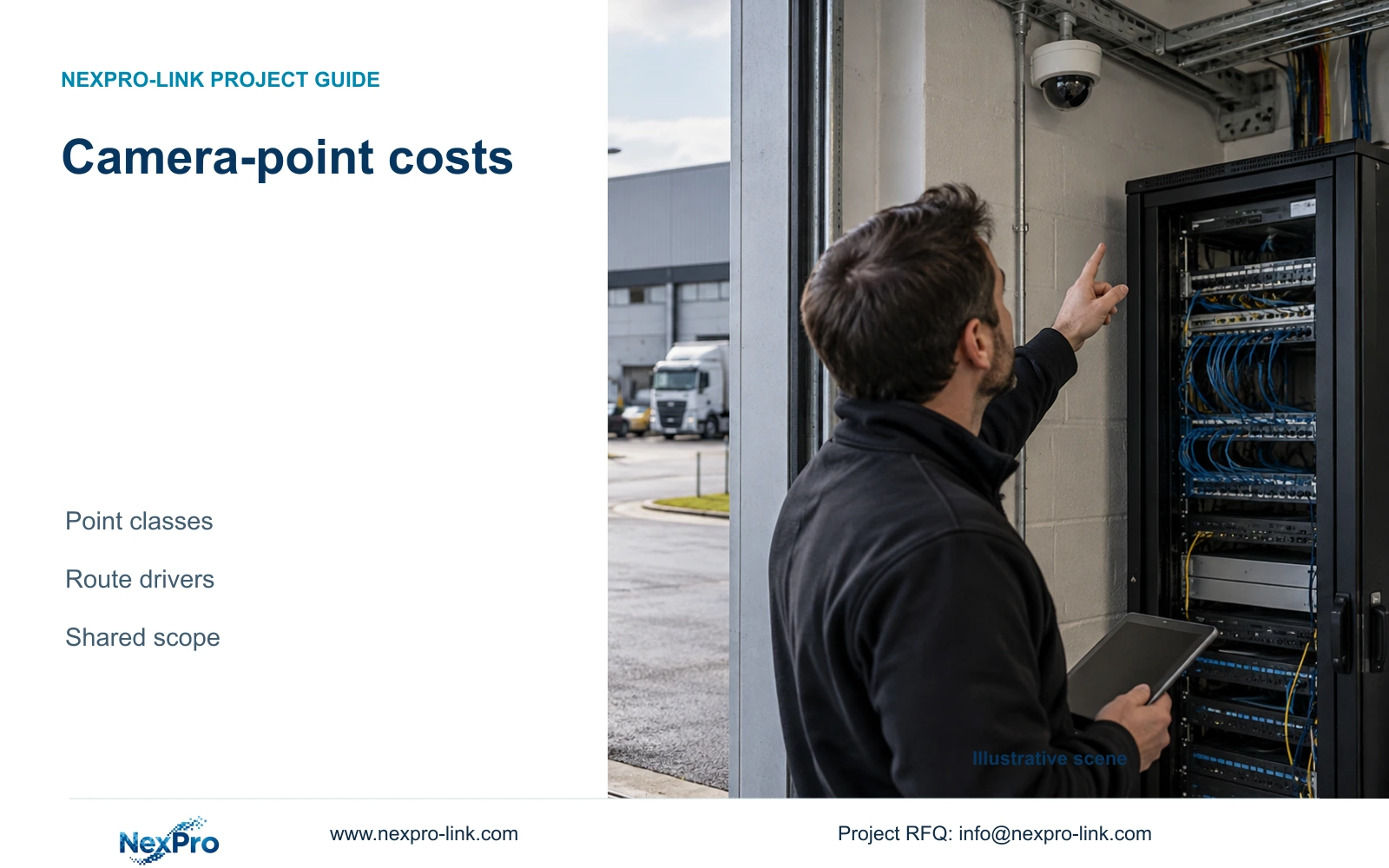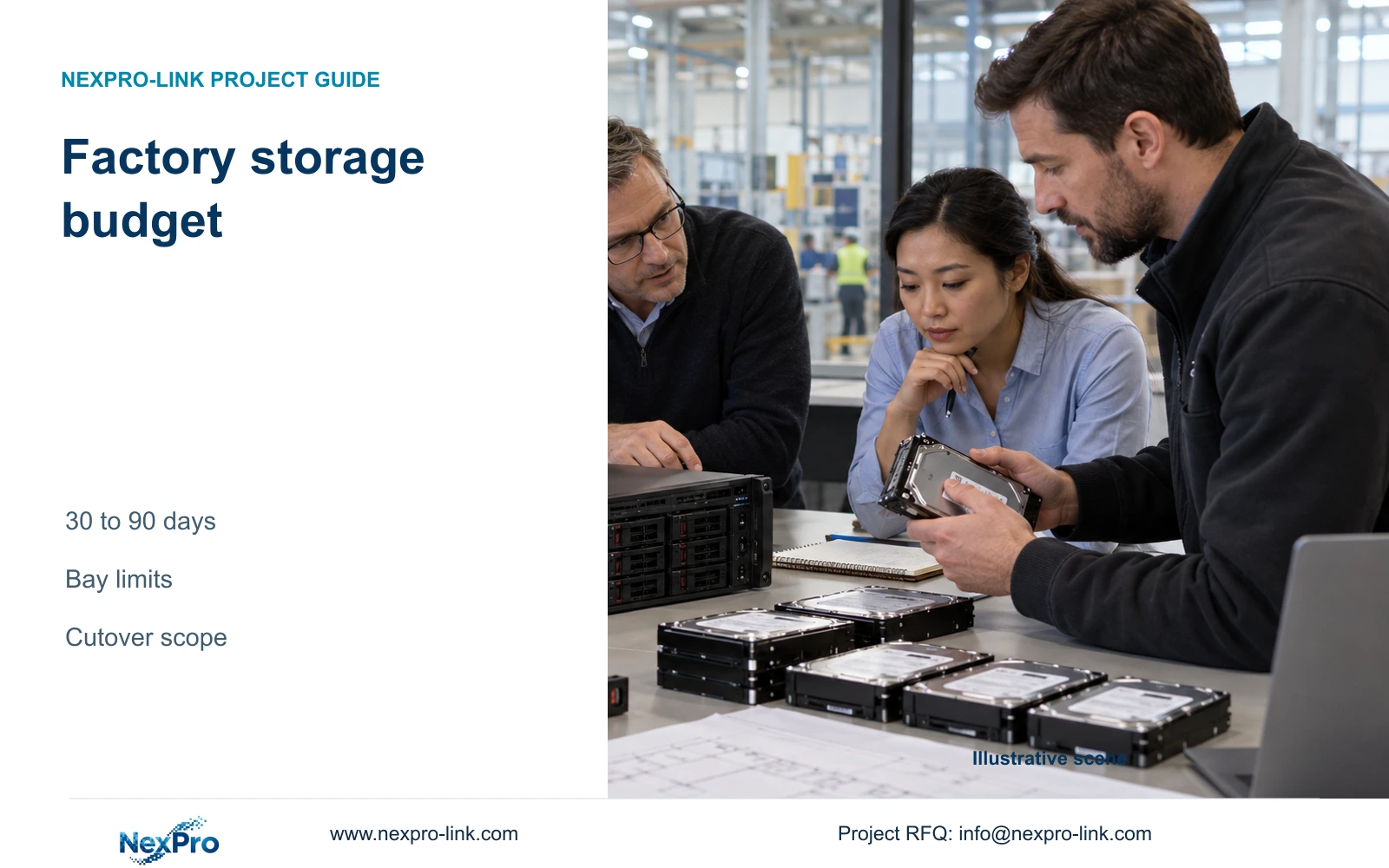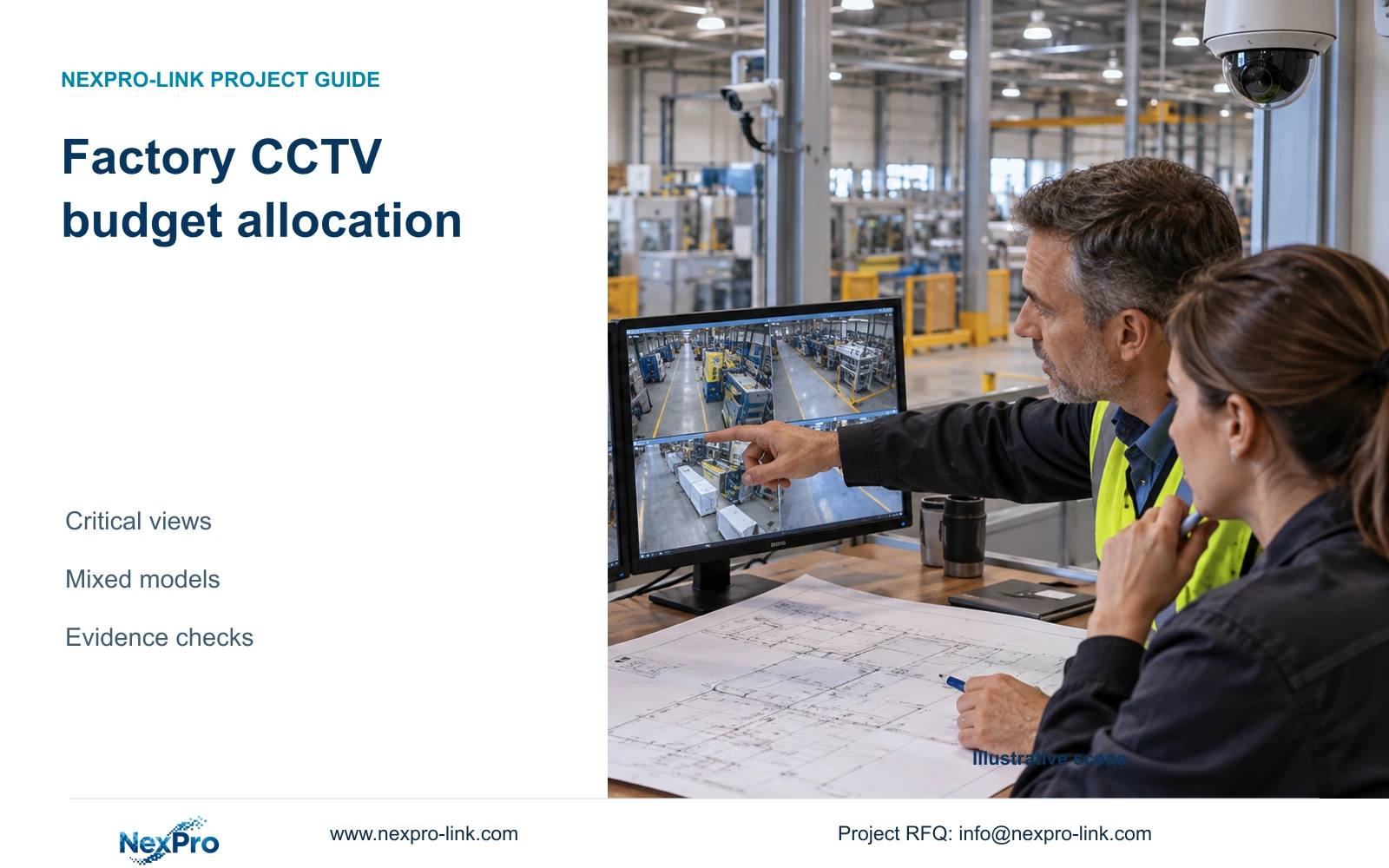
List failed or unverified evidence tasks before allocating an upgrade budget. Rank each by the owner's operational consequence and required remedy, including framing or lighting rather than resolution alone.
Section 01
Define the evidence required at each camera point
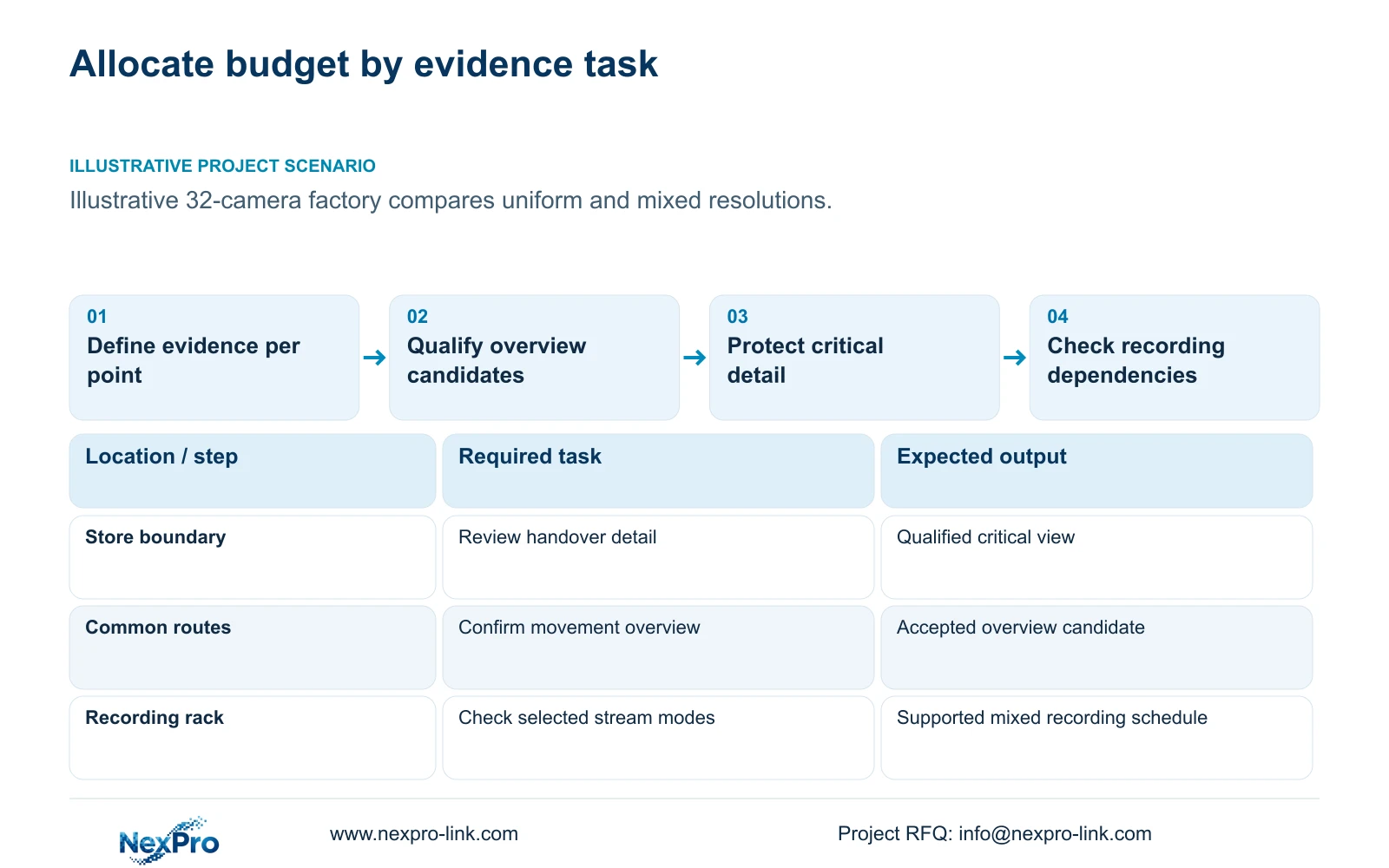
List failed or unverified evidence tasks before allocating an upgrade budget. Rank each by the owner's operational consequence and required remedy, including framing or lighting rather than resolution alone. Preserve qualified overview views. This produces a task-based spending order without assuming that every higher-resolution substitution improves the recorded decision.
Allocate a factory CCTV budget by the evidence each view must supply. Retain suitable detail at critical handover points and compare qualified overview options elsewhere. Uniform 8MP may simplify the camera schedule, but it does not remove the need to check framing, lighting, recording support and installed cost. A mixed schedule is useful only when every required task remains satisfied.
Illustrative project scenario: The buyer compares a uniform high-resolution scheme with a task-based mix. Use CASE01's hypothetical 32-camera CNC factory as the location background: four gate views, six store views, ten permitted machine-hall transfer views, four common-route views, six dispatch views and two equipment-room approaches. Resolution allocations within those groups remain planning choices to be qualified.
For each point, state the target, target-plane width, expected movement, lighting condition and evidence to be retrieved. Distinguish an overview of a transfer from a close view of the handover boundary. The owner and engineer should approve those tasks before the quantity surveyor changes camera classes. Removing the only useful detail view is a scope reduction, even if the camera count stays unchanged.
Section 02
Build the mixed schedule around accepted view classes
Start with a point-by-point schedule rather than assigning one resolution to each building automatically. A store entrance can require more usable detail than a much larger circulation space. Gate overview and plate reading are different tasks; the ordinary human/vehicle classification role does not establish plate identification. Keep any specialist requirement separate from this ordinary-security comparison.
The supplied bullet references are NexPro-BL2812M55-5MP-DIC-AI and NexPro-BL2812M88-8MP-DIC-AI. The 5MP-family source lists 2880×1620 output and 25fps@5MP; the 8MP source lists 3840×2160@25fps. Both list a 2.8 to 12 mm motorized lens. Retain those exact source dimensions in the schedule rather than replacing the 5MP field with another presumed output mode.
Where a Dome form is suitable, the DM2812M source likewise distinguishes listed 2880×1620 and 3840×2160 outputs. Housing choice still needs mounting and environment checks; the Dome name does not establish an IK rating. Request candidate models against the approved task and record why each substitution qualifies. This makes a mixed schedule reviewable without asserting that a resolution label alone proves acceptance.
Section 03
Recalculate infrastructure from the selected stream groups
Build storage from the actual proposed streams. Use video_TB = 0.0108 × days × sum(camera_count × average_Mbps) for continuous recording in decimal TB. CASE01's 32 cameras at an assumed 4 Mbps produce 41.472 TB over 30 days. That figure is a teaching baseline for its supported 5MP-class assumption, not a fixed bitrate for either camera family.
Changing some or all views to 8MP requires new stream inputs and supported recorder-mode checks. The NexPro-NVR4449-4K summary distinguishes 49×5MP from 9×4K; its channel count cannot be reused as an all-8MP recording promise. Price any necessary recording architecture change alongside the camera substitution. Spare bandwidth does not resolve an unsupported stream mode.
Handle power independently. CASE01 assumes 12 W device-side demand per ordinary camera, but the supplied camera specifications do not provide maximum W. Obtain selected-model demand before confirming per-port and total PoE budgets. Count complete switch AC input when updating UPS loads so camera watts are not duplicated. A mixed-resolution offer has no demonstrated power saving merely because some cameras have lower pixel counts.
Section 04
Compare listed horizontal pixels at the same target width
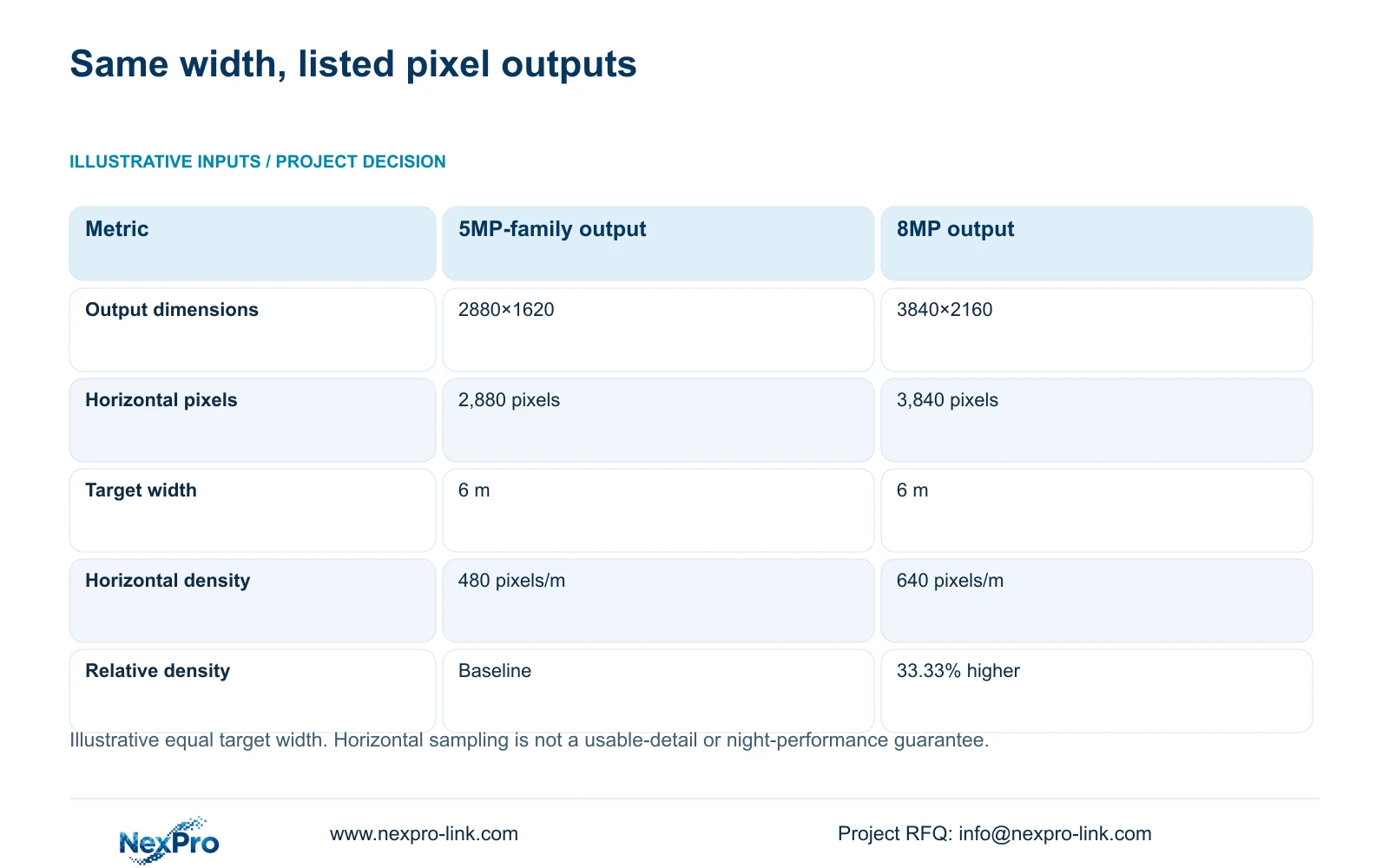
For the supplied illustrative six-metre target plane, planning pixels per metre = horizontal_pixels/6. The listed 2880-pixel output gives 480 pixels/m; the 3840-pixel output gives 640 pixels/m. Calculate the relative horizontal-density increase as (3840/2880 minus 1) × 100 = 33.33%. The comparison uses the same target width for arithmetic only.
This is a useful geometric difference, but it is not a 60% usable-detail guarantee derived from the 5MP and 8MP labels. Lens geometry, focus, exposure, compression and target movement still affect recorded detail. Nor does the calculation establish comparative night performance. Use a sample scene with the intended framing to decide whether the extra horizontal sampling helps the required evidence.
If the lower-resolution candidate fails, examine the reason before choosing the remedy. A narrower view, revised mounting position or additional dedicated view may help, but can change coverage and installation scope. If both candidates satisfy the same approved task, their complete package costs can then be compared. If only the higher-detail arrangement qualifies, its capability belongs in the required baseline.
| Metric | 5MP-family output | 8MP output |
|---|---|---|
| Listed output dimensions | 2880×1620 | 3840×2160 |
| Horizontal output pixels | 2,880 pixels | 3,840 pixels |
| Target-plane width | 6 m | 6 m |
| Planning horizontal density | 480 pixels/m | 640 pixels/m |
Section 05
Protect critical views before seeking package savings
Prefer a task-based mix when overview candidates pass the approved evidence checks and critical views retain suitable detail. Keep the uniform 8MP option as a separately qualified comparison. The cost team should show camera quantity and model changes, any recorder or storage changes and unchanged installation scope. No saving is established until matching quotations are available.
Use the same recorded playback and export checks for both offers. A convincing live image is insufficient if the stored stream uses another resolution or overly restrictive compression. Test difficult lighting and representative movement at the locations driving the decision. The engineer should record the accepted configuration, while the owner confirms that the retrieved footage answers the operational question.
Choose a uniform configuration when the approved specification requires it, the tested mix fails required tasks or standardization benefits justify its complete cost. Conversely, retain a lower-resolution overview where it qualifies and spend the available budget on an unresolved critical view or necessary infrastructure. Any such reallocation should name the preserved outcome and the item receiving the expenditure.
Section 06
Quote camera classes and their dependencies together
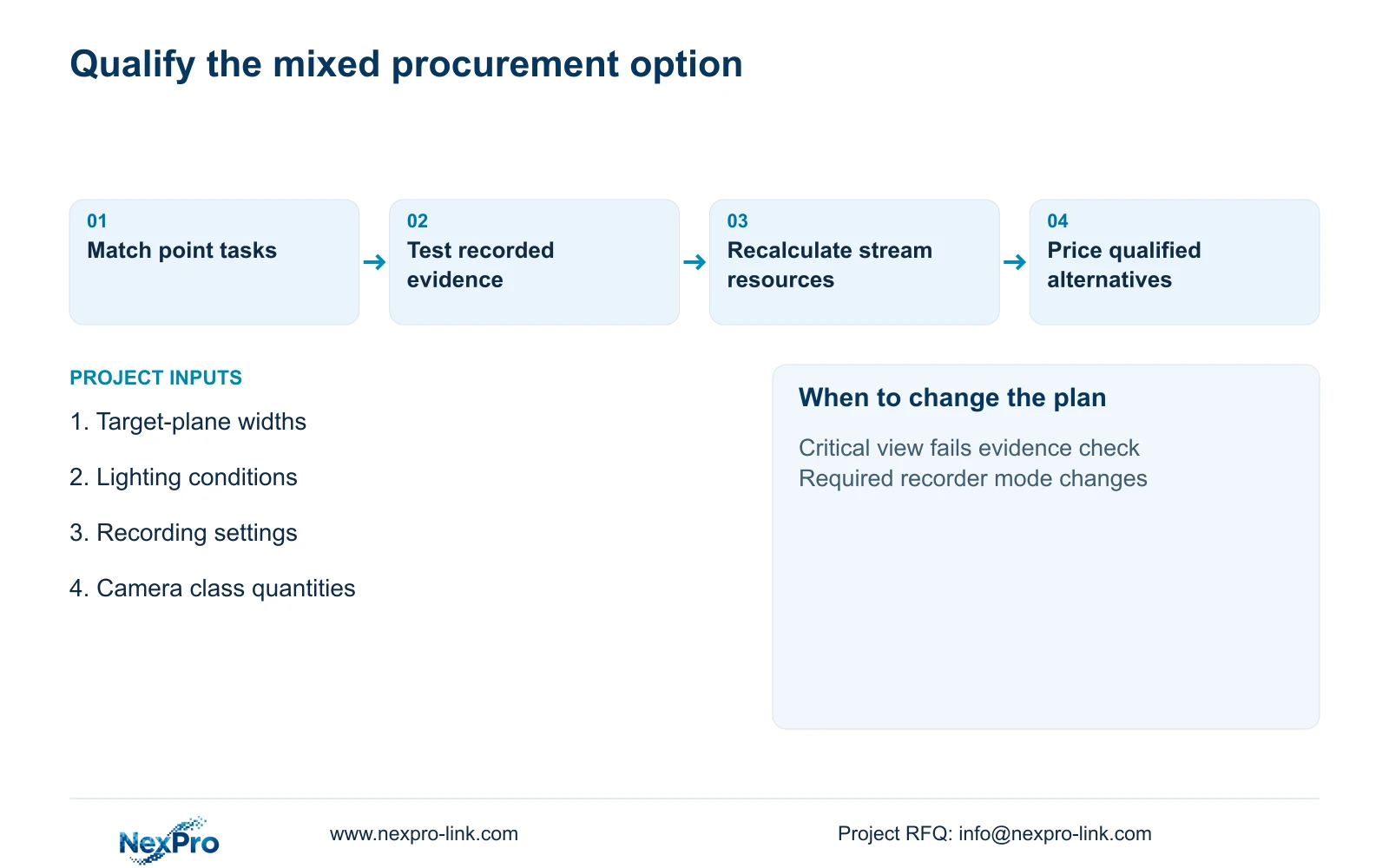
Prepare two schedules using identical point identifiers and approved tasks. Show the uniform option beside the mixed option, with the selected stream mode, recorded bitrate assumption and acceptance status at each changed point. Identify unresolved conditions rather than describing the entire mix as compliant before testing. Keep required mounts, links and installation boundaries consistent.
NexPro-Link's BOQ and tender-support scope can help match its bullet and Dome references to that schedule and document model differences. Project supply can coordinate the related equipment and packing scope. Factory preparation can preserve approved settings and location labels, while final scene framing and recorded-evidence acceptance remain site tasks.
At purchase approval, retain the accepted stream schedule with the equipment list. Reopen the calculation if a target-plane width, night-lighting condition or recorder architecture changes. This gives the cost plan a technical basis for selective expenditure and prevents a late blanket upgrade from carrying unsupported storage, power or performance assumptions into the order.
Section 07
Buyer questions
Can a motorized lens replace the need for a higher-resolution camera? It may improve framing for a particular target, but narrowing the view can remove surrounding coverage. Compare the resulting recorded evidence and retained coverage before accepting it as an equivalent alternative.
Does using fewer 8MP cameras prove lower storage cost? No. Storage follows the configured average bitrates, recording hours and retention periods. Obtain those inputs for each stream group and check the supported recorder architecture before claiming a cost difference.
Can the same camera class serve an overview and a detail task? Possibly, if one framing supplies both accepted outcomes under the relevant conditions. Where it cannot, separate views may be needed. Keep that additional quantity visible in the comparison.
Section 08
Compare a task-based factory camera schedule
Send your point-by-point observation tasks, target widths and lighting conditions, proposed recording settings, and uniform-versus-mixed quantities to info@nexpro-link.com for model-matching discussion.
Engineering references
These sources support the general planning principles. Always use the selected product's current datasheet and applicable project standards for final design.