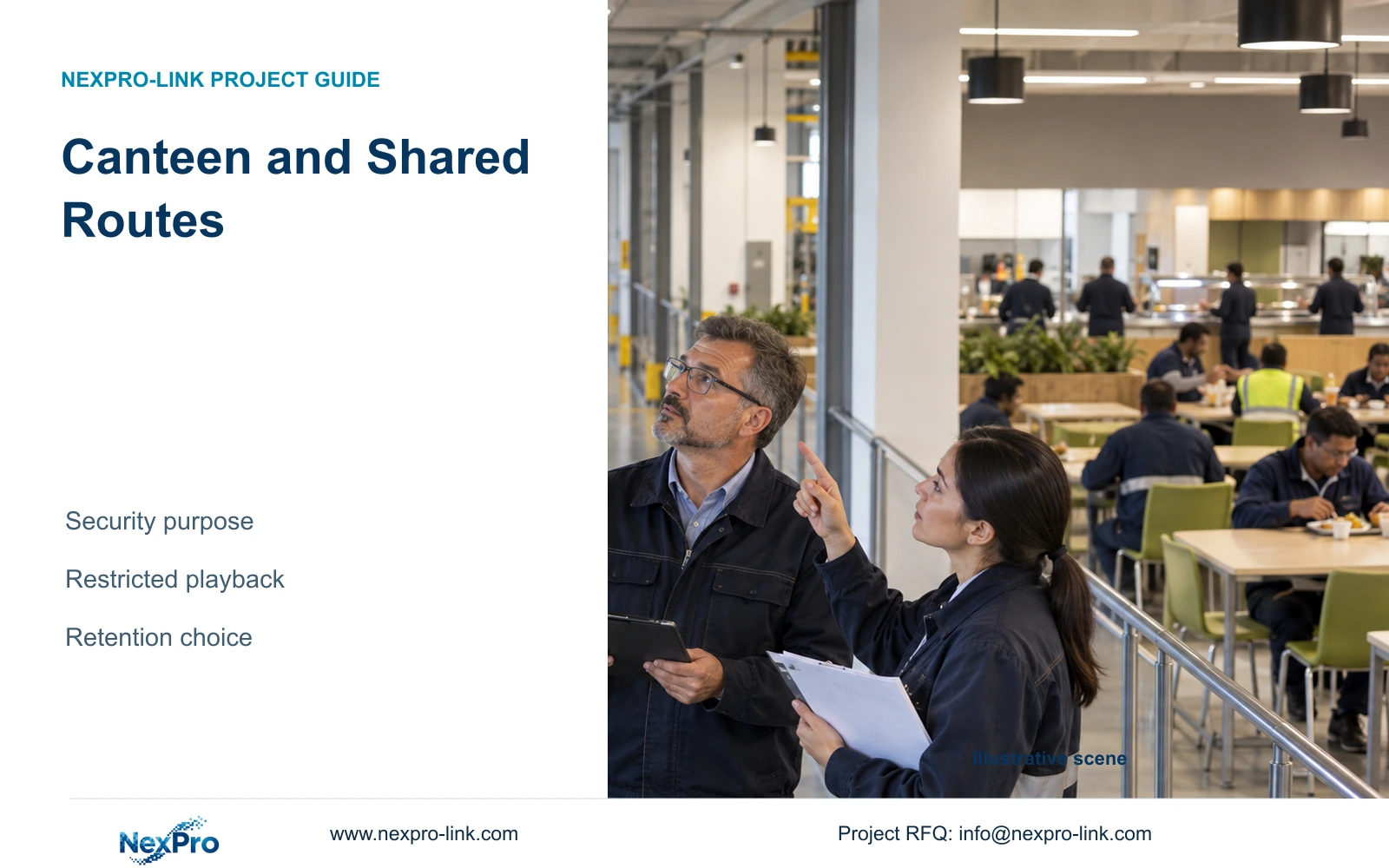
Shared canteen CCTV should answer defined security questions. Purpose-led coverage, controlled playback and explicit retention choices keep procurement tied to those questions.
Section 01
Approve the security question before choosing views
Factory canteen and shared routes need CCTV coverage tied to agreed security and access tasks. Document the entrance movement, reported incident or service-route event that requires review. Exclude automated employee-performance scoring from this security package. Recording purpose should determine view selection, reviewer access and retention before the camera schedule is priced.
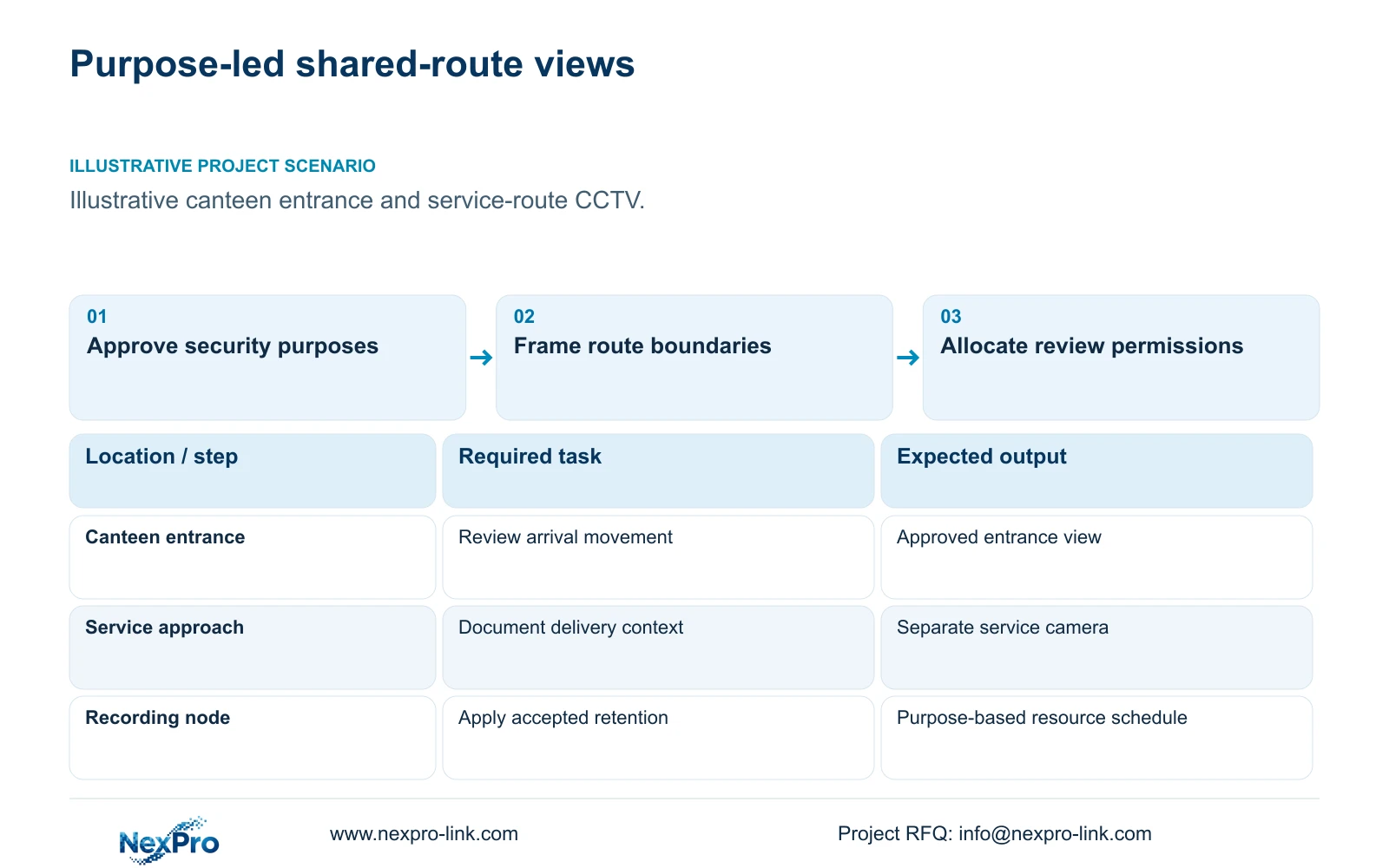
Illustrative project scenario: A factory asks for CCTV around a shared canteen and circulation route. Assume the canteen entrance connects employee circulation with a separate service approach used for deliveries. The proposed task is to review entry context and reported incidents along those routes. Seating behavior and individual break duration are outside the assumed scope.
The project manager should obtain one written purpose statement for each proposed view. An entrance view might establish direction and timing, while a service-door view documents a delivery handover. If a requested camera has no approved security question, leave it out of the baseline or return it for clarification. That decision avoids procuring storage and review services for unrelated footage.
Section 02
Aim cameras at movement boundaries and service events
Use the route drawing to identify where movement can be observed without prolonged close coverage of seated staff. Check queues, door swings and temporary barriers at representative occupancy. A ceiling position that looks adequate in an empty room may lose the entrance behind people or signs during a meal changeover. Acceptance should use the occupied route and its actual lighting.
Keep the service entrance distinct from employee circulation where the layout allows. Its camera may need to show a trolley or container transfer, while the canteen entrance needs movement context. Do not treat one wide room view as proof that both tasks are covered. Conversely, a close service view should not be extended across seating simply to fill the screen.
For a suitable ordinary location, the NexPro-BL2812M55-5MP-DIC-AI offers a 2.8–12mm motorized lens and listed 2880×1620 output in the 5MP family specification. Those fields help frame a defined view. Human or vehicle classification does not establish staff productivity measurement, and ordinary security cameras should not be specified as hygiene inspection or food-process safety devices.
Section 03
Allocate playback rights and retention approval separately
Define a reviewer role for reported incidents and a separate authority for exports. Routine live access may be unnecessary if the operational task is retrospective review. The owner should also decide whether service-area and employee-route footage need different permissions. Confirm the selected recorder or client can deliver those distinctions before they become contractual requirements.
Create a shared-equipment allocation with clear status and responsibility. In the illustrative package, cameras and recording equipment are supplied, existing network services may be retained after confirmation, and local account setup and image alignment are installer-provided. An additional management platform remains optional until its task and supported interfaces are identified. The owner retains approval of recording purpose and duration.
CASE08’s four independent 32-camera nodes provide a useful building-level pattern. Shared fibre permits authorized viewing without granting every tenant access to another building’s footage. Apply the same boundary to a shared canteen: identify the footage owner and approved users even if multiple organizations use the route. Equipment coordination does not create unrestricted sharing or automatic software integration.
Section 04
Price the retention choice using usable capacity
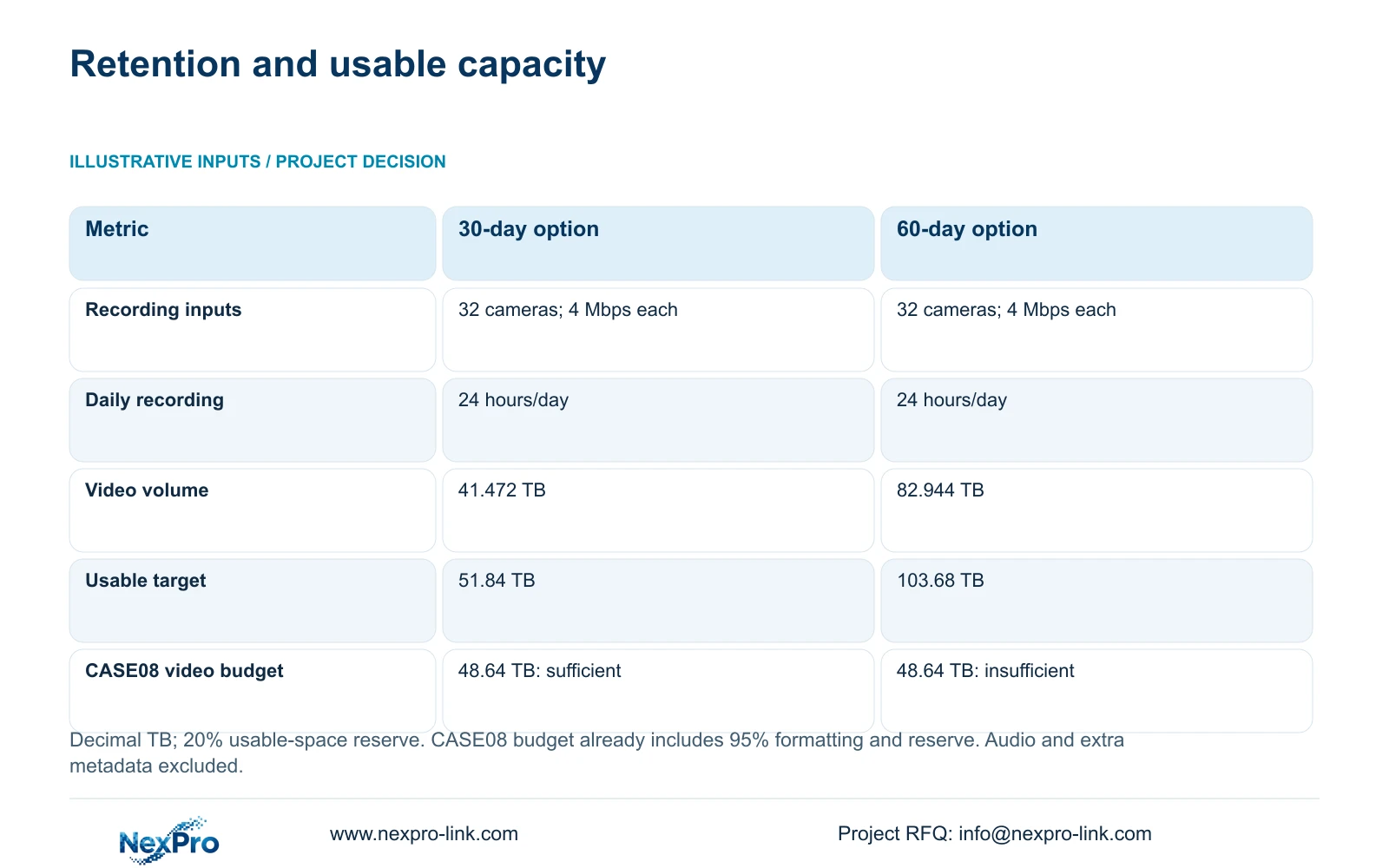
The illustrative comparison uses a complete 32-camera node, not 32 cameras dedicated to the canteen. Each camera averages 4 Mbps and records 24 hours/day. Video_TB = cameras × Mbps × 10^6 × 86,400 × days / 8 / 10^12. At 30 days, the result is 41.472 decimal TB; at 60 days, it is 82.944 TB. Audio and extra metadata are excluded.
With 20% of usable space kept free, required_usable_TB = video_TB / 0.80. The targets are therefore 51.84 TB and 103.68 TB. Doubling retention doubles the video volume at unchanged recording assumptions. It does not show superior compression by any supplier. Choose the duration from the approved review purpose, then replace the assumed average bitrate with representative measurements for final design.
In CASE08, four 16 TB disks give 64 TB raw per node, 60.8 TB at the illustrative 95% formatting factor, and a 48.64 TB video budget after reserve. Compare 41.472 TB directly with 48.64 TB for 30 days; 82.944 TB exceeds that budget for 60 days. The reserve is already included, so applying it again would distort the selection.
| Metric | Option A | Option B |
|---|---|---|
| Cameras | 32 | 32 |
| Average bitrate and schedule | 4 Mbps each; 24 hours/day | 4 Mbps each; 24 hours/day |
| Retention target | 30 days | 60 days |
| Video data | 41.472 TB | 82.944 TB |
| Required usable capacity | 51.84 TB | 103.68 TB |
Section 05
Extend retention only when the review purpose requires it
Use the shorter approved duration when it meets the owner’s investigation and review process. Choose 60 days only when the documented reporting interval or project requirement justifies it. Verify local privacy and retention requirements with the responsible team; neither example is a universal legal period. Preserve necessary incident material through a separately approved handling process rather than expanding every camera’s routine retention by default.
A 60-day change requires a storage architecture review. The NexPro-NVR4449-4K reference has four SATA bays supporting up to 18 TB per drive, but its bay count does not establish RAID. Under the stated 95% factor, even four 18 TB disks yield 68.4 TB usable, below the 103.68 TB target. A different supported storage arrangement must therefore be evaluated for this example.
The quantity surveyor should compare the same approved views, bitrate assumptions and usable capacity across bids. Include compatible disks, configuration, installation and support separately. Adding storage may change recorder choice, drive power and cabinet needs. A display wall does not resolve retention; an ordinary authorized workstation may be sufficient for incident review.
Section 06
Hand over a purpose-to-camera and resource schedule
Link each canteen or route camera to its approved purpose, owner, recorder and review role. Include the selected retention target and the storage calculation boundary. Where a shared node serves other factory areas, list those camera groups too. This makes clear whether the proposed retention change applies to the whole node or only a supported subset.
NexPro-Link can discuss model matching, technical submittals and BOQ coordination around that schedule. Project packing can group employee-route and service-area devices by location tag. Local installation, privacy approval and final account configuration remain assigned project tasks. Any proposed analytics or integration should be described separately from the basic camera-to-recording package.
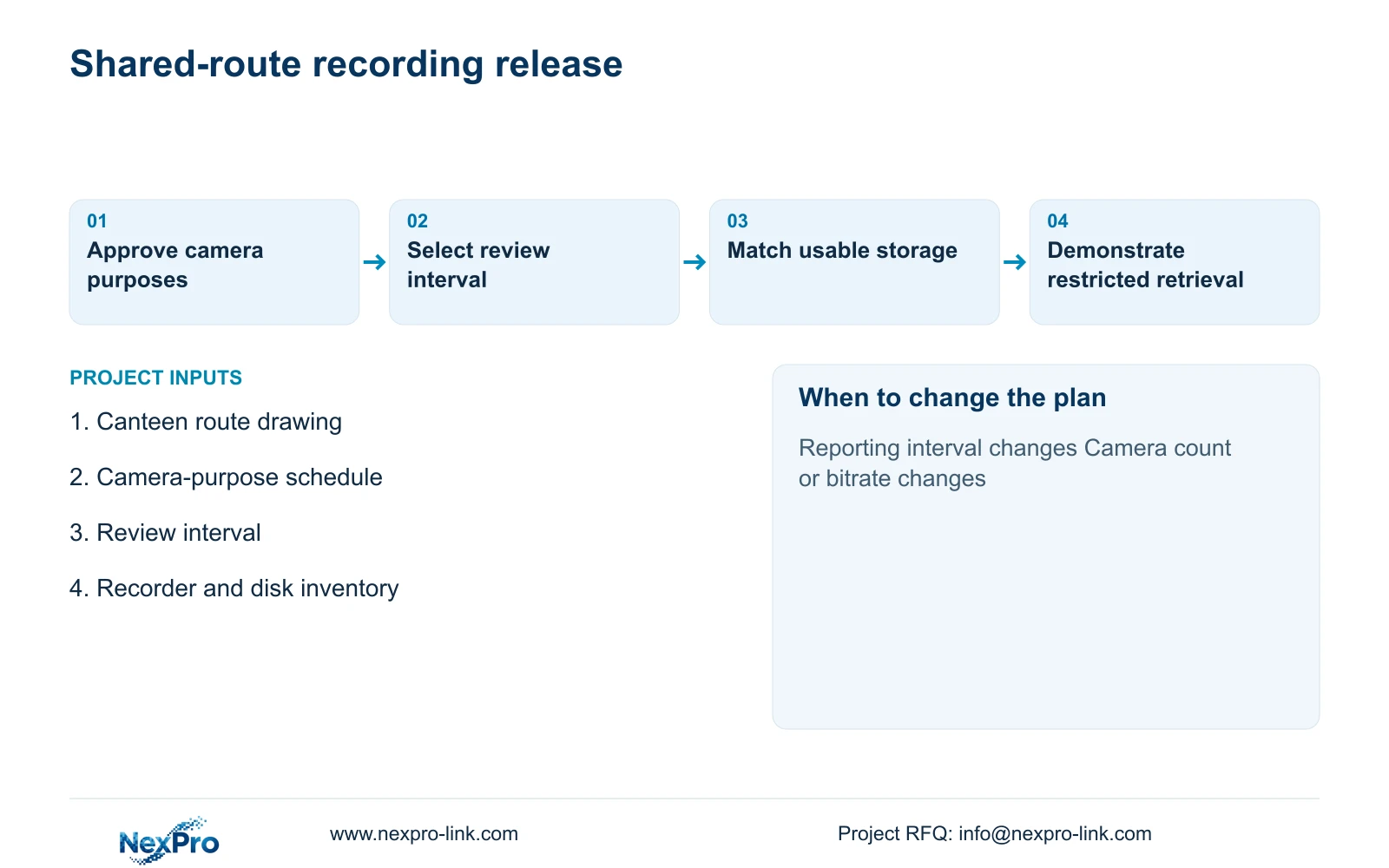
At acceptance, demonstrate playback of a representative route event and an authorized export. Check that the approved users can complete their tasks and that unrelated users cannot access the footage through another configured client. Review storage settings after commissioning and revisit the plan when route layouts, reporting intervals or camera quantities change.
Section 07
Buyer questions
Can event recording replace continuous recording in this example? It can be evaluated, but it requires a new calculation and an acceptance test for missed or delayed events. The supplied figures assume continuous recording and cannot be reused as an event-recording forecast.
Does a shared canteen require shared CCTV credentials? No. Establish footage ownership and approved reviewer roles independently of building use. If the proposed platform cannot enforce the required separation, reconsider the platform or recording arrangement.
Should we lower bitrate to fit a longer retention target? Only after testing that the revised recording still meets the approved task. A capacity constraint should not silently reduce entrance or service-event detail.
Section 08
Scope the shared-route recording package
Send the canteen and circulation layout, camera-purpose schedule, required review interval and existing recorder/storage details to info@nexpro-link.com for a matched equipment and retention proposal.
Engineering references
These sources support the general planning principles. Always use the selected product's current datasheet and applicable project standards for final design.