On a tray revision, distinguish uncut stock from cuts already allocated to changed routes. Map reusable cuts only to links they can complete continuously under the approved design.
Section 01
Approve revised routes before releasing affected cable
On a tray revision, distinguish uncut stock from cuts already allocated to changed routes. Map reusable cuts only to links they can complete continuously under the approved design. Price new cuts and remnant handling separately. A route-only revision may require cable procurement without changing any recorder, channel or camera-power quantity.
Factory cable tray coordination should establish approved CCTV routes early and recalculate affected continuous lengths whenever those routes change. Record the applicable separation and containment design basis without inventing universal distances or fill limits. Release cable against an accepted revision, with unresolved links held separately from unaffected work.
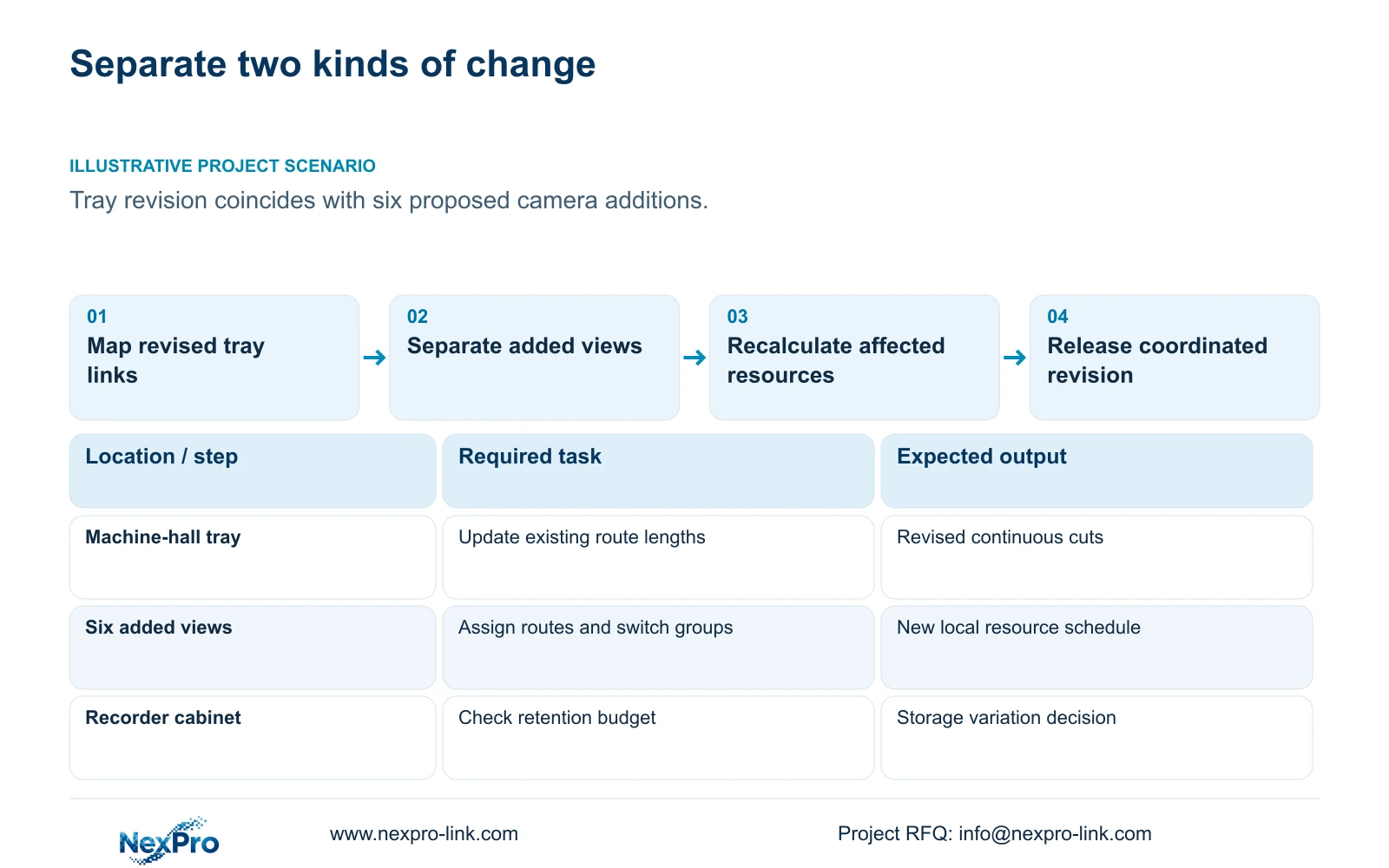
Illustrative project scenario: The MEP contractor revises the tray path after the security cable takeoff. Assume the CCTV team is using CASE01's 32-camera ordinary-area baseline and must review a changed section above the machine hall. During coordination, the owner also requests six additional security views. The route revision and camera addition are separate changes with different resource consequences.
Compare the old and new drawings by affected link ID. Identify the cabinet, route segments, elevations and endpoint position for each changed run. Keep a route-only revision from becoming an unexplained increase in camera quantity, and keep added views from being priced as cable changes alone. The engineer and quantity surveyor need the same change classification.
Section 02
Coordinate separation and future service access
Review the proposed route with the teams responsible for electrical services, production equipment and other building systems. Confirm that CCTV cable installation and later maintenance can be completed through the accepted access arrangement. A route that is available before machinery arrives may become difficult to reach once production equipment and other services are installed.
Ask the responsible designers to state the applicable segregation, support and containment requirements. Cable construction, neighbouring services and the actual installation arrangement affect that review. Do not quote a generic tray fill percentage or separation distance as if it applied to every project. Keep the accepted basis with the coordinated drawing.
For each rerouted camera, recompute horizontal travel, rises, drops and explicit endpoint allowances. Check the individual permanent-link boundary before adding the lengths to the total. Fluke Networks guidance distinguishes the typical 90 m permanent link from the 100 m complete channel; final technology and test scope must match the installation. A shorter total across the project does not compensate for one unsuitable run.
Section 03
Update the cut plan and scope by changed item
Create a revision register with the affected link, previous length, revised length, reason and release status. Identify whether cable has been ordered, cut or installed. Uncut stock may be reallocated through a revised feasible plan; already cut stock needs an actual remaining-length check. Avoid assuming that every shorter remnant can serve a newly extended route.
CASE01's baseline has 32 continuous links of 41 to 76 m, totalling 1,872 m, with a feasible seven-reel allocation. Those figures remain a reference for unchanged scope. The new tray path has no supplied surveyed dimensions, and the six additional routes have no supplied lengths. Their new cable total and reel quantity must therefore remain open until the schedule is revised.
Name the party responsible for changed supports, penetrations, access equipment and any reinstatement. NexPro-Link's SP5648 Cat6 48-port patch panel and DT968MX Cat6 tool-less module are termination references, not tray or bulk cable specifications. Check additional panel positions and modules by cabinet rather than assuming an available global port total resolves every local connection.
Section 04
Check added views against recording and power thresholds
For the separate six-camera addition, retain the supplied illustrative assumptions: 4 Mbps average per camera, 30 days of continuous video and 12 W camera-side PD demand. The formulas are Mbps = n × 4; video_TB = 0.0108 × n × 4 × 30; PD_W = n × 12. The coefficient uses decimal TB and continuous recording.
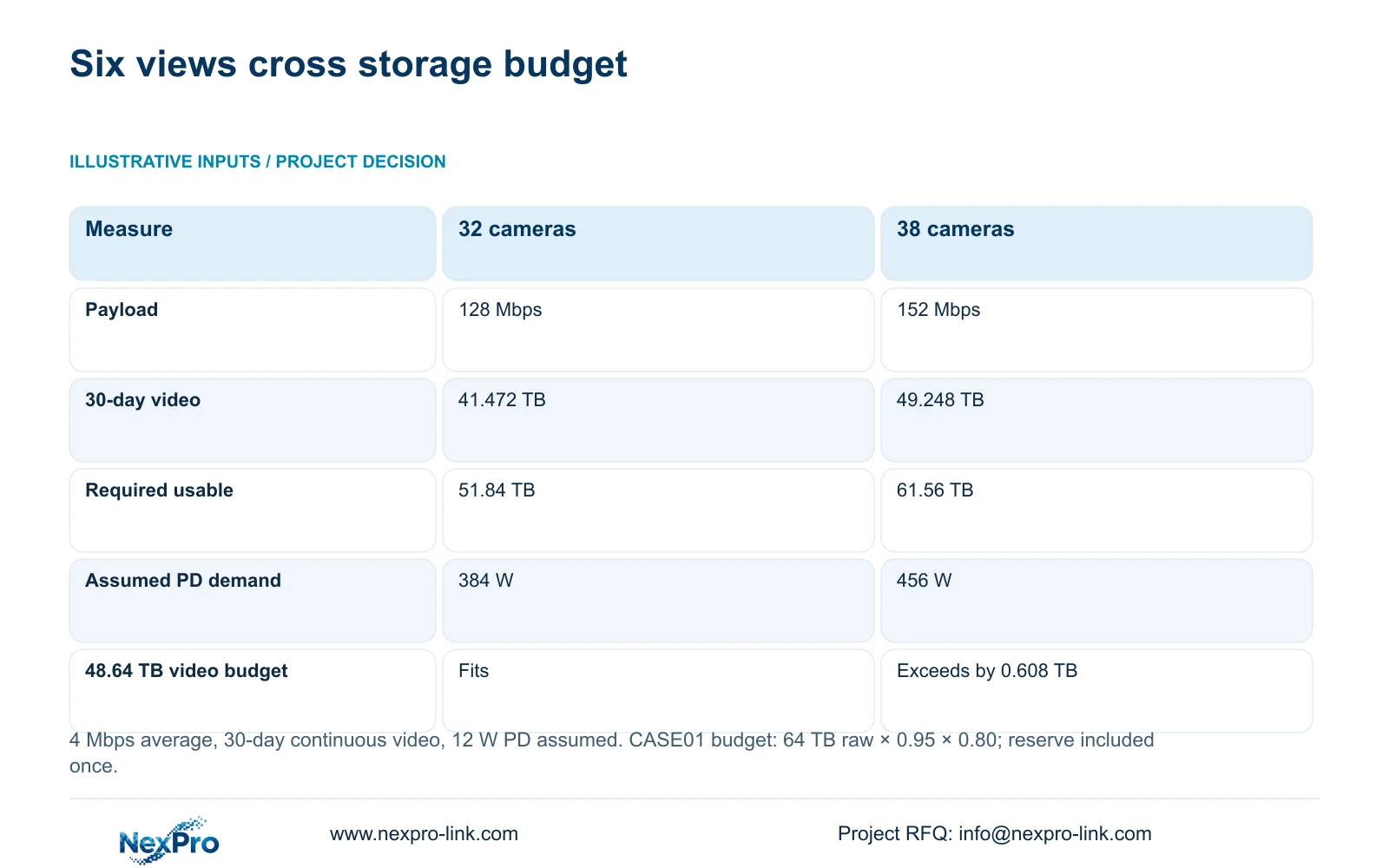
At 32 cameras, the results are 128 Mbps, 41.472 TB of video and 384 W camera-side demand. At 38 cameras, they become 152 Mbps, 49.248 TB and 456 W. Required usable storage at 80% occupancy is video_TB / 0.80, giving 51.84 TB and 61.56 TB. These are design assumptions, not camera maximum-power measurements.
CASE01 installs 4 × 16 TB drives, or 64 TB raw. Its assumed recording budget is 64 × 0.95 × 0.80 = 48.64 TB. The original 41.472 TB fits, but 49.248 TB exceeds that budget by 0.608 TB. Equivalently, 61.56 TB required usable exceeds 60.8 TB after the 95% allowance. Do not apply the 20% reserve a second time. This storage threshold is a specific reason to revise the hardware scope.
| Measure | 32-camera baseline | 38-camera revision |
|---|---|---|
| Recording payload | 128 Mbps | 152 Mbps |
| 30-day video | 41.472 TB | 49.248 TB |
| Required usable at 80% occupancy | 51.84 TB | 61.56 TB |
| Assumed camera-side demand | 384 W | 456 W |
| Fits CASE01's 48.64 TB video budget | Yes | No |
Section 05
Revise the resource that the change actually affects
The NexPro-NVR4449-4K reference lists 49 channels, 320 Mbps input and four SATA bays supporting up to 18 TB per drive. The revised 152 Mbps payload is below that published input figure, but channels, supported stream modes, playback and storage still need separate checks. The channel count does not establish every mixed-resolution or decoding arrangement.
A revised compatible drive combination is one storage option, subject to the selected recorder's support and an updated capacity calculation. A different recorder architecture may be appropriate if other requirements also change. Reducing retention is a separate owner decision and must not be used silently to make the old disks appear adequate. No RAID protection is established by the four-bay reference.
The six extra cameras add 72 W of assumed PD demand, but that is not the complete AC increase. Assign them to actual switch groups, check ports and PSE budgets, then include switch overhead and conversion assumptions in the protected-load schedule. If a new remote node is needed, define its local supply and backup separately. A route-only tray change would not create these camera recording and power increments.
Section 06
Release a coordinated revision rather than a blanket reprice
Issue a change package separating rerouted existing links, new camera views, unchanged equipment and affected shared resources. Attach the revised continuous-cut allocation and cabinet schedule when lengths are confirmed. Keep local installation work, optional changes and retained materials on distinct quotation lines so procurement can compare the actual variation.
NexPro-Link's BOQ and Tender Support scope can coordinate model matching, technical deviations and the relevant equipment quotation. Provide the accepted drawing revision and mark pending approvals. The local team retains tray design, route approval and installation responsibilities; equipment supply does not establish that containment or electrical work is included.
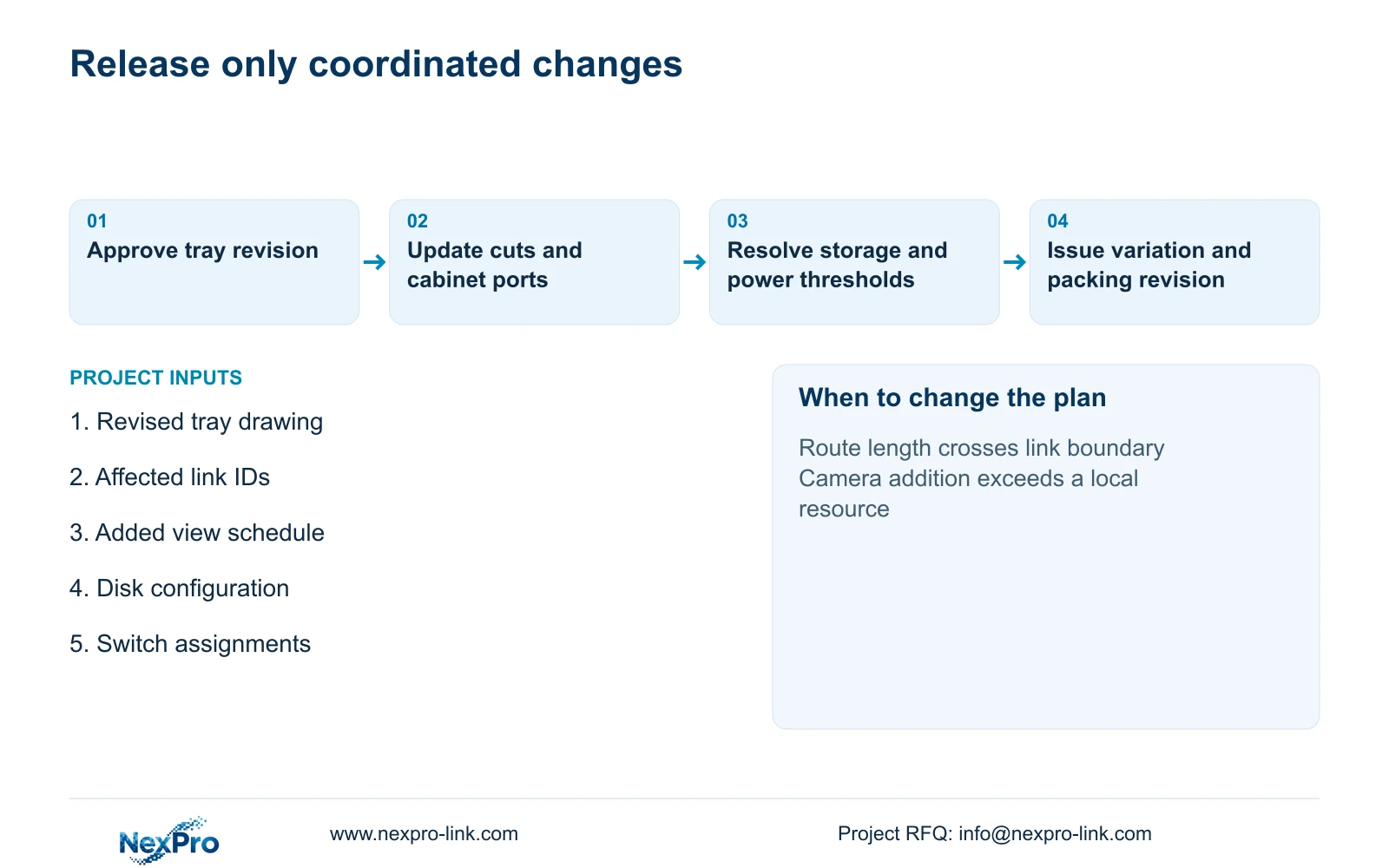
Before cable cutting or shipment release, check that the camera schedule, storage calculation, switch assignments and packing labels carry the same revision. Preserve unchanged items where they remain suitable. A targeted release avoids repricing the entire system blindly while still capturing the genuine disk, port, power or installation threshold crossed by the added views.
Section 07
Buyer questions
Should a tray reroute automatically trigger a new recorder? No. A route-only change primarily requires length, installation and link-boundary review. Recorder resources change when camera quantity, stream requirements or recording tasks change.
Can we release unaffected cable while the addition is reviewed? Yes, if the approved unaffected cuts and stock allocation remain feasible. Identify the held links and prevent their provisional lengths from entering the issued cutting instructions.
Does a spare channel mean an added camera is free of infrastructure changes? No. Check its local port, PoE supply, route, retention capacity and protected power. Spare recorder channels address only one part of the addition.
Section 08
Price the coordinated CCTV variation
Send the revised tray drawing, affected link schedule, added camera requirements and current disk and switch configuration to info@nexpro-link.com to discuss the specific equipment and supply changes.
Engineering references
These sources support the general planning principles. Always use the selected product's current datasheet and applicable project standards for final design.