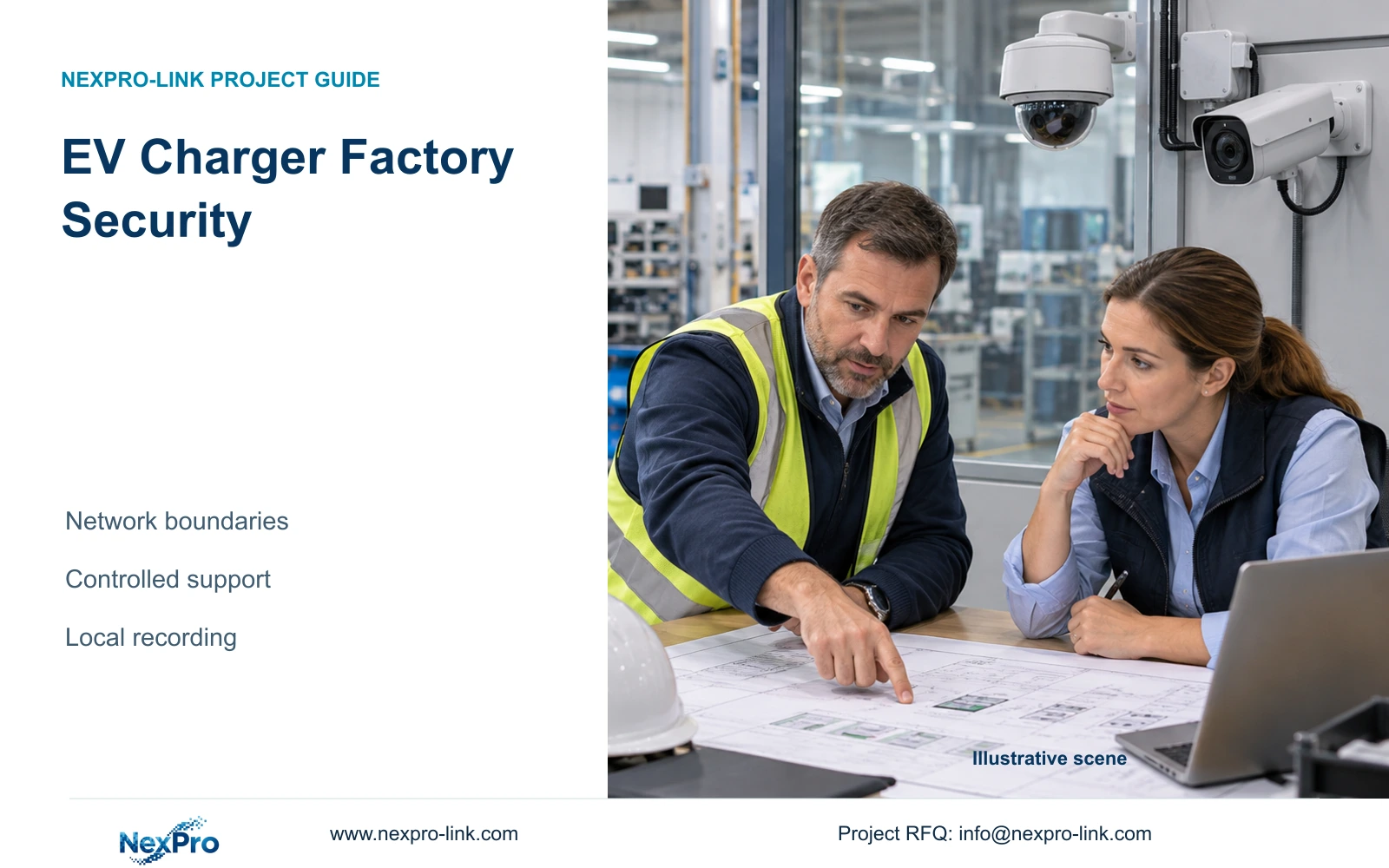
EV charger factory security needs an approved recording network and controlled support paths. Sharing infrastructure requires clear boundaries, with local CCTV kept independent of product-test connectivity.
Section 01
Approve the security boundary before sharing infrastructure
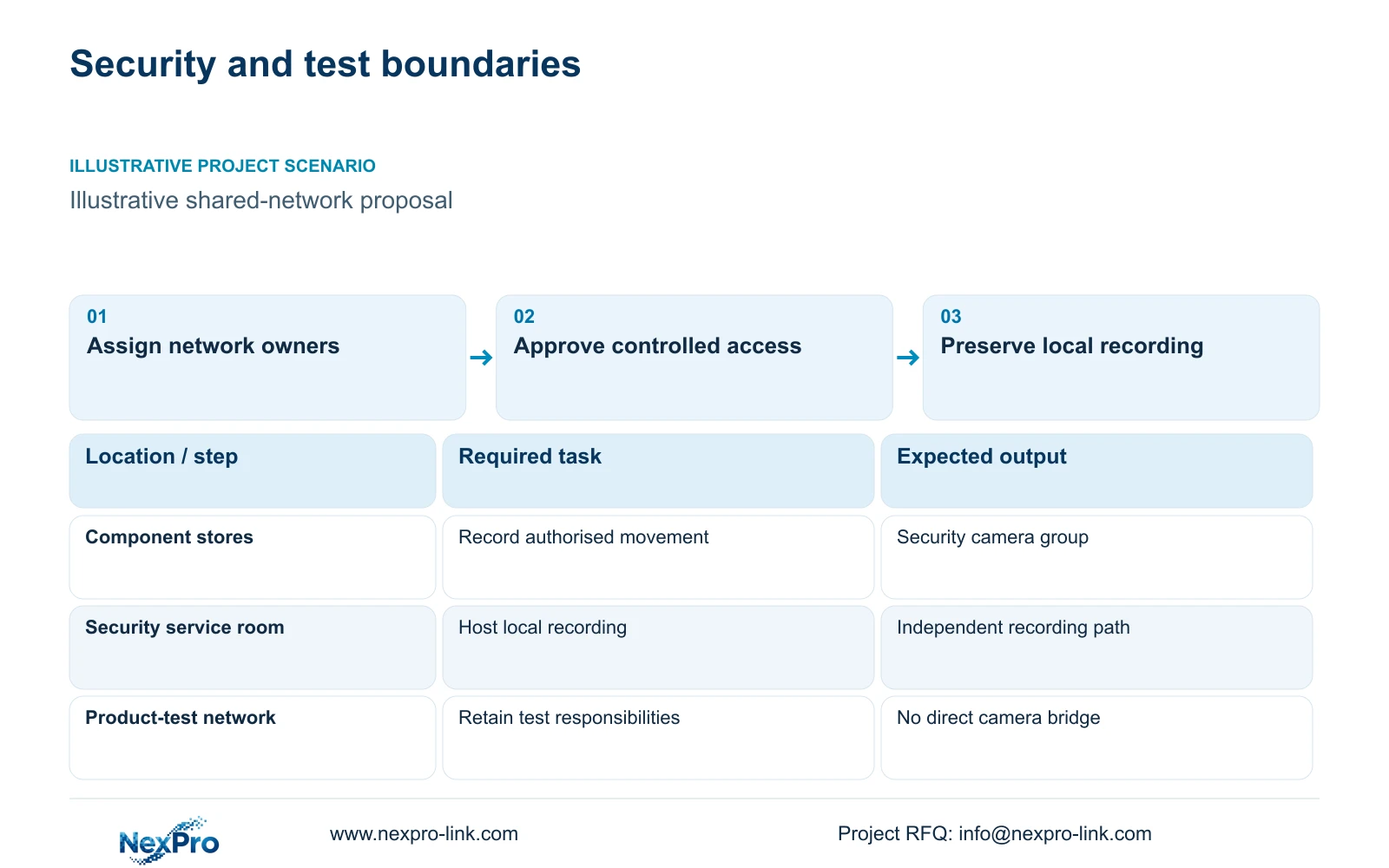
EV charger factory security should use approved network boundaries and controlled traffic paths. Cameras should not be bridged directly into production or product-test networks for convenience. Define security recording, operator access and supplier support separately from the connected test environment. The project manager needs an ownership decision before a shared switch becomes an assumed project dependency.
Illustrative project scenario: A charger factory already has a connected test environment and proposes sharing its network with CCTV. Assume the security task covers component stores, transfer approaches and dispatch, while product testing retains its own equipment and support arrangements. The immediate decision is whether any shared infrastructure can preserve the approved separation and operating duties.
Ask both network owners to identify address ranges, routing boundaries, management access and permitted shared services. Sharing cable pathways or a cabinet does not require sharing unrestricted device access. Record any proposed cross-boundary communication with its purpose and owner. If no security workflow needs a route to test devices, omit that route from the design.
Section 02
Limit supplier support to the equipment being serviced
Specify who authorises remote support, which devices the supplier may reach and when the session ends. Prefer an owner-controlled support method with identifiable users, bounded permissions and a recorded change request. A camera configuration session should not provide incidental access to charger test devices. Keep the test supplier's support permissions separate from those of the security equipment supplier.
NIST SP 800-82 Rev.3 is a published OT-security reference for considering operational constraints and separation. Use it as context when the site's IT and test teams evaluate access paths. It does not prove that a proposed VLAN, recorder or remote-access product is secure in the actual configuration. Acceptance needs to examine the implemented routing and access policy.
When cloud or app viewing is proposed, list its required communications and account ownership for approval. NexPro-Link's Seetong page supplies APP and PC-client context, not a blanket statement of enterprise-policy fit. Keep remote viewing optional where the owner has not approved it, and provide a supported local service route rather than making external connectivity essential to recording.
Section 03
Keep camera-to-recorder operation independent of the test network
Place the camera-to-recorder path inside the approved security boundary. Identify the local switch, recorder, storage and required time or management services. Decide which functions must survive loss of internet, the viewing connection or the test environment. Local recording can remain a design objective only if its actual dependencies are kept available and verified.
CASE05 illustrates a solar-module campus with three 32-camera local recording nodes. At an assumed 4Mbps per stream, each recorder receives 128Mbps. The same distributed principle can inform separate stores and dispatch buildings at a charger factory, but its camera count and ordinary-area assumptions require a fresh task schedule.
NexPro-NVR4449-4K lists 320Mbps input, four SATA bays and dual Gigabit LAN. Two network interfaces do not establish an approved firewall or isolation boundary. The network team must define their use. Put the local security power chain on its own load schedule, with camera demand included through complete switch AC input where applicable; charger test loads remain separate.
Section 04
Size the approved viewing branch without changing recording
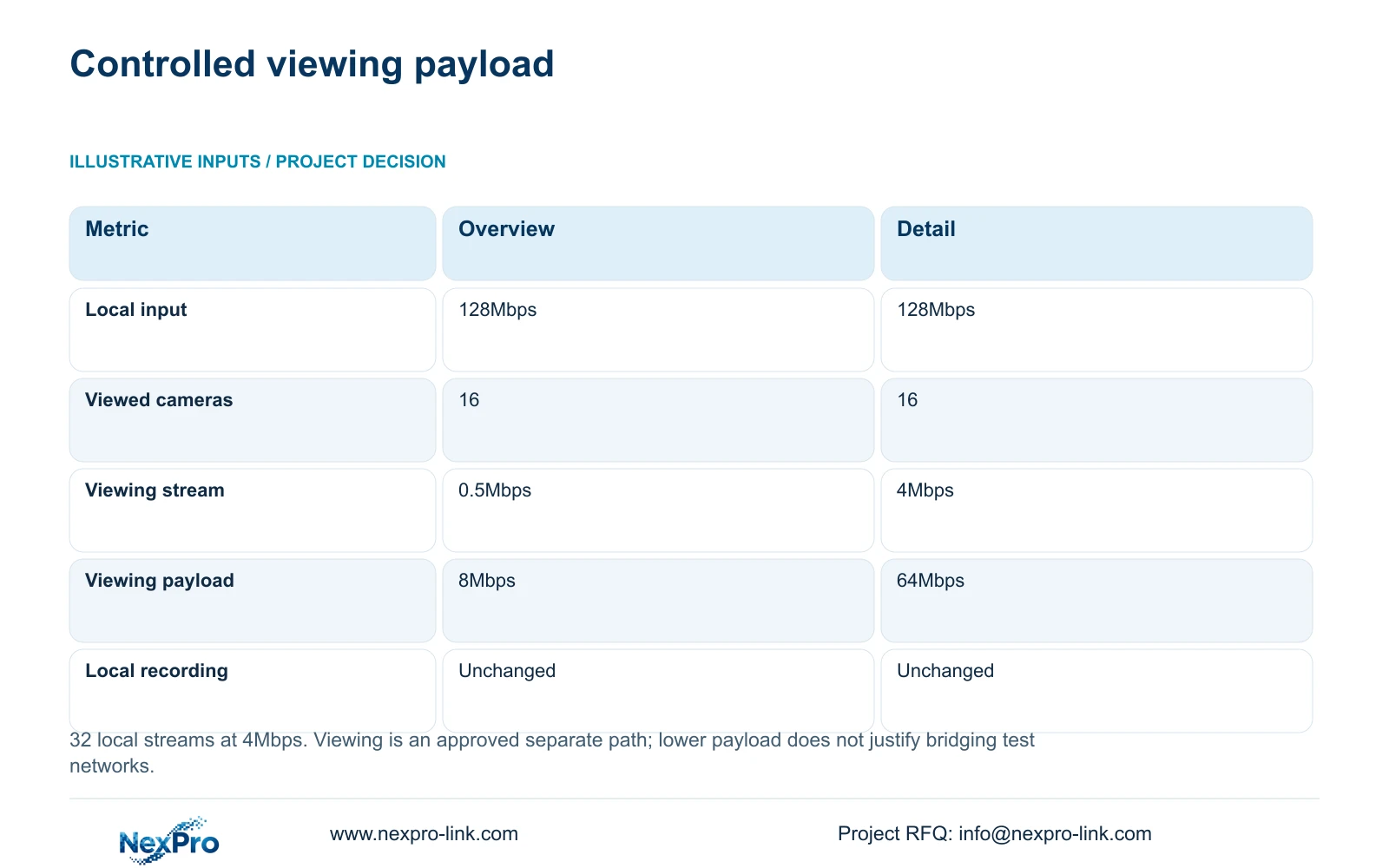
The illustrative model uses 32 local main streams at 4Mbps each and 16 simultaneously viewed cameras. Recorder input is recorder_Mbps = 32 × 4 = 128Mbps in both options. Overview viewing assumes 0.5Mbps per stream, giving viewing_Mbps = 16 × 0.5 = 8Mbps. Detail viewing at 4Mbps gives 16 × 4 = 64Mbps before protocol overhead.
This comparison supports an approved low-bandwidth overview while keeping local recording quality unchanged. The decisive difference is stream choice on the client path. It does not make a direct connection to the test network acceptable, and it does not prove that the selected devices and client can supply every substream workflow.
Draw the actual path before adding traffic totals. A corporate viewing interface may carry selected live views, playback and exports, while local recorder input stays within the security group. If both use one physical uplink, assess the applicable directional traffic and other services. Confirm usable capacity and concurrency through the chosen configuration rather than treating the payload table as a network performance test.
| Metric | Approved overview | Approved detail |
|---|---|---|
| Local recorder input | 128Mbps | 128Mbps |
| Concurrent viewed cameras | 16 | 16 |
| Viewing stream each | 0.5Mbps | 4Mbps |
| Viewing payload | 8Mbps | 64Mbps |
| Recording stream reduction | None | None |
Section 05
Choose separation that the owner can operate and verify
Recommend a dedicated security access and recording scope, with only explicitly approved operator and support paths. Shared managed infrastructure can remain an option when the network owners accept its configuration, capacity and maintenance responsibilities. Separate physical equipment may be preferable where those responsibilities cannot be resolved before commissioning.
Price the consequences of each option: access switches, routing or filtering work, configuration, approved support access and acceptance testing. Retained infrastructure should have a named owner and an agreed change process. Treat unknown work as unresolved scope rather than zero cost. The project manager should know who restores recording after a shared network change.
Change the recommendation when the owner's policy mandates a platform, when necessary integrations require controlled exchange, or when service arrangements cannot support the proposed boundary. Preserve those requirements in an alternative bid. Ordinary cameras can support material and access evidence, but they do not certify charger quality or control product-test safety.
Section 06
Handover the permitted paths and recovery tests
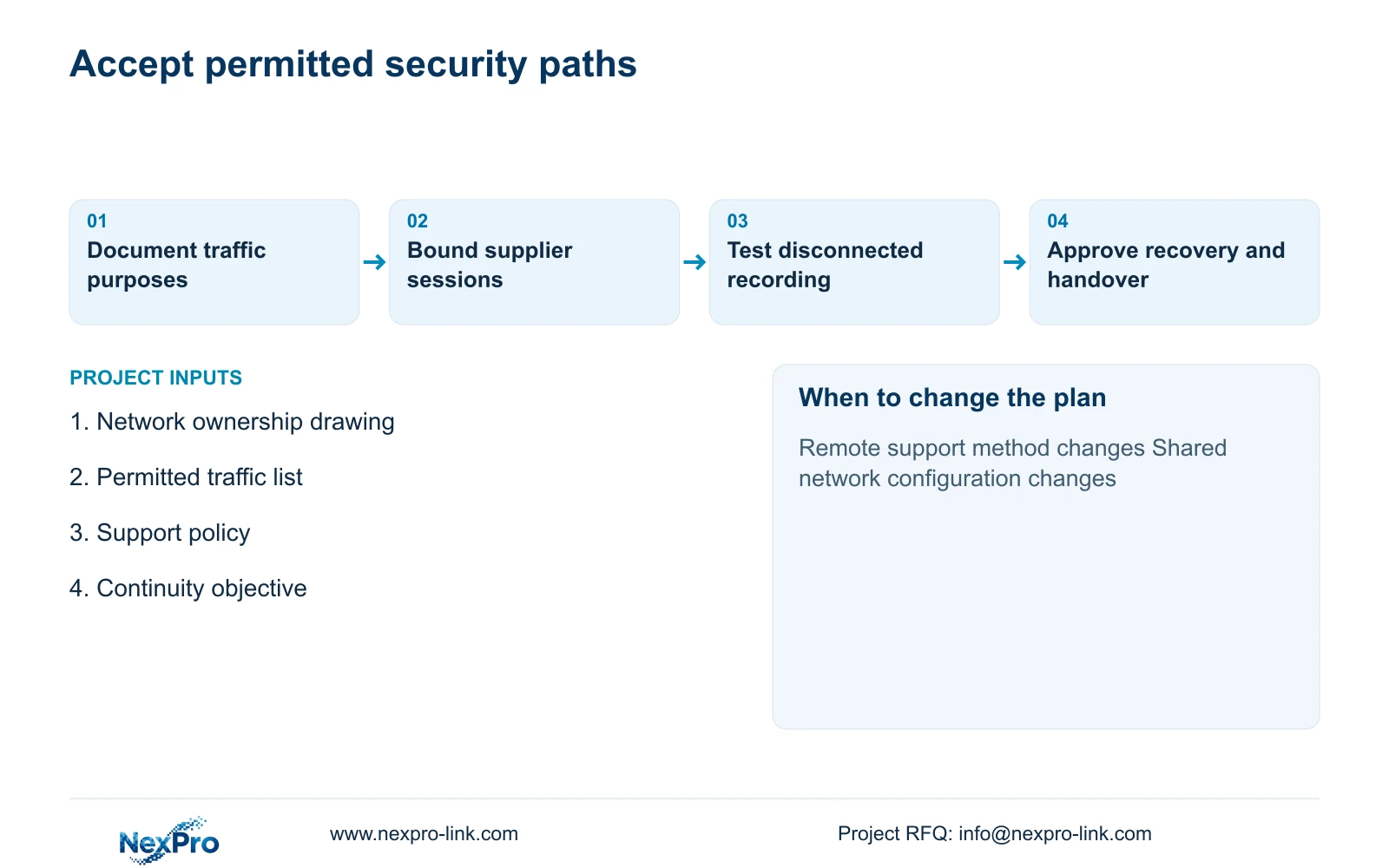
The handover package should include a logical network drawing, device identities, permitted traffic purposes and the support approval procedure. Mark supplied security hardware, retained corporate services and excluded test equipment separately. Assign the local integrator to implement the approved configuration and the site network owners to accept the resulting access boundaries.
For ordinary security views, NexPro-BL2812M55-5MP-DIC-AI lists PoE, a 2.8-12mm motorized lens and a 5MP-family output including 2880x1620 at 25fps. Model matching belongs after the view and network requirements are clear. NexPro-Link's BOQ support can help align equipment and documentation, without implying that supplier preparation replaces site security approval.
Test recording with the external viewing connection unavailable, then verify authorised playback after restoration. Demonstrate that supplier access reaches its approved security devices and does not depend on a bridge into the product-test network. Use tests agreed by the network owners to avoid disrupting production. Reapprove paths whenever support methods or shared infrastructure change.
Section 07
Buyer questions
Is a CCTV VLAN enough to approve shared switches? A VLAN is one configuration element. The owners still need to review routing, management access, shared services, capacity and maintenance permissions, then verify the implemented boundary.
Can the recorder's second LAN port isolate the test environment? Do not assume that role. Its use must fit the approved network design and supported device behaviour. A dual-interface specification does not establish firewall functions.
Can we keep remote supplier support disabled at handover? Yes, if the approved operating and maintenance plan provides a workable local support route. Any later remote method should follow the owner's access approval and change process.
Section 08
Define an approved security network
Send the security and test network ownership map, required operator access, supplier-support policy, and local recording continuity objective to info@nexpro-link.com to discuss equipment and documentation boundaries.
Engineering references
These sources support the general planning principles. Always use the selected product's current datasheet and applicable project standards for final design.