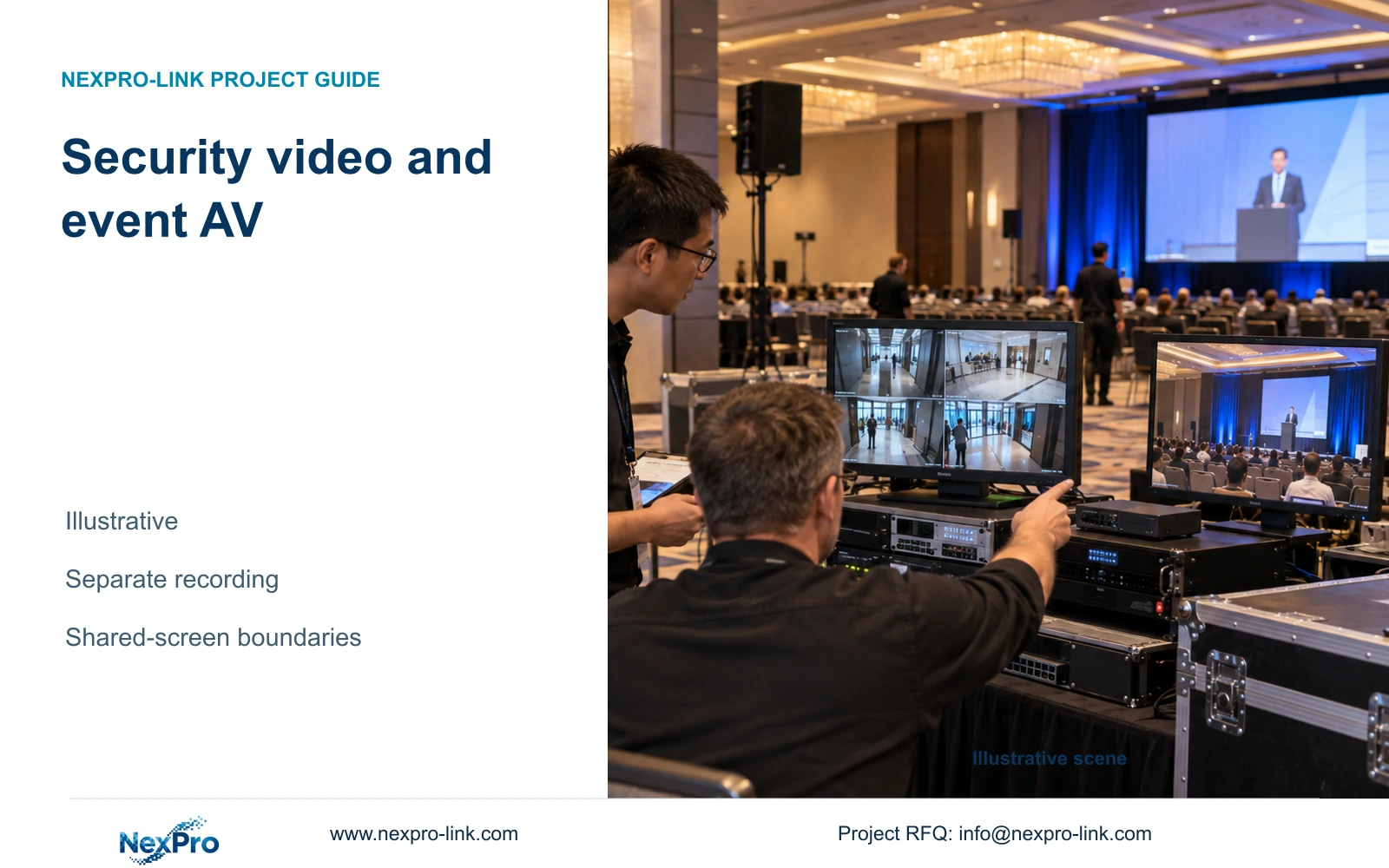
Keep the convention hotel's required recording profile stable while event operators change viewing layouts, with network, decoding and power sized independently.
Section 01
Choose separate normal and event viewing workflows
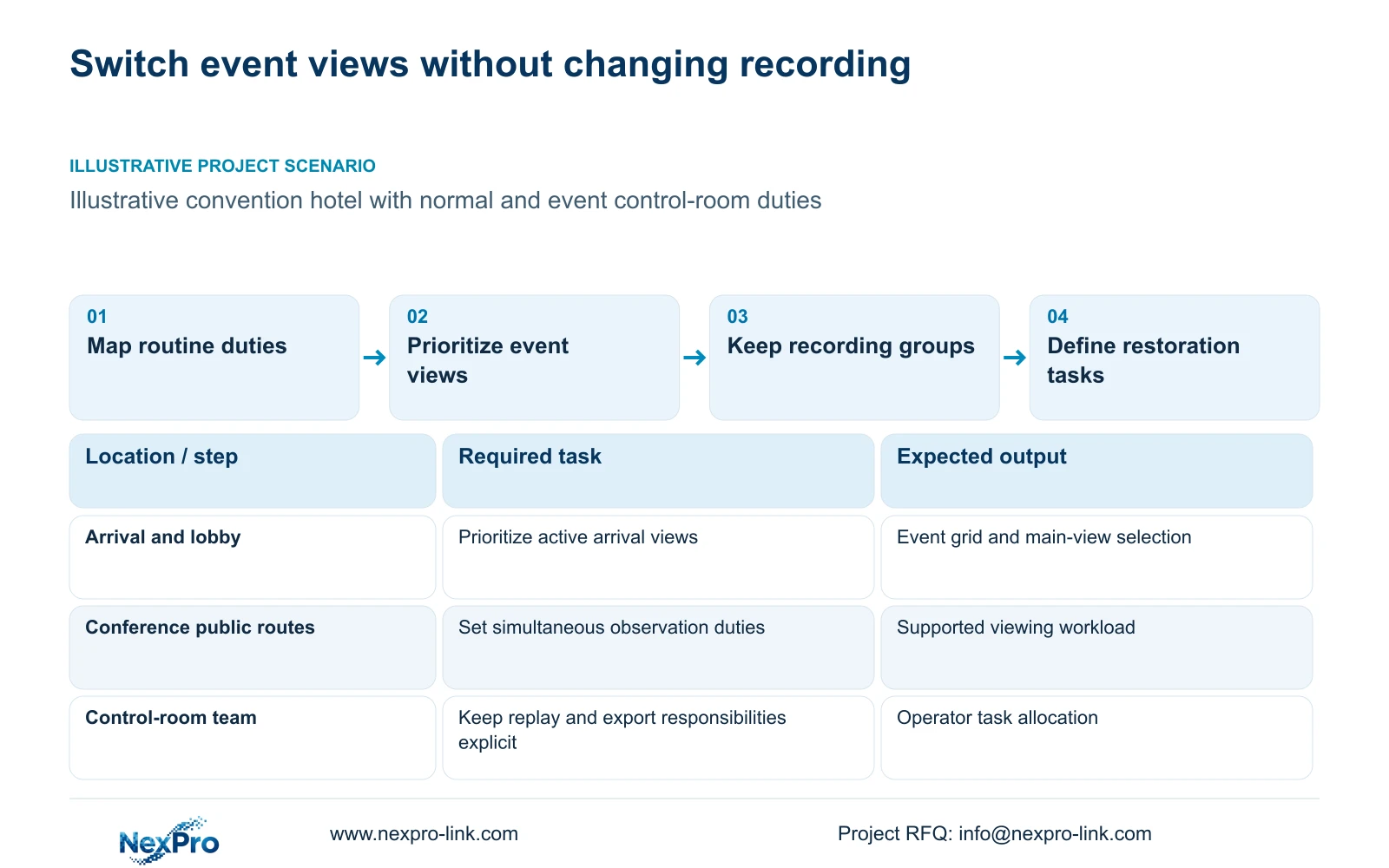
Keep the required recording profiles unchanged between ordinary operation and event peaks, while adapting the viewing layout to the active task. Use overview substreams and supported main-stream enlargement when they satisfy operator needs. Increase decoding or backbone capacity when the approved concurrent workload exceeds that arrangement; do not reduce essential recording to make the display run.
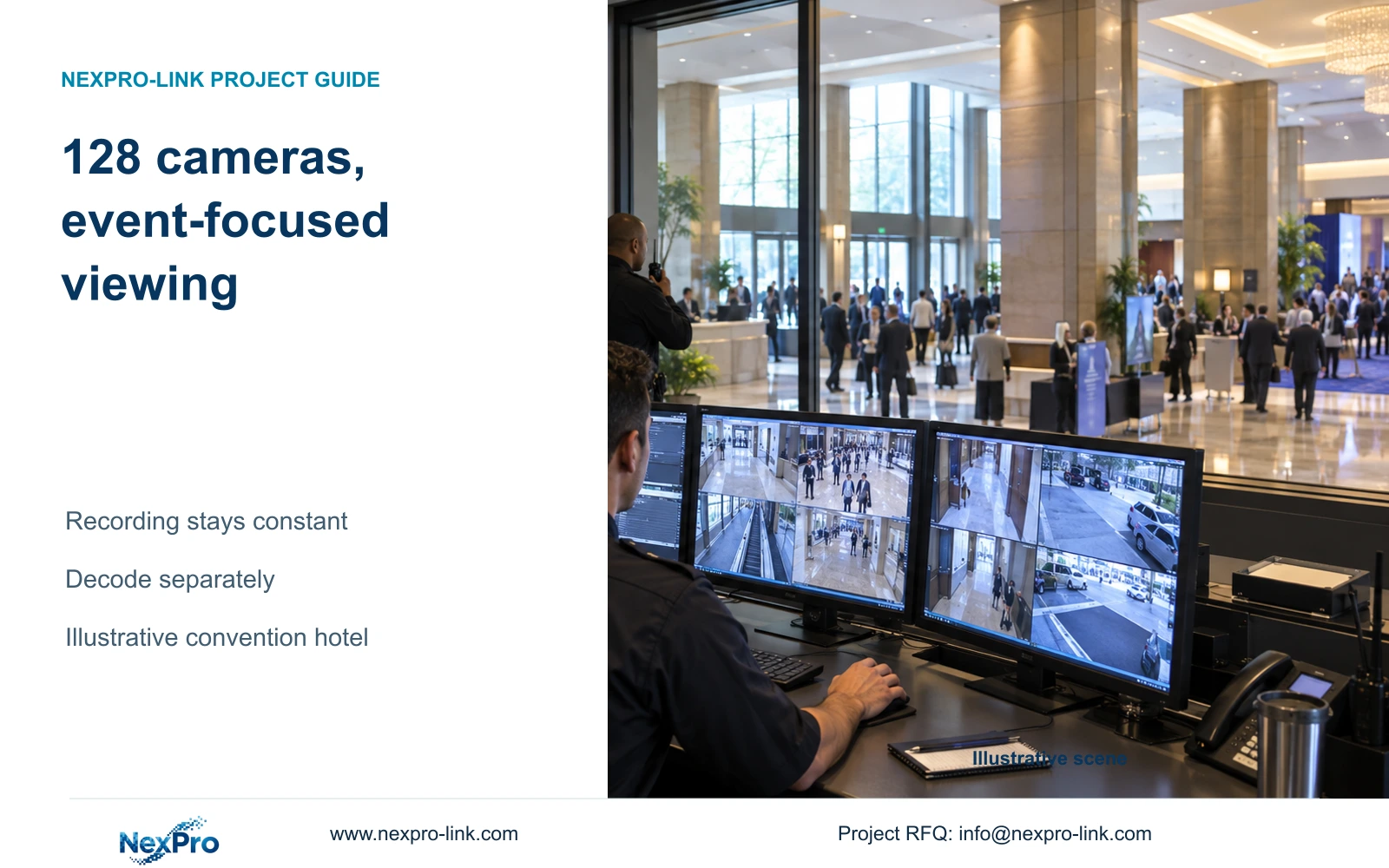
The illustrative CASE05 convention hotel has 400 rooms and 128 public-area camera tasks. During normal operation, staff may inspect selected entrances or retrieve incidents. An event can require simultaneous observation of arrival routes, conference circulation and parking. Specify which views remain visible and which event view receives enlargement, with authorized replay and export duties defined separately.
Identify the functions whose restoration matters during an event and who can act locally. If spare equipment is proposed, base it on the affected task and replenishment conditions. Replacement compatibility requires the supported power, mounting and recording behavior; an arbitrary percentage of every SKU does not explain its operational value. No failure-rate or restoration-time evidence is supplied for this reference.
| Operating task | Given context | Decision needed |
|---|---|---|
| Routine incident work | Selected views and retrieval | Authorized replay and export duties |
| Event observation | Arrival and conference public routes | Concurrent grid and enlarged views |
| Restoration | Required recording continues | Local actions and replacement scope |
Section 02
Create recording groups without tying them to display pages
CASE05 allocates sixteen views to arrival and lobby, forty to guest public routes, twenty-four to conference public routes, twenty-four to parking and twenty-four to service routes. Guest-room interiors and sensitive spaces are excluded. Assign exact observation tasks and permitted framing before deciding camera models or treating an event layout as a permanent recording group.
The recording reference uses four groups of 32 cameras, each assigned to one NexPro-NVR4449-4K. At the assumed 4 Mbps average, each recorder receives 128 Mbps. Its public record lists 320 Mbps input and four SATA bays, but image modes, compatible disks and replay concurrency remain separate requirements. The 49-channel designation does not authorize 49 simultaneous 8MP streams.
Display pages can draw from several recording groups if the selected client or decoder supports the required workflow. Keep camera identifiers consistent across the operator layout, recorder assignment and cable labels. Approved recording duties should survive a change from normal to event viewing. Any associated software or integration scope needs explicit support; buying devices together does not establish native interoperability.
Section 03
Calculate recording capacity and peak path traffic
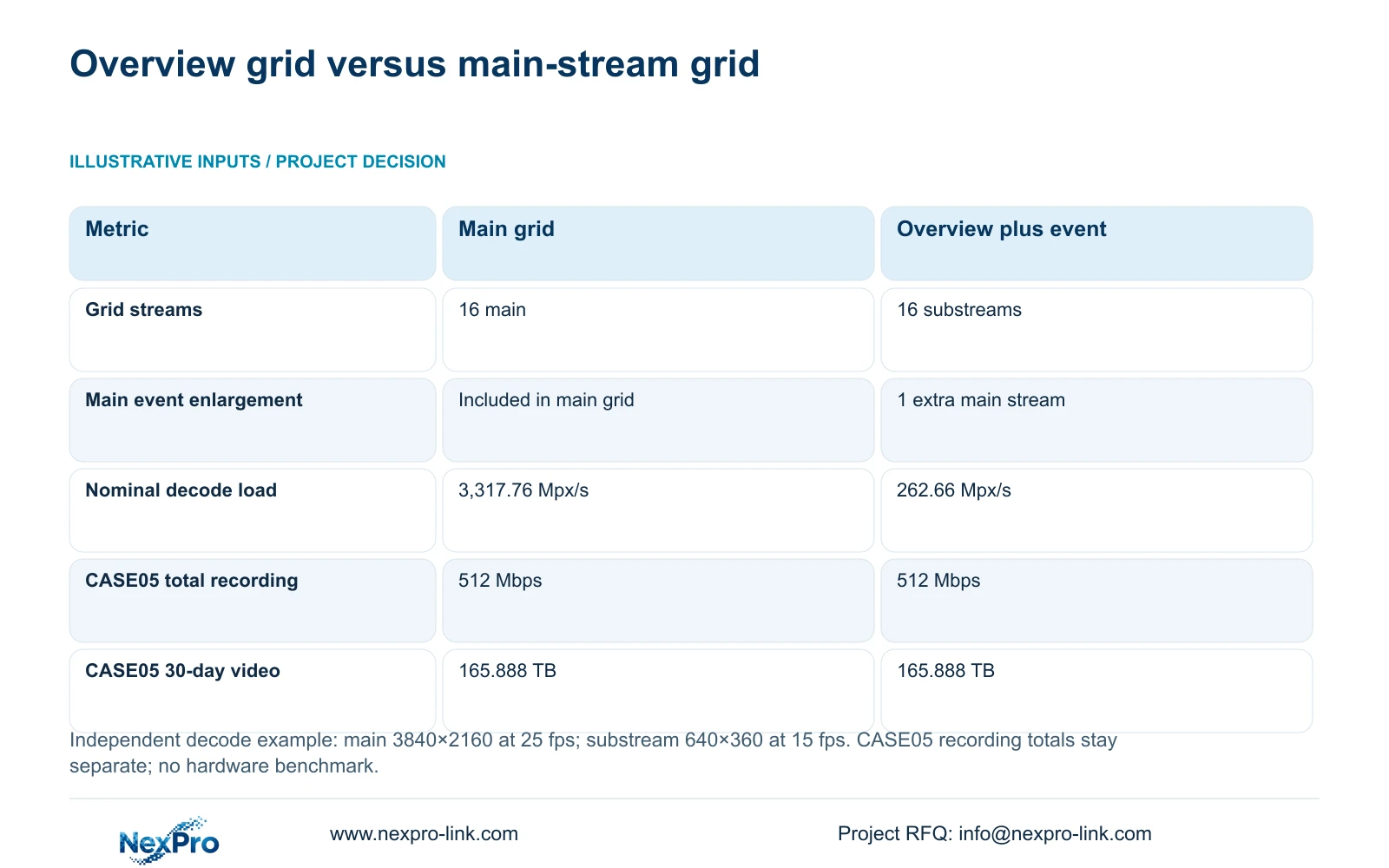
The topic calculation uses 128 cameras at 4 Mbps average, recording continuously for 30 days. Total input is 512 Mbps. Decimal video volume is 0.0108 × 128 × 4 × 30 = 165.888 TB. With 20% of usable space kept free, required usable capacity is 207.36 TB. These outcomes remain identical in the essential and enhanced options.
CASE05 assigns four 16 TB drives to each of four recorders. The 256 TB raw total becomes 243.2 TB under an assumed 95% formatting factor. After reserve, 194.56 TB remains for video, exceeding the 165.888 TB payload and corresponding to 35.19 planning days. This is an independent-disk arrangement without RAID loss, not a claimed array capability.
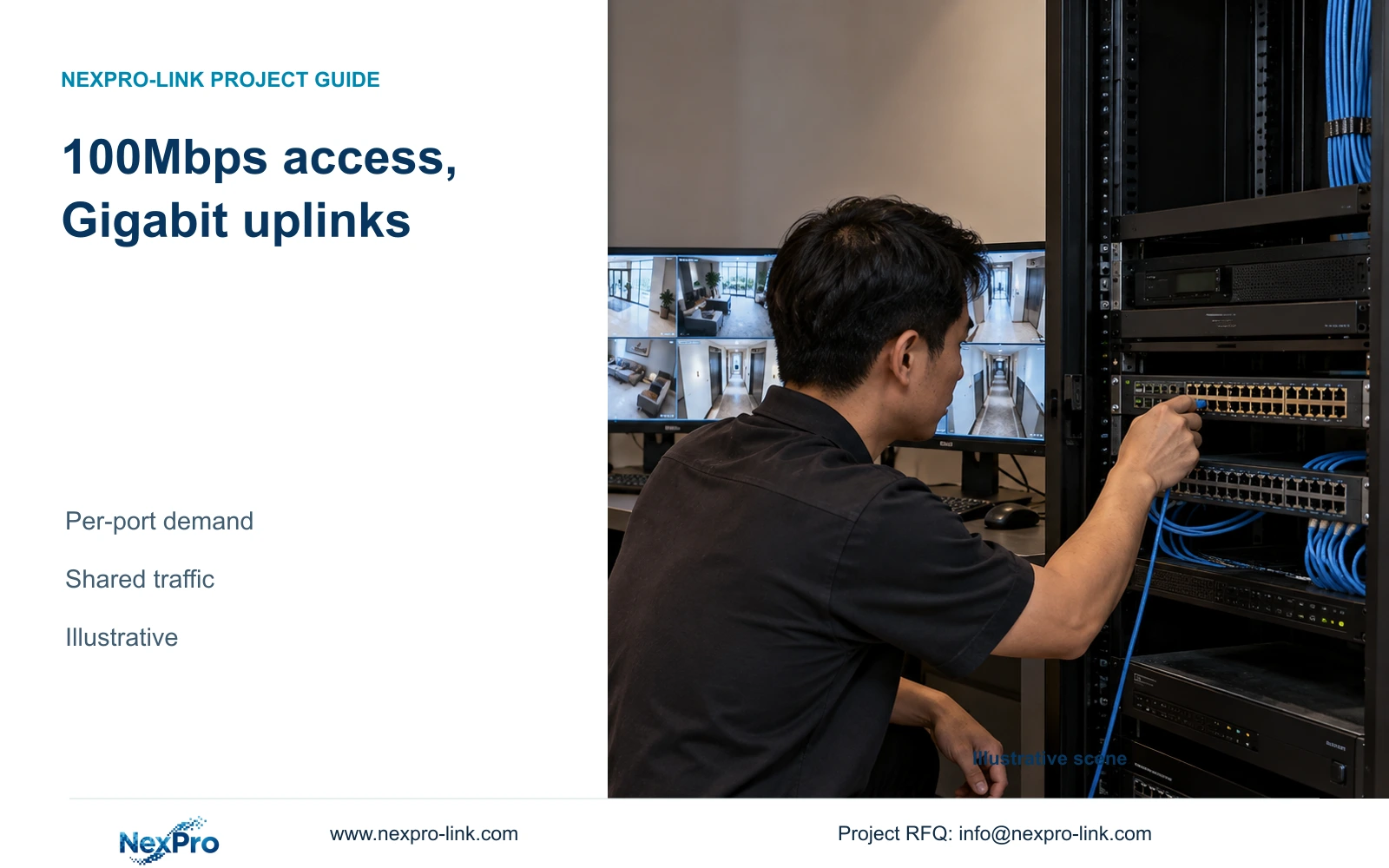
Eight access nodes each carry sixteen cameras, giving 64 Mbps pure recording traffic per node or 70.4 Mbps with a 10% allowance. The 512 Mbps aggregate crosses a particular core link only when the topology routes all those recordings through it. Add event viewing, replay and export streams on their actual shared paths. Access-port rate, switch forwarding, NVR input and client decoding are independent constraints; a faster uplink cannot establish adequate decoder performance.
| Metric or condition | Essential package A | Enhanced package B |
|---|---|---|
| Aggregate recording input | 512 Mbps | 512 Mbps |
| 30-day video data | 165.888 TB | 165.888 TB |
| Required usable capacity | 207.36 TB | 207.36 TB |
| Protected path | Cameras, network and recording | Same plus selected extras |
| Operator display | Task-sized monitor/workstation | Optional wall; independent recording |
| Cost comparison | Complete required-scope quote | Documented incremental scope |
Section 04
Size event decoding separately from stored video
Use resolution × frame rate × simultaneous streams to describe the viewing workload. The supplied decoder illustration compares sixteen 3840 × 2160 main streams at 25 fps with sixteen 640 × 360 substreams at 15 fps plus one 3840 × 2160 event stream at 25 fps. The nominal loads are 3,317.76 and 262.66 million pixels per second respectively.
This separate workload illustration is not CASE05's recording profile and is not a hardware benchmark. It demonstrates why an overview grid with event enlargement can reduce decoding demand while leaving stored main streams unchanged. Confirm the codec, client version and actual concurrency, including replay or other windows, before accepting the operating layout.
A two-by-two wall using NX-VP-5535 Full HD LCD panels has a nominal 3840 × 2160 canvas through a suitable signal path. A 16-view grid allocates 960 × 540 pixels per tile. A single 4K monitor has the same nominal canvas with different viewing distance and physical layout. NX-VP-5535 is not direct-view LED, and the name NX-VD-4K16 does not establish sixteen simultaneous 4K decode channels.
| Viewing arrangement | Nominal load | Recording effect |
|---|---|---|
| 16 main streams: 3840 × 2160 at 25 fps | 3,317.76 Mpx/s | Main recording unchanged |
| 16 substreams plus 1 main event stream | 262.66 Mpx/s | Main recording unchanged |
Section 05
Coordinate protected power and equipment-room loads
Each CASE05 sixteen-camera node assumes 192 W at powered devices. With 90% delivery, required PSE output is 213.33 W; retaining 20% spare requires 266.67 W. NexPro SW-POE1618G remains provisional because total watts are absent and access-port speed fields conflict. Confirm the actual night-load state and per-port capability.
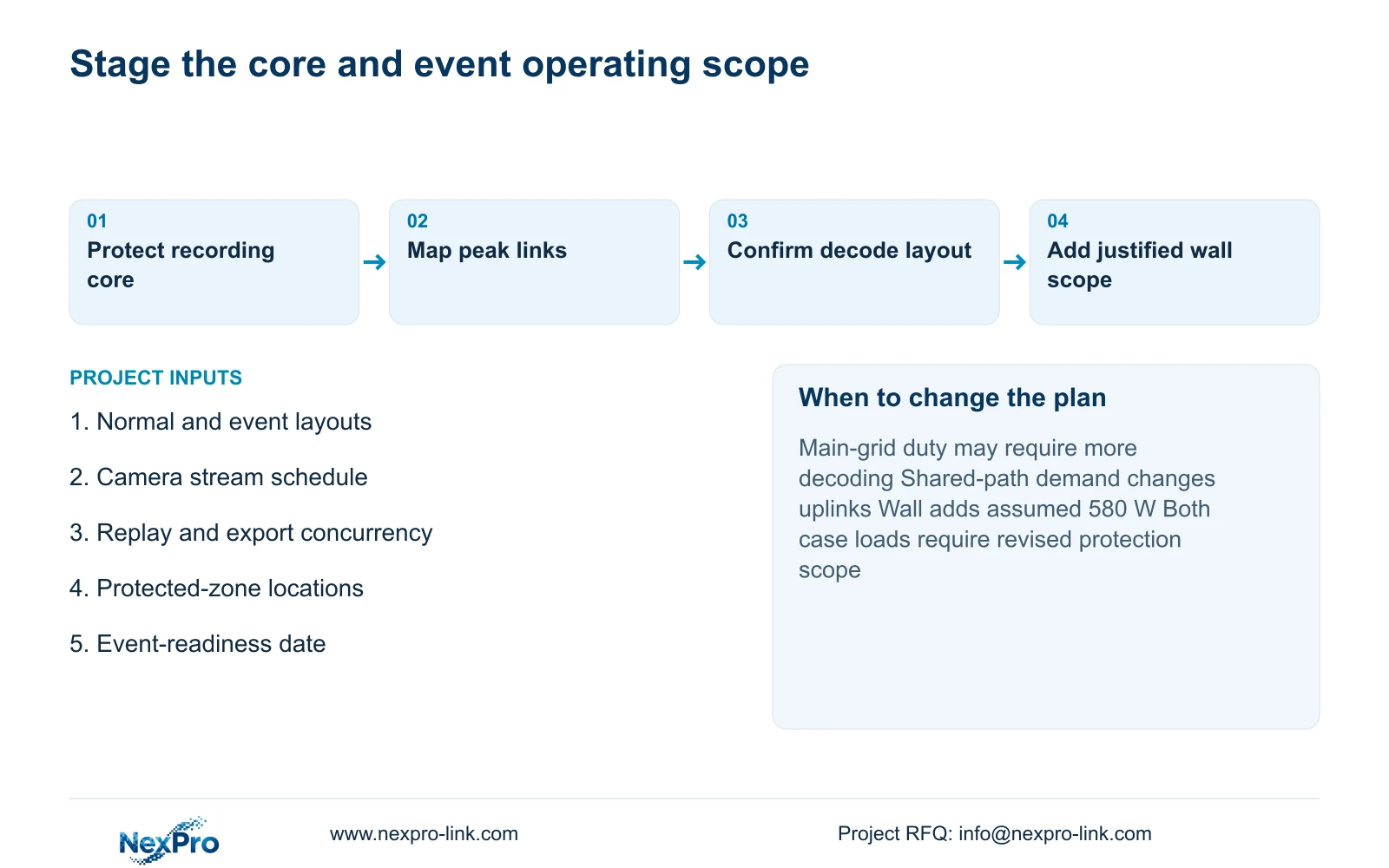
The case estimates complete switch AC input once, including camera delivery and conversion losses. Across eight nodes this is 2,015.07 W. Four recorders, core and ordinary screen raise the total to 2,315.07 W and 2,572.3 VA at PF 0.9. Adding the assumed 580 W wall and decoder gives 2,895.07 W and 3,216.75 VA. Neither total retains the specified 20% reserve on the listed 3 kVA/2700 W rack model.
Use split protected zones or a larger explicitly supported configuration. The basic 30-minute nominal-energy estimate is 1,607.69 Wh using assumed 90% inverter efficiency and 80% usable energy; actual runtime requires the selected battery curve. Provide the mechanical team with equipment-location loads and airflow needs. UPS losses and downstream heat need consistent boundaries, while room cooling also includes people, lighting and other loads outside this power calculation.
Section 06
Release the recording core before optional event upgrades
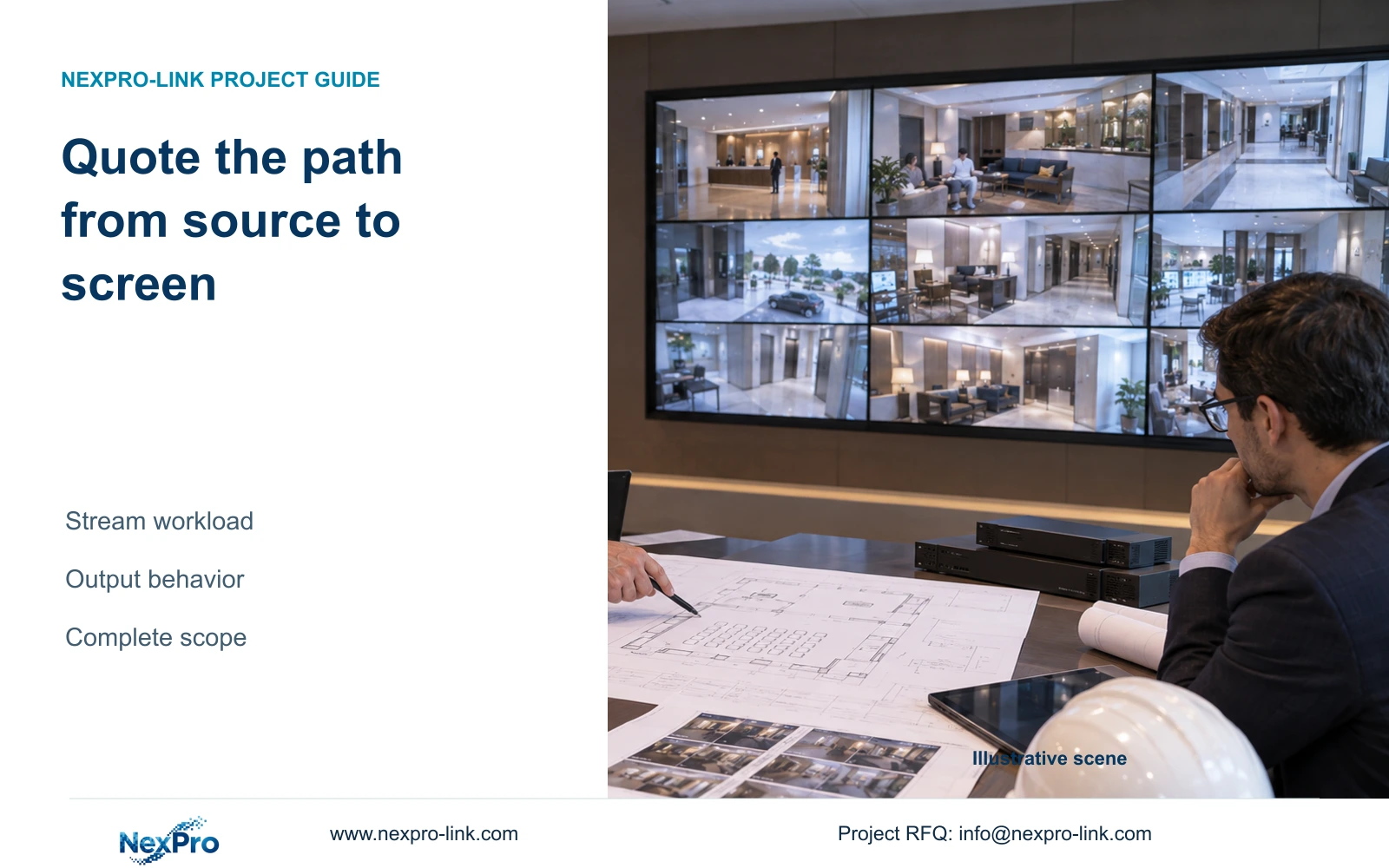
Recommend the complete recording and protected-network core first, followed by a supported event layout using overview streams and selected main views. Add wall capacity when several operators need sustained shared observation, or revise decoding when the required concurrent detail cannot fit the proposed workflow. Staging should leave every approved recording task intact.
CASE05's copper plan totals 7,394 m across 128 continuous routes. Its feasible 26-reel allocation uses 305 m reels and leaves 536 m in separate tails; the 25-reel total-length lower bound is not that feasible plan. Actual routes, patching and building interfaces determine final quantities. SP5648 is a patch panel, not bulk cable.
Send normal and event view layouts, the stream schedule, simultaneous replay/export duties and protected-power locations to info@nexpro-link.com, with destination and event-readiness date. NexPro-Link can discuss model matching and coordinated BOQ supply. Local installation, software interfaces and service costs remain explicit. Applicable main-equipment policy has a 24-month limited hardware baseline from receipt, with batteries and storage governed by their scoped terms.
Section 07
Buyer questions
Should event mode use the same viewing grid as normal operation? Only if it supports the event's simultaneous tasks. A supported event layout can prioritize arrival or conference routes while preserving recording settings and leaving authorized incident retrieval available.
Does the lower decoded-pixel figure prove a decoder will pass? No. It describes a workload. Confirm performance with the actual codecs, firmware or client version, display outputs and simultaneous tasks required by the project.
Can the wall be purchased later without changing the recording package? Yes, when recording is independent and the later signal, mounting, network and power additions are planned. A later wall must not inherit an unchanged runtime claim or remove the required core scope.
Engineering references
These sources support the general planning principles. Always use the selected product's current datasheet and applicable project standards for final design.