Ceramic tile factory CCTV should follow pallet handovers from packing to dispatch while keeping ordinary equipment away from unsuitable heat and exposing the true retention cost.
Section 01
Price kiln-boundary exceptions separately from pallet security
Use environmental zoning and a continuous pallet-handover sequence for ceramic tile factory CCTV. Keep ordinary equipment at suitable positions and separately specify any process-facing camera outside its documented envelope. For the quantity surveyor, this produces a measurable ordinary-area package and visible exceptions instead of a uniform camera allowance that hides heat-related work.
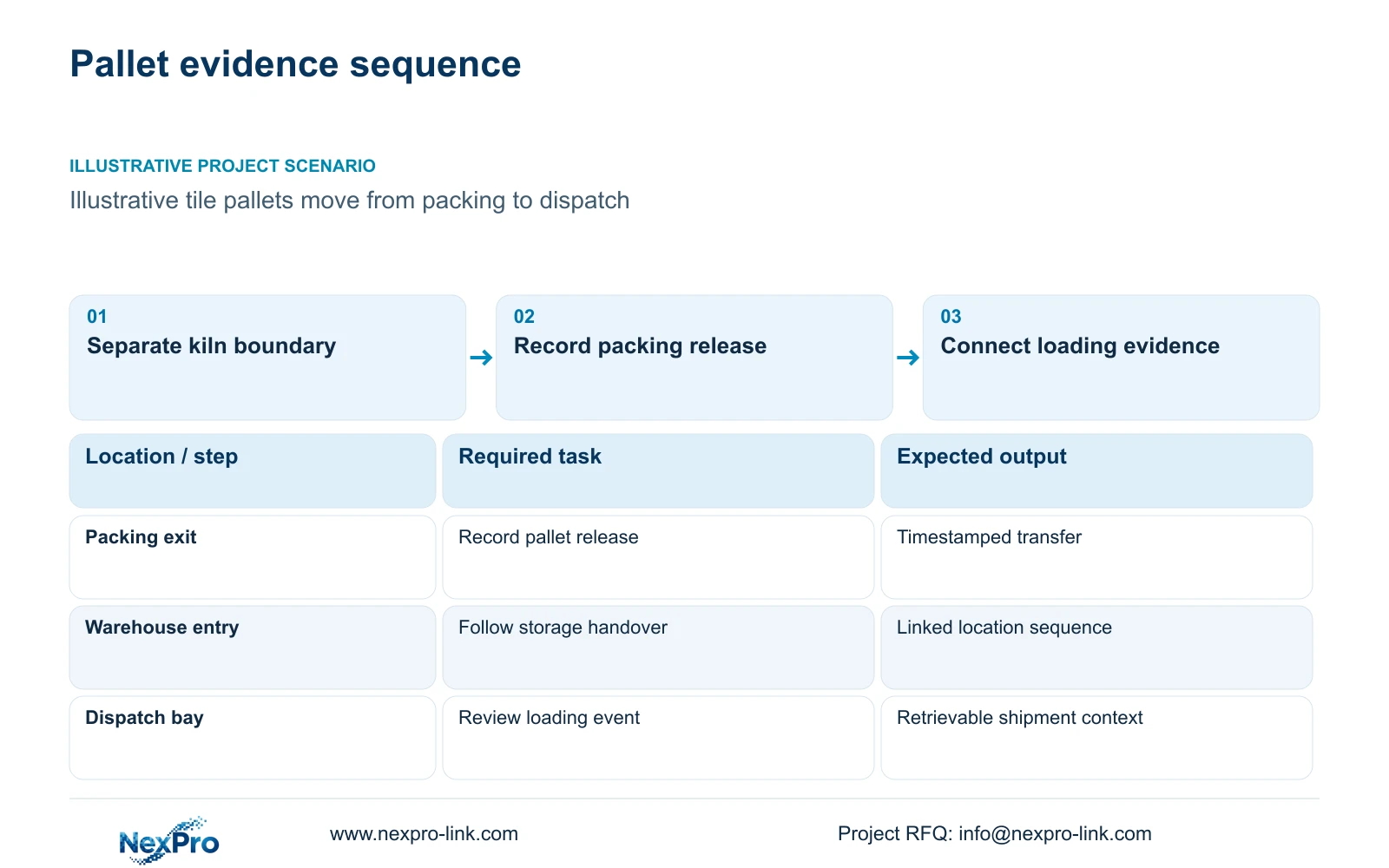
Illustrative project scenario: A tile factory seeks context for pallet movement from packing to dispatch. Assume proposed views cover packing release, warehouse entry and loading. A nearby kiln boundary is still being assessed. The security objective is to reconstruct the pallet sequence, not inspect firing conditions or judge tile quality.
Request a drawing showing the proposed mounting positions, radiant heat sources, cleaning conditions and normal service access. The supplied ordinary BL2812M55 and DM2812M55 references list IP66 and minus 20 to plus 60°C, but those fields do not establish kiln suitability. The local designer should decide whether relocation preserves the event or a specialist position is necessary.
Section 02
Define packing transitions before measuring camera quantities
Follow a pallet through release from packing, entry into storage and allocation to a truck. Identify where a handover can occur outside the proposed view or where wrapped pallets hide the relevant action. Give each transition a task identifier so the BOQ quantity follows an accepted observation requirement.
A broad packing overview can show movement around the line, while a closer release view may be needed to associate a pallet with a timestamp. Keep production records as the source of batch and pallet identity unless the camera trial proves the required identifier is readable. Ordinary security recording does not establish automated barcode recognition or inspection capability.
Agree the usable recorded event with the owner, including night-shift lighting and representative pallet traffic. For suitable ordinary points, the supplied 5MP-family documents retain 2880×1620 output, 25fps and a 2.8 to 12mm motorized lens. Choose framing through the event trial rather than treating those ratings as a guarantee of readable wrapping labels.
Section 03
Connect warehouse and loading views through a retrieval schedule
Make warehouse-entry and loading camera names match the site location schedule. Have the warehouse team provide the dispatch time reference and the installer verify time consistency across the relevant recording devices. A reviewer should be able to find a packing release and follow the same movement through storage without guessing which camera name belongs to which aisle.
Separate the data route from the protected power route. Cameras connect through access switches to a recorder and authorised clients; backup power covers only devices on the actual supplied circuits. If the loading cabinet is remote, include its local power and link endpoints rather than assuming the recorder-room UPS reaches it.
Use CASE01 as an illustrative package discipline, not a tile-factory camera count. It assigns 32 ordinary points to tasks and keeps the recording, PoE, storage and cable assumptions explicit. A tile project with a different handover schedule must replace those quantities. Additional cameras or a changed average bitrate should enter the retention calculation before pricing.
Section 04
Compare thirty and sixty days on usable storage
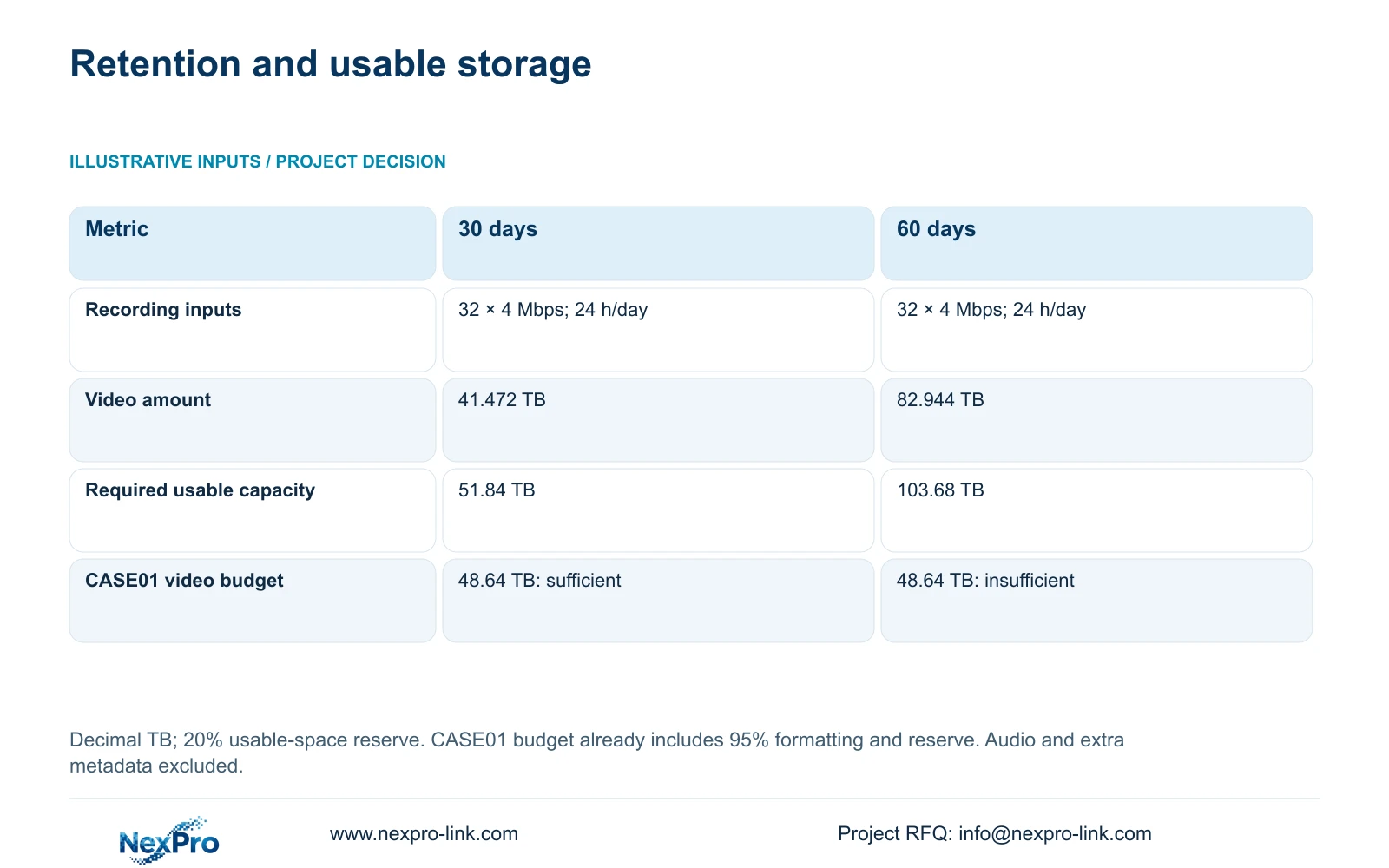
For the supplied illustrative calculation, use 32 cameras averaging 4 Mbps each, continuous recording for 24 hours/day and either 30 or 60 days. Video_TB = cameras × Mbps × 10^6 × 86400 × days / 8 / 10^12. The results are 41.472 TB and 82.944 TB in decimal units. Required usable capacity = video_TB / 0.8 when 20% of usable space is reserved.
The resulting targets are 51.84 TB and 103.68 TB usable. Doubling retention doubles this video demand at the same quality assumptions. It does not demonstrate a compression advantage for any brand. Audio and additional metadata are excluded, and the average bitrate should be replaced with representative project measurements for a binding design.
CASE01 installs four 16 TB drives: 64 TB raw, 60.8 TB at its illustrative 95% formatting factor and 48.64 TB video budget after its 20% reserve. Compare 41.472 TB directly with 48.64 TB. That arrangement meets the example's 30-day video amount and fails the 60-day amount; reserve must not be added again.
| Metric | 30-day option | 60-day option |
|---|---|---|
| Cameras | 32 | 32 |
| Average bitrate | 4 Mbps each | 4 Mbps each |
| Video amount | 41.472 TB | 82.944 TB |
| Required usable capacity | 51.84 TB | 103.68 TB |
| CASE01 video budget | 48.64 TB: sufficient | 48.64 TB: insufficient |
Section 05
Carry retention changes into recorder and service costs
Recommend the shortest retention period the owner can justify from its investigation and dispatch-review needs, then price a longer option explicitly. The 30- and 60-day figures here are buyer choices, not an industry-wide legal requirement. Verify any applicable local requirements through the project's responsible advisers before freezing the period.
The NexPro-NVR4449-4K reference lists four SATA bays up to 18 TB each and 320 Mbps input. The 60-day usable target of 103.68 TB exceeds even 72 TB raw from four maximum-capacity bays. More disks within that recorder cannot solve this example; select another supported storage architecture and recalculate its actual usable capacity.
Do not infer RAID or simultaneous decoding capability from bay count or the 49-channel label. Longer retention can change recorder hardware, drive quantities, cabinet space and power. Require competing bids to preserve the same accepted pallet views and retention assumptions, with specialist kiln scope and local services shown separately.
Section 06
Release a BOQ with traceable capacity and location decisions
Issue separate schedules for ordinary pallet-security points, kiln-boundary exceptions and shared infrastructure. Each item should show supplied, retained or optional status and the responsible party. Keep the approved camera output mode alongside the storage assumption so a resolution substitution cannot pass unnoticed.
NexPro-Link's BOQ and tender support can help match models, identify deviations and coordinate quotations against that schedule. Project packing may group the equipment by packing area, warehouse and dispatch cabinet. The local team retains responsibility for mounting qualification, electrical installation and final image acceptance.
For handover, ask the installer to retrieve a representative pallet sequence and report the configured recording mode and installed disk capacity. Retain the calculation sheet with its assumptions. If actual traffic or image settings increase bitrate, revise the recording budget and disclose the effect on retention rather than reporting the original planning duration as proven.
Section 07
Buyer questions
Can selected pallet events be kept longer than general footage? Consider a controlled export or archive workflow with an identified owner and storage location. Confirm the chosen system supports the required operation; do not assume event recording automatically provides a separate long-term archive.
Can we quote sixty days while buying the thirty-day disks first? Yes, as a clearly phased scope. Show the initial supported retention, the later hardware change and its installation boundary. Do not describe the first phase as already meeting sixty days.
Does adding a display wall change retention? The display branch alone does not change stored video demand. A simultaneous change to camera bitrate, recording mode or quantity does, and should be costed separately.
Section 08
Compare the pallet-security retention options
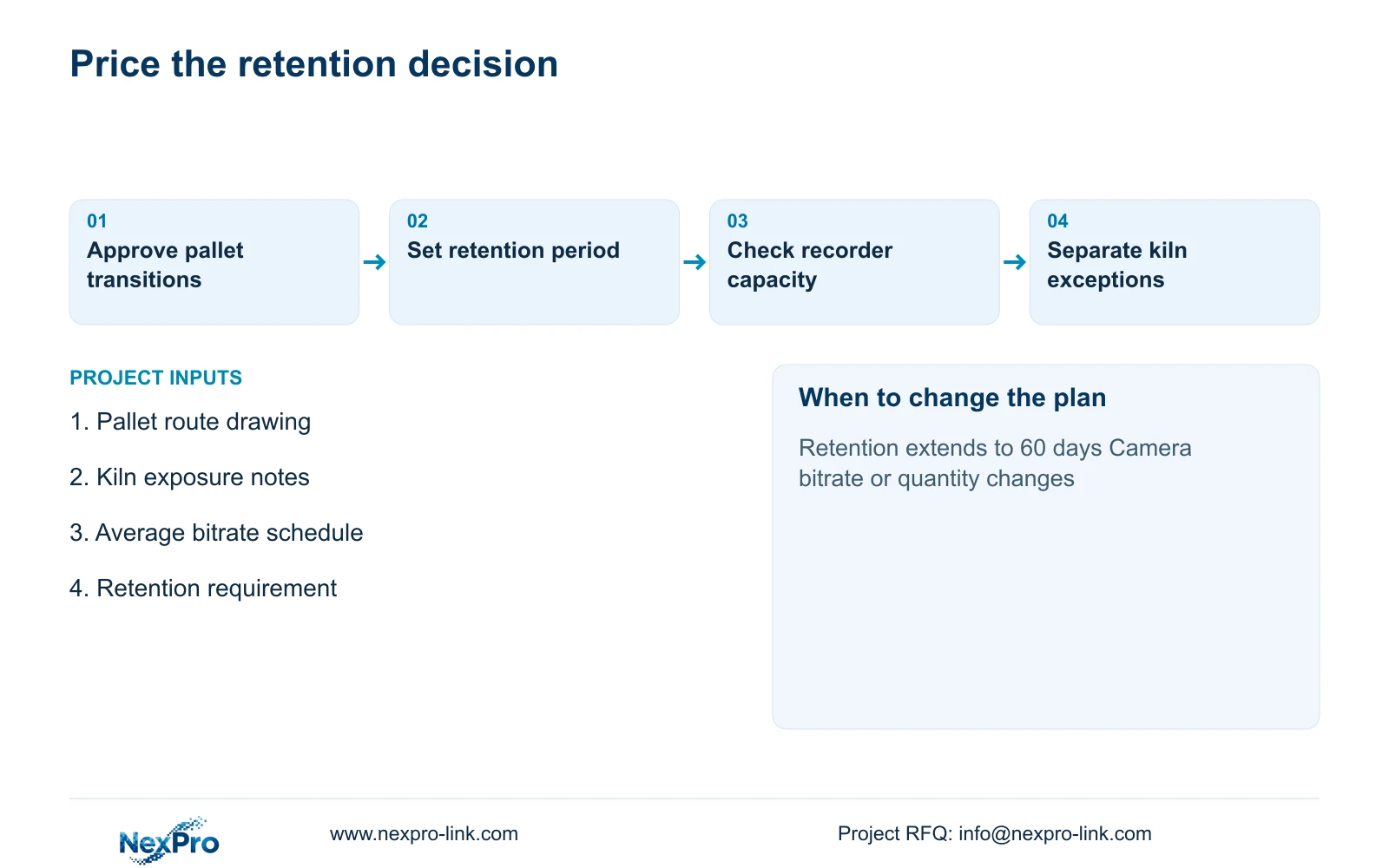
Send your packing-to-dispatch route, kiln-boundary exposure notes, camera and bitrate schedule, and required retention period to info@nexpro-link.com for a capacity-based BOQ discussion.
Engineering references
These sources support the general planning principles. Always use the selected product's current datasheet and applicable project standards for final design.