Plan CCTV monitoring wall design with practical guidance on define the operator's view and design the signal chain. NexPro-Link project guide.
Section 01
Define the Operator's View
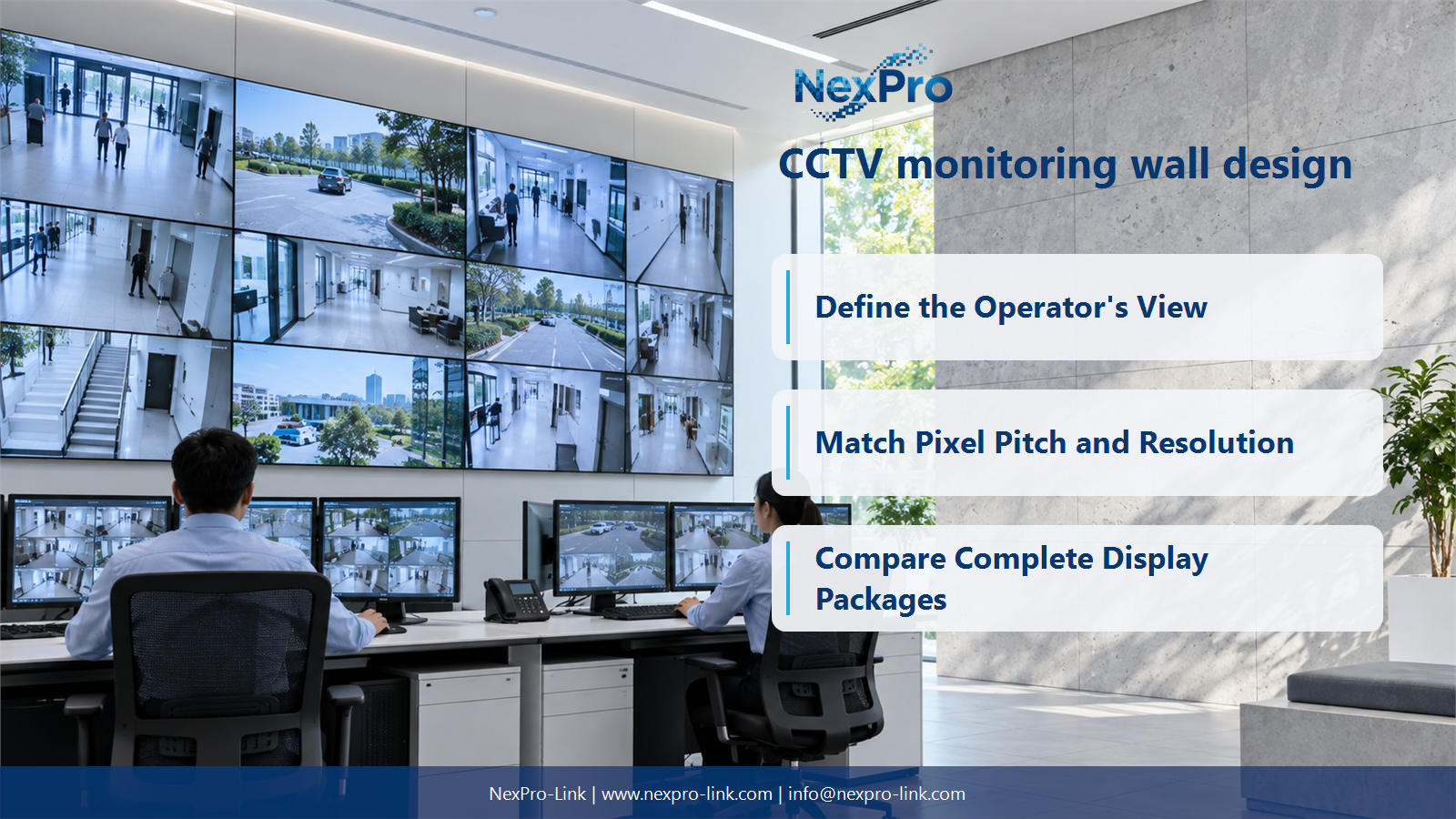
Specify the normal and event layouts, viewing positions, source detail and operator actions. A larger wall does not automatically make each camera image more useful. Calculate how much of the display each window receives and whether the required detail remains visible.
Turn the answer into a working record using Task, Layout, Windows, Viewing position, Required detail.
| Decision area | Buyer question | Required output |
|---|---|---|
| Define the Operator's View | What should be specified before choosing a monitoring wall? | Specify the normal and event layouts, viewing positions, source detail and operator actions. |
| Compare LCD and Direct-View LED | What is the main difference between LCD and direct-view LED walls? | LCD walls assemble panels with visible panel boundaries, while direct-view LED builds an image from emissive modules without the same panel-bezel arrangement. |
| Match Pixel Pitch and Resolution | Does smaller LED pitch always improve a CCTV wall? | It increases pixel density for a given physical size, but the benefit depends on source resolution, window layout and viewing distance. |
Section 02
Compare LCD and Direct-View LED
LCD walls assemble panels with visible panel boundaries, while direct-view LED builds an image from emissive modules without the same panel-bezel arrangement. Their pixel structure, brightness, service access and installation requirements differ. Compare the complete room application rather than assuming one technology is universally superior.
Use Technology, Image structure, Boundaries, Service, Room use to compare options on the same basis. Keep product capability, project assumption and operating responsibility in separate columns.
Section 03
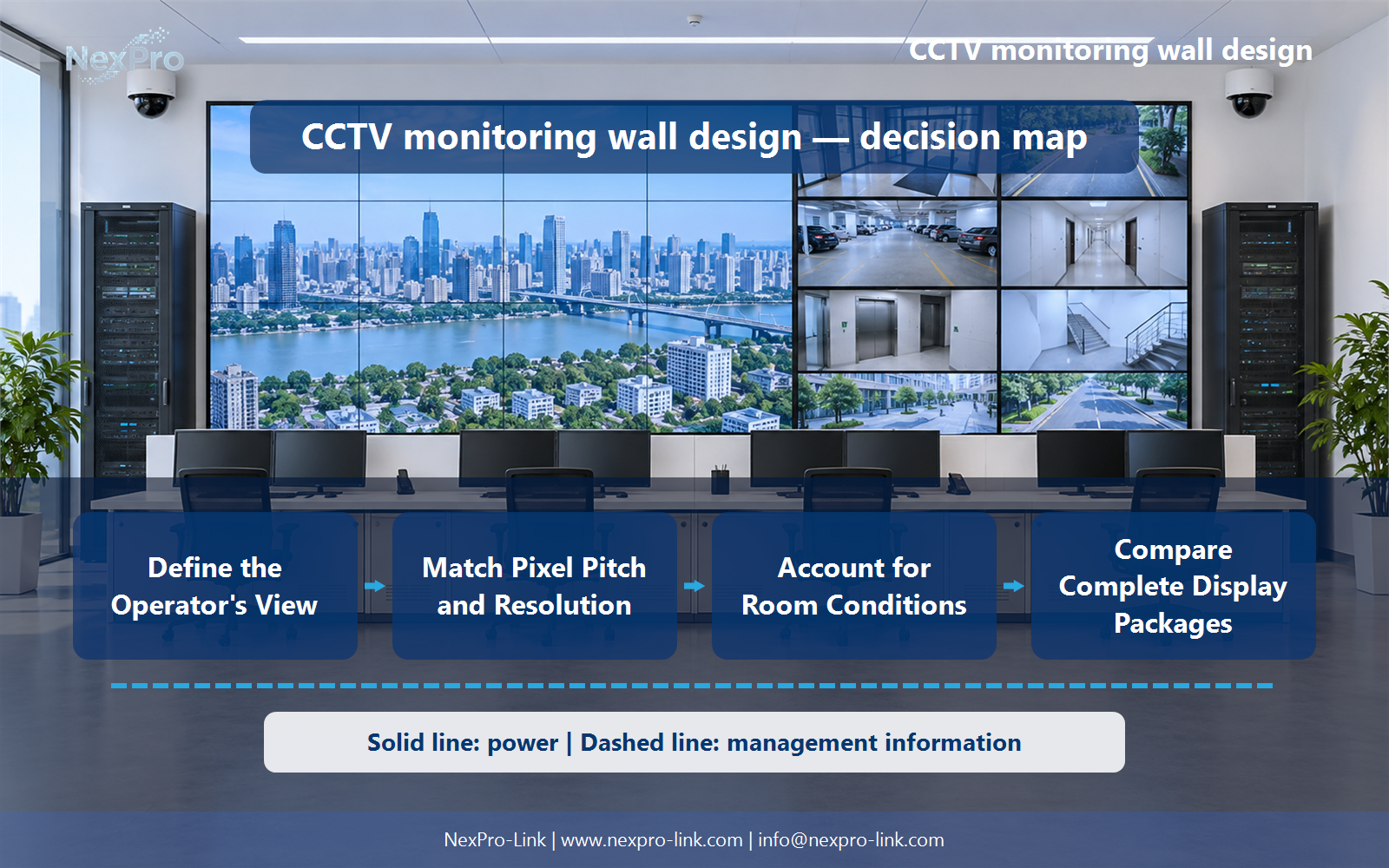
Match Pixel Pitch and Resolution
It increases pixel density for a given physical size, but the benefit depends on source resolution, window layout and viewing distance. Additional pixels cannot restore detail absent from a camera stream. Compare useful operator detail and cost rather than specifying the smallest pitch available by default.
The project output should make Pitch, Wall dimensions, Pixel dimensions, Window allocation traceable from input to acceptance.
- Confirm the answer to: Does smaller LED pitch always improve a CCTV wall?
- Record the project fields: Pitch / Wall dimensions / Pixel dimensions / Window allocation.
- Keep product capability, project assumptions and site responsibility in separate records.
Section 04
Design the Signal Chain
Some supported layouts can use recorder outputs, while others need a decoder, controller or workstation. Identify source types, simultaneous windows, output resolution and switching behavior. The display panels alone do not provide every decoding or layout function needed by the control room.
Record Source, Decoder, Layout control, Output, Display before selecting a product family. That makes later substitutions possible without silently changing the operational requirement.
Section 05
Account for Room Conditions
Ambient light, viewing geometry, acoustics, heat, maintenance access and operating hours all matter. Define useful operating brightness and service arrangements instead of selecting only a maximum brightness specification. Include the equipment behind the wall in power and cooling coordination.
Review Room condition, Display setting, Service access, Heat with the party that will operate or maintain the system.
Section 06
Compare Complete Display Packages
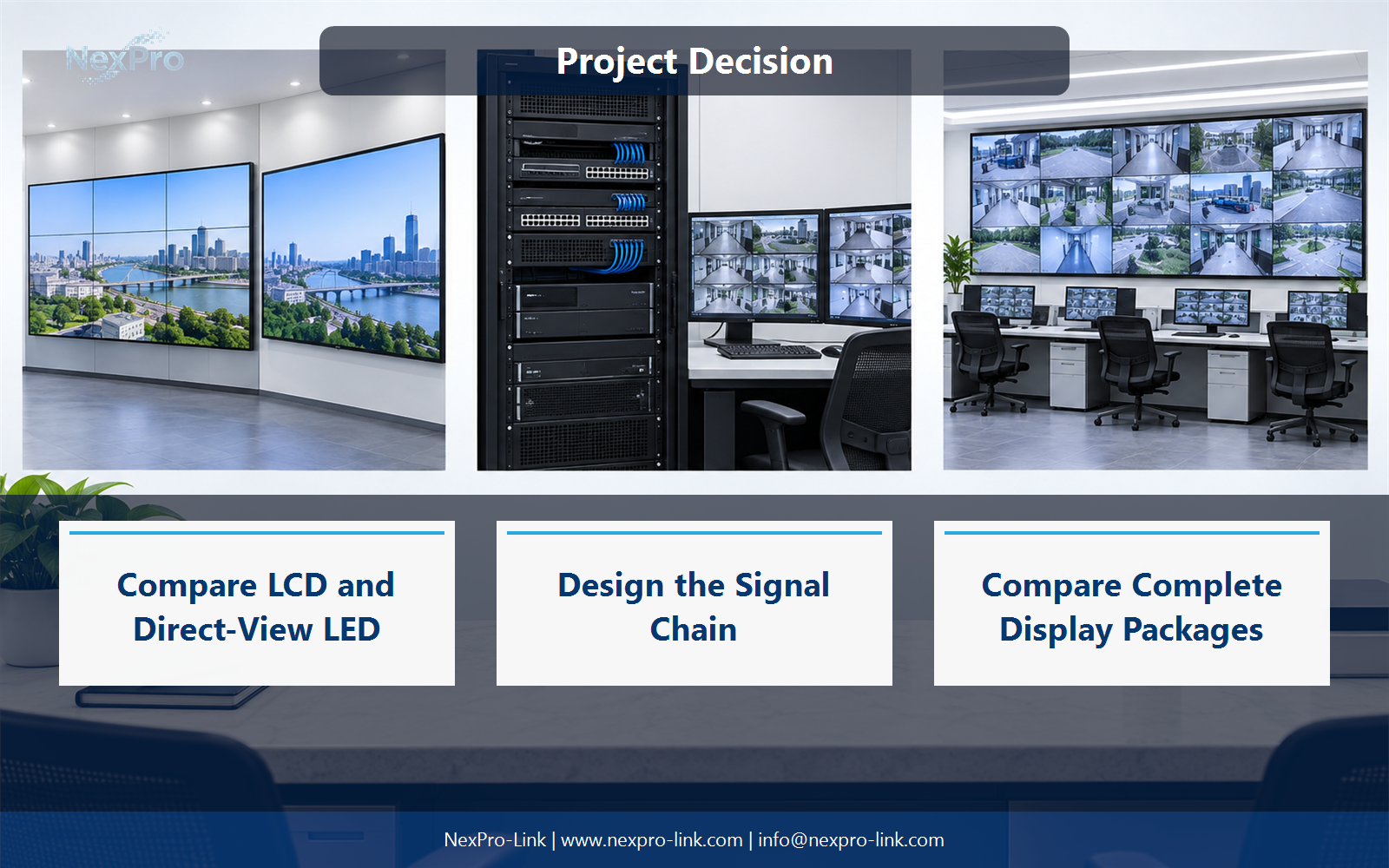
Include panels or modules, mounting, processing, decoding where needed, control, power, cabling and service access. Keep optional operator workstations separate. Use actual model identities: an LCD panel such as NX-VP-5535 should not be relabelled as a direct-view LED product.
Use Package, Display, Processing, Mounting, Power, Included scope as the handoff between design and procurement.
Engineering references
These sources support the general planning principles. Always use the selected product's current datasheet and applicable project standards for final design.