Useful CCTV handover labels connect a stable project point to the installed port, recorder channel and current serial number, with revisions preserved after replacement.
Section 01
Keep project points stable and product identities exact
CCTV labels at factory handover should align a stable project identity across cartons, installed connections, recorder channels and asset records. Keep exact model and serial data as separate fields. The project point identifies the role and location; the serial identifies the unit currently assigned to it.
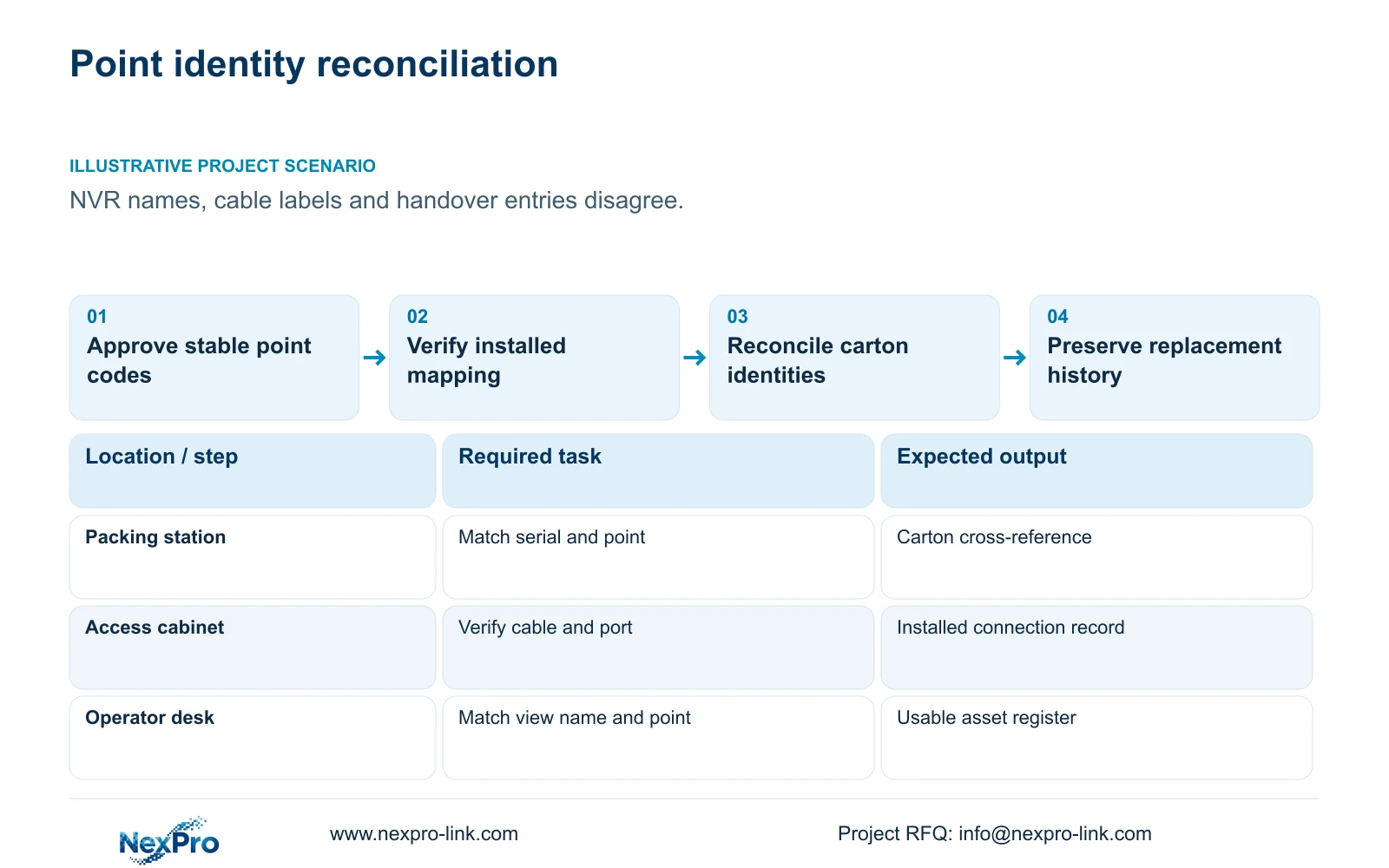
Illustrative project scenario: Equipment is installed, but names differ between the NVR, cable labels and handover sheet. In the hypothetical CASE01 CNC factory, the team uses 32 camera points across six task groups. Assume a dispatch view has a recognisable location name on the recorder but an unrelated number on its cable and carton record.
Choose one authoritative point register and approve its naming rules before correcting individual labels. Retain readable location descriptions alongside stable point codes. Do not overwrite original manufacturer identity with a project nickname or private-label mark. Maintenance staff need both the operational reference used by guards and the product identity needed for technical support.
Section 02
Verify the point-to-port connection on the installed system
For each camera point, record the cable identity, patch-panel position, switch and port, recorder and channel, and installed location. Use a consistent format while allowing the actual cabinet arrangement to determine the entries. A proposed mapping is a planning record until the installer verifies it against the installed connections.
CASE01's N1-CAM01 to N1-CAM32 identities can provide the stable point structure. The installer should match each point to its actual scene and trace its connections using approved methods. Record discrepancies as specific items: a wrong label, an incorrect register entry or a connection differing from the drawing. Do not silently adjust one field without reviewing the connected records.
The SP5648 reference is a Cat6 48-port patch panel and DT968MX a Cat6 tool-less module. Their role can be recorded where the selected termination arrangement uses them, but neither defines the camera-to-port mapping automatically. Keep cable test identifiers linked to the same connection record so the handover connects physical evidence with the operational point.
Section 03
Preserve the point when a device is replaced
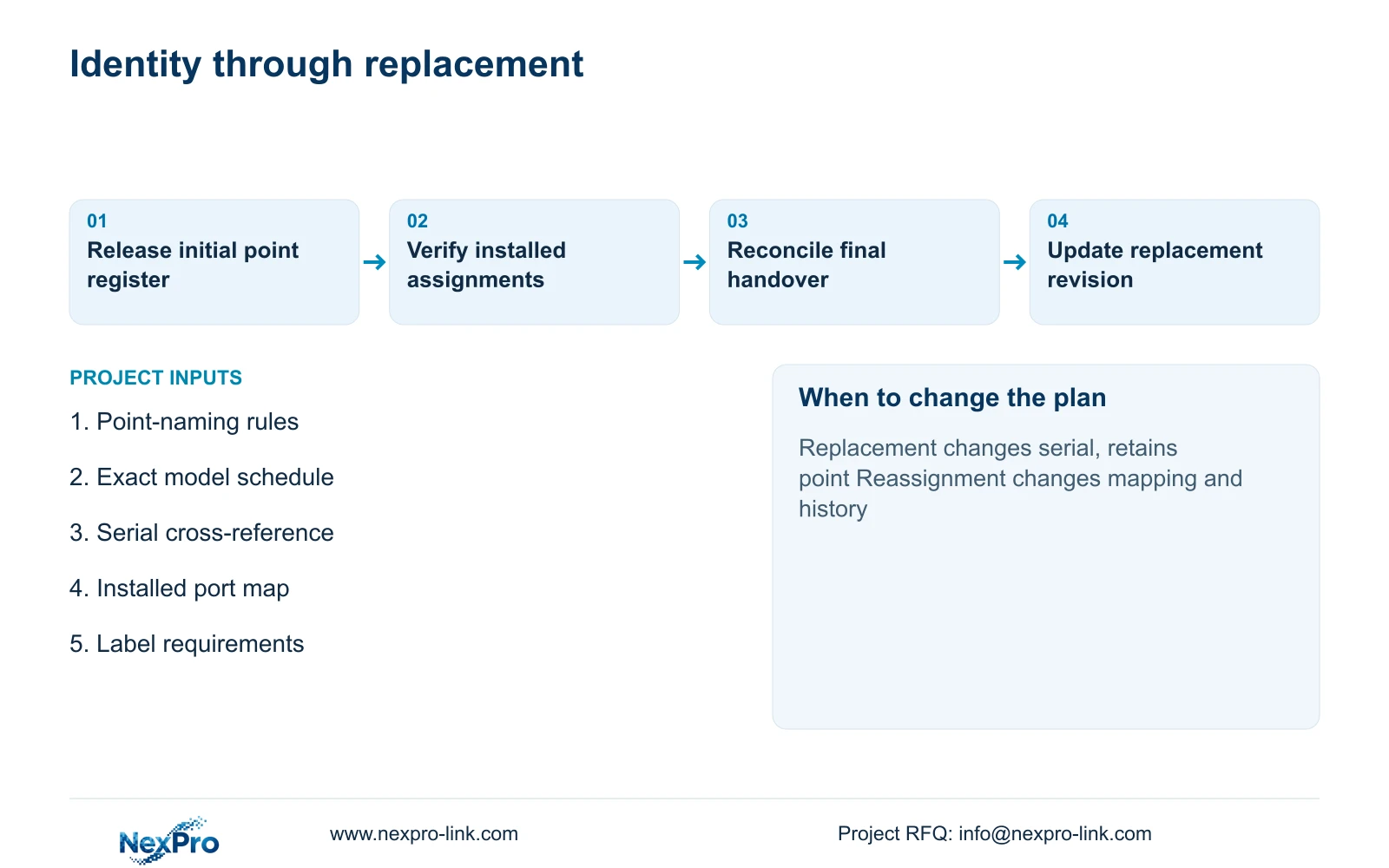
A replacement normally changes the installed product identity while the project point remains stable. Record the outgoing serial, incoming exact model and serial, reason for the change and effective revision. Update the current assignment without deleting the historical entry needed to interpret earlier service and test records.
If a camera moves to another role, record the reassignment explicitly. A serial number should not appear as the current installed unit at two points because an old row was copied. A spare should be marked as a spare until allocated, even if it carries the same buyer branding and approved model family.
Retest the functions affected by the replacement, including the view and required recording task. Update the recorder label, point register and support record together. Factory preparation can establish the replacement's supplied identity, while the local installer verifies its physical assignment. A matching carton label cannot establish that the intended unit was fitted at the intended location.
Section 04
Choose a complete register before adding asset integration
The minimum handover package needs an accurate current register that operators and maintenance staff can use. Additional asset-system integration is justified when the owner has a defined workflow, such as controlled import into an existing maintenance platform. Develop that as an added scope while retaining the complete recording and physical-mapping records.
The decisive difference between the options below is the interface obligation. Option B adds field mapping, import ownership, access requirements and revision handling. It does not make incomplete physical verification acceptable. A spreadsheet may be sufficient for the core task if its ownership and update process are clear.
Assign each deliverable to supplied, retained, installer-provided or optional. For example, supplier carton cross-references can be supplied, final installed ports installer-provided and an existing maintenance platform retained. Name one owner for reconciling these records. An empty platform field is an unresolved requirement, not evidence of native integration or a free service.
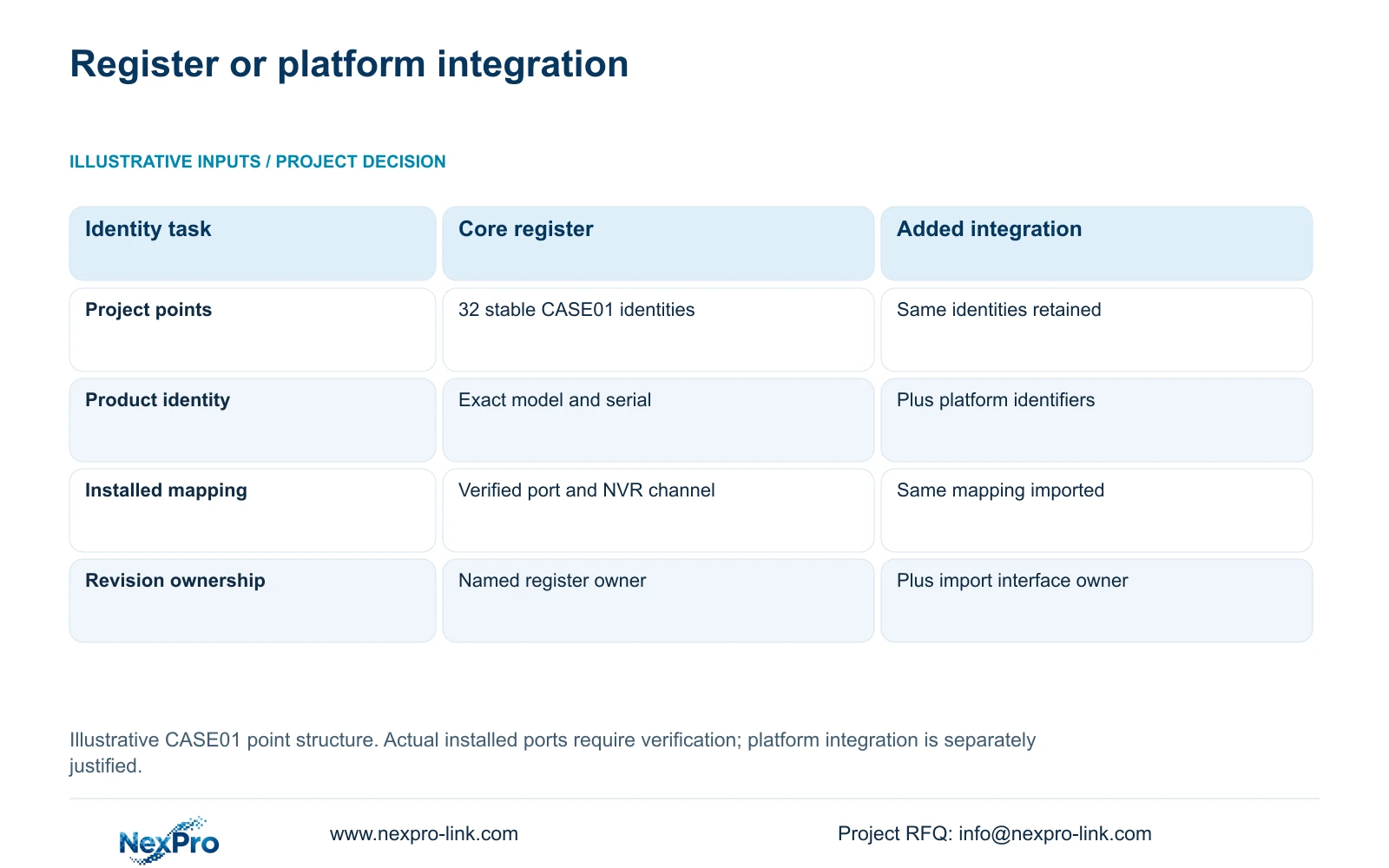
| Decision | Option A: core register | Option B: asset integration |
|---|---|---|
| Recording reference | Stable points match NVR channels | Same point references retained |
| Hardware identity | Exact model, serial and assignment | Same data plus platform identifiers |
| Network and power | Installed ports and protected-node references | Added interface dependencies recorded |
| Access | Approved register and retrieval users | Platform roles and import access added |
| Procurement output | Verified register and revision owner | Added import scope and interface owner |
Section 05
Use labels for retrieval and maintenance decisions
Recommend stable point codes with readable descriptions, exact product identities and an agreed revision owner. Keep the label legible where it must be read and confirm the proposed material and placement against the actual surface and service conditions. Do not infer durability or chemical resistance from the presence of a laser mark.
NexPro-Link's OEM/ODM scope includes labels, barcodes, manuals and packaging options. User-stated laser-logo capability can be discussed for a specified surface and artwork, but branding should remain separate from the technical asset fields. A buyer logo alone cannot direct an installer to the right cable or an operator to the correct recording.
Use QR or barcode content only where the owner has an approved destination and maintenance process. A code may identify a project point or controlled asset record; it should not reveal passwords or depend on an inaccessible account. If the owner has no maintained asset platform, choose a readable label and controlled register rather than an unowned online dependency.
Section 06
Reconcile packing, installed records and operator names
Perform a final reconciliation using the supplier's packing cross-reference, the installer's verified mapping and the recorder's current point names. Identify delivered spares, installed substitutions and points awaiting completion. The reviewer should be able to trace a location description to the current device and its connection without relying on memory.
Include a short operator exercise in handover: locate a named dispatch point, retrieve a known event and report the correct point identity for support. This checks whether the labels serve the operational task. A register that matches cartons but uses unfamiliar location names may still be difficult for guards to use.
The procurement scope should state who prints initial labels, who applies site labels and who issues the final revision. NexPro-Link can discuss project packing and equipment-document coordination, while installed mapping remains with the appointed site team. For later replacements, keep the same reconciliation process so the handover record remains useful after the original project crew leaves.
Section 07
Buyer questions
Should the IP address be the permanent camera identity? Use a stable project point as the primary operational reference. Keep the current network address as a controlled configuration field, because it may change without changing the camera's role.
Can labels be printed before final ports are known? Print approved point identities first and leave port assignments provisional. The installer should verify the final map before issuing installed labels and the as-built register.
How should identical branded spares be recorded? List their exact model and serial numbers with spare status. Record the point assignment only when a unit is installed, then update the replacement history and affected test records.
Section 08
Build a consistent handover identity map
Send your approved point-naming rules, camera model schedule, cabinet and recorder mapping, and label or carton requirements to info@nexpro-link.com. NexPro-Link can discuss project identification and packing records that support the final installed register.
Engineering references
These sources support the general planning principles. Always use the selected product's current datasheet and applicable project standards for final design.