Plan CCTV cable testing with practical guidance on define the test object and limit and understand crosstalk and termination effects. NexPro-Link project guide.
Section 01
Define the Test Object and Limit
Define whether the test covers a permanent link or channel, the required application or category limit, and the installed identifiers. Use suitable equipment and adapters for that scope. Testing against the wrong limit can create a misleading pass even when a report looks professional.
Turn the answer into a working record using Link ID, Test scope, Limit, Adapter, Instrument.
| Decision area | Buyer question | Required output |
|---|---|---|
| Define the Test Object and Limit | What should be agreed before cable testing? | Define whether the test covers a permanent link or channel, the required application or category limit, and the installed identifiers. |
| Separate Continuity from Performance | Does a wire-map test certify a CAT6 link? | No. |
| Interpret Length and Loss Measurements | Why are length and insertion loss relevant? | They help assess whether the installed path behaves within the chosen test limits. |
Section 02
Separate Continuity from Performance
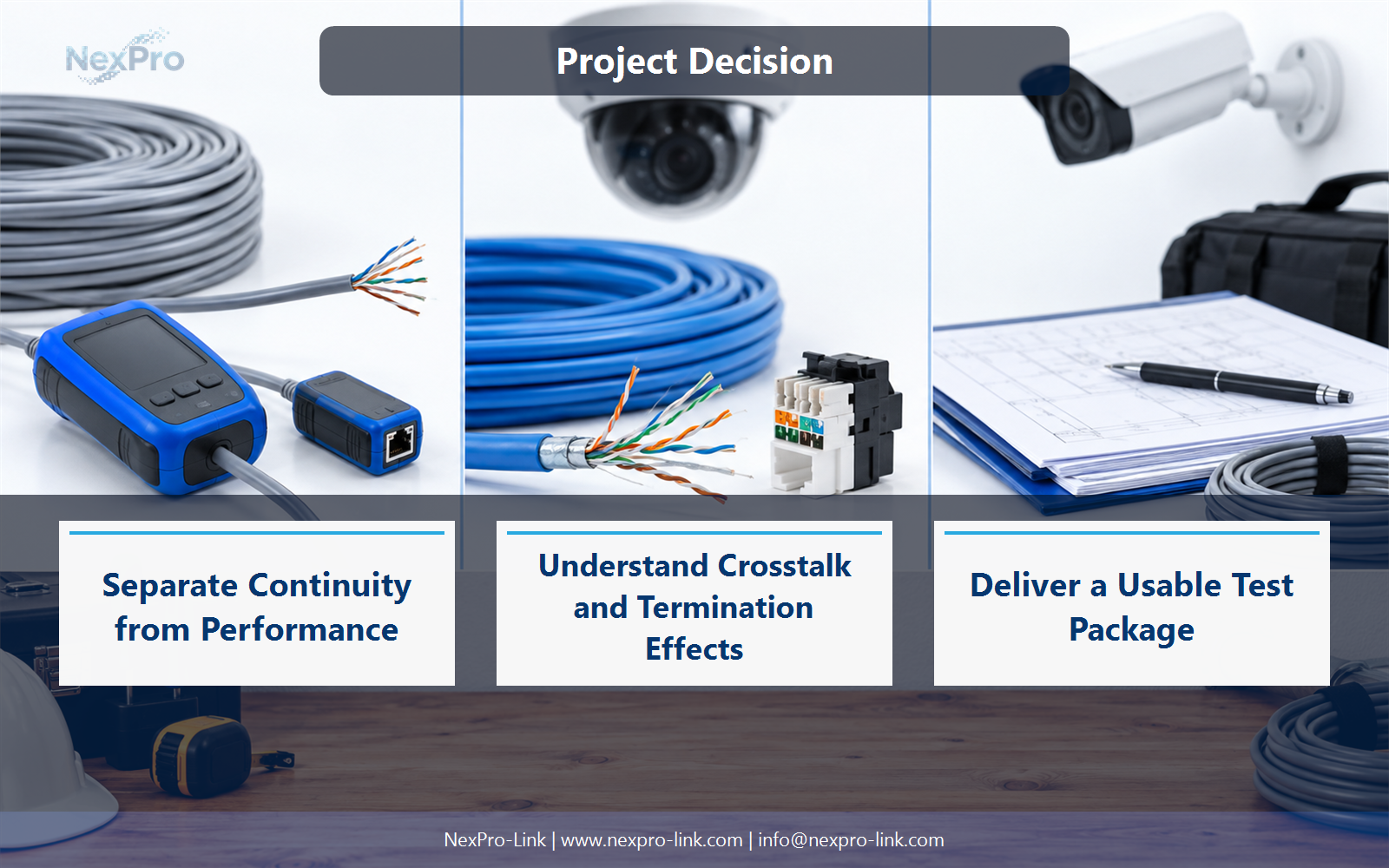
No. Wire mapping identifies connection arrangement and some faults, but category performance involves additional measurements under the selected test standard. A camera successfully displaying an image also does not establish that the installed link meets the specified performance requirement.
Use Check, What it shows, What it does not show to compare options on the same basis. Keep product capability, project assumption and operating responsibility in separate columns.
Section 03
Interpret Length and Loss Measurements
They help assess whether the installed path behaves within the chosen test limits. Excessive length, unsuitable components or installation damage can affect results. Interpret the complete report and conditions rather than declaring a link acceptable from only one favourable measurement.
The project output should make Measurement, Selected limit, Result, Link context traceable from input to acceptance.
- Confirm the answer to: Why are length and insertion loss relevant?
- Record the project fields: Measurement / Selected limit / Result / Link context.
- Keep product capability, project assumptions and site responsibility in separate records.
Section 04
Understand Crosstalk and Termination Effects
Termination quality, pair handling, components and installation conditions can contribute. Use the report and inspection to locate the problem rather than guessing from cable category alone. Correct the installation using appropriate methods, then retest the same defined link and limit.
Record Failed parameter, Location clue, Suspected cause, Repair before selecting a product family. That makes later substitutions possible without silently changing the operational requirement.
Section 05
Manage Retest Records
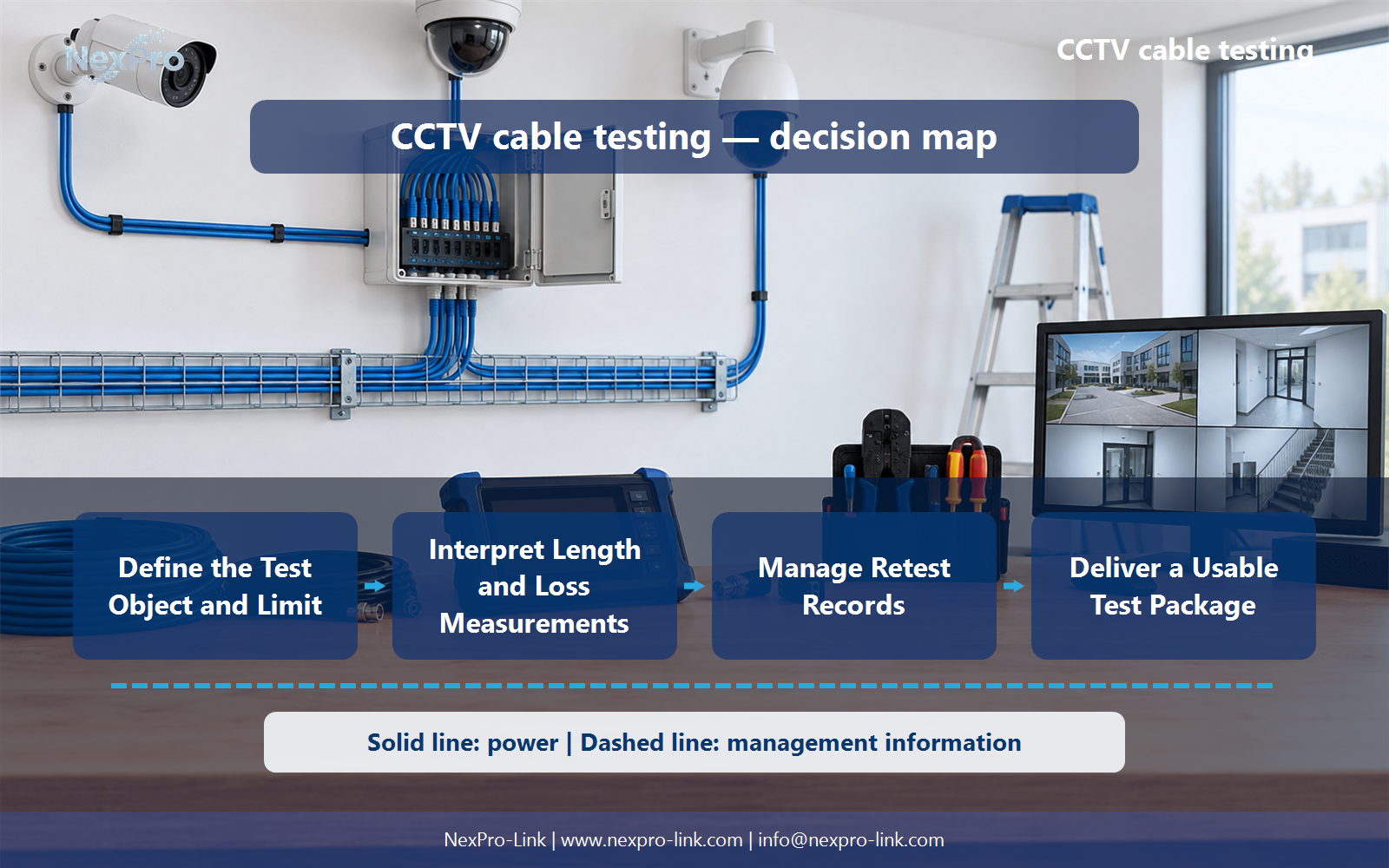
Keep a clear record of the final accepted result and the corrective action according to project requirements. The important point is traceability between the physical link, the repair and the final test. Do not combine results from different links or test scopes as one acceptance record.
Review Link, Fault, Repair, Retest date, Final report with the party that will operate or maintain the system.
Section 06
Deliver a Usable Test Package
Provide identifiable reports, the link schedule and sufficient test context to understand the results, including the selected limits and equipment details where required. Organize them by the actual cable identifiers. A folder of unnamed screenshots is far less useful than searchable, correctly mapped records.
Use Cable ID, Camera, Patch port, Report file, Result as the handoff between design and procurement.
Engineering references
These sources support the general planning principles. Always use the selected product's current datasheet and applicable project standards for final design.