Plan CAT6 cabling for CCTV with practical guidance on select category from the application and match indoor and outdoor conditions. NexPro-Link project guide.
Section 01
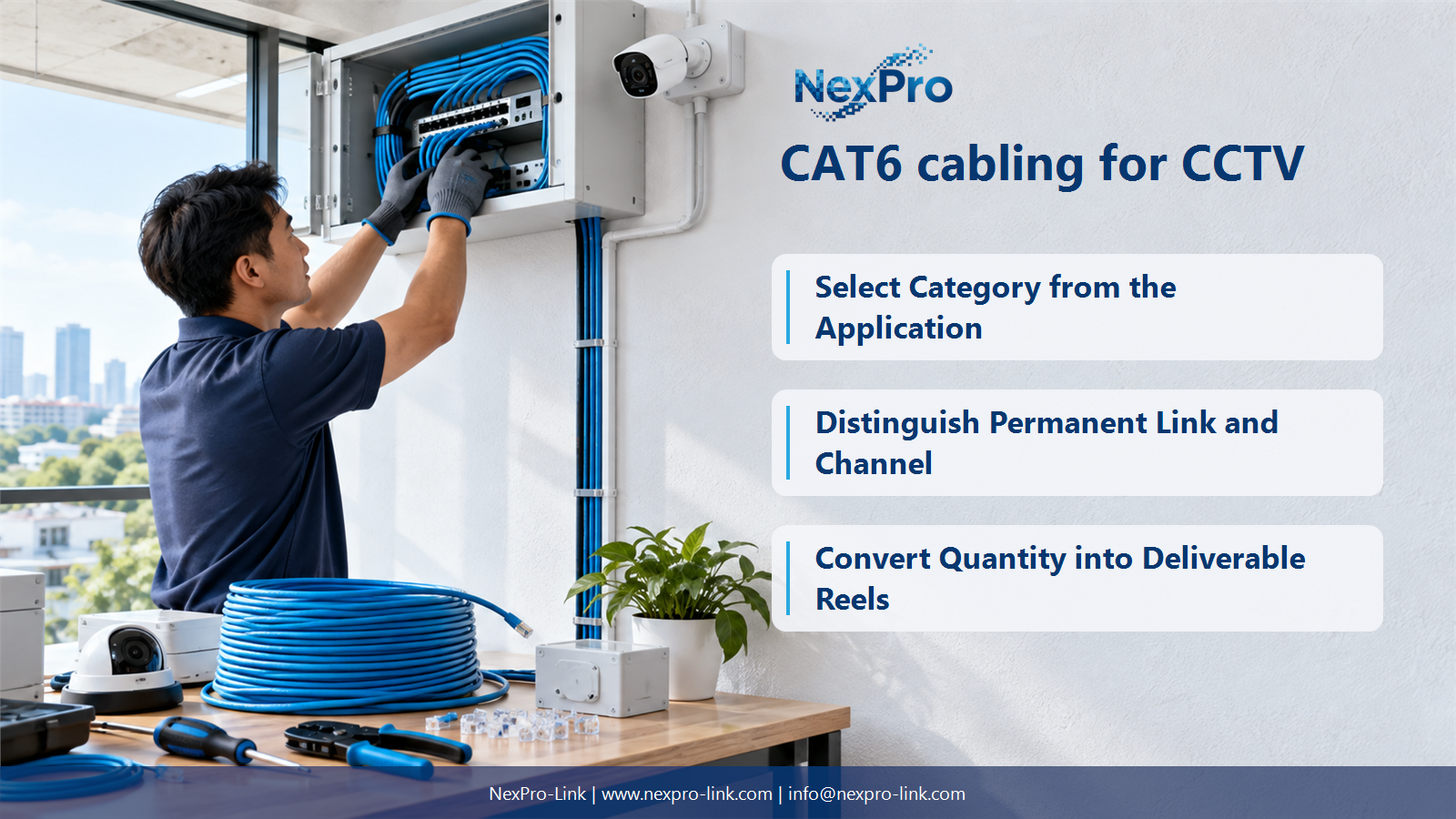
Select Category from the Application
No. Camera resolution does not itself require a cable category. Select the cabling from the supported Ethernet application, channel length, PoE conditions and future needs. CAT6 and CAT6A have different category specifications, but the required link should be defined before upgrading all cable by default.
Turn the answer into a working record using Application, Link speed, Channel, Category, Expansion.
| Decision area | Buyer question | Required output |
|---|---|---|
| Select Category from the Application | Does every 4K camera require CAT6A? | No. |
| Specify the Cable Beyond Its Category | Is 23 AWG mandatory for every CAT6 cable? | No. |
| Distinguish Permanent Link and Channel | Should patch leads be included in the distance calculation? | Yes. |
Section 02
Specify the Cable Beyond Its Category
No. A category designation does not make one conductor gauge universal. Specify suitable conductor construction, resistance, jacket and operating conditions for the application. Avoid treating cable category, gauge and fire classification as interchangeable descriptions of the same property.
Use Category, Conductor, Gauge, Jacket, Temperature to compare options on the same basis. Keep product capability, project assumption and operating responsibility in separate columns.
Section 03
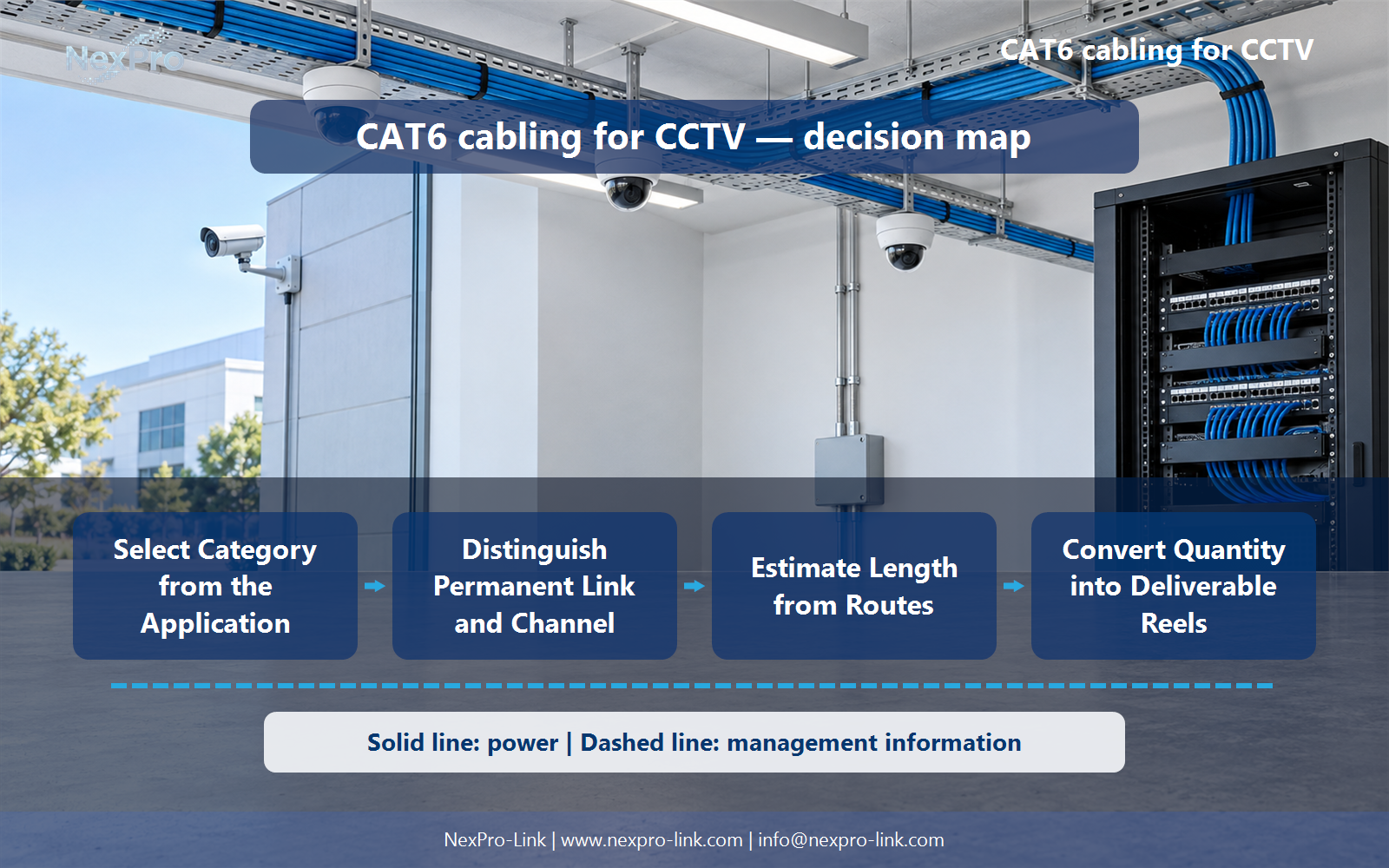
Distinguish Permanent Link and Channel
Yes. The installed channel includes the relevant connecting cords as well as fixed cabling. Conventional structured-cabling limits distinguish the permanent link from the complete channel. Use the applicable design and product conditions rather than allocating the full channel length to fixed cable and then adding cords freely.
The project output should make Fixed link, Equipment cord, Patch cord, Channel length traceable from input to acceptance.
- Confirm the answer to: Should patch leads be included in the distance calculation?
- Record the project fields: Fixed link / Equipment cord / Patch cord / Channel length.
- Keep product capability, project assumptions and site responsibility in separate records.
Section 04
Match Indoor and Outdoor Conditions
Conduit does not automatically remove moisture, temperature or exposure requirements. Select a cable and pathway arrangement suitable for the actual conditions and applicable installation requirements. Indoor, outdoor, direct-burial and fire-related classifications address different aspects of use.
Record Route environment, Moisture, Jacket, Pathway, Entry transition before selecting a product family. That makes later substitutions possible without silently changing the operational requirement.
Section 05
Estimate Length from Routes
Add routed horizontal and vertical lengths, explicit service allowances and the number of links. Use a clearly labelled waste or contingency assumption when necessary. A point count multiplied by an unexplained average can support only a rough budget, not a final cutting plan.
Review Link, Route m, Vertical m, Allowance m, Total with the party that will operate or maintain the system.
Section 06
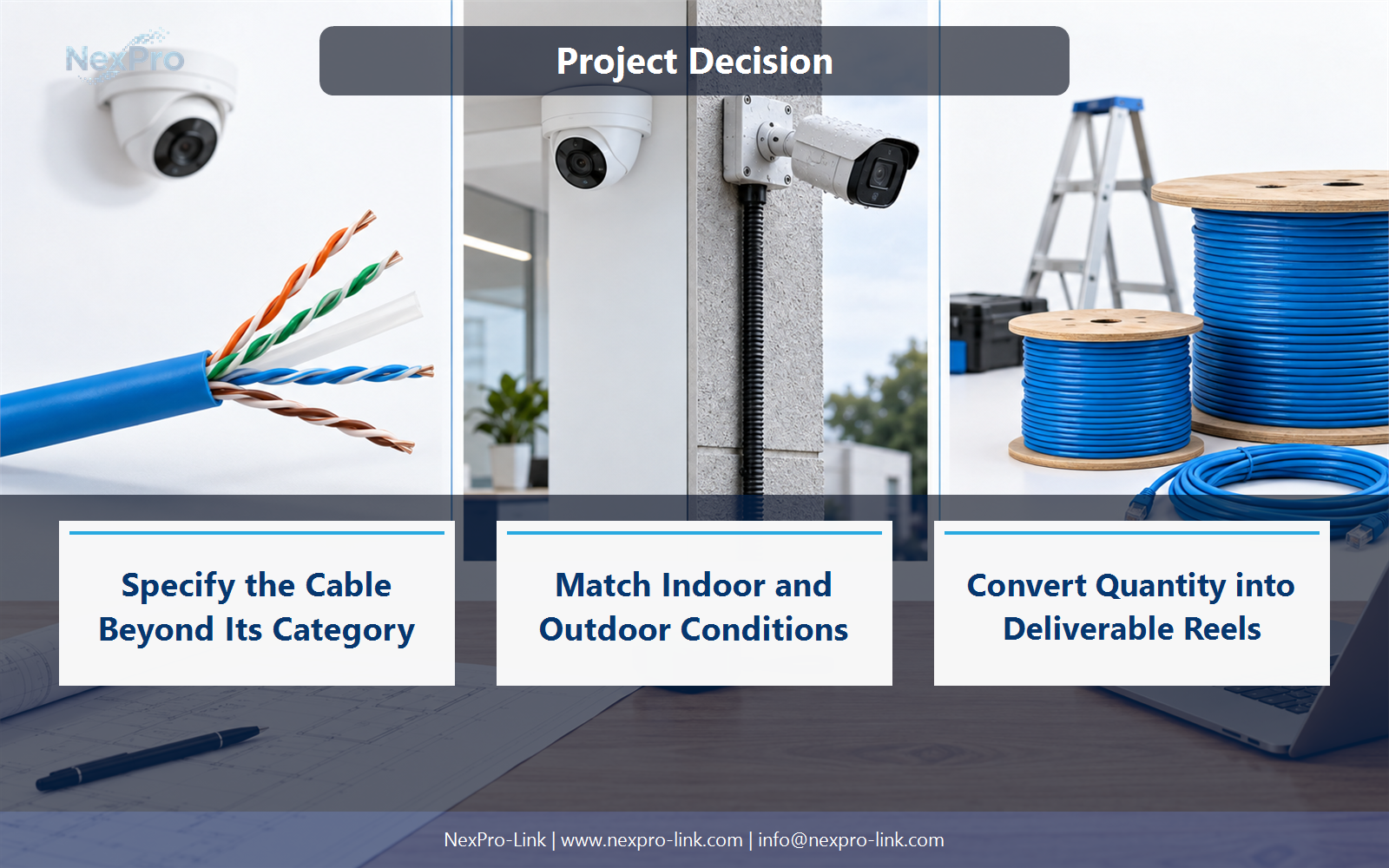
Convert Quantity into Deliverable Reels
It gives an initial quantity but not a complete cutting solution. Each permanent run should remain continuous within the chosen installation method, so reel remainders matter. Check long runs, spare material and delivery batches before turning an aggregate estimate into a purchase order.
Use Reel, Assigned runs, Used length, Remainder, Spare as the handoff between design and procurement.
Engineering references
These sources support the general planning principles. Always use the selected product's current datasheet and applicable project standards for final design.