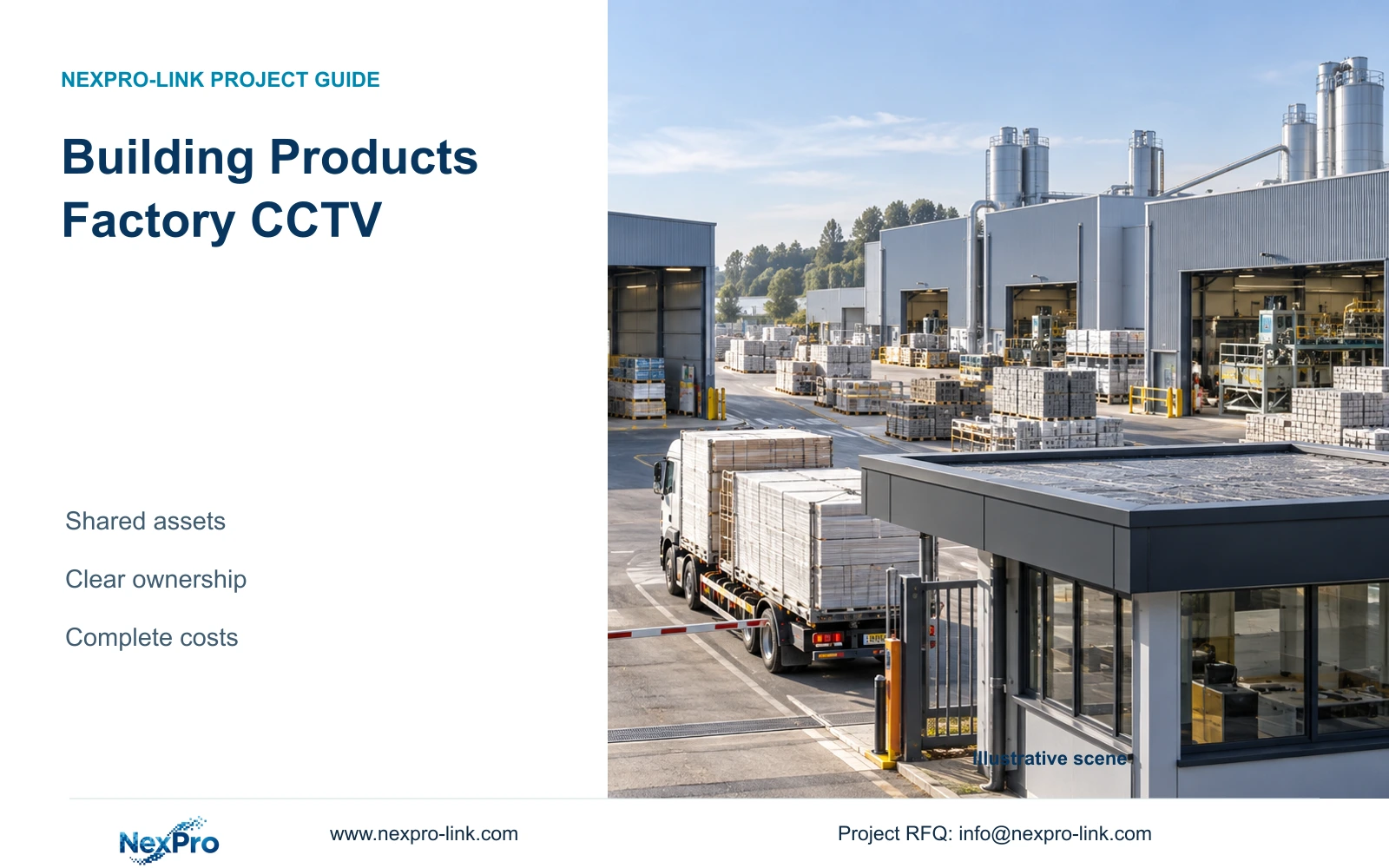
Building products factory CCTV can share warehouse and gate infrastructure without duplicating the BOQ. Trace each line's custody path and compare complete scope before discussing savings.
Section 01
Map separate custody paths onto the shared warehouse
Count common recording, links and power once in a building products factory CCTV BOQ, while keeping each production line's observation and service responsibilities explicit. Begin with product custody paths, not separate camera kits for every department. Shared procurement should reflect actual common assets and preserve the evidence each line needs.
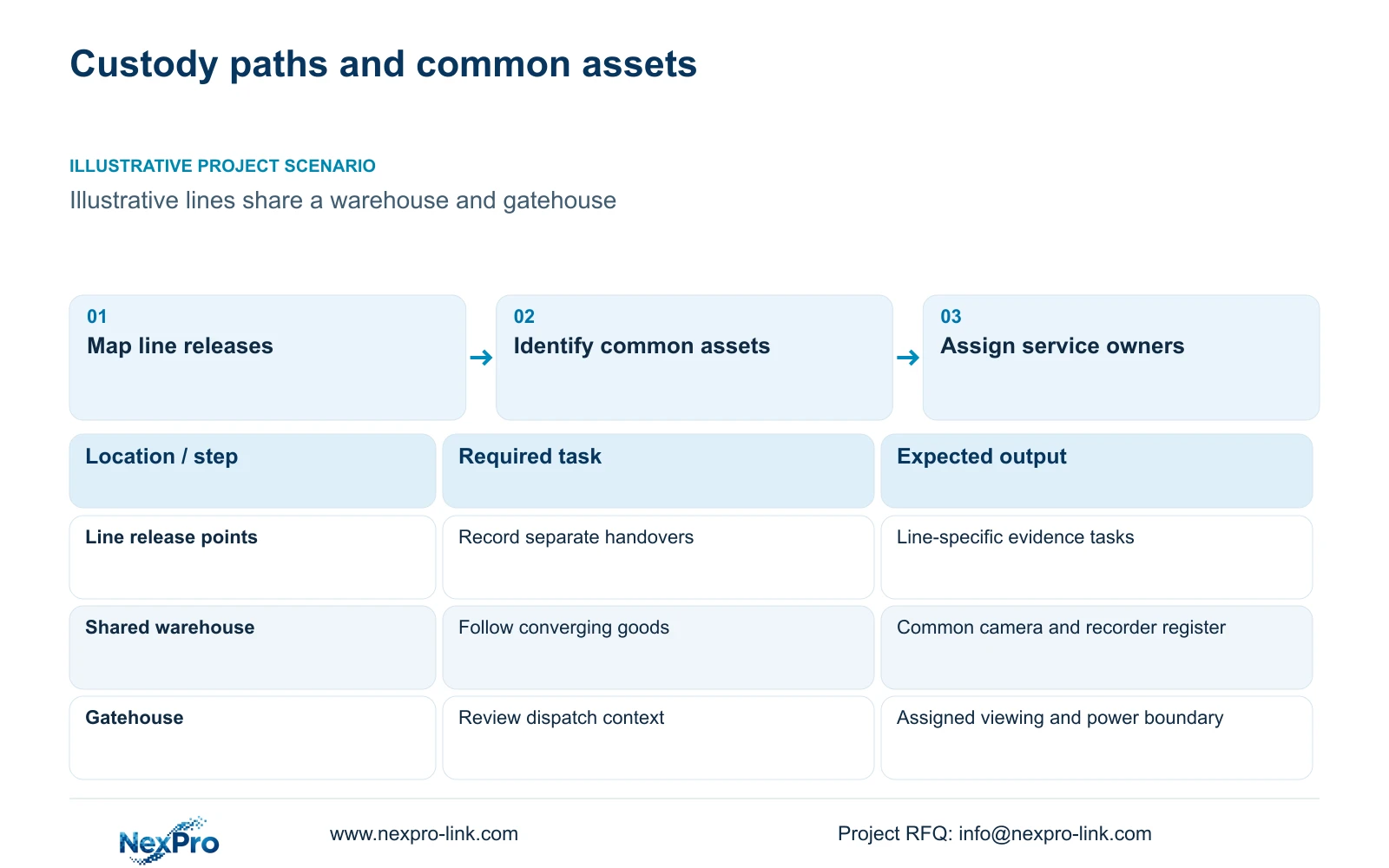
Illustrative project scenario: Several production lines share one dispatch warehouse and gatehouse. Assume each line releases finished goods into a common receiving route before loading. The planning team wants to associate release, warehouse movement and dispatch without purchasing duplicate infrastructure. These are hypothetical operating assumptions, not a measured savings case.
Give every transfer event a location and task identifier. Identify where line-specific goods converge and where their records remain separate. Stock height, vehicle routes, dust, radiant heat and cleaning conditions can change the required views or product suitability. A shared warehouse camera should be counted once only when its accepted view actually serves the required tasks.
Section 03
Assign shared service and viewing responsibilities
Identify who manages warehouse views, who reviews line-specific footage and who can export dispatch evidence. A shared recorder does not require every department to have the same access. Confirm the exact platform supports the proposed permission workflow before treating departmental separation as included.
Give each common asset a service owner and a maintenance access arrangement. The warehouse team may own the operating task while the appointed integrator maintains the recorder; both responsibilities should be written into the schedule. Mark retained equipment separately and confirm its usable capacity and interfaces before relying on it.
Shared data and protected power are different boundaries. Count each physical UPS once, but map the circuits it actually supplies. A gatehouse remote AC node may need separate protection even when it uses the common network. Similarly, do not duplicate camera watts within a complete switch AC load when preparing the shared protected-load list.
Section 04
Normalise complete quotation scope before calculating a difference
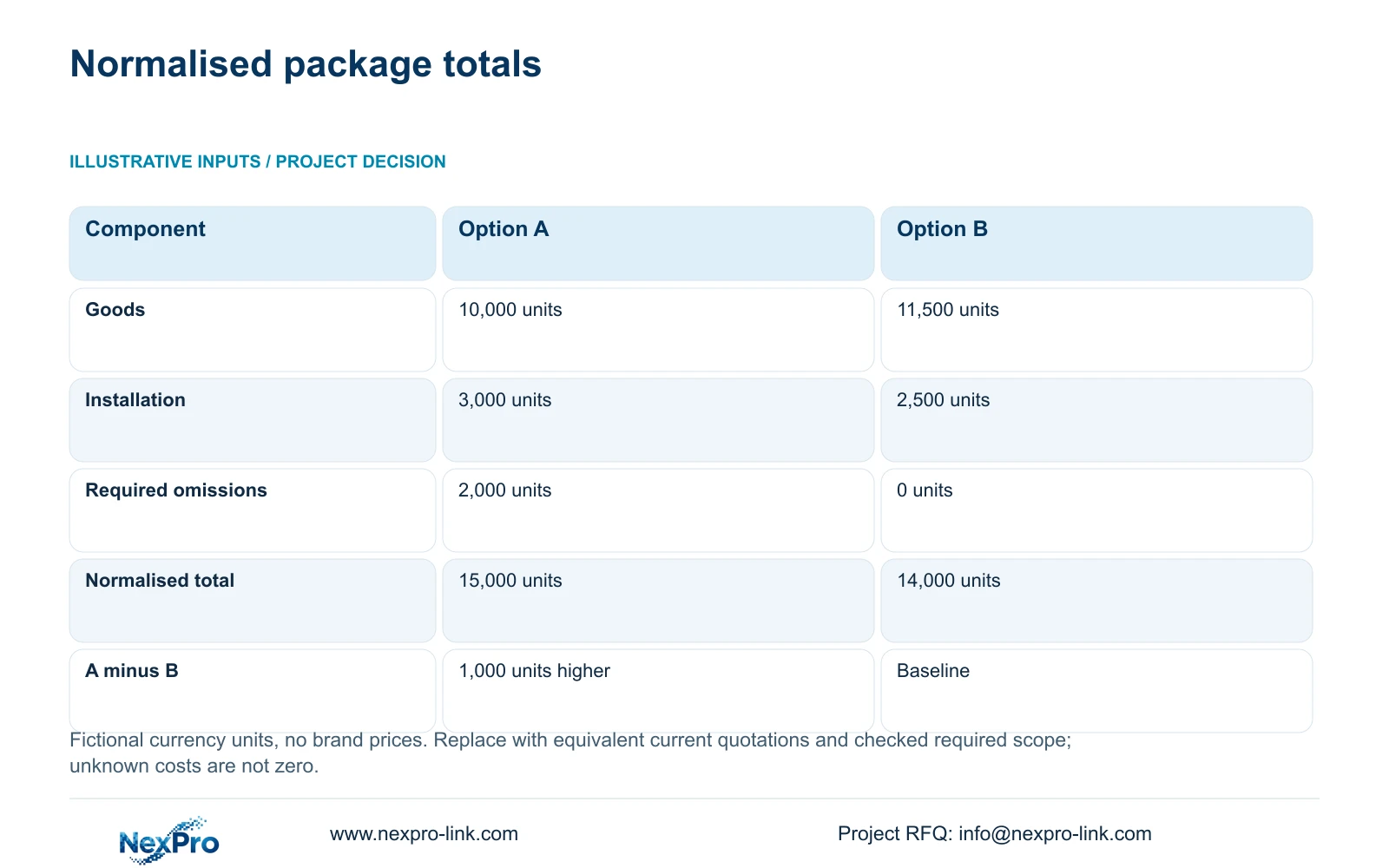
The supplied fictional currency-unit example compares two unbranded packages. Option A includes goods of 10,000 units, installation of 3,000 units and required omitted scope of 2,000 units. Option B includes goods of 11,500 units, installation of 2,500 units and no required omitted scope within this example.
Use normalized_total = goods + installation + required_omitted_items. Option A totals 15,000 units and Option B totals 14,000 units. Difference = A_total - B_total = 1,000 units. The lower goods quote becomes the higher complete total because its required omissions and installation outweigh the initial goods difference.
The decisive issue is equivalent scope, not supplier identity. These figures establish no NexPro-Link or competitor market price or saving. For a real comparison, replace every input with same-date, same-quantity, same-currency quotations using the same delivery and installation boundary. Unknown omissions should stay unresolved rather than being entered as zero.
| Cost component | Option A | Option B |
|---|---|---|
| Quoted goods | 10,000 units | 11,500 units |
| Installation | 3,000 units | 2,500 units |
| Required omitted scope | 2,000 units | 0 units |
| Normalised total | 15,000 units | 14,000 units |
| A minus B | 1,000 units higher | Comparison baseline |
Section 05
Choose sharing only where capacity and ownership remain workable
Recommend a common infrastructure package with line-specific camera tasks and an explicit shared-asset register. Keep separate nodes where physical distance, local power, operational independence or platform constraints justify them. Shared procurement should remove accidental duplication without removing required recording or environmental capability.
Normalise bids against the same custody events and outage objective. Include cabinet fit, cable routes, software functions, installation and handover work. If one proposal retains a mandated platform or specialist position, preserve that requirement in every equivalent alternative. Do not claim a saving by silently reducing it.
Use ordinary cameras only at qualified locations. The supplied 5MP-family references list 2880×1620 output, 25fps and a 2.8 to 12mm motorized lens, with ordinary environmental fields that need site matching. Common purchasing does not make a single model appropriate for every production line's heat, dust or cleaning exposure.
Section 06
Release one procurement list with traceable line allocations
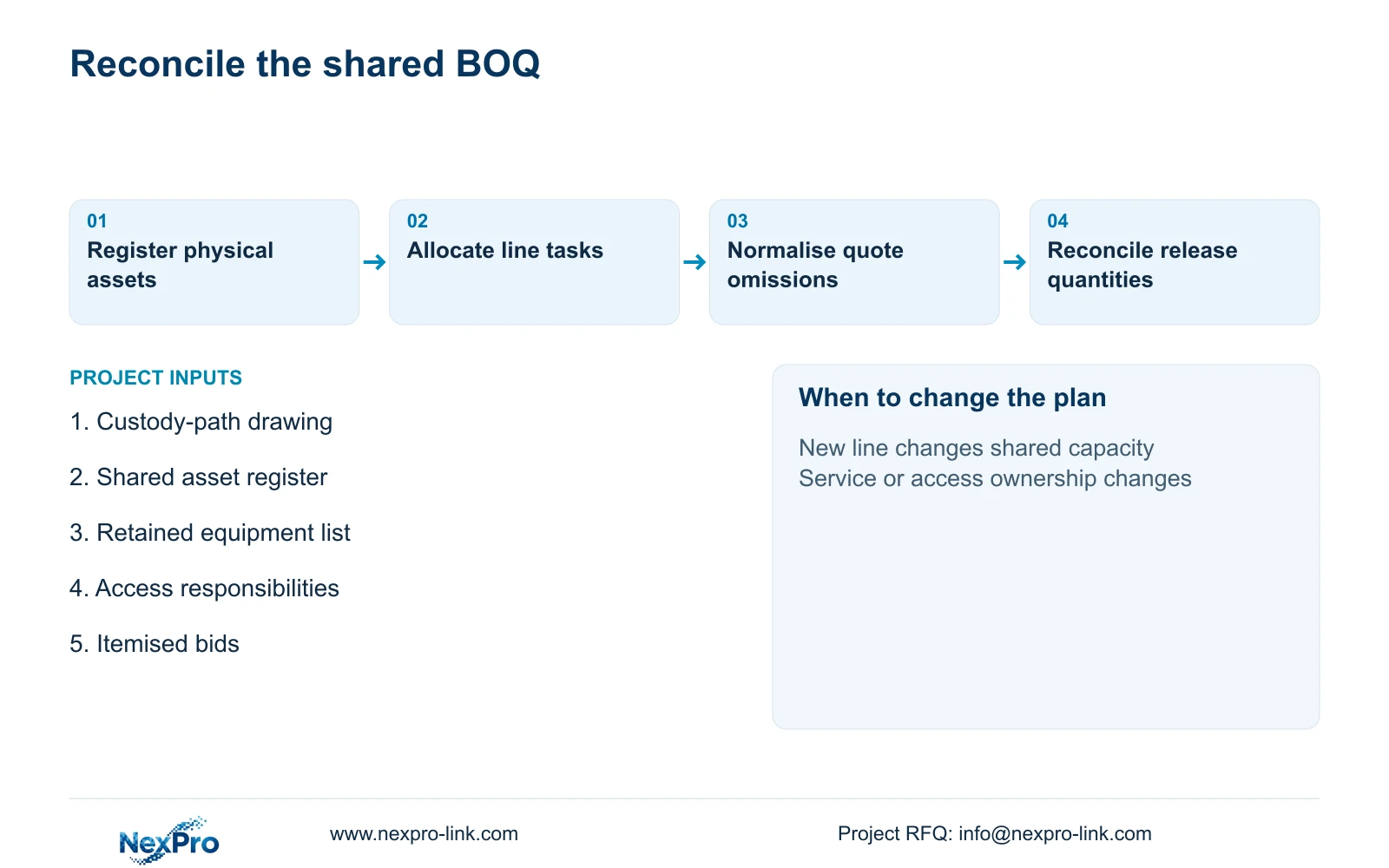
Prepare a physical BOQ, a line-allocation schedule and a responsibility schedule. The physical BOQ contains each asset once. The allocation schedule shows which tasks use it, while the responsibility schedule identifies the service and approval owner. Keep optional capacity or displays distinct from required common infrastructure.
NexPro-Link's BOQ and tender support can help match models, record deviations and coordinate a quotation against those schedules. Factory project supply can include related equipment coordination and project packing. Pack line-specific cameras by location while identifying common cabinet equipment as shared, so the delivery structure does not reintroduce duplicate quantities.
Before ordering, reconcile retained, supplied and optional items across all schedules. At handover, demonstrate a sample release-to-dispatch sequence for each relevant line and verify authorised retrieval. A new production line, revised retention period or change in access ownership should trigger a capacity and responsibility review before the next purchase.
Section 07
Buyer questions
Can shared infrastructure costs still be allocated to departments? Yes. Keep accounting allocation separate from physical procurement quantity. Several departments may share a cost while the equipment list contains one identified asset.
When should two lines retain separate recording nodes? Consider separate nodes when supported capacity, physical routes, local power or required operational independence make sharing unsuitable. Document the reason rather than treating duplication as automatically wasteful.
Does a zero omitted-scope value prove a bid is complete? Only within a checked comparison boundary. In the fictional example it is an input. For an actual bid, reconcile all required items and responsibilities before accepting zero omissions.
Section 08
Build one shared-scope quotation basis
Send your production-line custody paths, shared and retained asset list, viewing and service responsibilities, and itemised quotation scope to info@nexpro-link.com for BOQ and equipment-package coordination.
Engineering references
These sources support the general planning principles. Always use the selected product's current datasheet and applicable project standards for final design.