What is the end-to-end playout service? It is the full path from stored content through automation and processing to the output that leaves the center.
Section 01
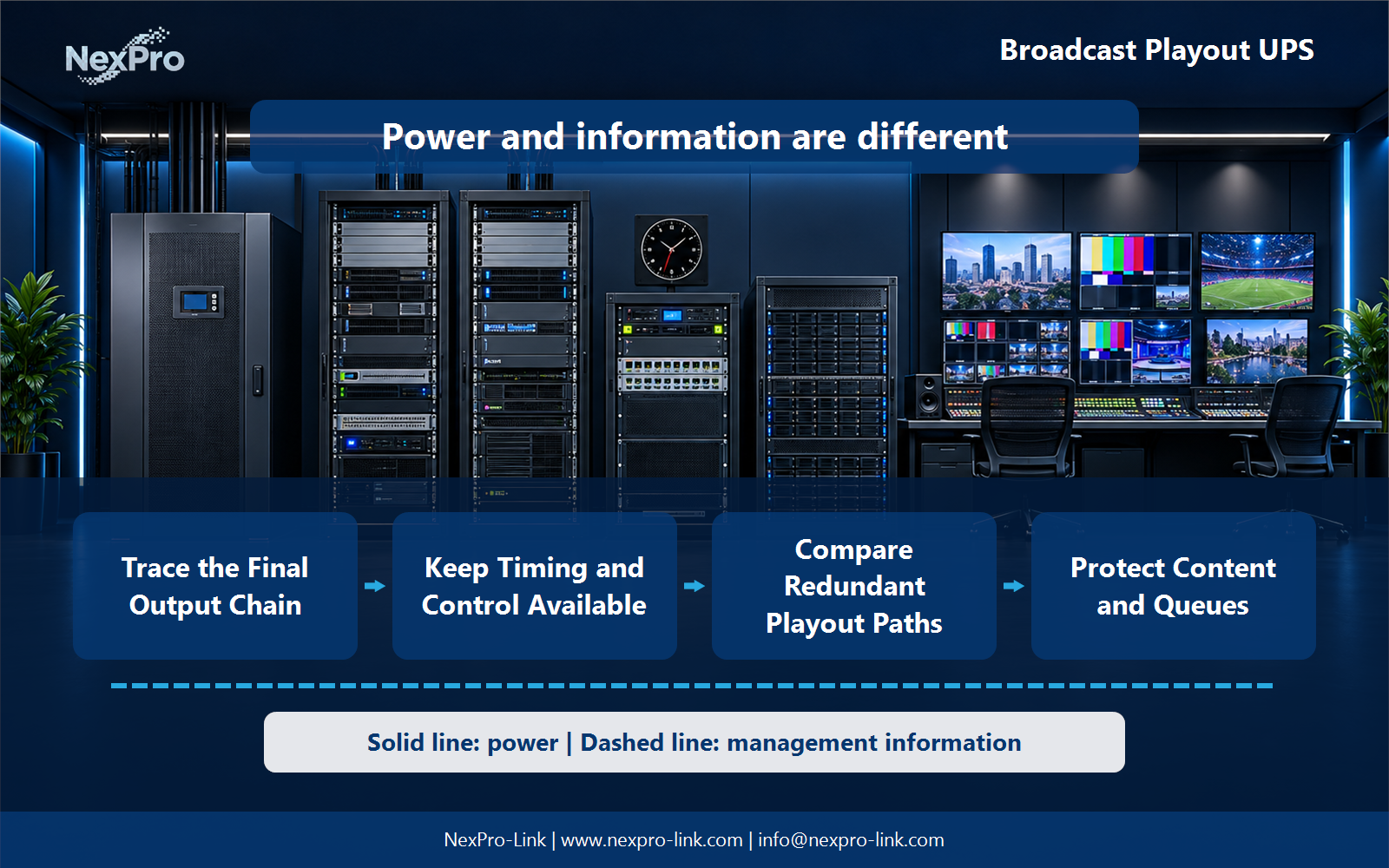
Trace the Final Output Chain
What is the end-to-end playout service? Follow content storage, automation, processing and the final output interface. Identify each required component and its power source. A backup plan that covers the automation server but omits an output device can leave the center unable to transmit its program. Broadcast playout engineers and operations teams can use that boundary to build the playout chain: storage / automation / processing / output and prepare playout chain, storage and timing dependencies and output-continuity objective before selection.
Capture the answer in the playout chain: storage / automation / processing / output before equipment is compared. This gives the project team a concrete service target and exposes missing dependencies early.
| Decision area | Project question | Required output |
|---|---|---|
| Trace the Final Output Chain | What is the end-to-end playout service? | Playout chain: storage / automation / processing / output |
| Keep Timing and Control Available | Why include timing and control equipment? | Dependency map: timing / control / data / output |
| Compare Redundant Playout Paths | Does redundant playout software prove independent power? | Fault map: path A / path B / shared component / outcome |
Section 02
Keep Timing and Control Available
They may be necessary for coordinated playback, switching and recovery. Record the actual dependencies rather than assume every system behaves identically. Power continuity should be assessed alongside the signals needed to produce a stable, usable output.
Use the dependency map: timing / control / data / output to keep real interfaces and operating states visible. Measured demand, equipment limits and future allowances should remain separate entries.
Section 03
Compare Redundant Playout Paths
No. Separate playout paths may still share UPS, distribution, storage or control dependencies. Trace those common points and compare the intended failure states. The architecture should describe what survives, not only how many servers are present.
Review the fault map: path a / path b / shared component / outcome with the owners of the connected systems. Power continuity only supports the functions that remain connected and available during the event.
- Confirm the answer to: Does redundant playout software prove independent power?
- Draw electrical power as a solid path and management information as a separate dashed path.
- Keep external services and specialist approvals outside the UPS equipment claim.
Section 04
Protect Content and Queues
Follow the platform's supported sequence for stopping scheduled actions and protecting persistent state. Include storage and management paths. A UPS provides time and signaling, but does not replace application consistency or a tested recovery procedure.
Document this choice in the stop sequence: schedule / automation / storage / hosts, including the condition that triggers it and the person responsible for the response.
Section 05
Plan Recovery Without On-Air Assumptions
Confirm required sources, application state and the designated output path before declaring recovery. The operational team should authorize return to normal service. Restored power alone should not be treated as proof that the correct content is playing.
Test the sequence represented by the readiness table: power / control / content / output / operator during an approved maintenance window. Record the observations needed to confirm recovery.
Section 06
Prepare an Output-Oriented RFQ
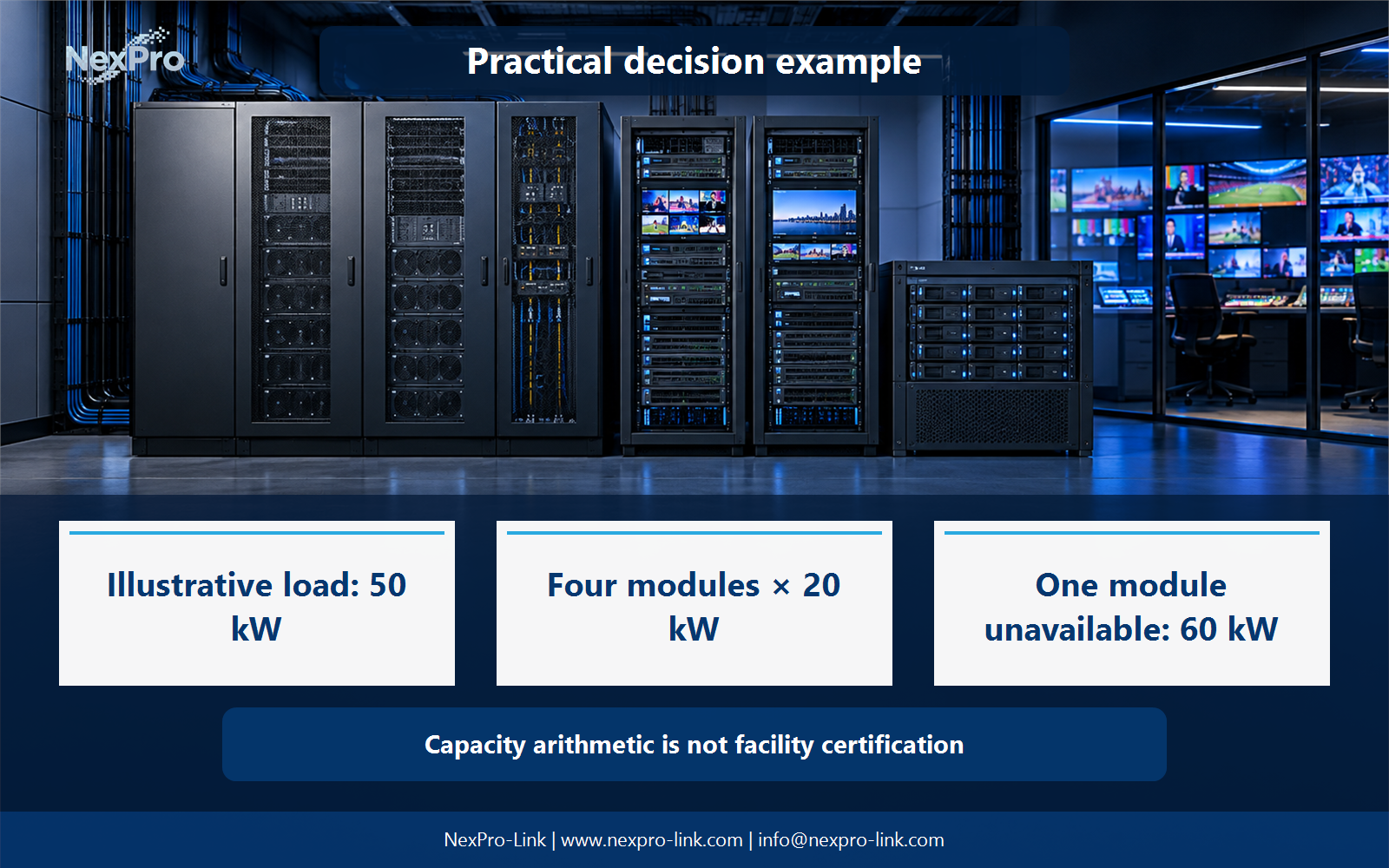
Provide the complete output chain, electrical demand, path arrangement and operating objective. NexPro-Link can discuss power equipment for that scope. Avoid an unsupported universal claim of zero interruption or broadcast-grade approval across all configurations.
Send the completed rfq map: output objective / load / paths / runtime / interfaces with the project request. It is more useful than a capacity number without interfaces, operating states or a defined service boundary.
Engineering references
These sources support the general planning principles. Always use the selected product's current datasheet and applicable project standards for final design.