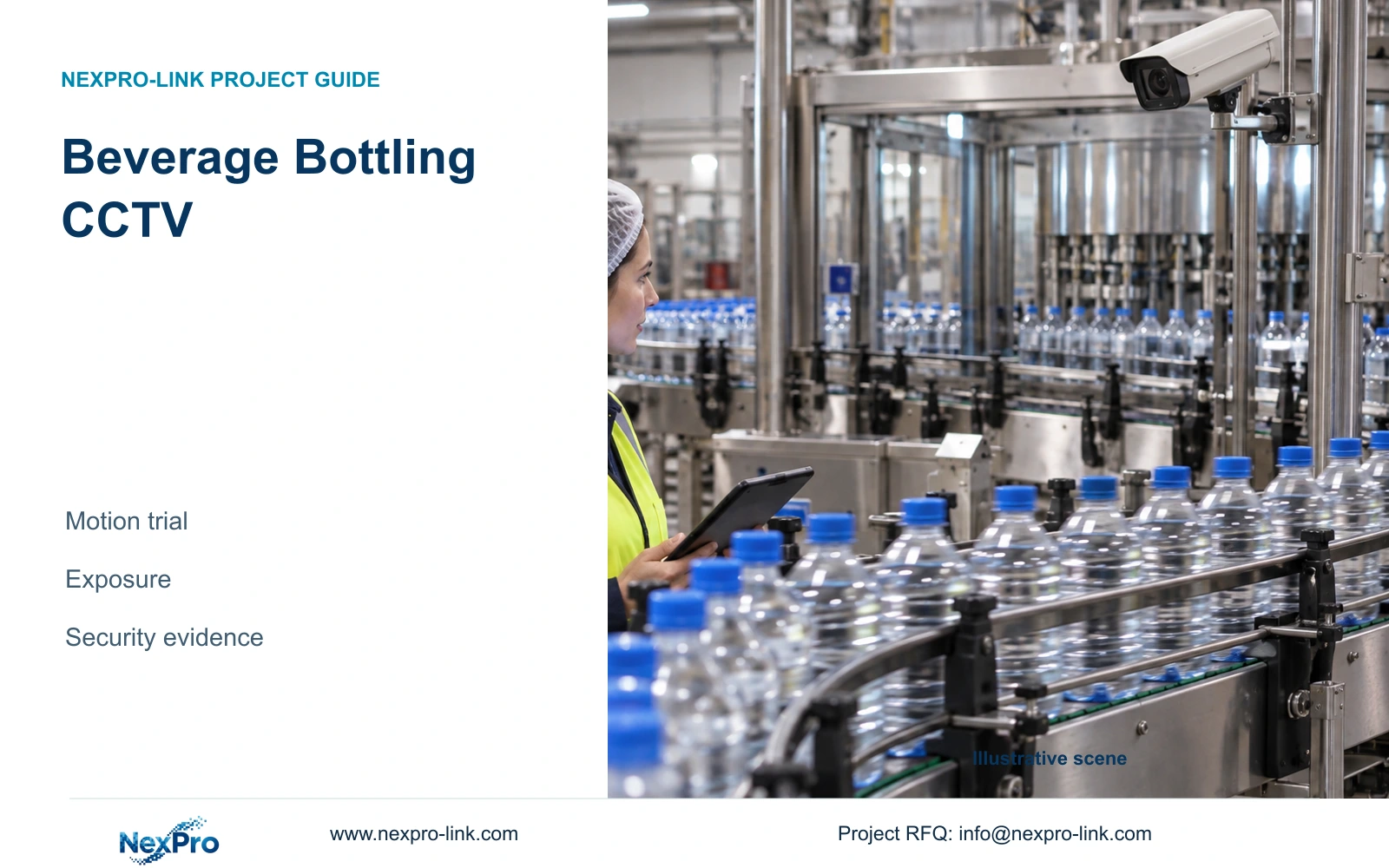
A bottling-line camera can show access and pallet movement without proving cap inspection. Exposure, lighting and recorded playback need a task-specific trial before the equipment schedule is approved.
Section 01
Define the handover evidence the camera must capture
Beverage bottling CCTV should be specified around access, pallet handling and handover evidence, with a realistic recorded-motion test. A frame-rate figure does not prove cap inspection, defect detection or reject-system performance. Keep those production functions with the equipment and specialists responsible for them.
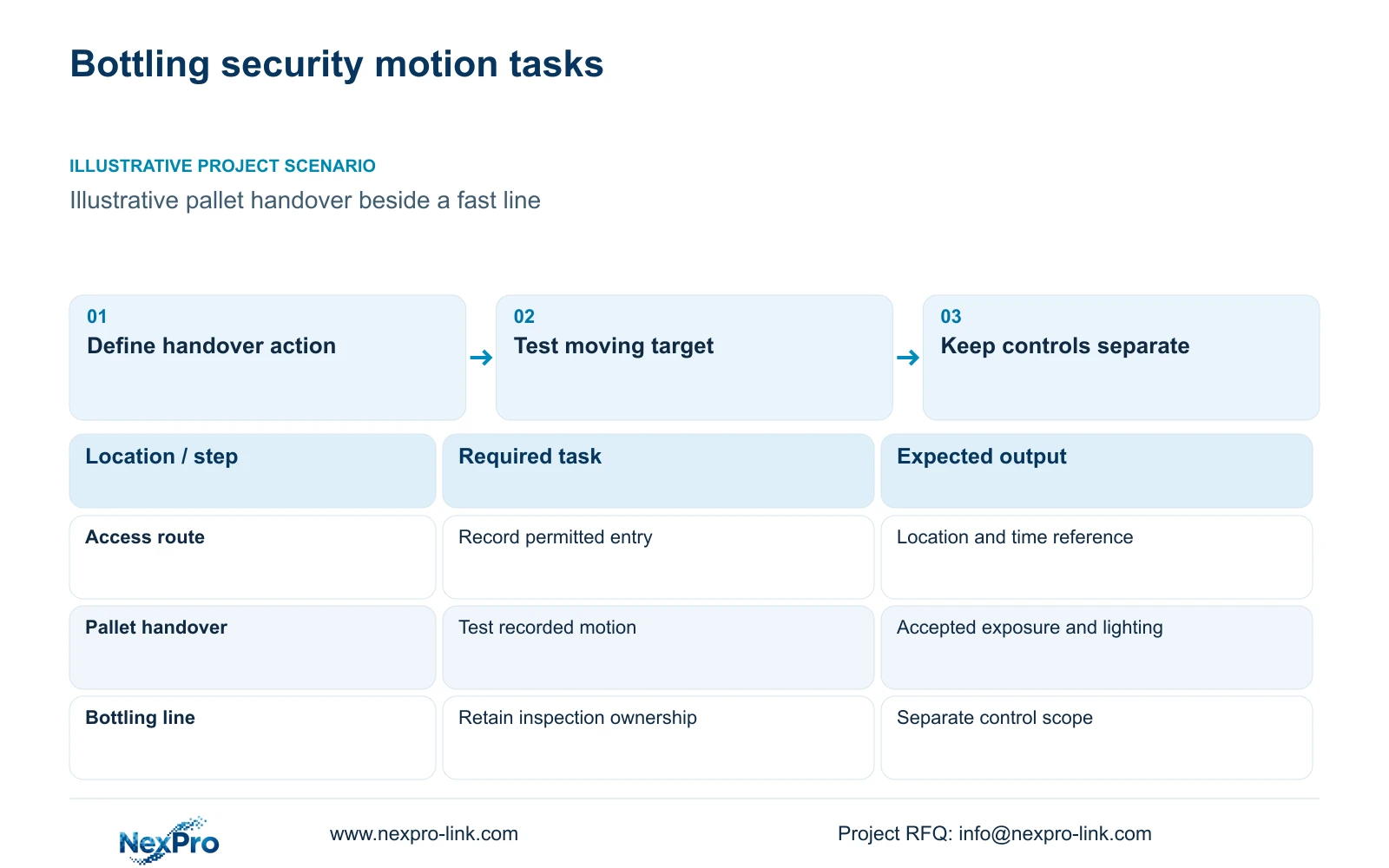
Illustrative project scenario: The bottling plant asks for access and pallet-handling footage beside a fast production line. Assume the security review concerns who entered a permitted route, which load crossed the packing handover and when it reached dispatch. The nearby bottles provide background activity, not an additional inspection duty assigned to the security camera.
Write the acceptance action before choosing a model: follow a moving pallet through the agreed handover view and retrieve the recording by location and time. Confirm hygiene zoning and cleaning exposure at the mount. A normal-area position may suit that action, while a view inside the cleaned production boundary could require a different complete assembly.
Section 02
Test exposure and lighting at the actual target plane
The motion test needs target speed, direction, image scale and operating light. Use the location where the required action occurs, rather than a static object near the camera. Include a representative loaded pallet and the door or conveyor movement that might obscure it. The target should remain useful in recorded playback, not merely look smooth in live view.
Start with the intended field of view and compare exposure settings under the same lighting. A shorter exposure reduces the distance travelled during each exposure, but it also changes the available light captured. Gain and processing may then affect the detail the buyer wants to preserve. A brighter demonstration setting cannot stand in for the agreed operating conditions.
The NexPro-BL2812M55-5MP-DIC-AI reference lists 25fps@5MP, the listed 2880×1620 output and a 2.8–12mm motorized lens. These are selection inputs, not a demonstrated moving-load result. Confirm that the chosen configuration provides the required settings and stream mode before writing them into the acceptance schedule.
Section 03
Keep security recording outside the line-control function
Give the security system a clear data path: camera to local access switch to recorder and authorised client. The bottling controls, inspection equipment and reject mechanisms retain their own defined functions. NIST SP 800-82 Rev.3 is a relevant published reference for considering operational constraints and separation; it does not establish compatibility for a particular camera installation.
If the owner wants a production event reference alongside video, first define the information exchanged, responsible system and permitted interface. A manual timestamp or approved event record may be sufficient for investigation. Do not assume the ordinary camera can generate a dependable reject command or that network access to the line is available.
The mechanical and hygiene interfaces also need owners. Camera supply, the approved mount, local penetrations and cleaning release should appear separately in the schedule. IP66 does not establish suitability for every washdown method. Moving a camera closer to the action may improve image scale while introducing an environmental requirement that changes the equipment.
Section 04
Calculate movement during one exposure
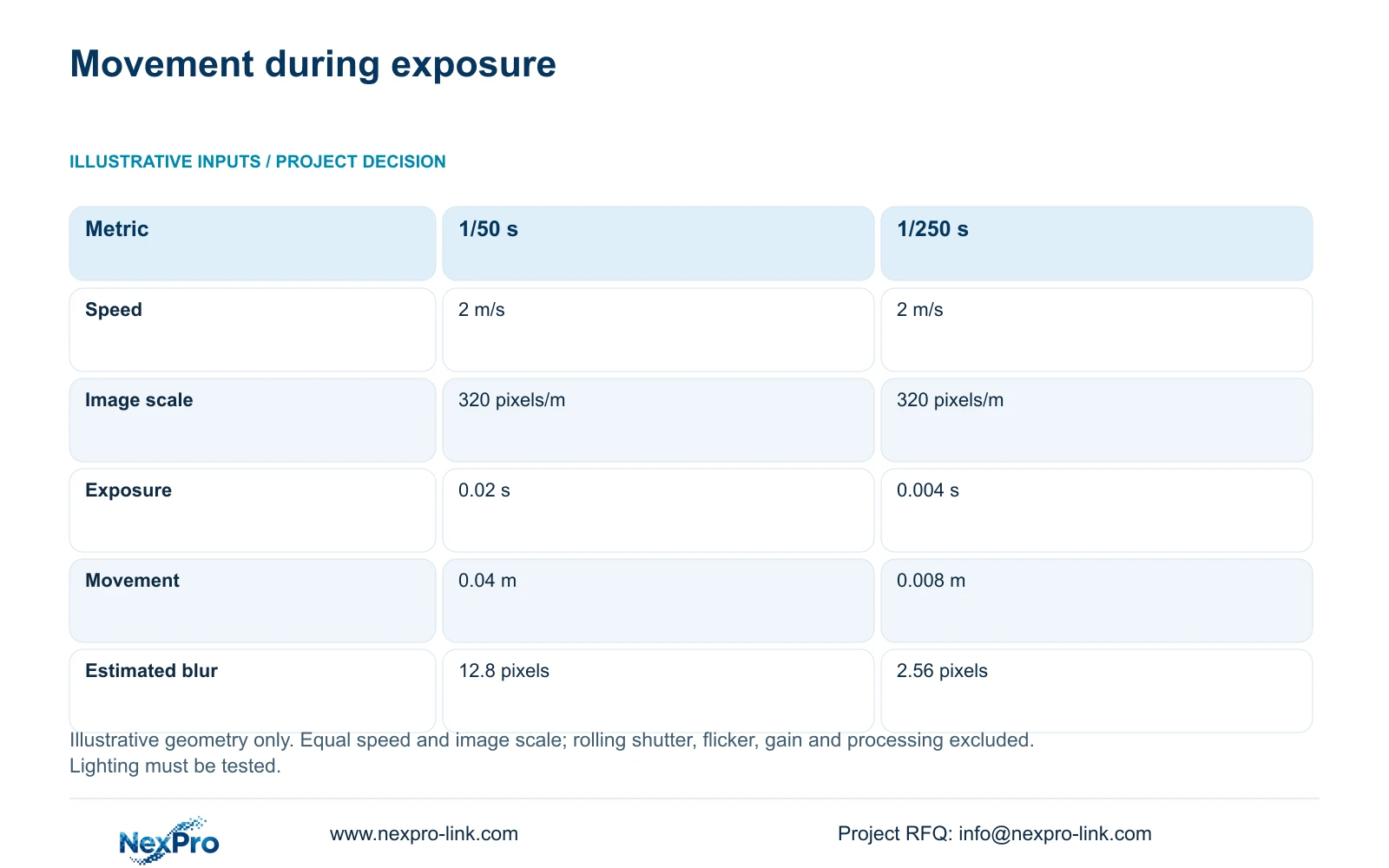
For an illustrative estimate, assume target speed is 2 m/s and image scale is 320 pixels/m. Use movement_m = speed_m_s × exposure_s, then estimated_blur_px = movement_m × pixels_per_m. Compare 1/50 s, or 0.02 s, with 1/250 s, or 0.004 s, without changing speed or scale.
At 1/50 s, movement is 2 × 0.02 = 0.04 m, giving 0.04 × 320 = 12.8 pixels. At 1/250 s, movement is 2 × 0.004 = 0.008 m, giving 0.008 × 320 = 2.56 pixels. The decisive change comes from exposure duration. Increasing fps alone does not deliver these shorter-exposure results.
This calculation is a geometric estimate, not a sensor test or an inspection rating. Rolling shutter, lighting flicker, gain and processing are not modelled. Use the comparison to select trial conditions, then judge whether the recorded load and handover action remain clear enough for the owner's stated security purpose.
| Metric | Option A | Option B |
|---|---|---|
| Target speed | 2 m/s | 2 m/s |
| Image scale | 320 pixels/m | 320 pixels/m |
| Exposure | 1/50 s = 0.02 s | 1/250 s = 0.004 s |
| Movement during exposure | 0.04 m | 0.008 m |
| Geometric blur estimate | 12.8 pixels | 2.56 pixels |
Section 05
Choose the tested security view without expanding its duty
Recommend a task-adjusted view at the handover, supported by an overview only when the surrounding movement matters. Prefer the shorter-exposure trial if it preserves useful recorded detail under actual lighting. If it fails because illumination is inadequate or the target becomes too small, revise lighting, position or field of view before assuming more megapixels will solve the problem.
CASE03 illustrates the wider supply boundary: 48 cameras split across two 24-camera recording nodes, including eight separately qualified positions. Its assumed 4 Mbps average streams and 30-day continuous recording are planning inputs. A changed exposure or scene complexity should prompt representative bitrate measurement rather than an unsupported promise that the existing storage allowance remains sufficient.
Compare NexPro-Link and other proposals using the same moving-load trial, environmental assembly and playback task. Preserve mandatory inspection systems and platform integrations. Show the cost of added illumination, an extra overview camera or specialist installation separately; none has a supplied market price or measured saving in this example.
Section 06
Carry the trial settings into the procurement package
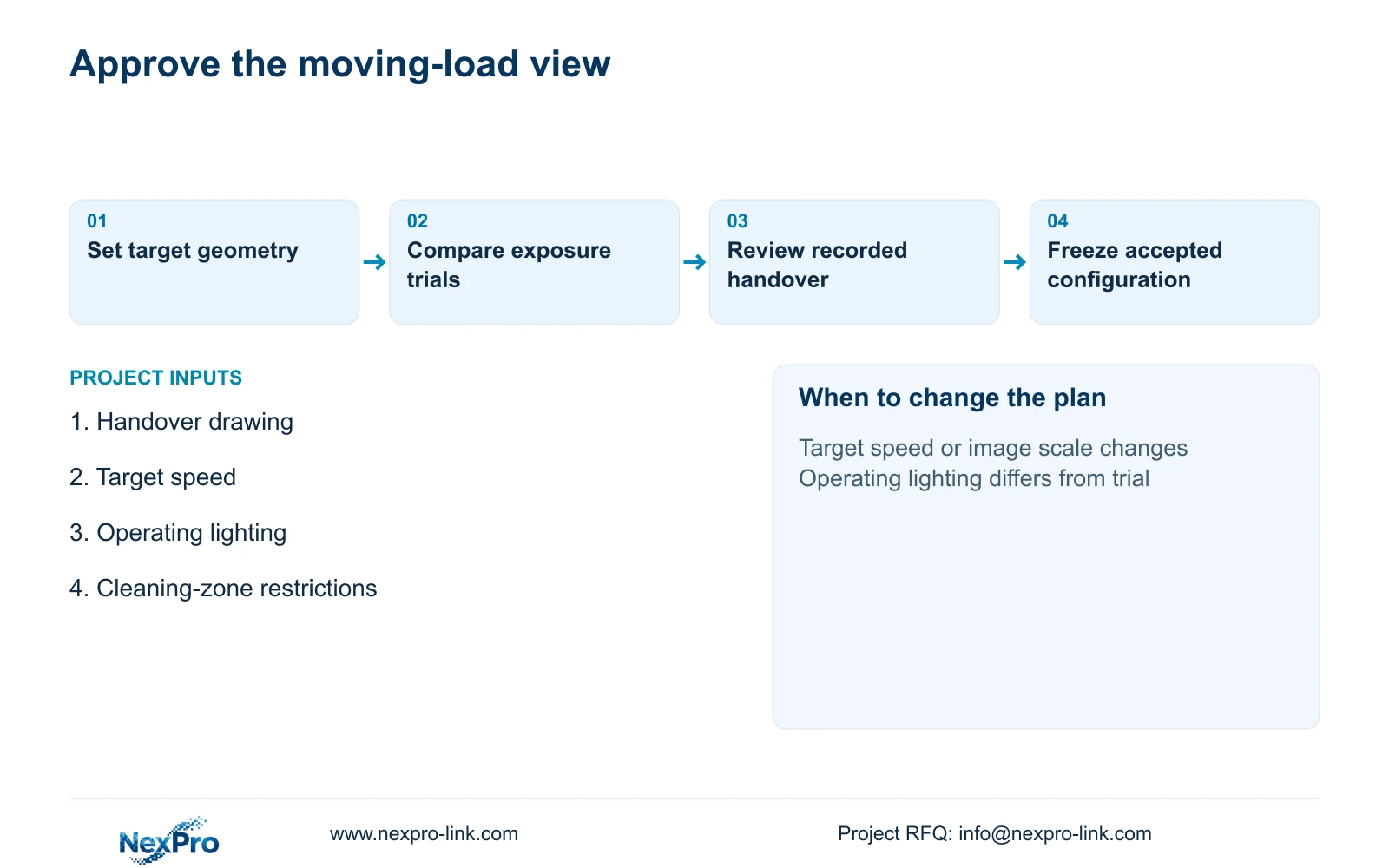
Release a camera schedule that records target action, location, accepted field of view, tested lighting and stream configuration. Identify which settings require site tuning. A bench demonstration can confirm menu access and recording behaviour, while the local trial confirms the moving target under the bottling hall's actual conditions.
NexPro-Link can discuss model matching and technical deviations through its BOQ & Tender Support scope. Packing labels can distinguish the ordinary access camera from any separately qualified production-boundary assembly. Keep the line-control exclusions explicit so a contractor does not inherit an inspection obligation through ambiguous wording.
Specify local recorder and switch protection where outage footage matters, and verify actual camera power before sizing PoE. Display selection follows the operator's review task; a suitable playback screen may be sufficient. The handover check should include a recorded moving load, a location-and-time search and an export that can be replayed by the intended recipient.
Section 07
Buyer questions
Can a 25fps camera record a fast bottling line usefully? It may provide useful security context, depending on exposure, light, field of view and the required action. That does not establish bottle or cap inspection performance. Agree a representative recorded trial rather than accepting fps alone.
Must every camera use the same exposure setting? No. A static access view and a moving-pallet handover may need different settings. Document the accepted settings by task and confirm that lighting changes do not make the critical view unusable.
What change invalidates the 12.8 and 2.56 pixel estimates? A different target speed, exposure time or image scale changes the calculation. Moving the camera or changing its field of view can alter pixels per metre even when the output resolution stays the same.
Section 08
Specify a bottling-hall motion trial
Send the handover-view drawing, expected load speed, operating-light description and cleaning-zone restrictions to info@nexpro-link.com. NexPro-Link can discuss camera candidates and a recording trial tied to your security acceptance task.
Engineering references
These sources support the general planning principles. Always use the selected product's current datasheet and applicable project standards for final design.