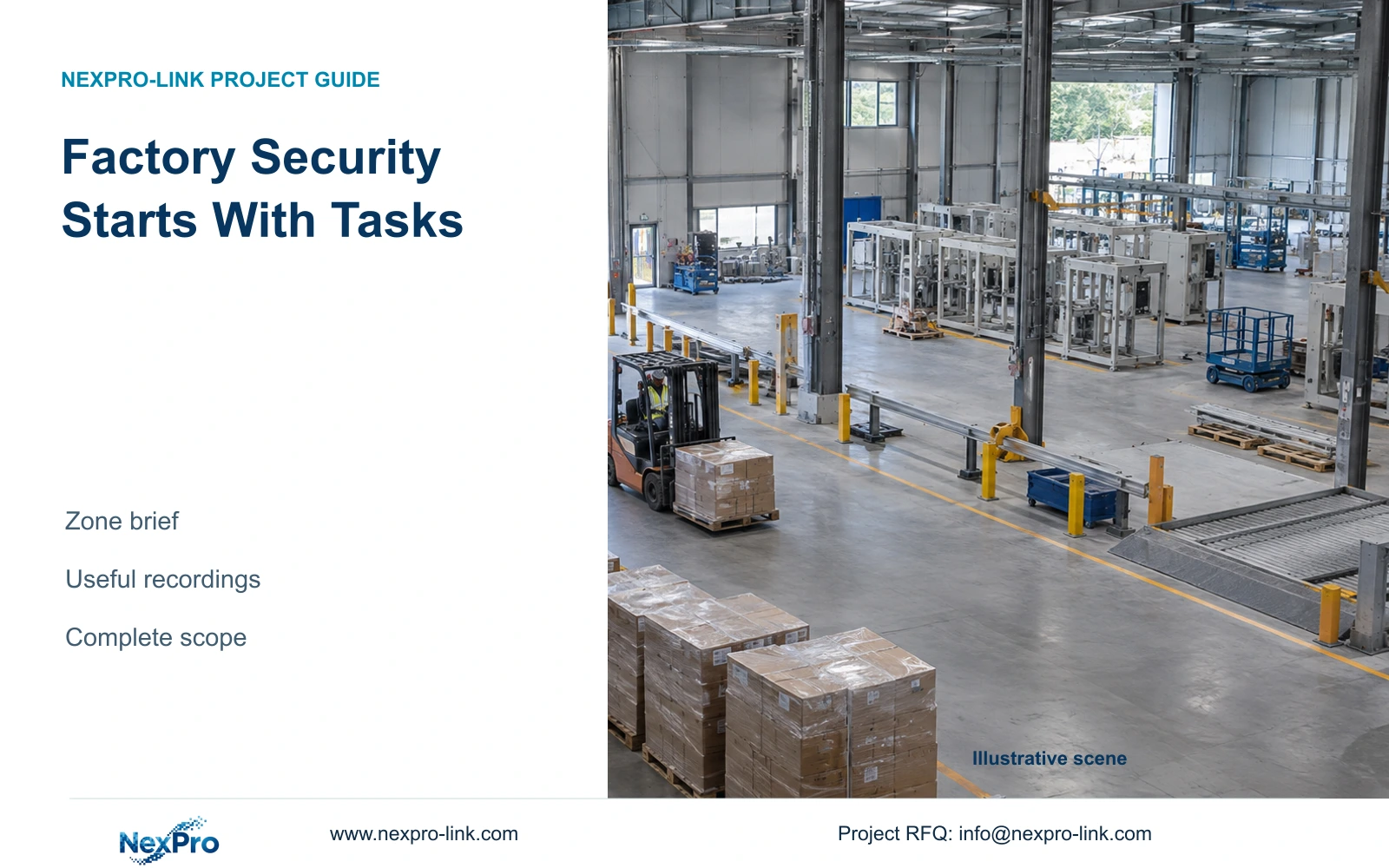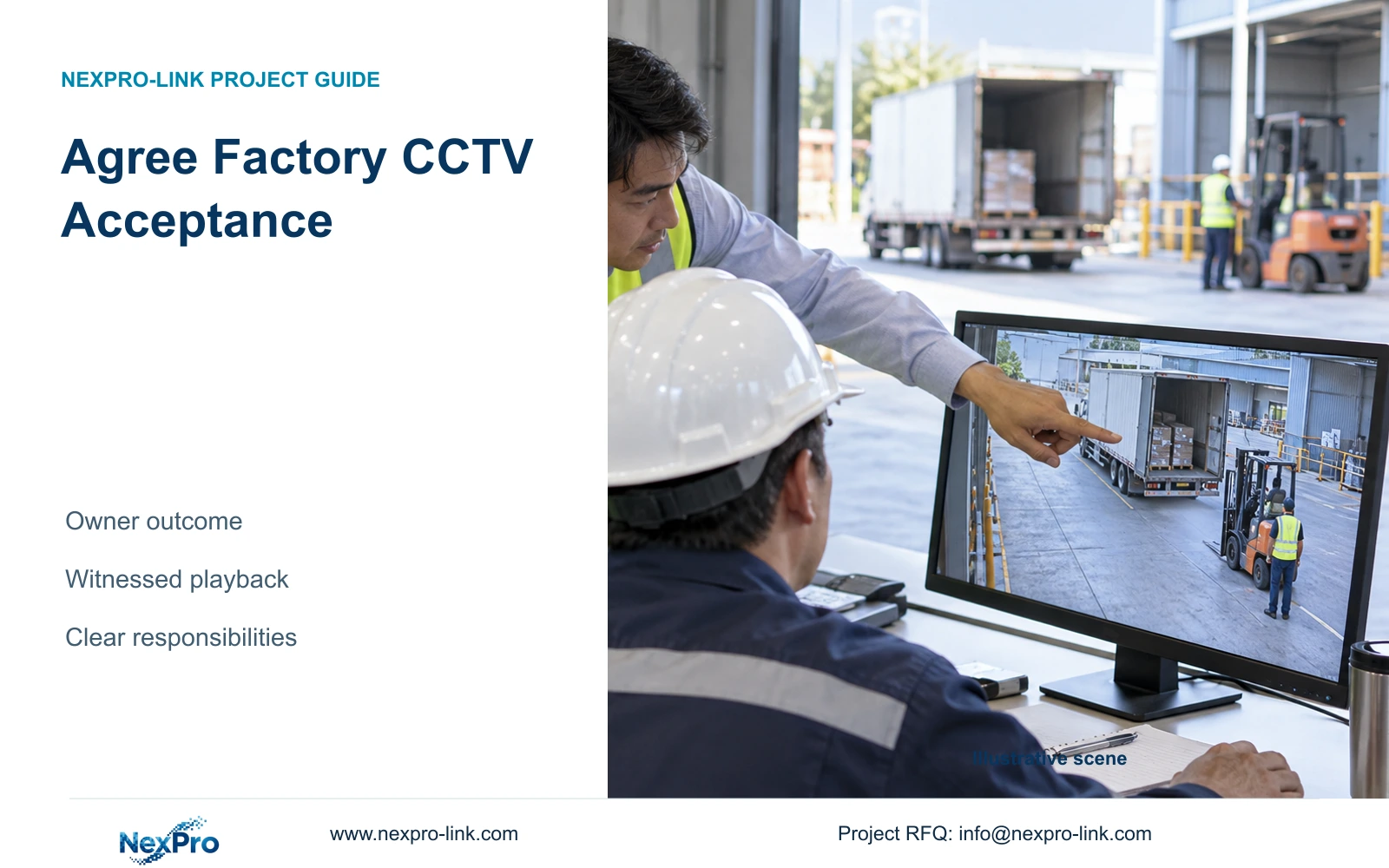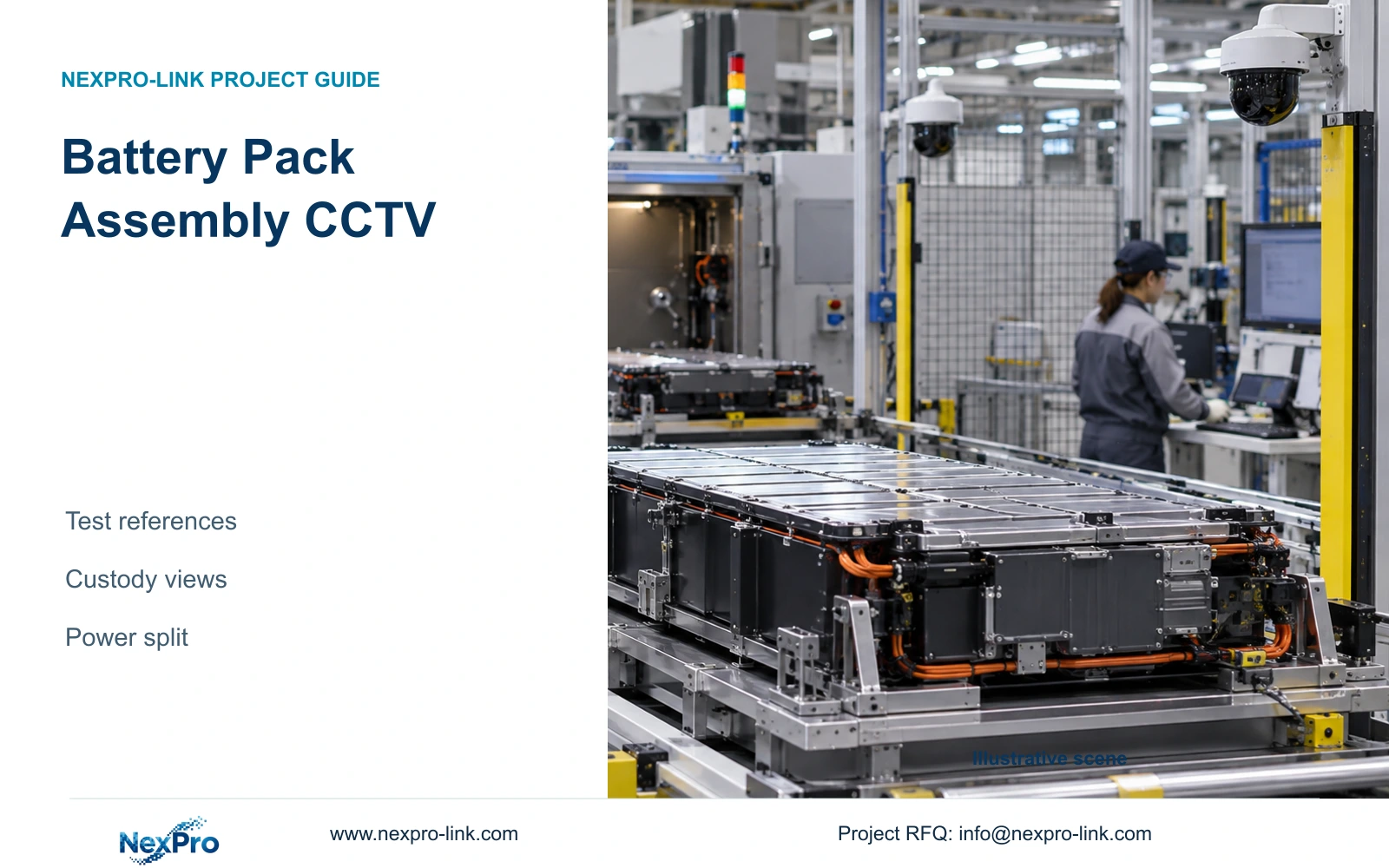
Traceable battery-pack handover depends on a reliable test-record reference, mapped camera views and a complete event window. CCTV recording and backup power remain separate from production test duties.
Section 01
Use the test record to locate the handling event
Battery pack assembly CCTV should use the test record as the lookup reference for handling footage. Coordinate station identities, timestamps and camera names, while leaving quality and safety decisions with the test system. The quantity surveyor should price a demonstrable retrieval workflow: an authorised reviewer receives a record, finds the relevant view and preserves the required handling sequence.
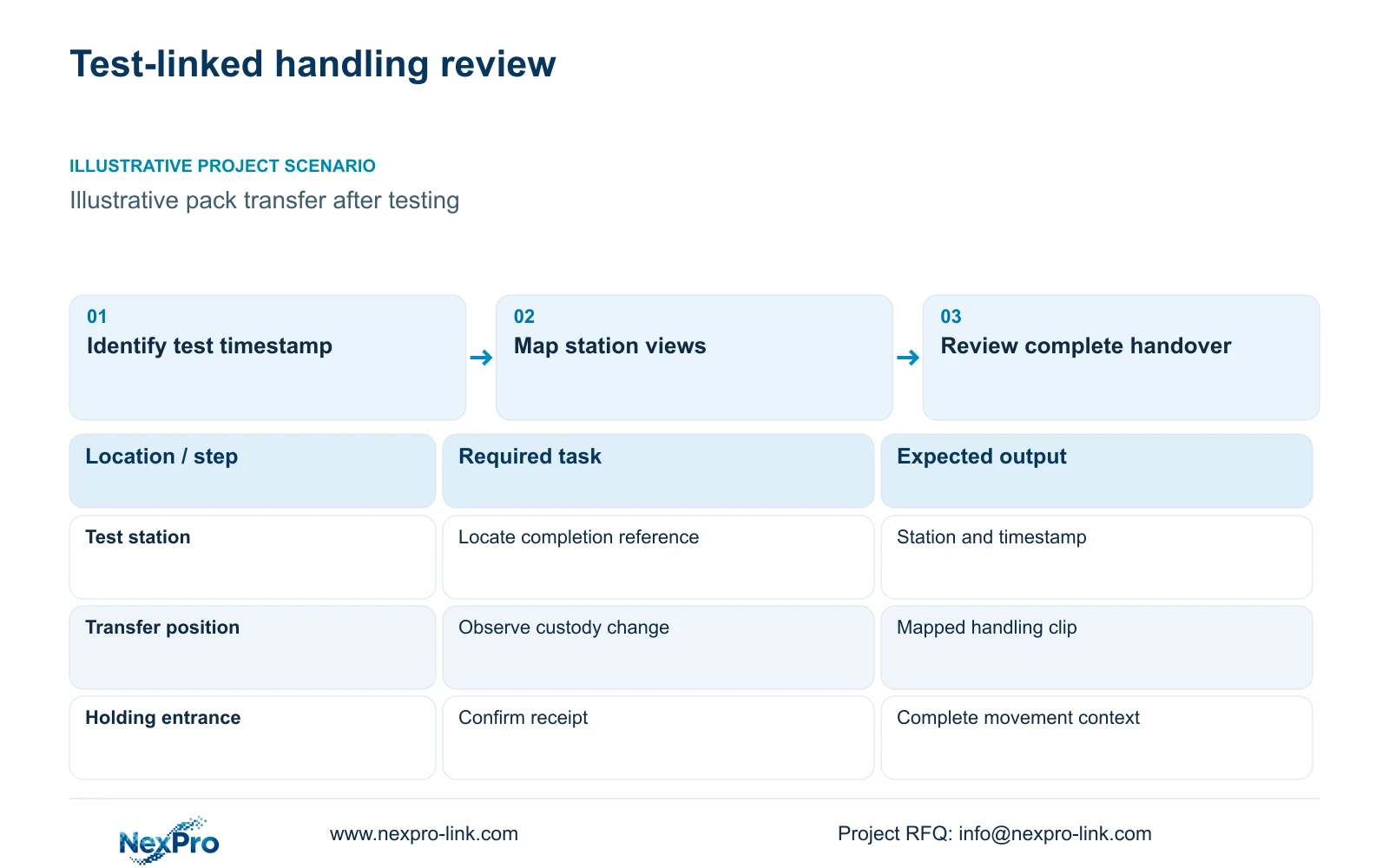
Illustrative project scenario: A pack assembly plant wants to review a handling event using a test timestamp. Assume a pack leaves a test station and passes through a defined transfer position before entering holding storage. The planning objective is to connect that movement with the existing test record. It does not include reading every serial label automatically or deciding whether the pack passed its electrical test.
Ask the test-system owner which timestamp is available: test start, completion, record creation or release. Those events can point to different moments in the footage. Document timezone and the relationship between the recorded event and physical handover. Without that definition, a technically synchronised camera may still show the wrong stage of the process.
Section 02
Place views around the authorised transition
Map the handling path before selecting the camera quantity. Identify where the pack becomes visible, where responsibility changes and where trolleys, screens or personnel can obscure it. A station overview can explain movement around the bench, while a dedicated transfer view can preserve departure and receipt. Treat these as different observation tasks when the overview cannot show the complete transition.
The NexPro-BL2812M55-5MP-DIC-AI reference lists a 5MP-family output including 2880x1620 at 25fps and a 2.8-12mm motorized lens. It can be considered for a suitable ordinary-area view, subject to recorded acceptance. Adjusting the lens changes the scene width; it does not establish automatic pack identification. Use the test or asset record for identity unless a separate identification system is specified.
Obtain environmental information for the camera and its route, including any controlled or hazardous boundary. Confirm who may review the footage and whether neighbouring workstations contain information outside the approved task. A narrower view may reduce unnecessary capture, but it must still show the receiving point. Resolve that balance during the sample review rather than after volume installation.
Section 03
Separate CCTV continuity from production test power
Prepare two load schedules: the security recording chain and the production test equipment. CCTV continuity includes the camera supply, access switches, recorder, disks and necessary network endpoints. Production test instruments and their controlled shutdown belong to their own design. A shared room or timestamp reference does not place the test bench on the security UPS.
CASE05 is an illustrative solar-module campus reference with three independent 32-camera nodes. Its recording-priority option assigns 682.7407W to node 1 and 617.7407W to each other node under declared assumptions. These values illustrate a complete security boundary; they are not battery-pack test loads. Camera power must not be counted twice when already included in complete switch AC demand.
SP1KR(S) is a quoted capacity reference of 1kVA/900W. It is not a runtime result. Match both W and VA constraints, then obtain the selected battery configuration and runtime evidence for the actual load. If the owner wants the test station to continue operating, create a separate requirement with the test supplier rather than enlarging the CCTV quotation without defining the duty.
Section 04
Calculate the selected footage without shortening the event
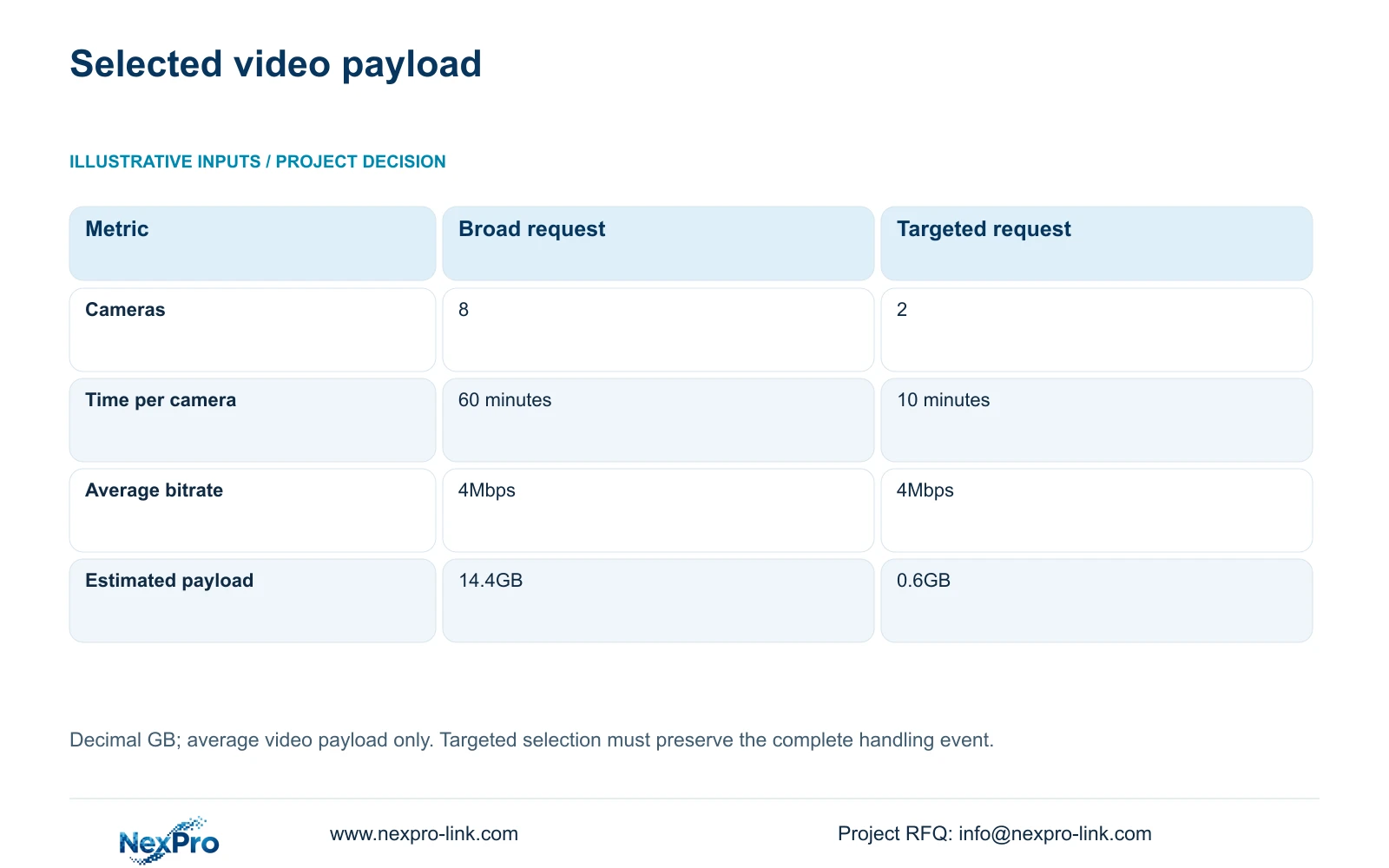
For the illustrative retrieval comparison, option A selects eight cameras for 60 minutes each at an average 4Mbps. Option B selects two relevant cameras for 10 minutes each at the same bitrate. Using decimal GB, the formula is GB = cameras × Mbps × seconds / 8 / 1000. The broad selection is 8 × 4 × 3600 / 8 / 1000 = 14.4GB; the targeted selection is 2 × 4 × 600 / 8 / 1000 = 0.6GB.
The difference comes from camera selection and duration, with no assumed reduction in recording quality. Option B is appropriate only when the mapped views and time window retain arrival, handover and departure. If a pack waits outside the ten-minute window or takes an alternative route, expand the selection. A smaller file is not evidence that the investigation is complete.
These figures estimate video payload, not guaranteed export duration or staff-time savings. Actual files can include container overhead, audio or other selected data. Retain the original recording according to the approved policy and record what was exported, by whom and for which request. Selection and preservation remain distinct operations.
| Input or result | Broad request | Targeted request |
|---|---|---|
| Selected cameras | 8 | 2 |
| Duration per camera | 60 minutes | 10 minutes |
| Average video bitrate | 4Mbps | 4Mbps |
| Estimated decimal payload | 14.4GB | 0.6GB |
| Acceptance condition | Review wider uncertain context | Retain the complete mapped event |
Section 05
Buy the retrieval workflow before adding integration
Recommend a controlled manual mapping first when the test record already gives a usable station and timestamp. Supply camera names, a station-to-view schedule and an authorised export procedure. This can establish the required review task without assuming a native connection between the recorder and the test platform. Price automatic integration separately when the owner has a defined need for it.
Change that basis if records lack reliable location information, if throughput makes manual mapping unsuitable, or if the owner requires a specific enterprise workflow. Any proposed integration should identify supported versions, data fields and acceptance actions. Basic video connectivity does not prove event search or business-record linkage. Retain a mandatory incumbent platform where the alternative cannot reproduce the approved task.
Compare bids using the same complete event and operator permissions. Include configuration, clock checks, trial exports, export media and local commissioning responsibilities. The 0.6GB example cannot justify reducing retention or removing other necessary cameras. Its value is a measurable selection method, not an unsupported commercial saving.
Section 06
Document the mapping and test it after changes
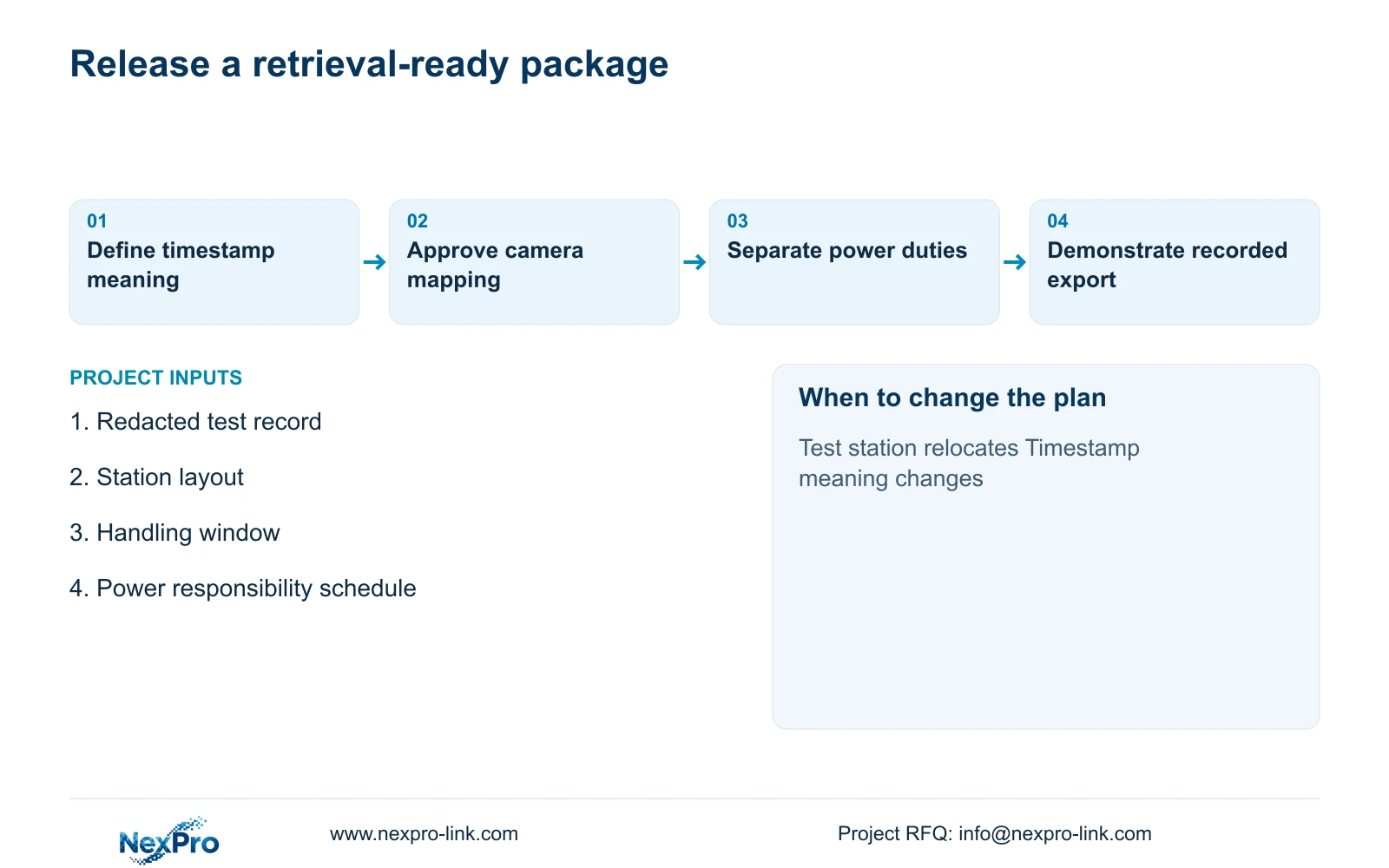
The delivery package should contain stable camera IDs, station references, recorder assignments and the clock-setting basis. Separate supplied security hardware from retained test systems and local installation work. Assign the test-system owner to confirm timestamp meaning, the security integrator to demonstrate playback, and the plant reviewer to approve the handling sequence.
Use a representative request for acceptance: take an approved test record, locate the transition and export the required footage. Check the recorded image rather than relying on live view alone. Confirm that the reviewer can find the receiving location and understand any documented clock offset. Keep sample records free of unnecessary customer or product-sensitive information during supplier demonstrations.
NexPro-Link can discuss model matching and technical submittals through its BOQ support scope. Project packing should preserve station and camera identities so commissioning follows the same schedule. Revisit the mapping when a test bench moves, a transfer route changes or recorder settings are revised. Those changes can affect views, retrieval selection and protected loads independently.
Section 07
Buyer questions
Do we need a direct software connection to the test system? Not necessarily. A controlled station-and-time mapping may meet the review requirement. Quote direct integration only after defining data fields, supported interfaces and the operator action it must enable.
What if the clocks were offset when an event occurred? Preserve the known offset and search a wider window. Correcting current settings does not explain historical footage by itself; record the basis used to locate the earlier event.
Can a handling video serve as the pack's test certificate? No. Keep the approved test result and its identity as the quality record. Video can add handling context without establishing electrical performance or safety acceptance.
Section 08
Specify test-linked handling review
Send a redacted test-record example, the station-to-holding route, your required event window, and the security-versus-test power split to info@nexpro-link.com for a scoped equipment and preparation discussion.
Engineering references
These sources support the general planning principles. Always use the selected product's current datasheet and applicable project standards for final design.