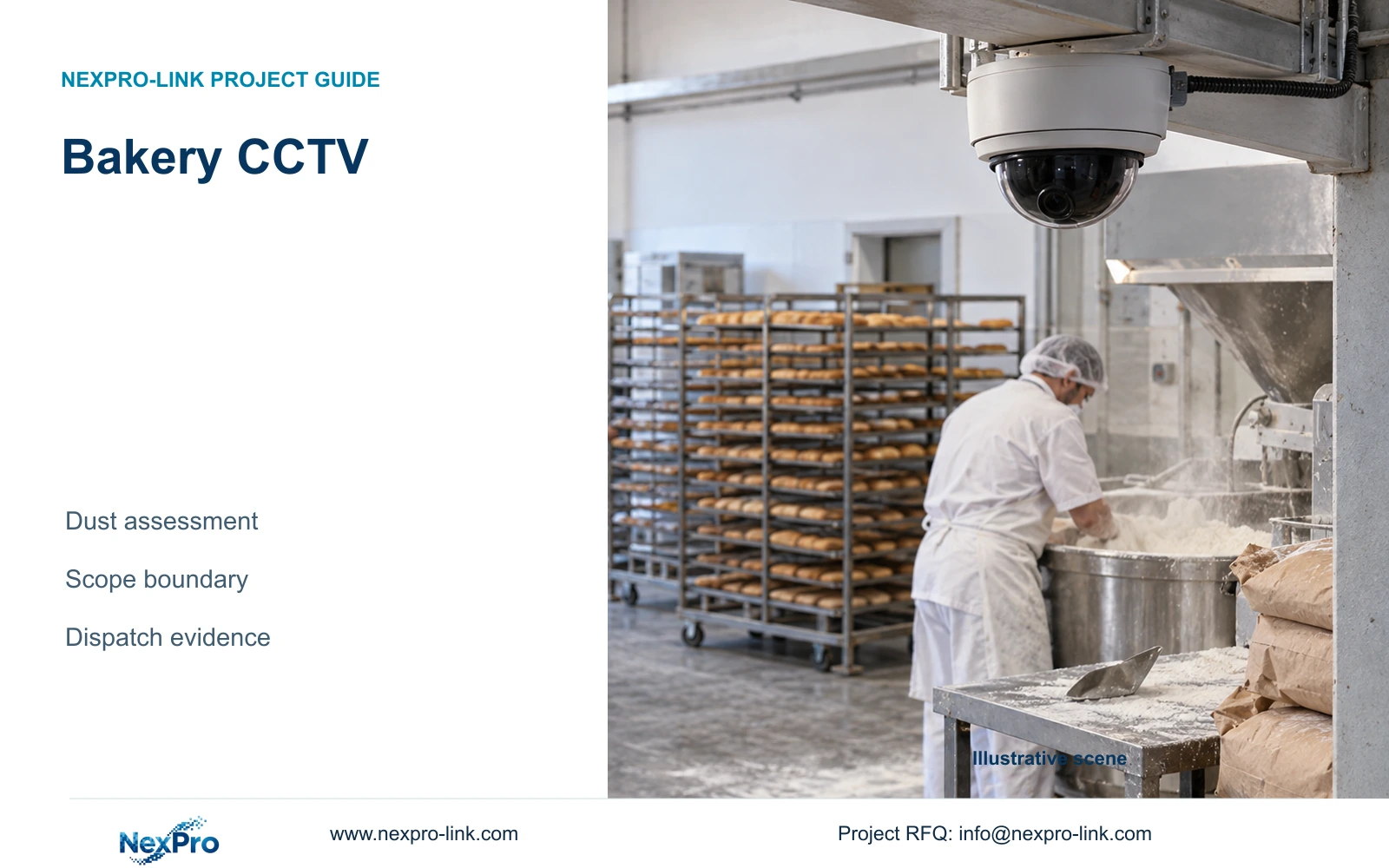
Bakery CCTV needs a documented boundary between general security locations and any specialist dust-area scope. An IP rating cannot establish an approved explosive-atmosphere installation.
Section 01
Use the site's dust assessment to define equipment scope
Bakery CCTV selection should follow the site's dust assessment and the classification decisions of the responsible specialists. Use ordinary cameras only at suitable confirmed general-area locations. An IP dust rating does not turn a standard camera, switch or gland into an approved explosive-atmosphere installation.
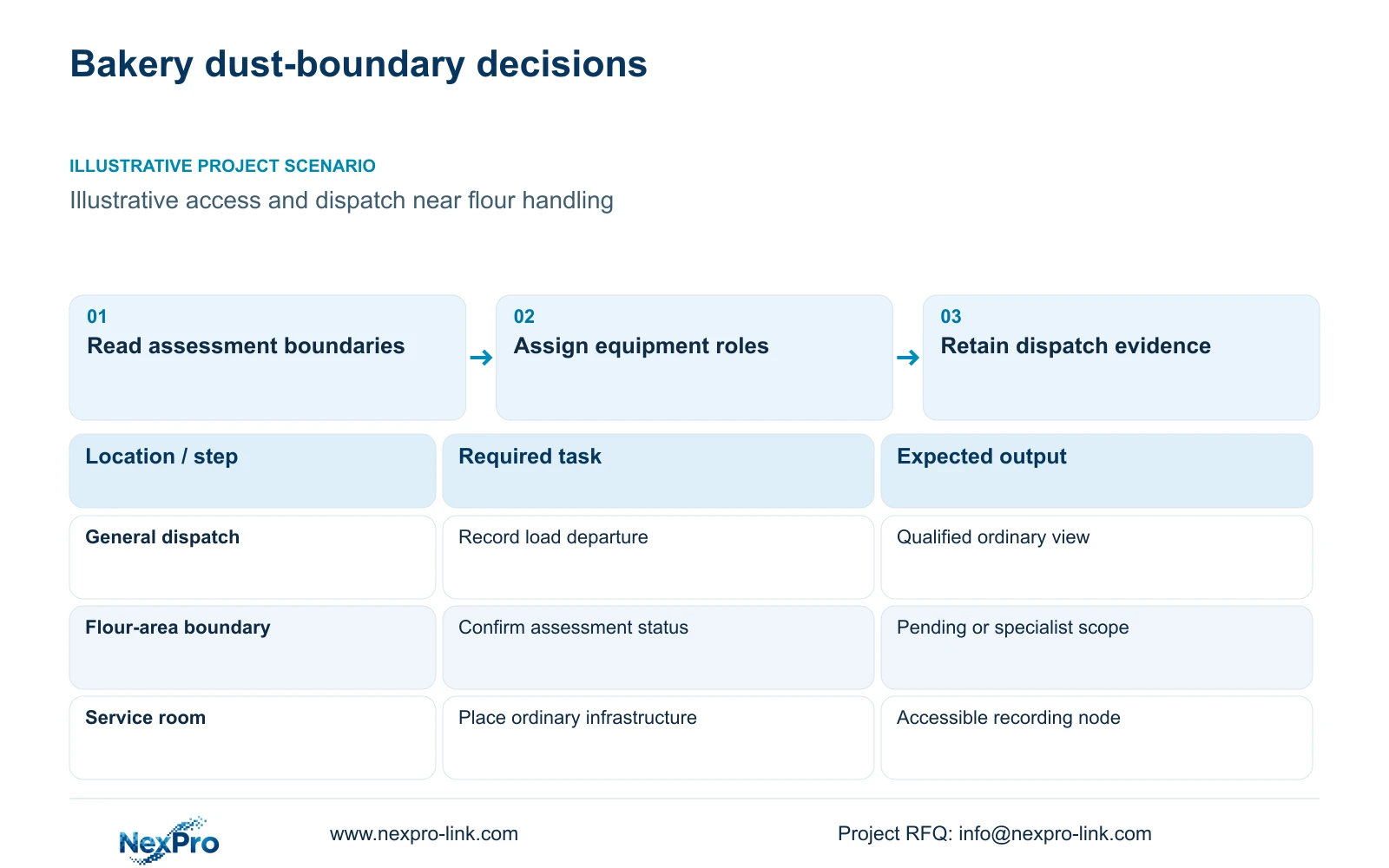
Illustrative project scenario: A bakery needs access and dispatch footage around areas where flour may be handled. Assume the owner wants to record permitted staff entry, material handover and finished-goods loading. No area-classification drawing or specialist equipment approval has been supplied, so the locations remain planning candidates rather than approved camera positions.
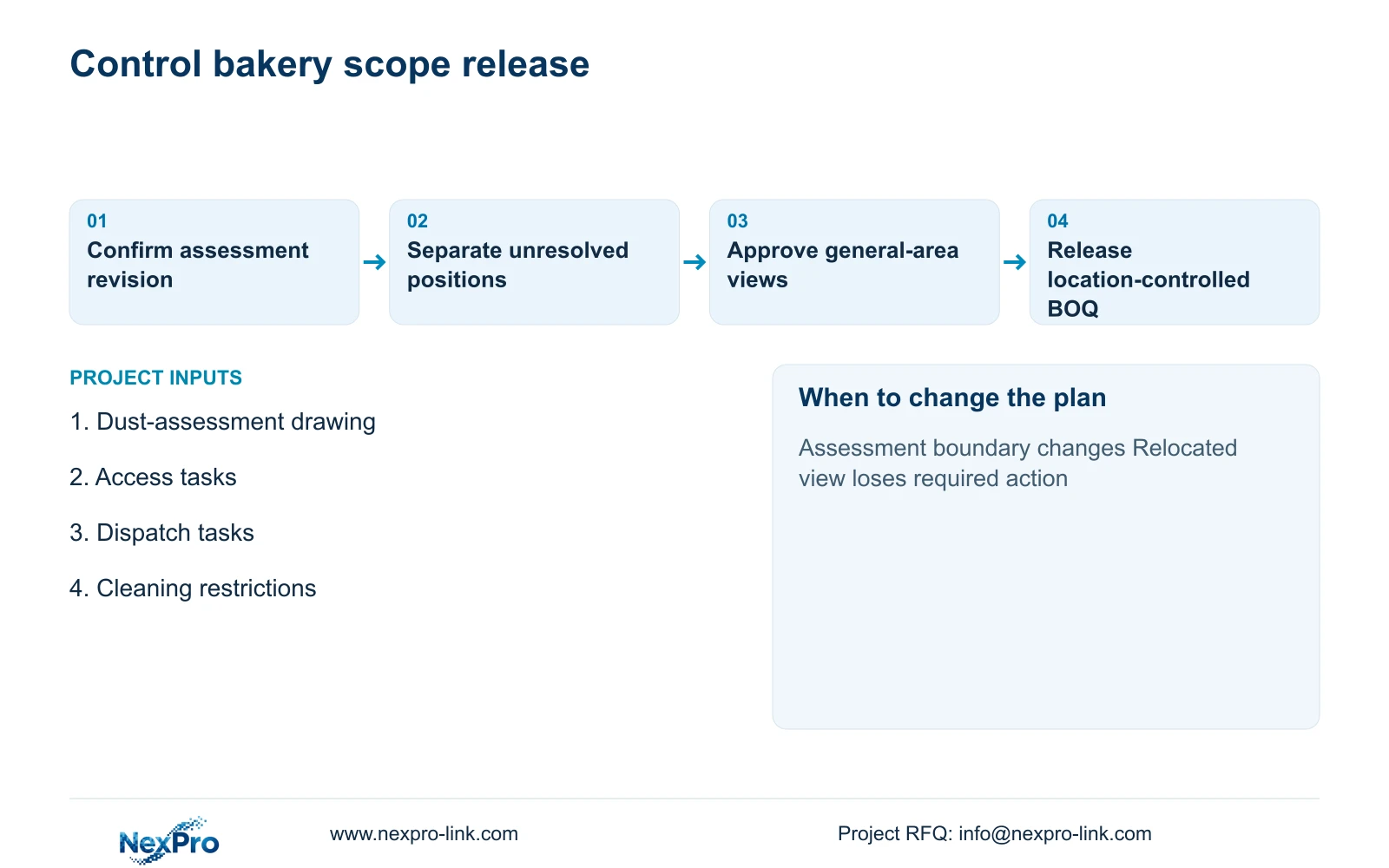
Overlay those candidate points and their cable routes on the current assessment drawing. Include supports, junction points and service access, not just the camera symbol. The specialist team determines the relevant boundaries and installation requirements. The security designer then decides which observation tasks can be met from suitable general locations and which require separately qualified equipment.
Section 02
Require evidence for the complete specialist assembly
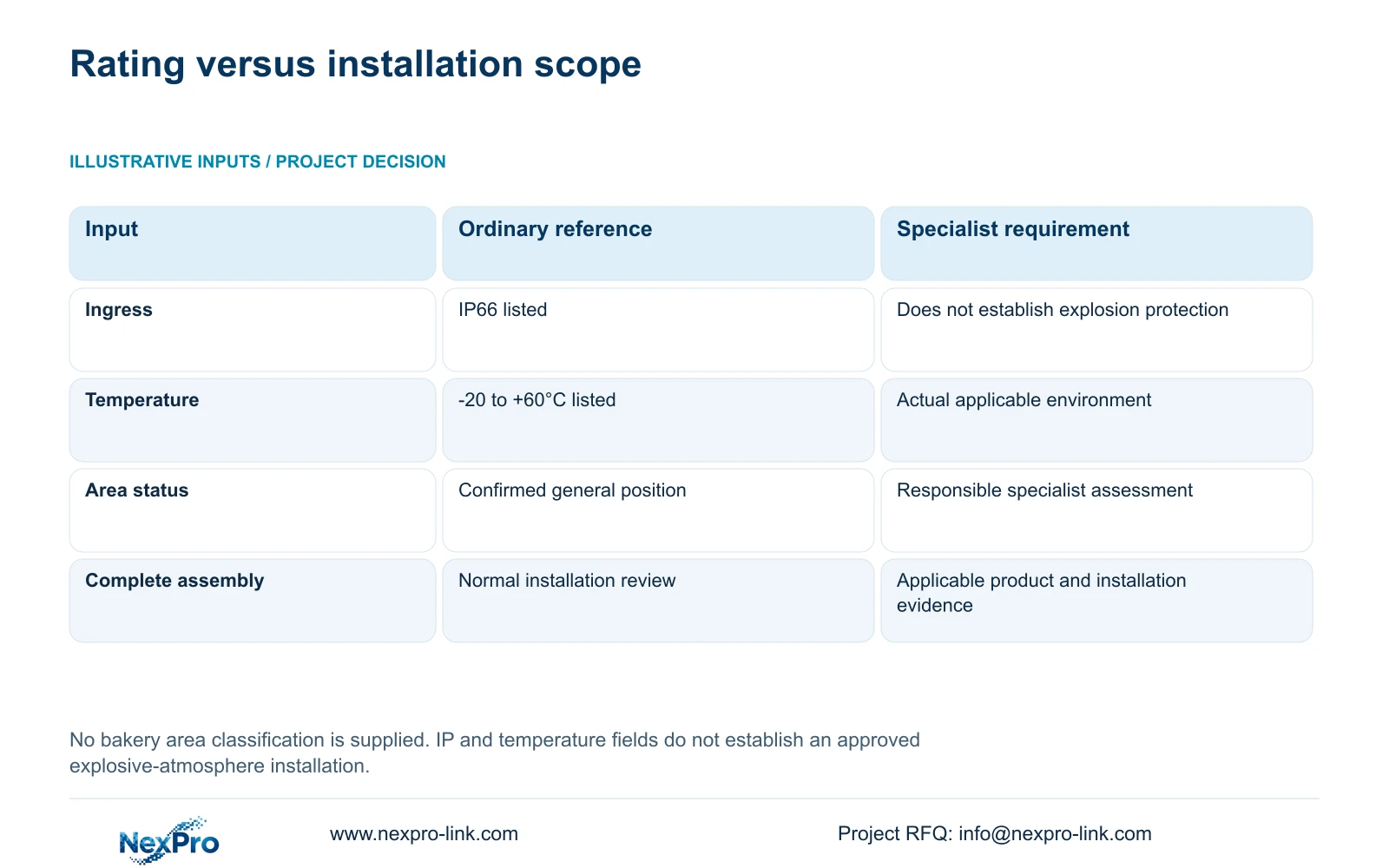
Keep ingress protection and explosion protection as different evidence fields in the submittal. The ordinary BL2812M and DM2812M 5MP references list IP66 and -20 to +60°C, along with the listed 2880×1620 output, 25fps and 2.8–12mm motorized lenses. Those fields do not establish hazardous-area suitability.
If the assessment identifies a specialist position, obtain the applicable complete product and installation scope from the responsible supplier and designer. Review the actual camera, connection method, support and service requirements. Do not infer approval from a metal enclosure or combine unrelated rated components and call the assembly certified.
The archived OSHA 1910.307 reference is a US-specific hazardous-location research source, not a worldwide installation rule for this bakery. The project team must verify applicable local requirements and current approval evidence. This article provides a procurement boundary, not an instruction for designing or assembling a hazardous-area installation.
Section 03
Retain useful access and dispatch footage from suitable positions
Identify the security actions that can be observed from confirmed general areas: entry through an approved route, a material handover at a boundary or a load leaving dispatch. Consider relocating the camera before adding specialist equipment, but preserve the accepted target action. A safe general position that sees only the back of a pallet does not satisfy a handover-detail requirement.
Test the view with the actual obstruction pattern expected at the location. Stacked cartons, moving loads and open doors can change the usable scene. Align camera names with the receiving and dispatch records, and demonstrate location-and-time search from an authorised review station.
The supplied CASE03 food-factory reference separates 40 ordinary views and eight specialist positions. Its distinction is useful for a bakery schedule, although the eight positions are not automatically classified flour-dust locations. Apply the bakery's assessment to its own point list. Keep cleaning access and hygienic installation responsibility attached to each location.
Section 04
Make qualification a condition of each BOQ line
Qualification requires location conditions AND complete product scope AND approved installation requirements to fit. This avoids a score-based comparison in which a good resolution or ingress field appears to compensate for missing specialist evidence. Each unresolved condition has a procurement consequence.
The matrix below separates confirmed general locations, unresolved boundaries and specialist positions. The decisive difference is whether the responsible team has established a suitable installation scope. When classification information is missing, keep the line provisional rather than allowing the quotation process to decide the boundary.
Recorders, switches and batteries should remain in suitable accessible rooms outside unsuitable locations wherever the design permits. Their connections and routes still need review. Dust accumulation or cleaning can also affect ordinary views, so general-area acceptance should include maintenance access and usable recorded images, not merely a successful power-on.
| Position or input | Ordinary equipment decision | Specialist or pending decision |
|---|---|---|
| Confirmed general dispatch | Check view, IP66 and temperature fit | Retain task if relocation is proposed |
| Flour-area boundary unresolved | Do not release as approved | Obtain current specialist assessment |
| Specialist position identified | Ordinary PDF is insufficient | Qualify complete applicable installation |
| Camera cleaning access | Approve method and materials | Revise assembly if exposure changes |
| Service infrastructure | Suitable accessible general room | Review every boundary-crossing route |
Section 05
Compare offers after the area boundary is preserved
Recommend a confirmed general-area package with specialist positions clearly separated. Release ordinary positions only after the assessment boundary, view and cleaning conditions are sufficiently defined. Retain the required specialist scope when the desired observation cannot be achieved from a suitable general location.
For the owner, this preserves dispatch and access evidence. For the engineer, it keeps environmental qualification visible. For the cost team, it separates ordinary cameras, specialist assemblies and local installation work. Compare brands at the same accepted locations and tasks rather than removing specialist protection from one bid to lower its apparent cost.
Use local recording and backup power according to the actual nodes. CASE03 demonstrates that data connectivity and UPS protection are separate layers; a central UPS does not automatically protect remote AC-powered equipment. Final PoE selection needs actual device demand and port requirements, including any specialist front-end power arrangement. Do not copy an ordinary camera's assumed demand into an unselected specialist model.
Section 06
Issue a controlled schedule with explicit approval owners
The supply schedule should name each observation point and record assessment status, camera role, connection scope and approval owner. Distinguish supplied ordinary equipment, retained assets, pending specialist assemblies and local route work. Keep the assessment drawing revision with the schedule so a later production change can be checked against the correct basis.
NexPro-Link's Factory & Warehouse supply and BOQ support can coordinate ordinary-camera selection, technical deviations and project packing. The specialist designer and local contractor retain their defined responsibilities for classified locations and installation. Carton labels should follow approved location identities without displaying unsupported protection marks.
Before handover, verify the approved location, recorded dispatch task and operator retrieval workflow. Maintain a change condition for revised flour-handling arrangements, changed assessment boundaries or altered cleaning exposure. Those changes may affect only a few points, but they must not be absorbed into repeat orders through undocumented substitutions.
Section 07
Buyer questions
Should every bakery camera be treated as a hazardous-area camera? No blanket classification is made here. The responsible specialists assess the actual locations. Suitable confirmed general areas can use ordinary candidates, while specialist positions retain their applicable complete equipment and installation scope.
Can we issue a tender while the dust assessment is incomplete? A provisional tender can separate confirmed general positions from unresolved lines. State the missing assessment input and the conditions that may change equipment or installation. Do not represent the unresolved positions as approved ordinary locations.
Does moving the camera outside a specialist area settle the whole installation? It may resolve the camera position, but routes, connections and service activities still need review. The relocated view must also preserve the required access or dispatch action.
Section 08
Define the bakery's ordinary security package
Send the current dust-assessment boundary drawing, proposed access and dispatch views, and cleaning or service restrictions to info@nexpro-link.com. NexPro-Link can discuss the confirmed ordinary-area package and identify separate specialist interfaces.
Engineering references
These sources support the general planning principles. Always use the selected product's current datasheet and applicable project standards for final design.