Specify independent test-bay context recording first, then define approved time references, network paths and optional event interfaces without changing test control.
Section 01
Define contextual evidence before requesting test integration
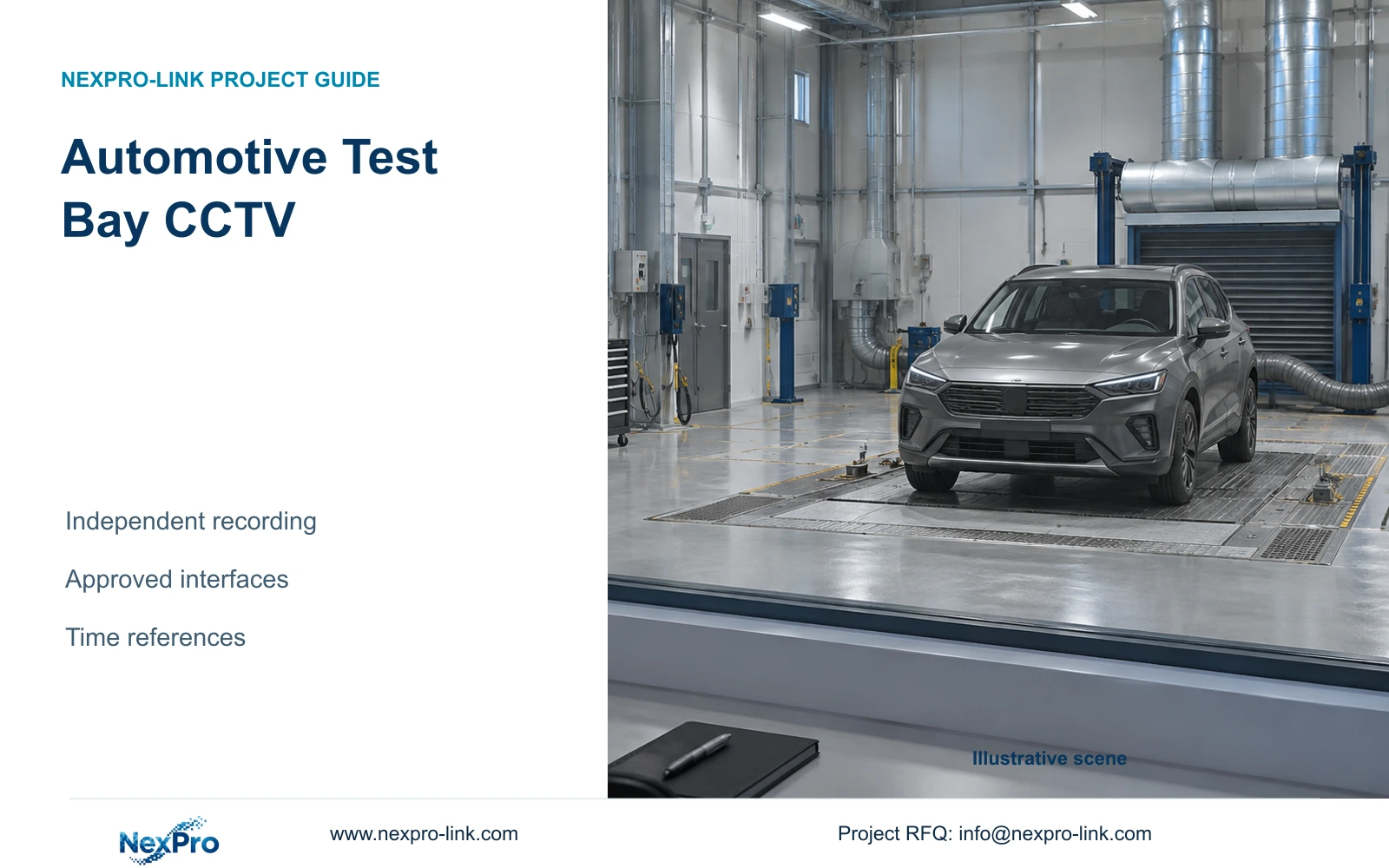
Automotive test bay CCTV should begin with independently recorded access and handling context, supported by an approved time reference. Automatic linking to a proprietary test event requires an explicit interface and an acceptance procedure. Security cameras should not become part of test control merely because their images appear beside test results.
Illustrative project scenario: A test bay wants synchronized video context next to a proprietary test system. Assume engineers want to review vehicle entry, preparation and removal after an unusual result, while the test supplier retains control of measurement and operating sequences. No interface capability or synchronization accuracy is assumed to have been demonstrated.
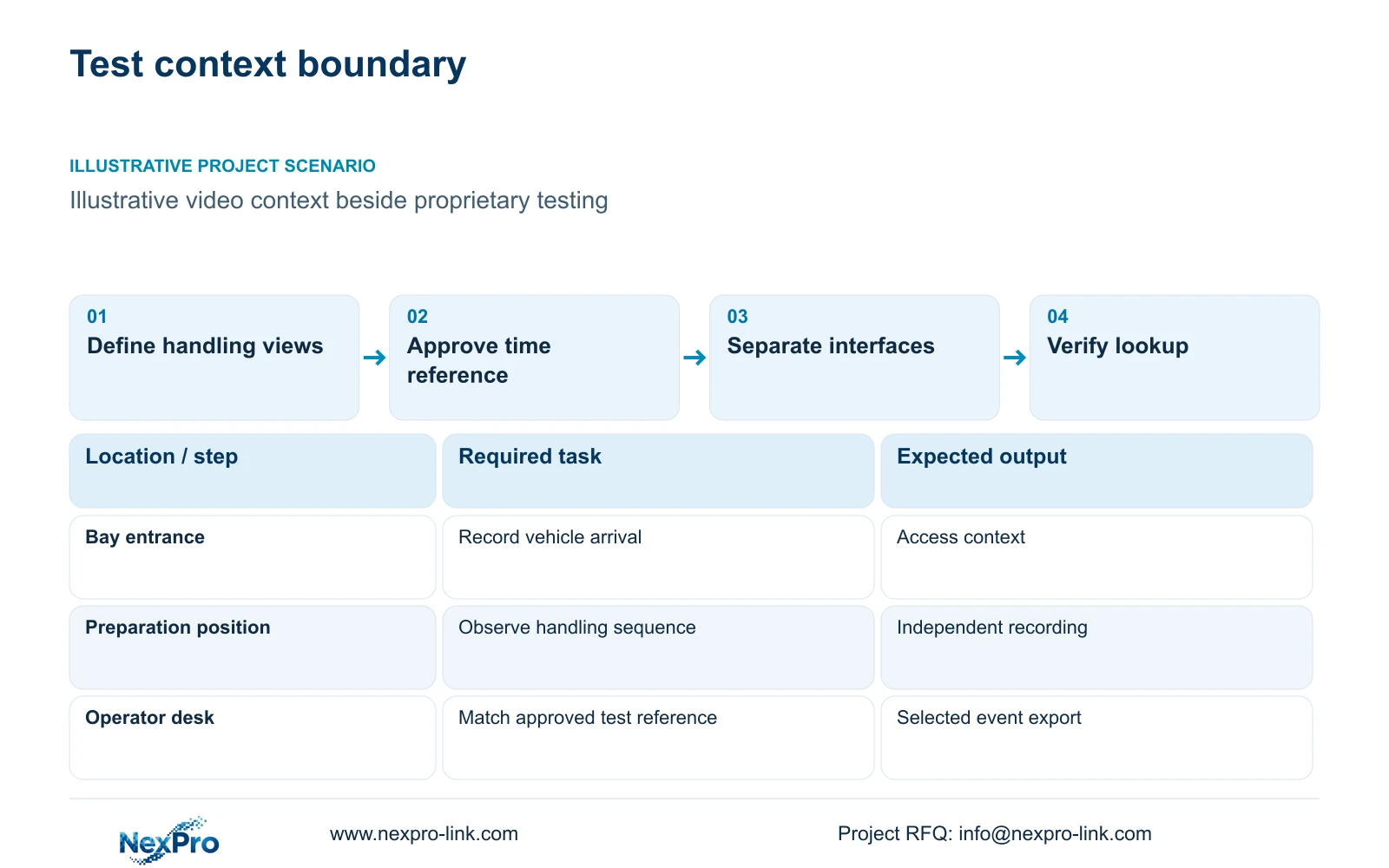
Define the questions the footage must answer: which vehicle entered, whether access occurred during preparation and how equipment was handled before departure. Identify the necessary view and event interval for each question. A camera showing the bay door may support access review but cannot establish a measurement value. That distinction gives the design engineer a bounded security scope and a separate list of potential test-system interfaces.
Section 02
Separate video access from test triggers
Draw the camera-to-switch-to-recorder path independently from the proprietary test network. List authorized operator access, time services and any proposed event interface as distinct connections. NIST SP 800-82 Rev.3 is a useful OT-security reference for considering operational constraints and separation; it does not supply this project's network design or vendor approval.
The baseline can use a test-run reference and timestamp entered into a lookup procedure. If automatic linking is required, obtain the actual event fields, interface direction, authentication method and failure behavior from the test supplier. A start-time message is different from a control command. The appointed integrator should explain precisely what crosses the boundary.
Confirm each camera and client stream combination on the selected firmware. ONVIF profile applicability concerns exact device and client implementations; successful basic video connection does not establish event search or proprietary test linking. Avoid enabling unnecessary camera lighting or audio functions near tests without the bay owner's approval. Any feature that could affect the test environment belongs in the reviewed configuration.
Section 03
Use the maintenance window for bounded acceptance work
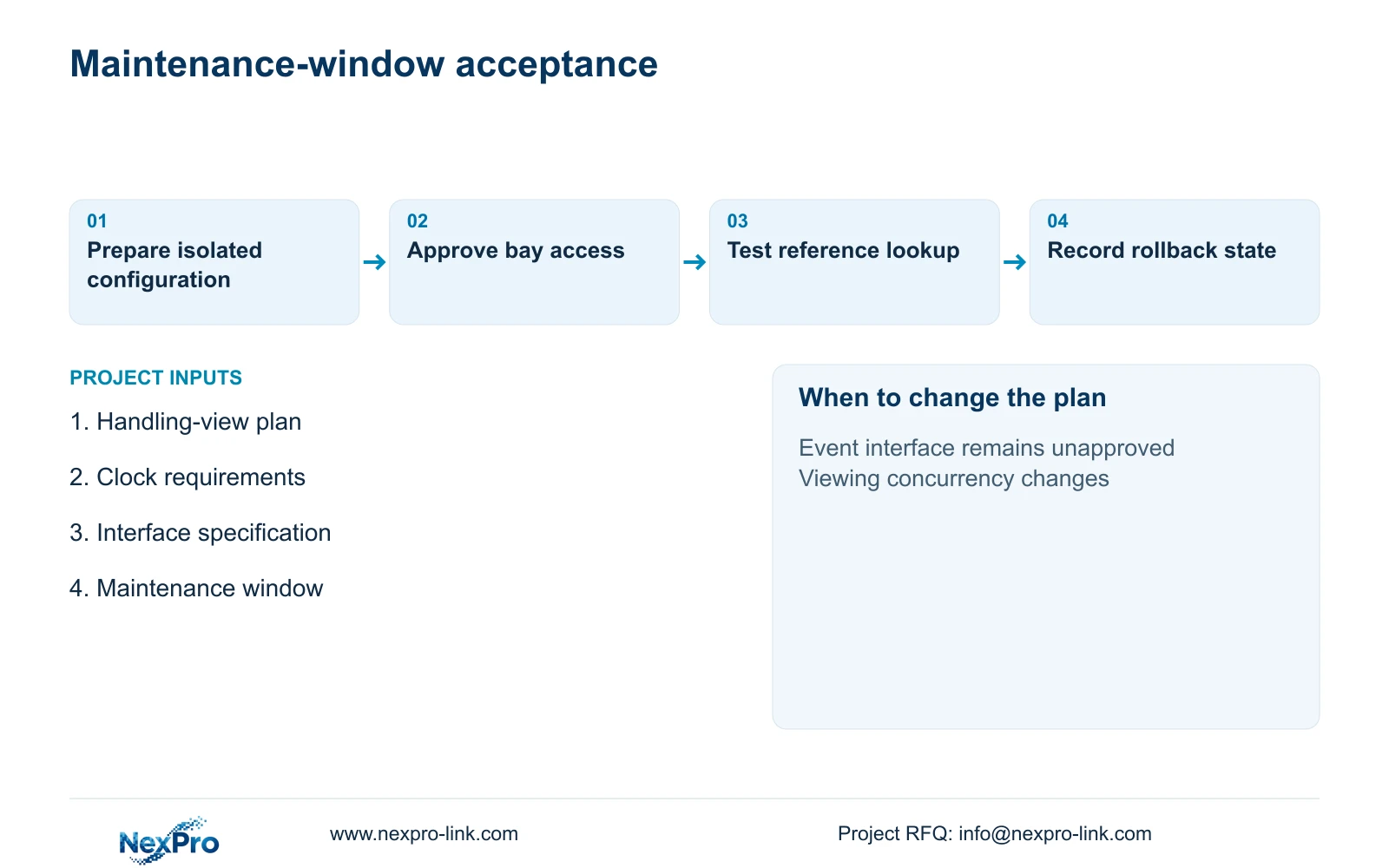
Prepare equipment configuration before the agreed maintenance window, then reserve site time for mounting, route verification and workflow checks that depend on the actual bay. The test supplier should identify when equipment can be approached and which areas remain unavailable. Do not treat an empty calendar slot as permission to alter test infrastructure.
Suitable ordinary-area viewpoints may use NexPro-BL2812M55-5MP-DIC-AI, whose source lists a 2.8–12mm motorized lens and 2880×1620 output in the 5MP family. Determine whether the view captures the required handling action without obstructing equipment or maintenance. These specifications do not establish specialist test capability or guaranteed synchronization.
Create an acceptance sequence with a known vehicle movement and test reference. Verify local recording, compare the approved time displays, locate the relevant interval and export it through the authorized client. For an optional interface, test missing and delayed events as well as normal operation. Preserve a rollback configuration and name the person who decides whether the test bay can return to service.
Section 04
Calculate the recording and viewing paths independently
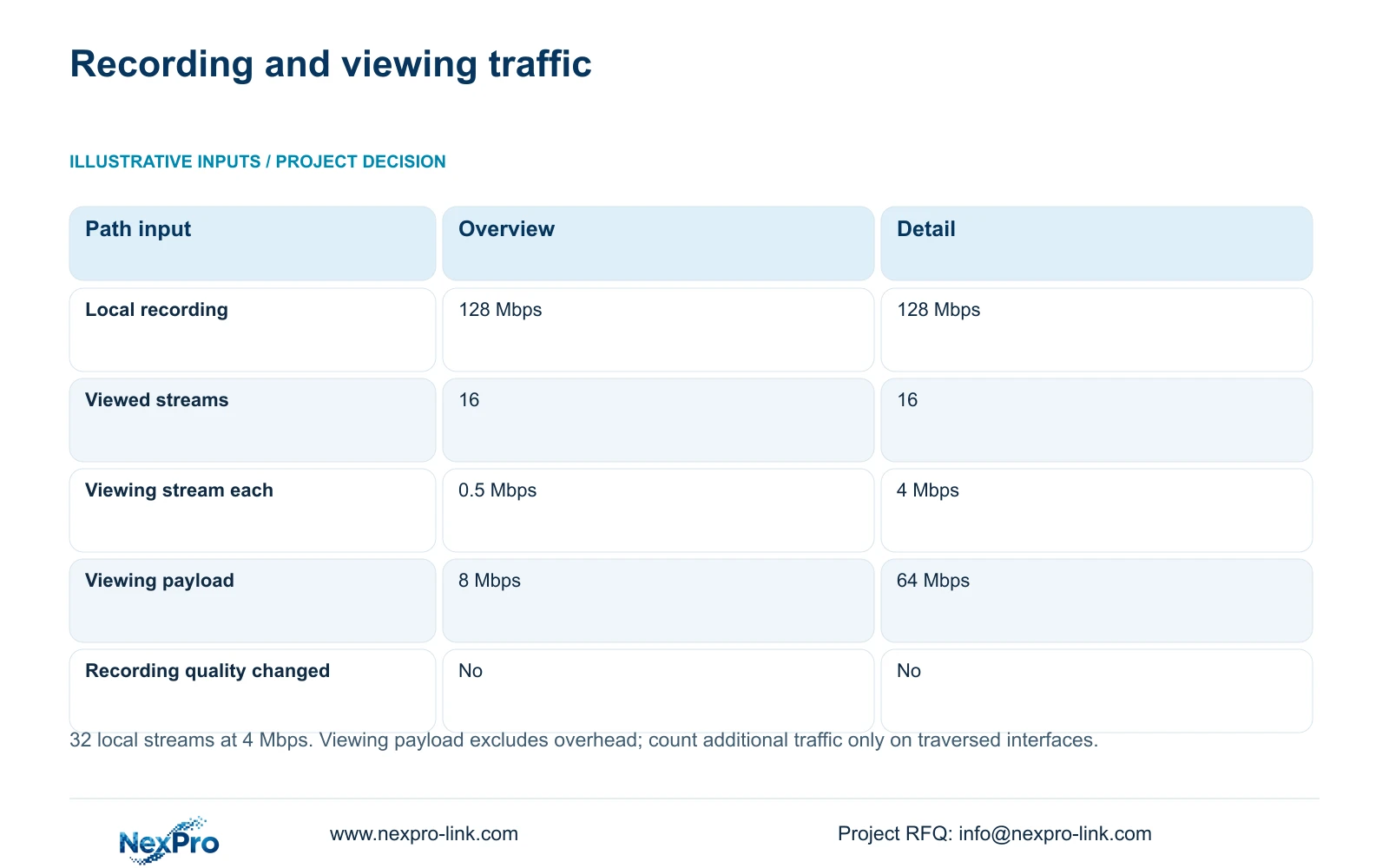
The illustrative network calculation uses 32 local main streams at 4 Mbps and 16 simultaneously viewed cameras. Local recorder payload is recorder_Mbps = 32 × 4 = 128 Mbps. Option A uses assumed 0.5 Mbps overview streams, giving viewing_Mbps = 16 × 0.5 = 8 Mbps. Option B views those cameras at 4 Mbps each, giving 16 × 4 = 64 Mbps.
Recording stays at the same assumed quality in both options. The decisive choice is which stream serves the operator's viewing task. An overview can preserve awareness on a constrained link, while selected detail viewing supports closer review. Confirm substream availability, client selection and recorded playback separately; the arithmetic establishes neither WAN performance nor universal stream compatibility.
Add traffic only where it actually crosses an interface. A shared uplink carrying recording and viewing needs both relevant flows, plus protocol overhead and other users. A separate remote-viewing link does not automatically carry all 128 Mbps of local recording. Include playback and exports when sizing their actual paths. CASE01's 32-camera basis provides context, but this traffic map must match the test-bay topology.
| Traffic input | Overview option | Detail option |
|---|---|---|
| Local recorder payload | 128 Mbps | 128 Mbps |
| Concurrent viewed cameras | 16 | 16 |
| Viewing stream per camera | 0.5 Mbps | 4 Mbps |
| Remote viewing payload | 8 Mbps | 64 Mbps |
| Local recording quality changed | No | No |
Section 05
Approve independent recording before optional automation
Recommend independent context recording and a documented time-based lookup as the initial scope. Add automatic event linking when repeated operational use justifies it and the test vendor provides a supported interface. If the required outcome concerns measurement accuracy or test-trigger timing beyond demonstrated CCTV capability, retain the specialist test-system solution.
The supplied CASE01 also shows that supporting power and storage remain independent design decisions. Its 30-day video estimate is 41.472 TB under continuous 4 Mbps recording assumptions. That amount does not shrink because operators use overview streams. Protect the camera switches and recorder through their actual supply nodes so a power interruption does not leave only the viewing client running.
NexPro-NVR4449-4K lists 320 Mbps input and four SATA bays, but its channel count does not prove the required simultaneous playback or decoding workflow. Demonstrate those operations on the selected configuration. A normal workstation may satisfy review needs; a display wall is an additional client branch, not a prerequisite for recording or a substitute for test-event integration.
Section 06
Issue an interface schedule with named owners
The supply package should contain handover views, a stream schedule and a separate process-interface list. State what is supplied, retained and optional. Assign camera configuration to the equipment scope, site cabling and mounting to the agreed installation party, and proprietary event access to the test supplier or appointed integrator.
NexPro-Link's BOQ and tender support can coordinate model matching, technical documentation and quotation deviations for the security equipment. The submission should preserve the selected firmware and stream settings so a prepared sample and the delivered batch can be compared. Project packing can identify bay-specific units without placing private network details on public labels.
Acceptance records should state the demonstrated lookup procedure, observed timestamp relationship and available export functions. Any automatic linking still awaiting vendor approval should remain an open interface, not a completed feature. This lets the owner procure useful context recording while keeping test-system responsibilities and later integration work visible.
Section 07
Buyer questions
Can CCTV timestamps validate the timing of a test measurement? Only to the accuracy actually specified and demonstrated for the required workflow. Contextual timestamp matching should not be presented as measurement-grade synchronization or proof of a test result.
Can the test-system supplier remain outside the CCTV order? Yes for independent recording, provided the time reference and lookup procedure are approved. Automatic event linking still needs its interface information and cooperation, even if its work is purchased separately.
What should happen if automatic event messages stop? Specify the degraded workflow before acceptance. Independent recording should remain available, missing links should be visible to operators, and the responsible party should investigate without silently implying that every test remains indexed.
Section 08
Define a test-bay recording boundary
Send your access and handling view plan, approved time-reference requirements, network and proposed interface diagram, and maintenance window to info@nexpro-link.com for a bounded CCTV equipment proposal.
Engineering references
These sources support the general planning principles. Always use the selected product's current datasheet and applicable project standards for final design.