Build an automotive parts CCTV schedule around custody transitions, common timestamps and usable exports, while keeping production traceability responsibilities separate.
Section 01
Define the custody change each view must explain
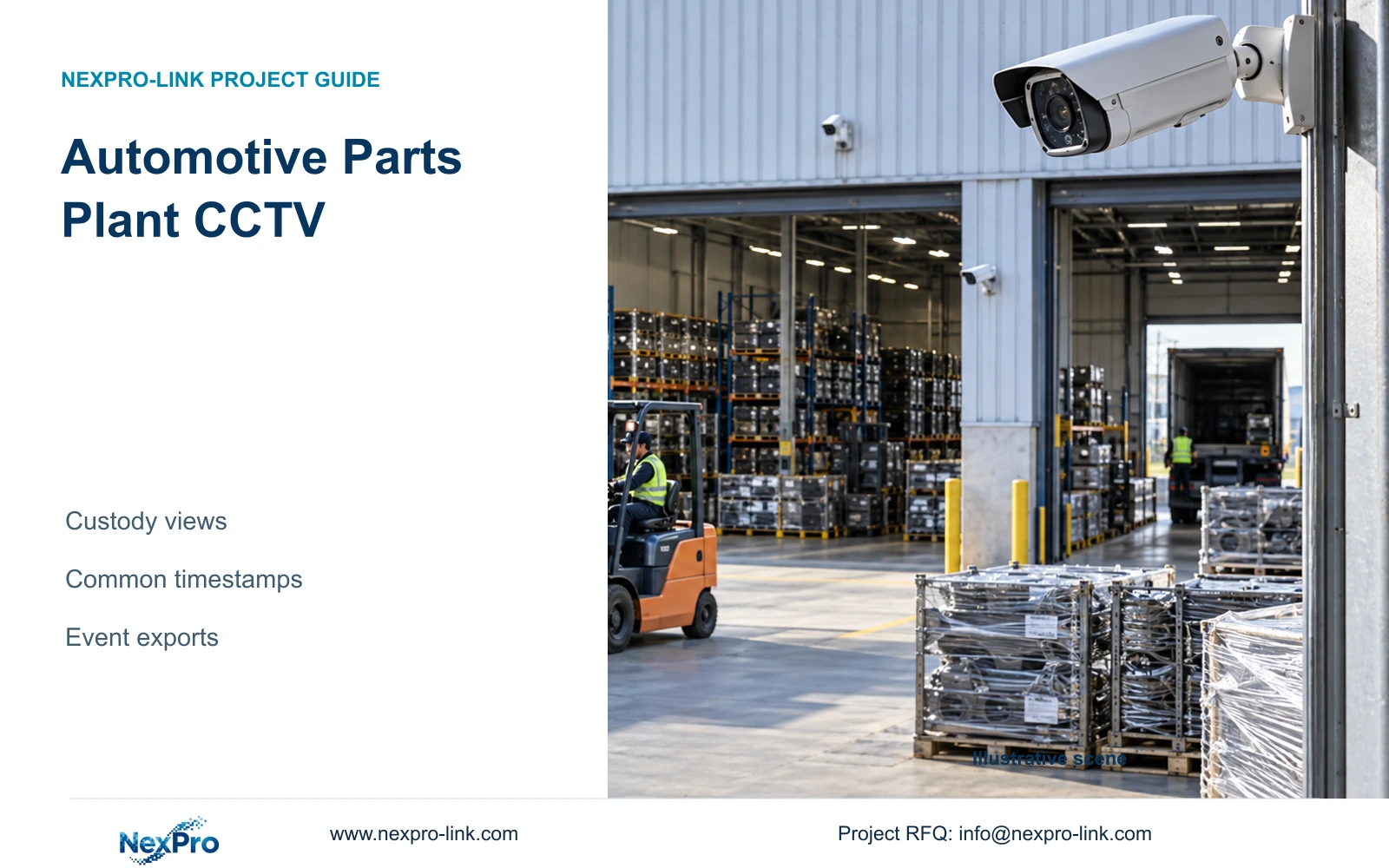
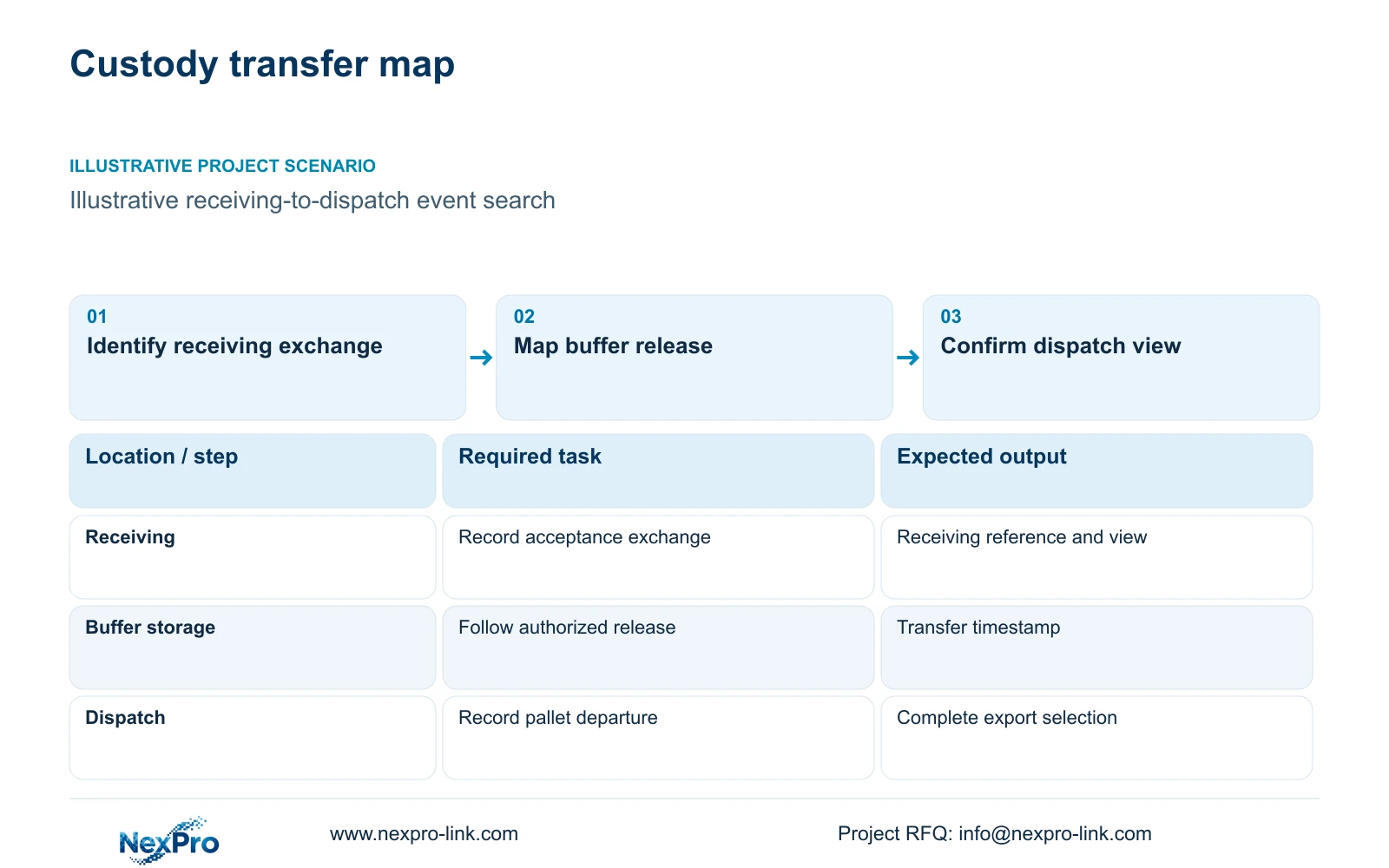
Automotive parts plant CCTV should follow the points where material changes custody: receiving acceptance, movement into buffer storage, release to assembly and finished-goods dispatch. Name each view by its transfer task and use an approved common time reference. This gives investigators a route through the recordings without treating security footage as a replacement for product traceability records.
Illustrative project scenario: A parts plant needs to locate an event from receiving, buffer storage and outgoing pallets. Assume its logistics team can provide receiving references and dispatch times, while assembly supervisors identify the permitted transfer routes. These are planning assumptions, not details of a completed customer installation.
For each transition, record who releases the material, who receives it, where the exchange occurs and what must remain visible. A gate overview may show vehicle arrival but miss the pallet handover behind the trailer. The quantity surveyor should therefore price accepted observation tasks, including their mounting and recording dependencies, rather than apply one camera allowance to every doorway.
Section 02
Keep station context separate from component inspection
At an assembly station, decide whether the requested image concerns access, material placement or component quality. Security recording can provide context for a transfer or handling question. Dimensional inspection, defect detection and machine control require their own specified systems. Keeping those outcomes separate prevents an ordinary camera specification from acquiring an unpriced inspection obligation.
Obtain the transfer width, camera distance, typical pallet height and lighting conditions during every operating shift. Review the view with a loaded trolley in place. If the operator or fixture hides the exchange, changing the lens alone may not recover it; move the viewpoint or add a justified second angle.
For suitable ordinary locations, NexPro-BL2812M55-5MP-DIC-AI is a candidate with a 2.8–12mm motorized lens and a listed 2880×1620 output within its 5MP-family specification. Those fields support a viewpoint discussion, not a guaranteed label-reading distance. Acceptance should use recorded footage of the actual transfer, including motion and compression, rather than a stationary live image.
Section 03
Carry one recording identity into drawings and exports
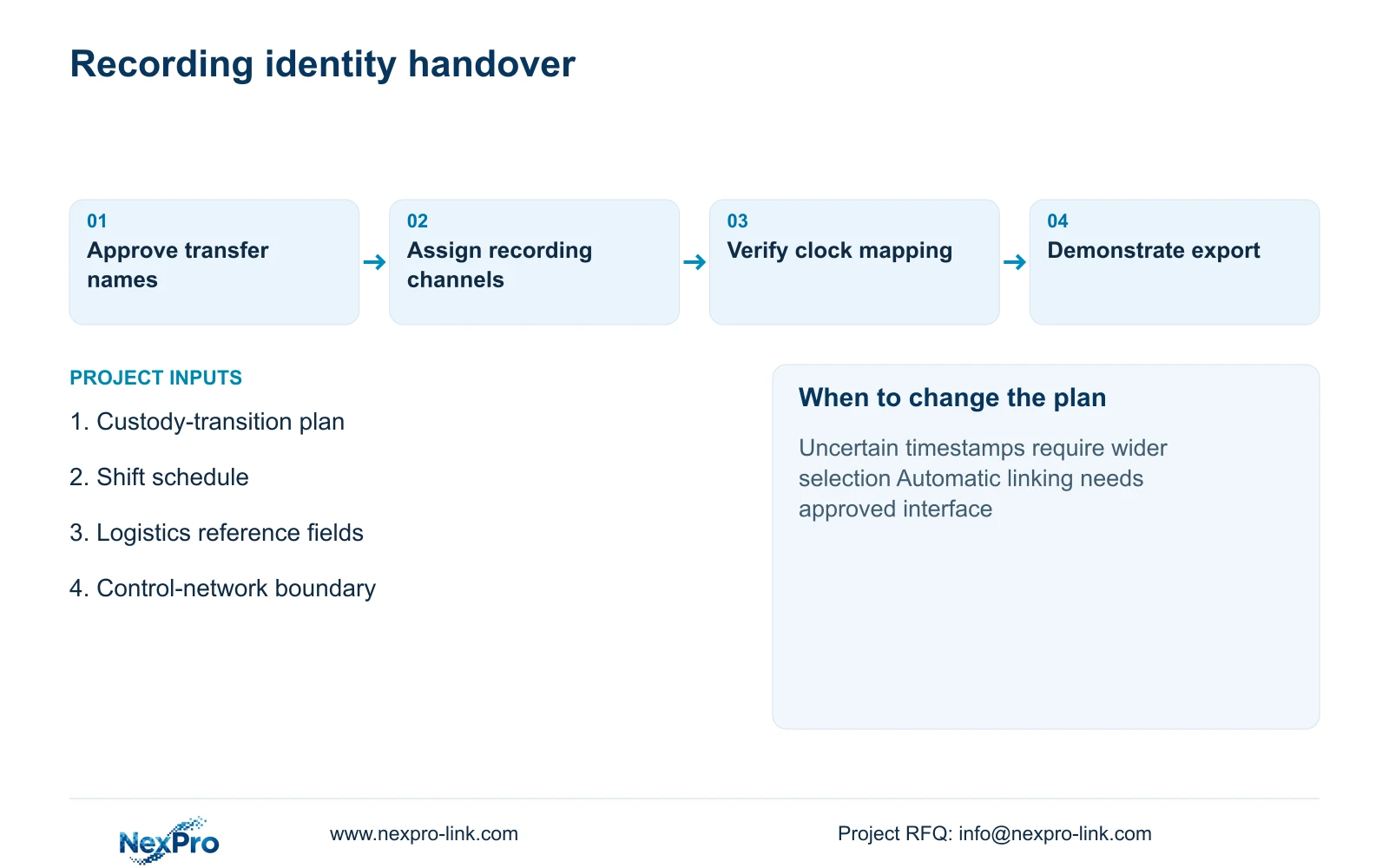
Use a stable location identifier such as receiving handover or buffer release, then associate it with the channel, device serial number and drawing position. Avoid naming cameras only by model or installer sequence. The logistics supervisor needs to recognize the task, while maintenance staff need to find the physical unit.
The engineer should specify the approved clock source, time zone and procedure for checking timestamp differences between CCTV and production records. Do not assume that identical displayed times prove precise synchronization. Include a commissioning exercise in which a known transfer is located from both the operational record and the exported video.
Create a handover-view schedule and a separate process-interface list. Mark cameras and recorder configuration as supplied, existing logistics records as retained, automatic event linking as optional, and cable installation as the local contractor's responsibility where that is the agreed split. Each optional interface needs an owner, documented data fields and an acceptance task before it enters the priced scope.
Section 04
Narrow exports only after confirming the complete event
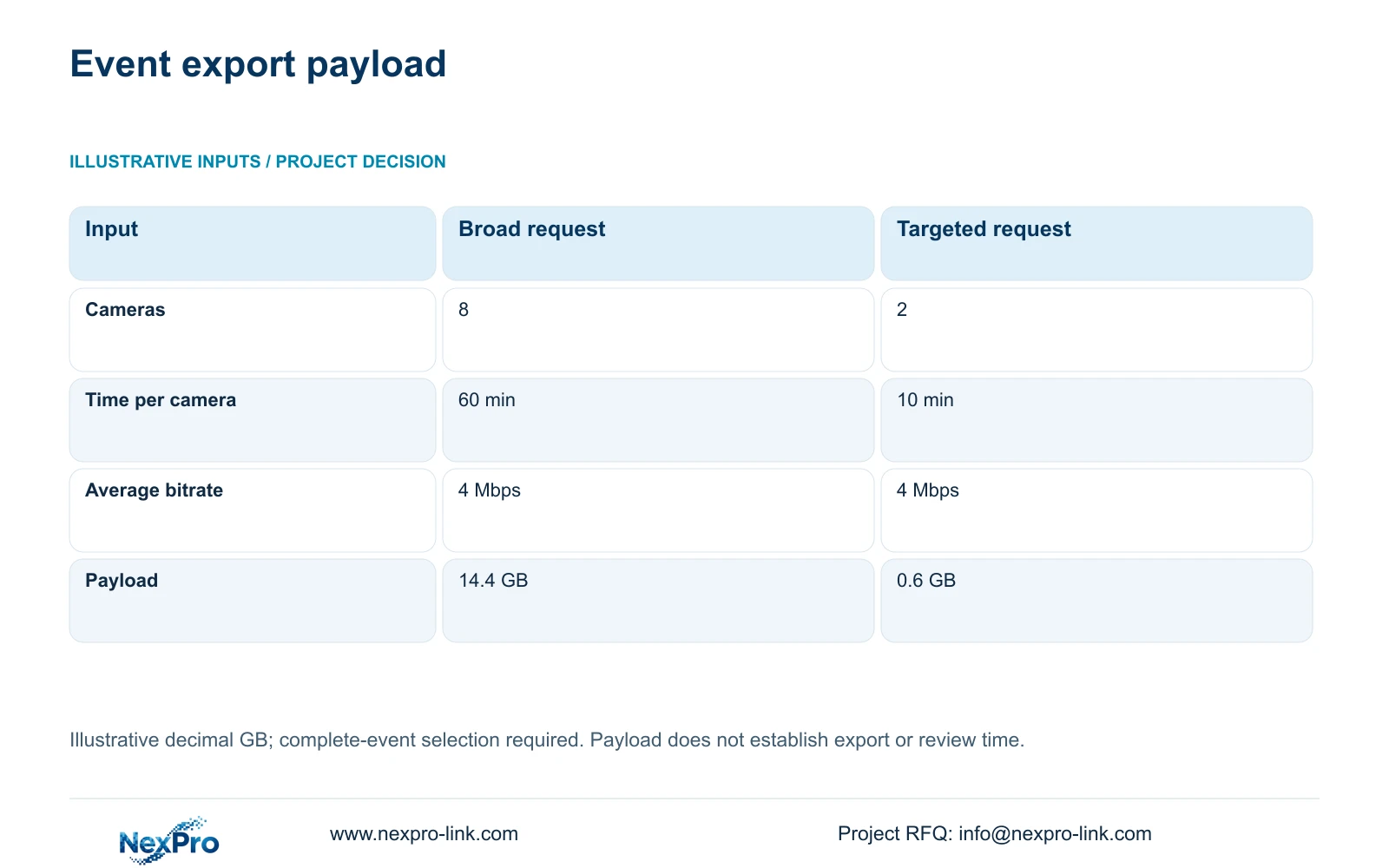
An illustrative broad request selects eight cameras for 60 minutes each at an assumed average 4 Mbps. A targeted request selects two relevant cameras for ten minutes each at the same rate. Using decimal units, GB = cameras × Mbps × seconds / 8 / 1000. The calculations are 8 × 4 × 3600 / 8 / 1000 = 14.4 GB and 2 × 4 × 600 / 8 / 1000 = 0.6 GB.
The decisive difference is the authorized selection of cameras and time, not a change in recording quality. A reliable transfer map can reduce unrelated material in the export. However, ten minutes is acceptable only when it includes the required lead-in, exchange and subsequent movement. An uncertain timestamp or unexplained gap calls for a wider selection.
Keep the retrieval calculation separate from retention sizing. The supplied CASE01 reference uses 32 cameras at 4 Mbps continuously for 30 days, producing 41.472 TB of video. Its four 16 TB disks provide an illustrative recording budget of 48.64 TB after the stated formatting and reserve allowances. A small export does not reduce that continuous recording requirement or establish faster staff review.
| Selection input | Broad request | Targeted request |
|---|---|---|
| Cameras selected | 8 | 2 |
| Minutes per camera | 60 | 10 |
| Average bitrate | 4 Mbps | 4 Mbps |
| Estimated payload | 14.4 GB | 0.6 GB |
Section 05
Price the working investigation path
Prefer transfer-focused views with a common recording identity and a usable search-and-export workstation. Add automatic production-event linking only when the plant requires it and the interface can be demonstrated. This preserves the investigation task while allowing the cost team to distinguish essential recording from optional integration.
The complete path includes cameras, local access switches, recorder and disks, authorized clients and the necessary cable routes. CASE01 illustrates why power belongs in that scope: protecting the recorder alone leaves camera-side switches dependent on their own supply. Where complete switch AC demand already includes PoE devices, do not count camera watts again.
NexPro-NVR4449-4K lists 49 channels, 320 Mbps input and four SATA bays up to 18 TB each. Its published summary separates 49×5MP from 9×4K; channel capacity does not settle playback concurrency or RAID. Compare alternative brand offers against the same transfer views, retention and export workflow, retaining required owner-platform functions rather than declaring a winner from camera prices.
Section 06
Make the supply schedule usable at receiving and commissioning
The procurement schedule should pair every observation task with its mounting accessories, termination method, recorder assignment and acceptance requirement. Separate retained equipment from new supply and show installation, configuration and operator instruction as distinct responsibilities. Unknown service costs should remain visible instead of disappearing into an equipment-only comparison.
NexPro-Link's BOQ and tender support can help translate the approved schedule into model matching, technical submittals and quotation deviations. Project labels and packing can preserve the transfer identities through shipment, so a receiving team can distinguish a dispatch-view kit from a buffer-storage kit without opening every carton.
Before handover, ask an authorized operator to locate a receiving reference, follow the relevant buffer transition and export the complete dispatch event. Record any timestamp difference, missing view or unavailable client function as an unresolved item. The resulting package is ready for procurement discussion when the required tasks and responsibilities are clear, even if optional integration remains outside the order.
Section 07
Buyer questions
Should every handover camera be upgraded to a higher resolution? Only where the accepted task needs additional detail and a recorded trial supports the change. A better position or narrower dedicated view may address the problem, while an overview remains necessary for movement context.
Can we use a production reference to open video automatically? Treat that as an interface requirement. Confirm the available identifier, timestamp, software endpoint and responsible integrator. Until demonstrated, retain manual lookup through an approved reference-to-camera mapping.
What if receiving and dispatch clocks disagree? Preserve the observed offset and widen the search interval. Correct the approved time configuration through a controlled change, then repeat the lookup exercise rather than silently relabeling earlier recordings.
Section 08
Define your parts-transfer recording scope
Send your custody-transition plan, shift and vehicle-movement schedule, recording and export requirements, and control-network boundary to info@nexpro-link.com for a task-based equipment and interface quotation.
Engineering references
These sources support the general planning principles. Always use the selected product's current datasheet and applicable project standards for final design.