Three solar-manufacturing blocks can retain security footage locally while a shared desk reviews selected events. This reference distinguishes 384 Mbps of site recording input from traffic that actually crosses the backbone.
Section 01
Allocate security tasks independently in each production block
For a 96-camera solar-manufacturing campus, keep each block's evidence complete locally and size shared viewing paths from actual operator sessions. Central duplication is not part of this reference. A shared desk should access selected events without becoming the recording destination for every camera or a connection into manufacturing test systems.
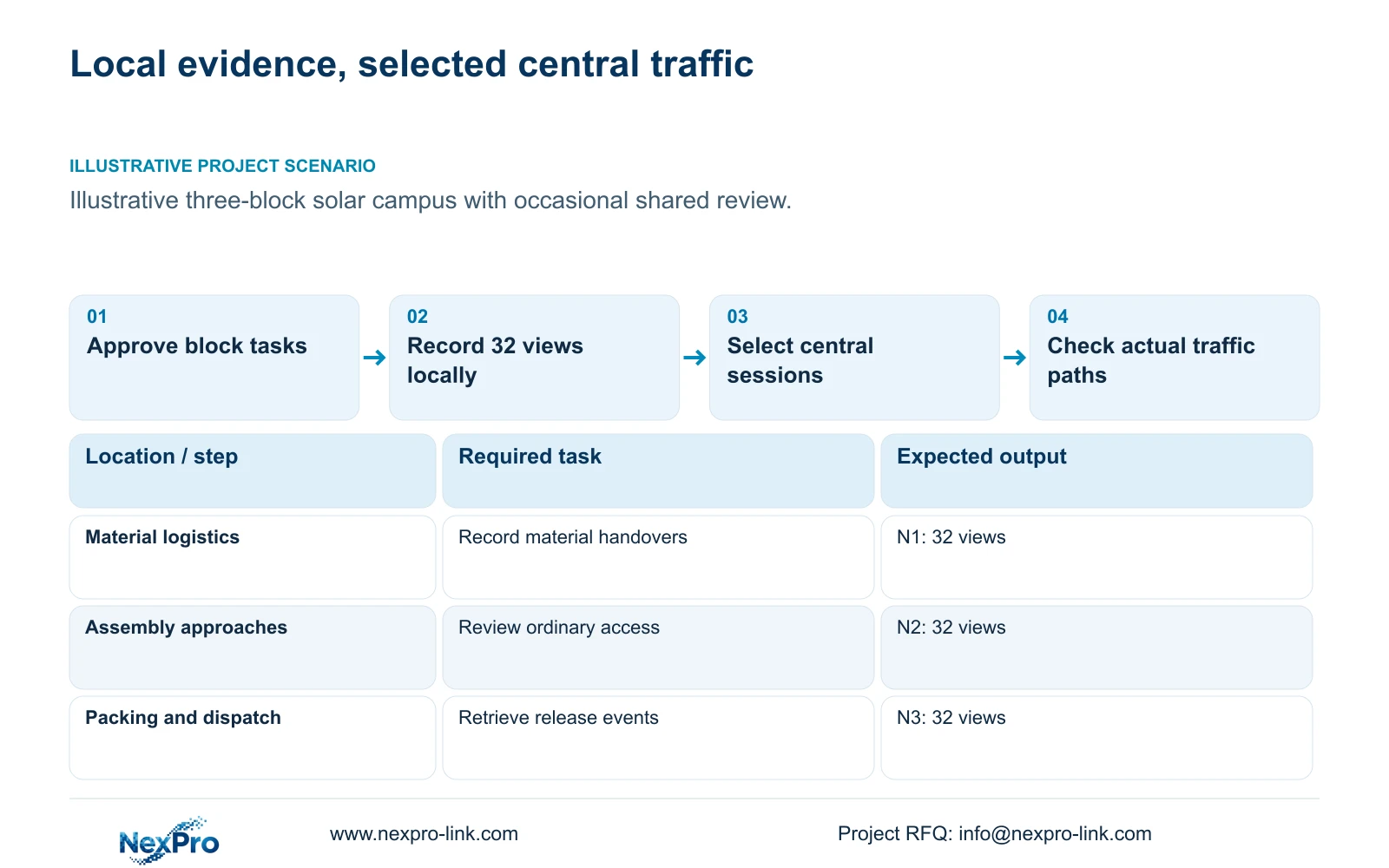
Illustrative project scenario: Three production blocks need 32 security views each and occasional central review without mandatory central duplication. N1 serves material logistics, N2 ordinary assembly approaches and N3 packing/dispatch. All ninety-six positions are ordinary security locations, with an illustrative 30-day continuous-recording target.
Give each block its own point schedule and acceptance owner. At panel handovers, identify the relevant aisle, transfer boundary and event-time reference. Check views with large panels and packing materials in place because the useful scene may change as stock accumulates. Security cameras record movement and handovers; cell inspection, electrical test results and line control remain separate systems with their own records.
Section 02
Size three local disk budgets rather than one campus pool
Assume 4 Mbps average per camera, 24-hour recording and 30 days. Each node receives 32 × 4 = 128 Mbps. Video_TB = 32 × 4 × 10^6 × 86400 × 30 / 8 / 10^12 = 41.472 TB per node. Site recording input totals 384 Mbps and required video totals 124.416 TB.
Install four compatible 16 TB drives per node for 64 TB raw. The illustrative formatted capacity is 64 × 0.95 = 60.8 TB; recording_budget = 64 × 0.95 × 0.80 = 48.64 TB. Each 41.472 TB requirement fits its own budget. Required usable capacity is 51.84 TB per node and 155.52 TB across the campus. Reserve is already included in the budget comparison.
NexPro-NVR4449-4K is the 320 Mbps, four-SATA-bay reference with up to 18 TB per drive. Confirm supported 5MP-class streams against the separate 49×5MP and 9×4K summary modes. BL/DM ordinary candidates list 2880×1620 output and 2.8-12 mm motorized lenses. Disk bays and recording channel counts do not demonstrate RAID, all-4K decoding or seamless cross-node recovery.
Section 03
Calculate shared traffic from the desk's actual workload
Each block contains SW1 through SW4 serving eight cameras each, for twelve access groups overall. At assumed 12 W device-side demand, each group requires 96 W. PSE_output_W = 96 / 0.90 = 106.6667 W; budget_W = 106.6667 / 0.80 = 133.3333 W. Complete switch_AC_W = (106.6667 + 15) / 0.90 = 135.1852 W.
These power figures do not establish a particular switch's suitability. Obtain actual camera maxima, port requirements, total switch budget and uplink configuration. Keep each 128 Mbps recording path local. The sum of 384 Mbps is useful for campus accounting, but it is not automatically the demand on a WAN link or the shared desk's receiving interface. For each block's eight-camera group, establish whether the switch admits devices by negotiated PoE class or another documented allocation policy. The estimated draw plus headroom does not alone establish that all eight devices will be admitted.
For a further illustrative desk workload, eight selected main streams at the same assumed 4 Mbps contribute 32 Mbps of video payload. Add playback, export and other sessions traversing that interface, with measured peaks and protocol overhead. Specify substream rates separately if overview windows use them. Test the agreed session mix and keep manufacturing inspection and control networks outside the authorised security path.
Section 04
Add central displays only to the circuit that powers them
Option A totals 682.7407 W at N1 and 617.7407 W each at N2 and N3. Each node includes four complete switch AC inputs, an assumed 30 W recorder and four drives at 8 W each. N1 also includes a 25 W core, 15 W router and 40 W retrieval display; other nodes include a 15 W link terminal. Camera power is already counted through the switches.
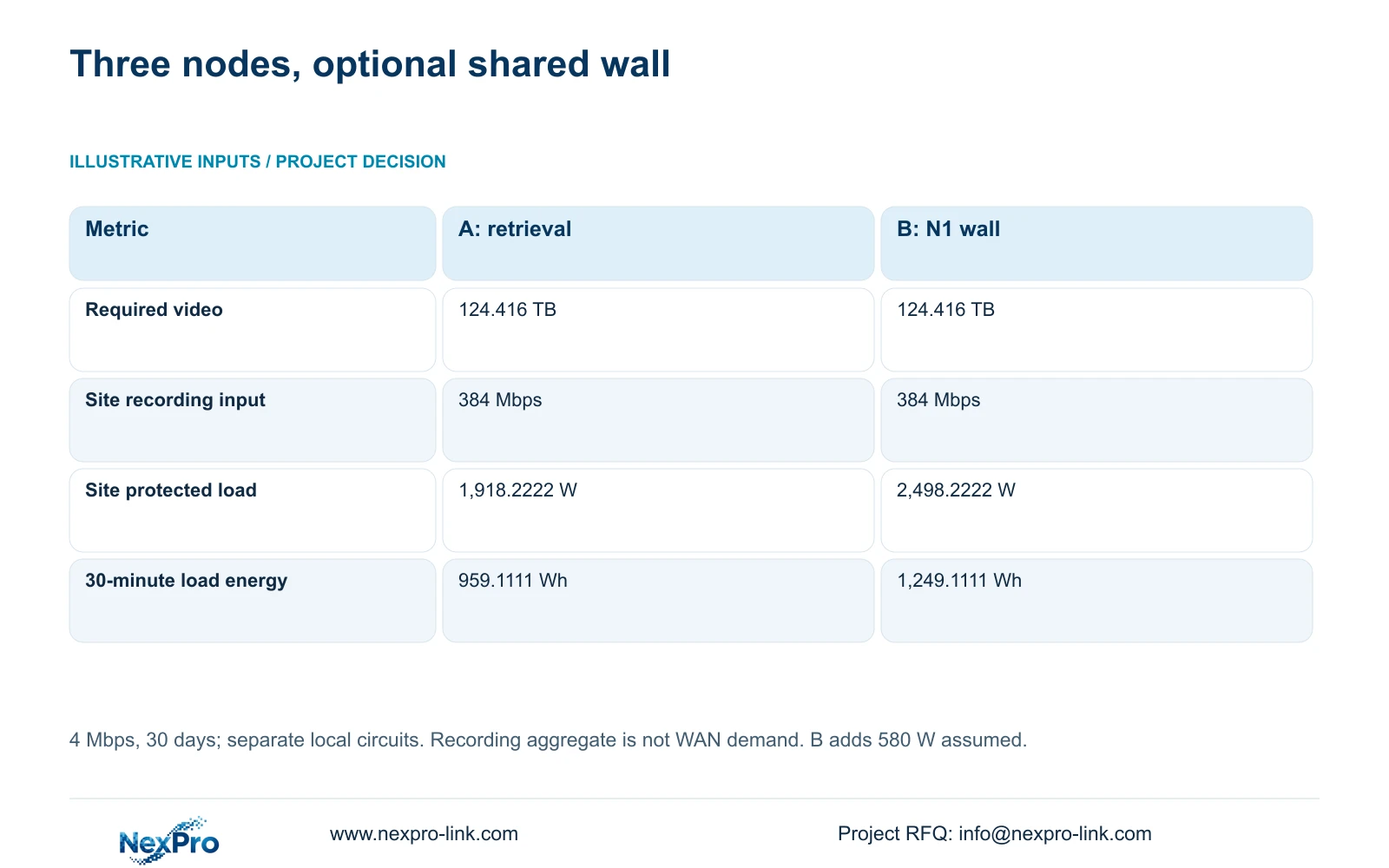
A four-panel LCD wall at an assumed 120 W per panel plus 100 W decoder adds 580 W at N1 only. N1 becomes 1,262.7407 W and site demand becomes 2,498.2222 W. The table shows identical video requirements but different power scope. Choose the wall if the operator task requires shared simultaneous visibility; a larger wall does not produce additional retained footage.
Check rated_W ≥ load_W / 0.80 and rated_VA ≥ load_W / 0.72 using assumed PF 0.9. SP1KR(S), rated 1 kVA/900 W, is A's candidate at each node; B changes N1 to SP2KR(S), rated 2 kVA/1800 W. Load_Wh = load_W × 30 / 60 gives 341.3704/631.3704 Wh at N1 and 308.8704 Wh at each other node. Obtain exact battery curves; site totals do not create a shared backup circuit.
| Metric | A: shared retrieval desk | B: add N1 wall |
|---|---|---|
| Required site video | 124.416 TB | 124.416 TB |
| Site recording input | 384 Mbps | 384 Mbps |
| N1 protected demand | 682.7407 W | 1,262.7407 W |
| Site protected demand | 1,918.2222 W | 2,498.2222 W |
| 30-minute site load energy | 959.1111 Wh | 1,249.1111 Wh |
Section 05
Separate local copper quantities from inter-block fibre
The reference's ninety-six new camera runs total 5,616 m. Each continuous run is 41 to 76 m, including a stated 6 m service/termination allowance added to base routes of 35 to 70 m. The reel lower bound is ceil(5,616 / 305) = 19, while the supplied feasible allocation requires twenty 305 m reels.
Preserve that difference in the purchase schedule. Four 76 m cuts use 304 m of a reel, and the supplied final reel holds one 41 m run. Those allocations demonstrate why total length alone cannot approve nineteen reels. Residue is not an undisclosed project reserve. A different cutting plan must assign every complete run before a smaller quantity is accepted.
Two module-ended terminations per run give 192 modules and 32 occupied panel ports per block. SP5648 is a local patch-panel reference, not a bulk cable specification. Design inter-block fibre from routes, terminations, optics and endpoint power separately. Keep patch cords, external sheath requirements, containment and test records tied to their actual installation locations.
Section 06
Release block kits and a separately qualified viewing branch
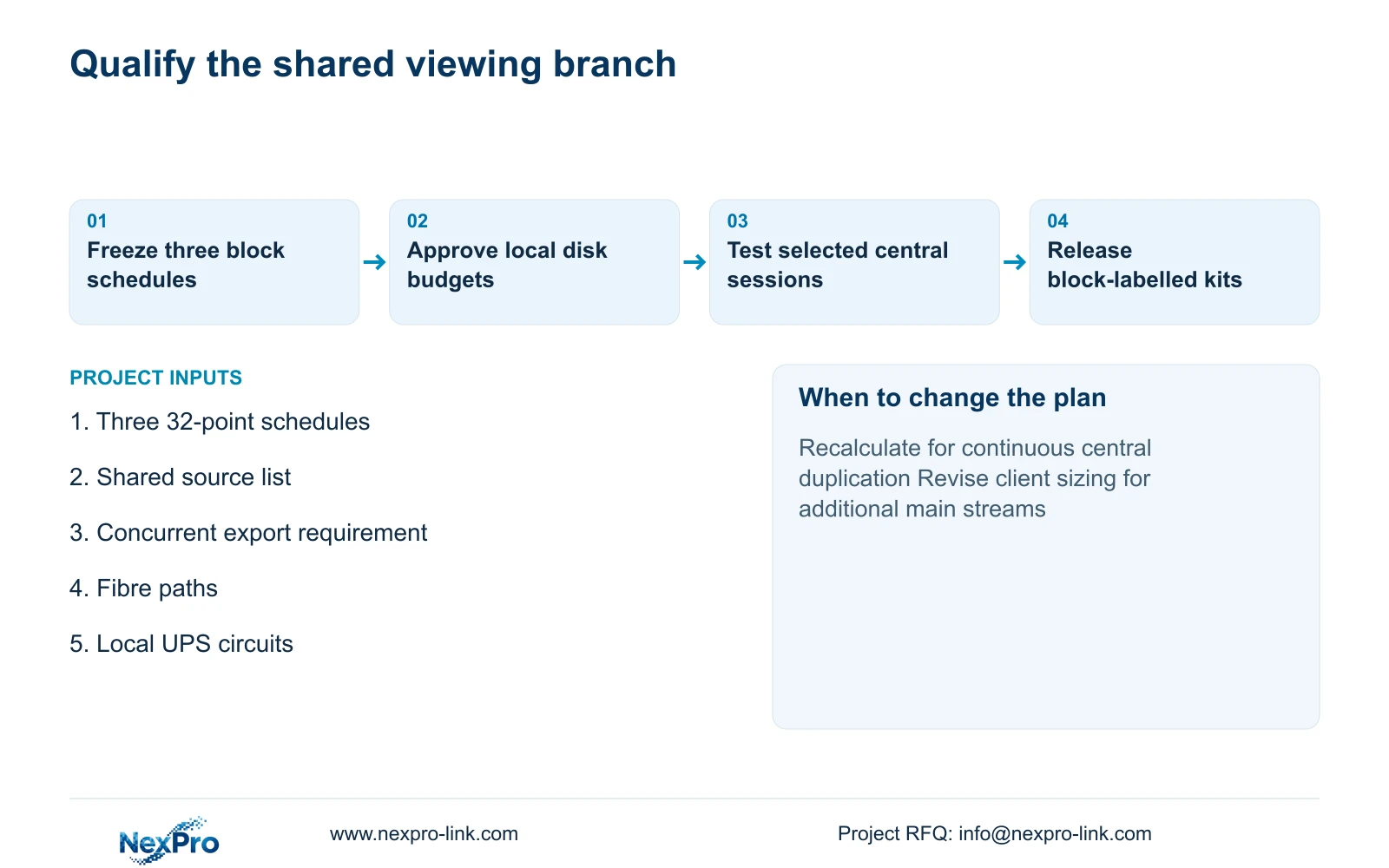
The baseline comprises ninety-six ordinary cameras, three recorders, twelve compatible 16 TB drives, twelve qualified access switches, three local UPS configurations and one retrieval display. Twenty cable reels support the supplied cutting allocation. Keep the shared desk's client hardware and software task visible because the reference display allowance does not define workstation decoding capability.
Release block-labelled schedules for logistics, assembly approaches and dispatch. The central branch needs an approved source list, concurrent viewing/export workload and permissions. NX-VP-5535 is an LCD option, while NX-VD-4K16 remains a decoder reference whose name does not establish every requested stream combination. Record those qualification results before ordering a wall package.
NexPro-Link can coordinate relevant equipment matching, submittals and project supply. Normalize alternative quotations to the same three local evidence tasks and shared-desk workload. Recalculate if the owner later requires continuous central duplication, more concurrent main streams or longer retention. Those changes add real network, storage and power work and should appear as explicit scope revisions.
Section 07
Buyer questions
Is 384 Mbps the required internet connection speed? No. It is the assumed sum of local recording inputs. Internet demand depends on authorised remote sessions, stream selection, playback and exports that actually traverse the WAN.
Can security footage verify a module's electrical test result? It may show a handling event or test-station approach, but it does not replace the electrical test record. Use the production record's event time to retrieve relevant security footage where permitted.
What if continuous central copying becomes mandatory? Treat it as a revised architecture. Specify the supported replication mechanism, destination capacity and outage behavior, then recalculate backbone traffic and protected equipment.
Section 08
Define the three-node and shared-desk workload
Send the three block schedules, local retention/stream settings, shared desk's concurrent source list, and backbone/power diagram to info@nexpro-link.com for a coordinated campus equipment scope.
Engineering references
These sources support the general planning principles. Always use the selected product's current datasheet and applicable project standards for final design.
- User BL2812M series product specification
- User DM2812M series product specification
- NexPro-NVR4449-4K
- NexPro-Link rack online UPS
- NexPro-Link Structured Cabling
- NexPro-Link BOQ & Tender Support
- NexPro-Link Project Supply
- NexPro-Link NX-VP-5535 LCD video wall panel
- NexPro-Link NX-VD-4K16 network video decoder
- Microchip: Next-Generation PoE IEEE 802.3bt White Paper