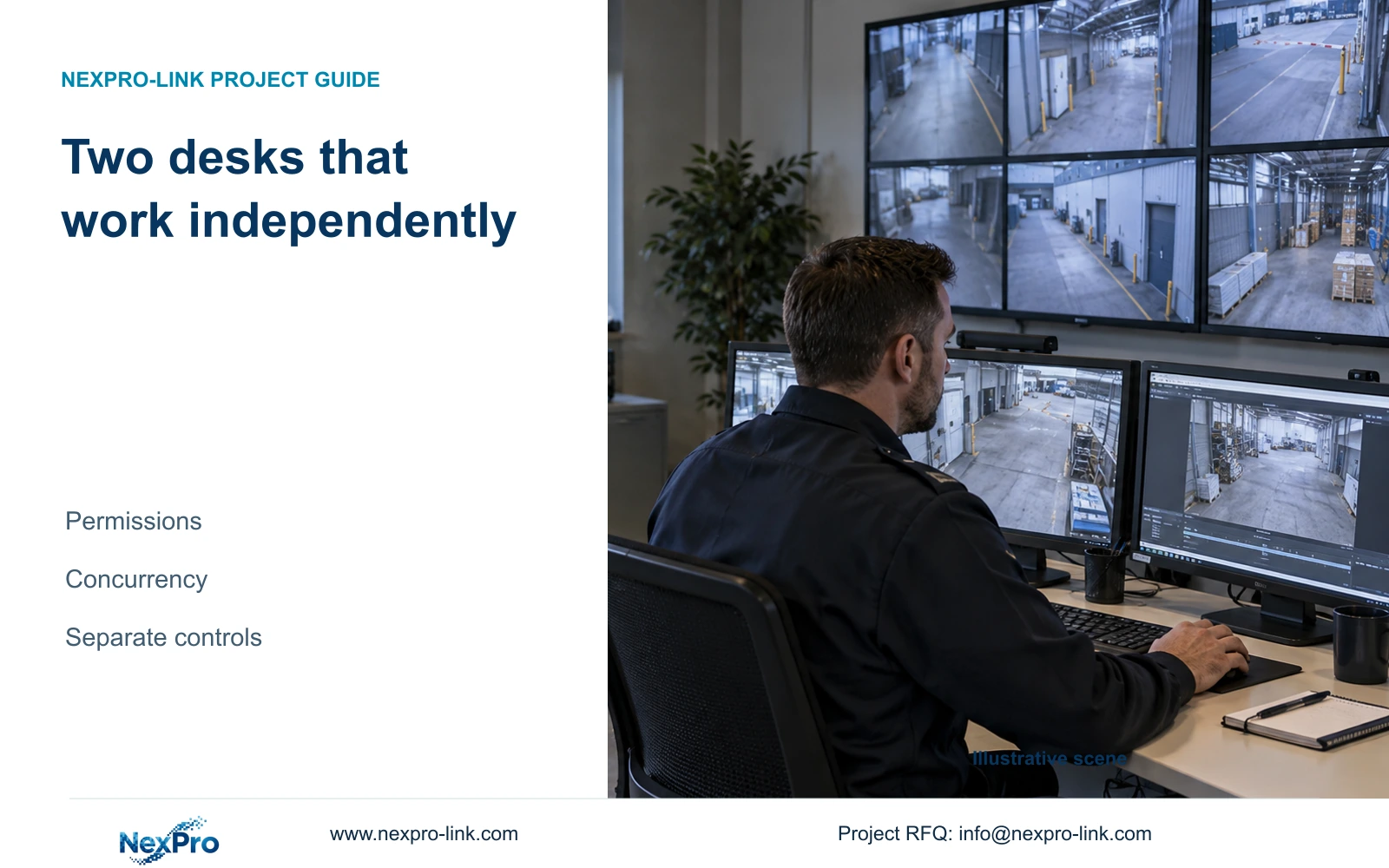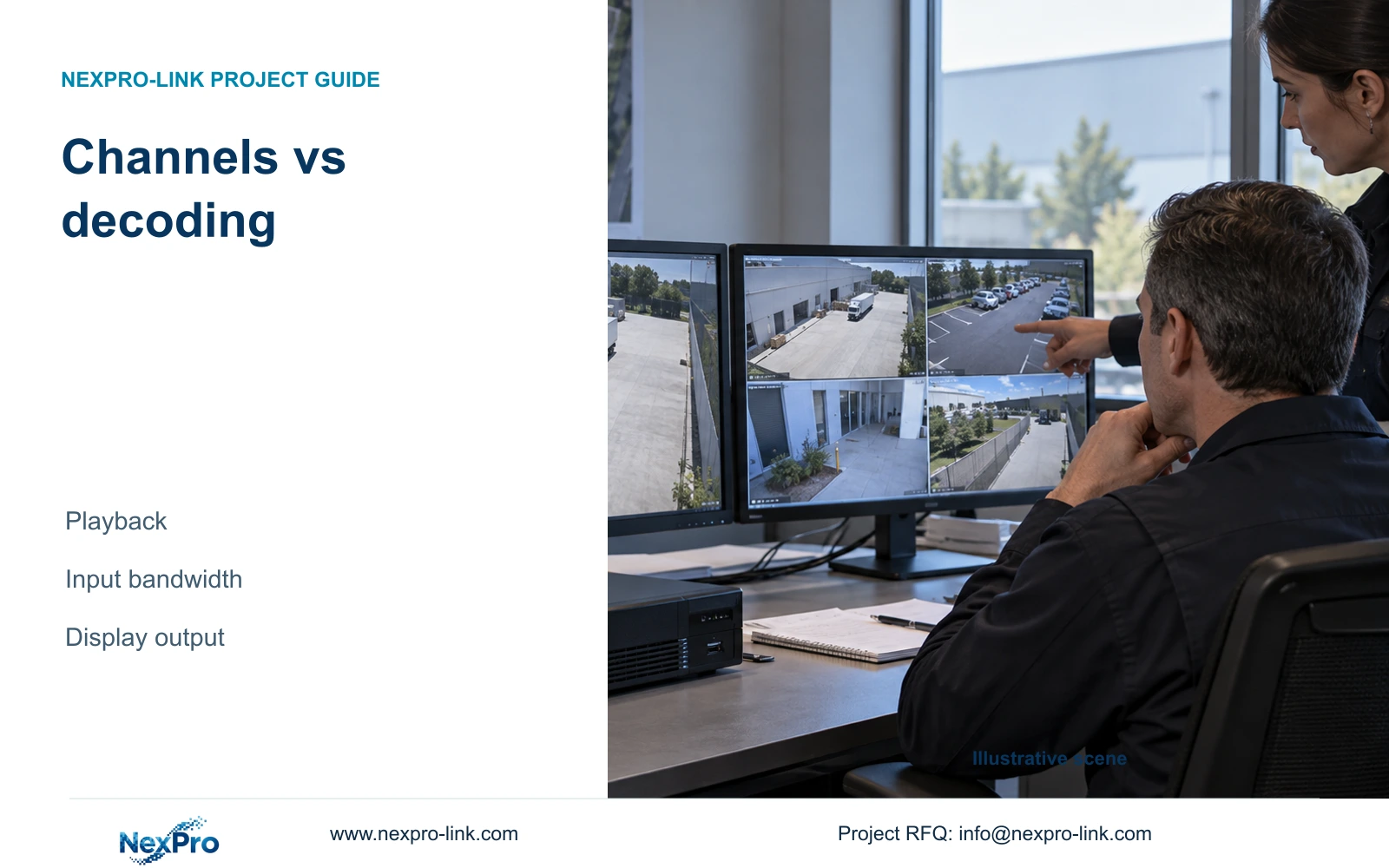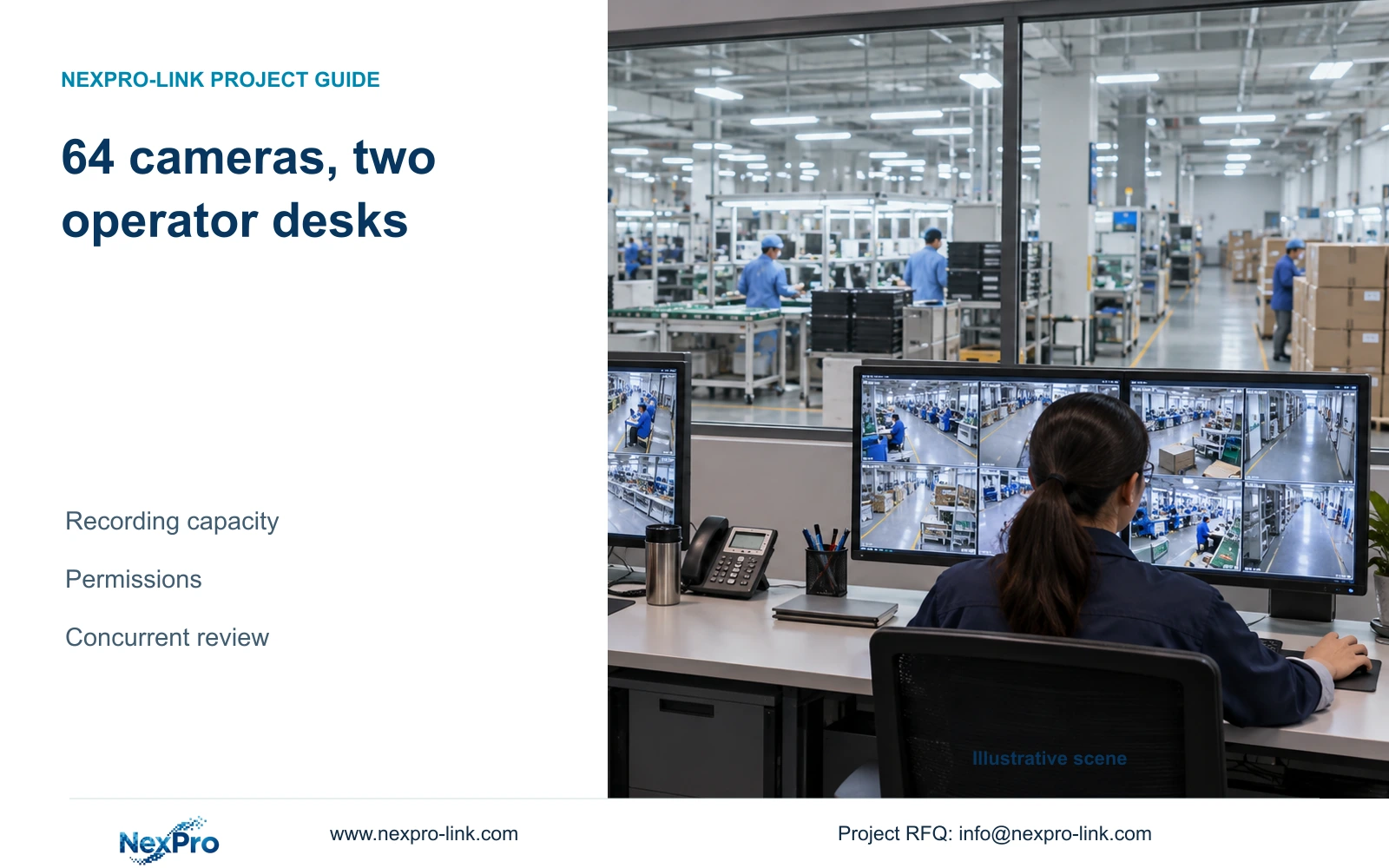
Two operator desks introduce permissions, playback and export demands that a 64-channel recording label cannot settle. This reference separates those tasks while coordinating storage, PoE, power and cabling.
Section 01
Separate confidential views from general operator duties
For a 64-camera electronics factory, size continuous recording first and qualify two simultaneous operator workflows afterward. Give confidential-area views explicit access rules and keep security traffic separate from product-test and production-control networks. Neither an additional desk nor a shared screen should silently expand who may review restricted footage.
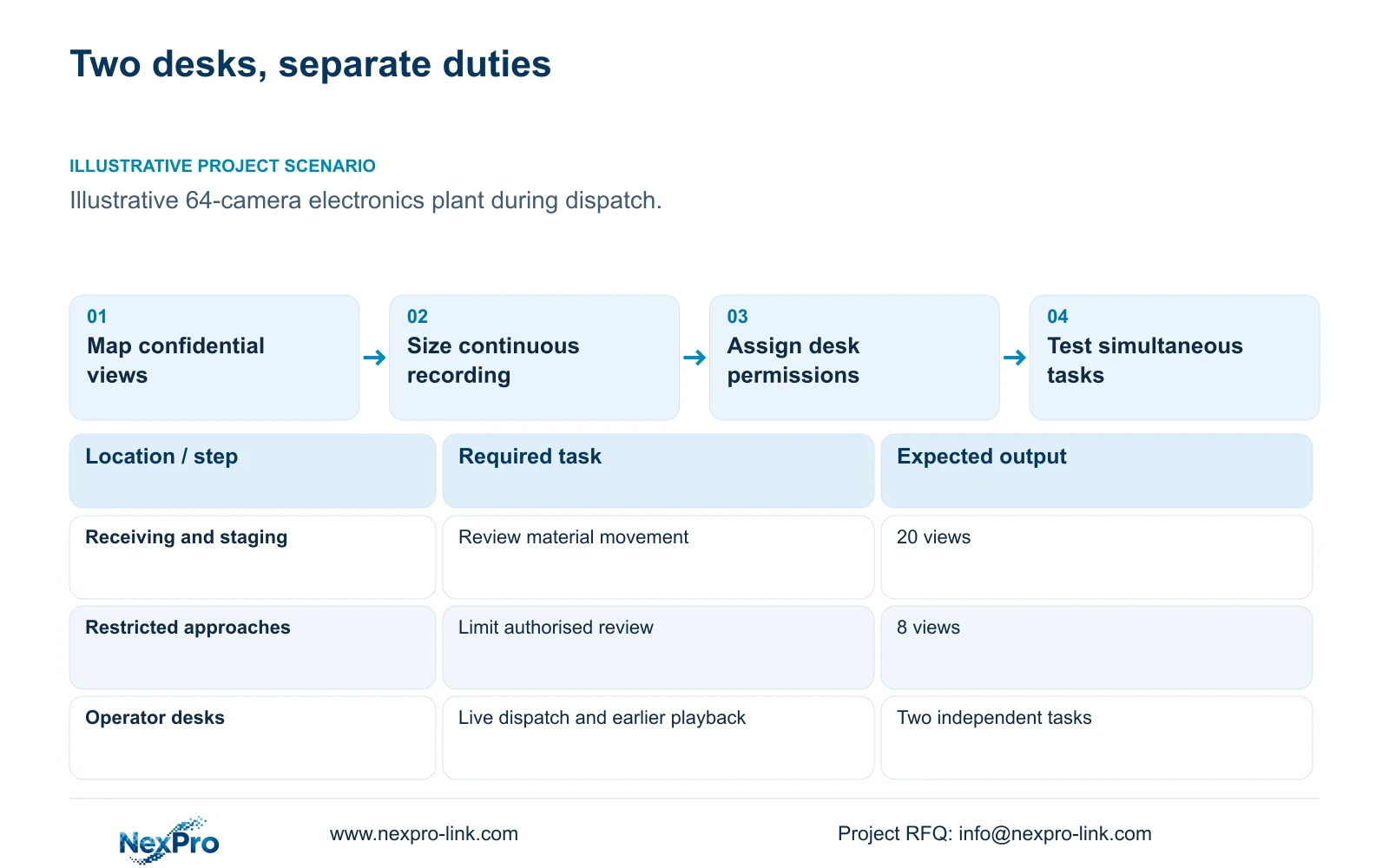
Illustrative project scenario: An electronics plant needs 64 normal-area cameras and two different operator tasks during a busy dispatch shift. The schedule assigns eight views to receiving, eight to restricted-room approaches, twelve to material staging, sixteen to assembly transfers, twelve to packing/dispatch and eight to shared routes. All record at one local node for an illustrative 30 days.
As a planning example, one desk could follow current dispatch activity while another retrieves an earlier material transfer. Define each user's live-view, playback and export permissions before testing. The eight restricted-room approaches do not imply cameras inside confidential rooms. Cleanroom and ESD installation requirements remain separate even though this reference contains no specialist camera positions.
Section 02
Approve disk capacity without assuming client performance
At an assumed average 4 Mbps per camera, input is 64 × 4 = 256 Mbps. Video_TB = 64 × 4 × 10^6 × 86400 × 30 / 8 / 10^12 = 82.944 TB. Required usable capacity with 20% free space is 82.944 / 0.80 = 103.68 TB. These figures describe the recording workload independently of which desk is active.
Eight 16 TB drives provide 128 TB raw and an illustrative 121.6 TB after the 95% formatted-capacity factor. Recording_budget = 128 × 0.95 × 0.80 = 97.28 TB. Compare required video of 82.944 TB with that budget; it already includes reserve. Extra audio, metadata and changed average bitrate need their own allowance.
NexPro-NVR8864-4K supplies a relevant 320 Mbps input reference and eight SATA bays, up to 18 TB per drive. Its published summary distinguishes 64×5MP from 16×4K. The case assumes supported 5MP-class streams, including the listed 2880×1620 output of the ordinary BL/DM candidates. Recording capacity does not establish dual-client decoding, RAID or unrestricted export performance.
Section 03
Build eight PoE groups and test both desks together
N1-SW1 through N1-SW8 each serve eight ordinary cameras. With the assumed 12 W device-side demand, each group totals 96 W. Required PSE output = 96 / 0.90 = 106.6667 W, and the 80% utilization target produces a 133.3333 W group budget requirement. Switch_AC_W = (106.6667 + 15) / 0.90 = 135.1852 W. This is an illustrative aggregate-draw estimate, not a sufficient switch order specification. Where switches reserve power by negotiated PoE class, check each group's total allocation separately against that switch's budget; allocated power may exceed the draw used here.
Replace the assumed consumption with selected-camera maximum data and verify both port capability and total switch budget. An eight-camera group also needs suitable uplink connections; eight devices do not automatically define the required switch port count. Draw the local recording path and the two desk paths so additional playback traffic is assigned to the interfaces that carry it.
Run an acceptance workload with continuous recording, desk-one live viewing and desk-two playback/export active together. Record selected stream resolution, codec, frame rate, window count and client hardware. Check that denied cameras remain inaccessible through playback and export as well as live view. Document approved support access separately from manufacturing networks.
Section 04
Include both workstations in the protected power boundary
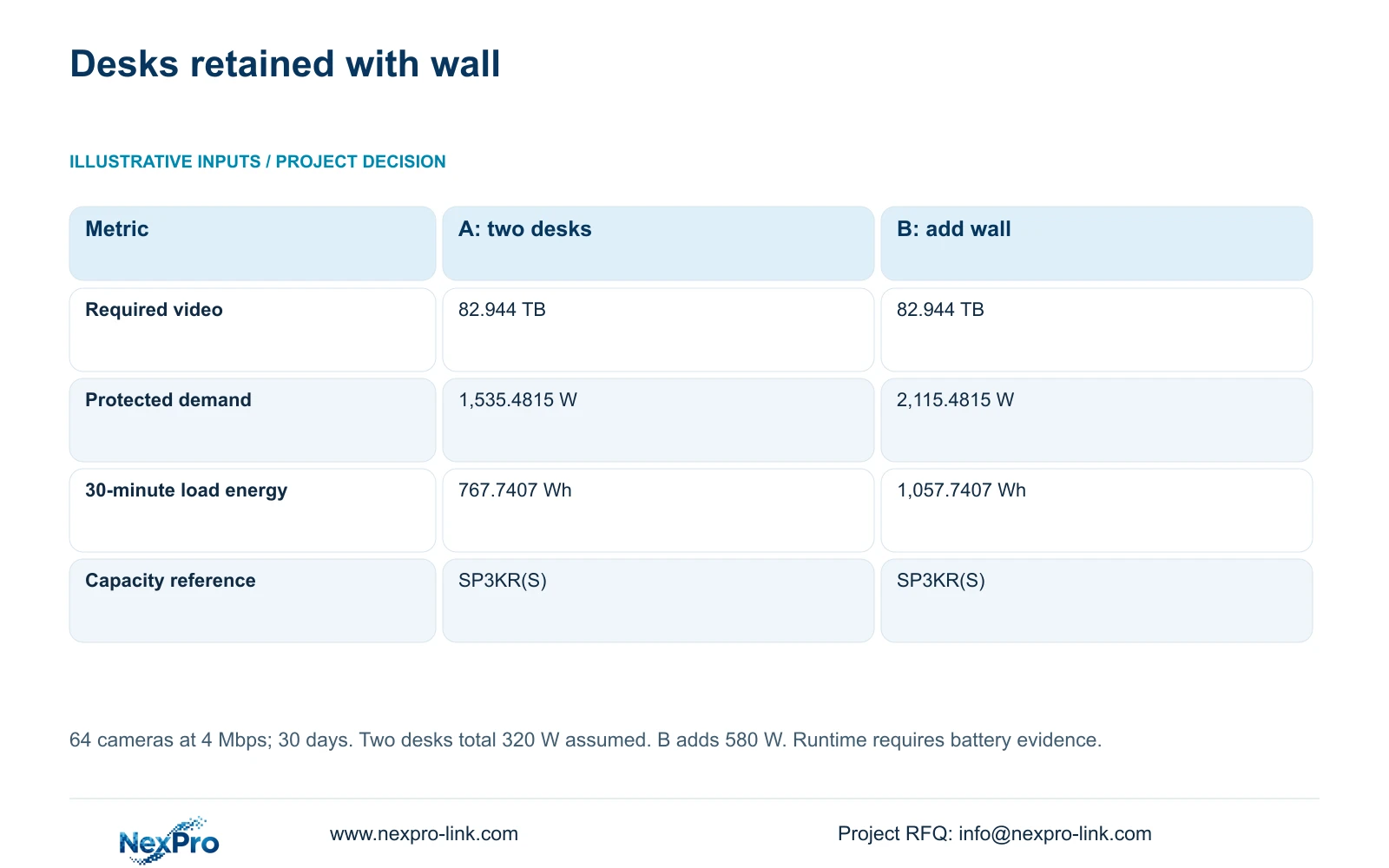
Option A includes eight complete switch AC loads, a 30 W recorder, eight drives at 8 W each, a 25 W core and a 15 W router. It also includes two workstations at 120 W each and two displays at 40 W each: 320 W of operator equipment. Total assumed protected demand is 1,535.4815 W. Do not add camera consumption again.
The optional wall adds four panels at 120 W each and a 100 W decoder while retaining both desks. Demand rises to 2,115.4815 W, but required video remains 82.944 TB. The table makes clear that the same capacity candidate can serve different energy requests. At PF 0.9 and 80% rated utilization, check rated_W ≥ load_W / 0.80 and rated_VA ≥ load_W / 0.72.
SP3KR(S), rated 3 kVA/2700 W, is the capacity reference for both options. Load_Wh = load_W × 30 / 60 gives 767.7407 Wh and 1,057.7407 Wh. Obtain battery curves for the exact configuration and room conditions. NX-VP-5535 is an LCD reference; panel and decoder assumptions are not published measured draws or proof of simultaneous 4K decoding.
| Metric | A: two desks | B: desks plus wall |
|---|---|---|
| Recording input | 256 Mbps | 256 Mbps |
| Required usable capacity | 103.68 TB | 103.68 TB |
| Protected demand | 1,535.4815 W | 2,115.4815 W |
| 30-minute load energy | 767.7407 Wh | 1,057.7407 Wh |
| Capacity candidate | SP3KR(S) | SP3KR(S) |
Section 05
Allocate camera runs without borrowing workstation cabling
The illustrative 64 camera links repeat base routes of 35 to 70 m, with 6 m service/termination allowance per run. Continuous lengths are 41 to 76 m and total 3,744 m. The camera-cable lower bound is ceil(3,744 / 305) = 13 reels, and the supplied allocation fits thirteen 305 m reels.
Examples include four 76 m cuts using 304 m, and four 66 m cuts plus a 41 m cut using 305 m. Preserve the complete point-to-reel allocation rather than replacing it with a percentage waste allowance. The plan contains no retained links or approved spare reels. Desk connections and any additional network services need separate takeoffs.
With two module-ended terminations per camera run, the reference requires 128 modules and 64 cabinet-side ports. SP5648 and DT968MX provide patch-panel and module references, not evidence that a bulk cable construction suits ESD or controlled areas. Confirm cabinet distribution, containment access and link-test method with the installation team; quote inter-building fibre only where the actual route requires it.
Section 06
Make simultaneous operation a procurement acceptance condition
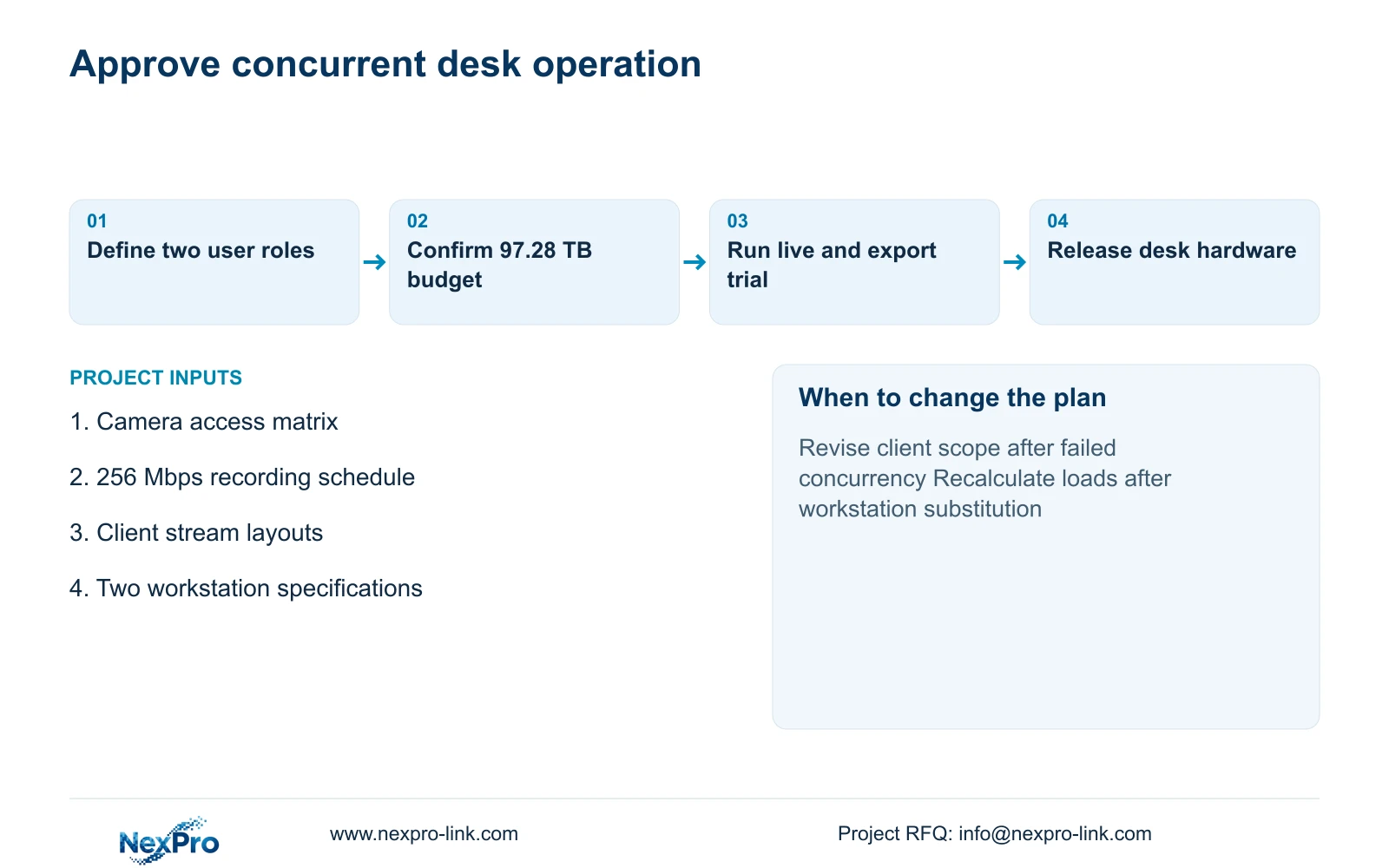
The baseline BOM should identify 64 ordinary cameras, one recorder, eight compatible 16 TB drives, eight qualified switches, one UPS configuration, two workstations, two displays and thirteen camera-cable reels. Record workstation hardware as a functional requirement pending the concurrency trial. Approve the two desk roles before deciding whether a shared wall adds operational value.
NexPro-Link BOQ support can coordinate exact models, technical submittals and deviations against this schedule. Keep factory preparation and project-labelled packing separate from local ESD installation, account commissioning and operator acceptance. A supplier's client software proposal should show the tested workflow, not simply a screenshot with many windows.
Compare alternative brands using the same permitted views, 30-day retention and two-user workload. Reconsider the architecture if restricted-zone permissions cannot be implemented, peak recording input exceeds the selected limit or the client trial fails. Adding cameras beyond the filled 64-point schedule also requires a new channel-capacity decision even when disk space remains.
Section 07
Buyer questions
Must both desks show the same live layout? No. Specify independent tasks and layouts, then demonstrate them on the proposed client configuration. A mirrored display arrangement should not be accepted as two independent operator seats.
Can the second desk use a general office account? Define a named security role instead. Establish which camera groups it can access and who approves exports, then test those restrictions on the selected software and firmware.
Does the wall replace either workstation? Not in this reference. Both workstations remain because their independent review tasks still exist. Any substitution needs a revised operating and power schedule.
Section 08
Specify the two-desk acceptance workload
Email the camera confidentiality map, recording stream/retention schedule, two operator task descriptions, and protected-power objective to info@nexpro-link.com for a scoped electronics-factory proposal.
Engineering references
These sources support the general planning principles. Always use the selected product's current datasheet and applicable project standards for final design.
- User BL2812M series product specification
- User DM2812M series product specification
- NexPro-NVR8864-4K
- NexPro-Link rack online UPS
- NexPro-Link Structured Cabling
- NexPro-Link BOQ & Tender Support
- NexPro-Link NX-VP-5535 LCD video wall panel
- NexPro-Link NX-VD-4K16 network video decoder
- Microchip: Next-Generation PoE IEEE 802.3bt White Paper