A central eight-bay recorder is the starting candidate for this 48-camera reference; split recording becomes useful when continuity or input demand changes.
Section 01
Define camera roles and acceptable recording interruption
Start with one adequately sized central recorder when the 48-camera schedule stays within the selected input reserve and the hotel accepts its recording-failure boundary. Choose split recording when approved continuity requirements call for separate groups or when actual stream demand exceeds that planning boundary. Confirm usable disk capacity in either arrangement before comparing price.
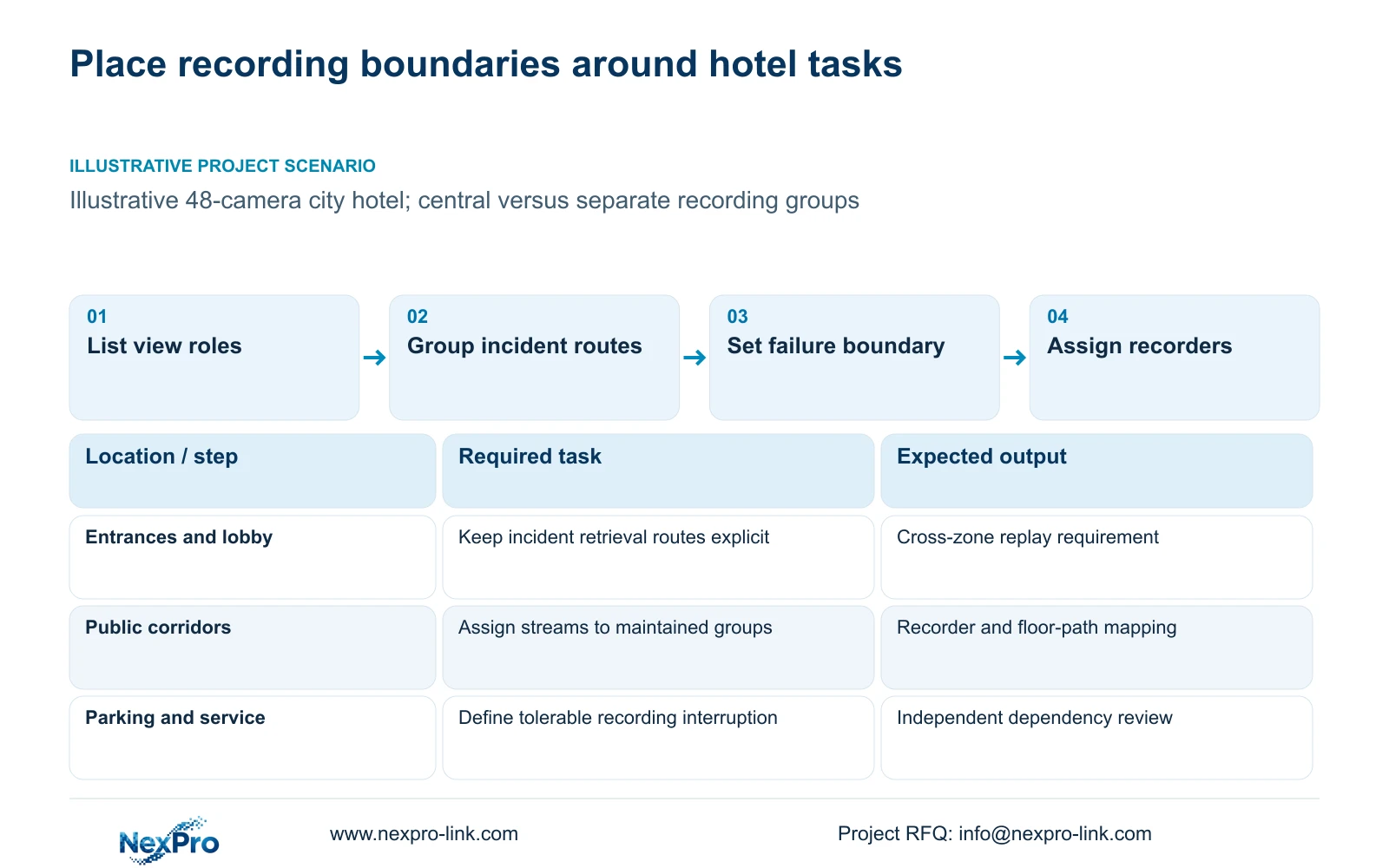
Illustrative project scenario — not a customer installation or measured project result. CASE03 describes an illustrative 150-room city hotel with six entrance views, six lobby and reception views, sixteen public-corridor views, eight back-of-house views, eight parking views and four grounds views. The room count does not generate these positions. Assign each view a task, stream profile and retention requirement, with private interiors excluded.
Define which cameras operators must search together during an incident. An entrance-to-parking sequence may cross recording groups even if those groups follow convenient floor boundaries. That relationship affects client selection and operator workload. Camera resolution, recorder channel count and advertised input rate each answer different selection questions.
| Task | Reference input | Decision needed |
|---|---|---|
| Routine recording | 48 public-area streams | Exact modes and average rates |
| Incident retrieval | Events may cross zones | Concurrent replay and export tasks |
| Continuity | Central or separate recording groups | Acceptable interruption boundary |
Section 02
Size input bandwidth for central and split arrangements
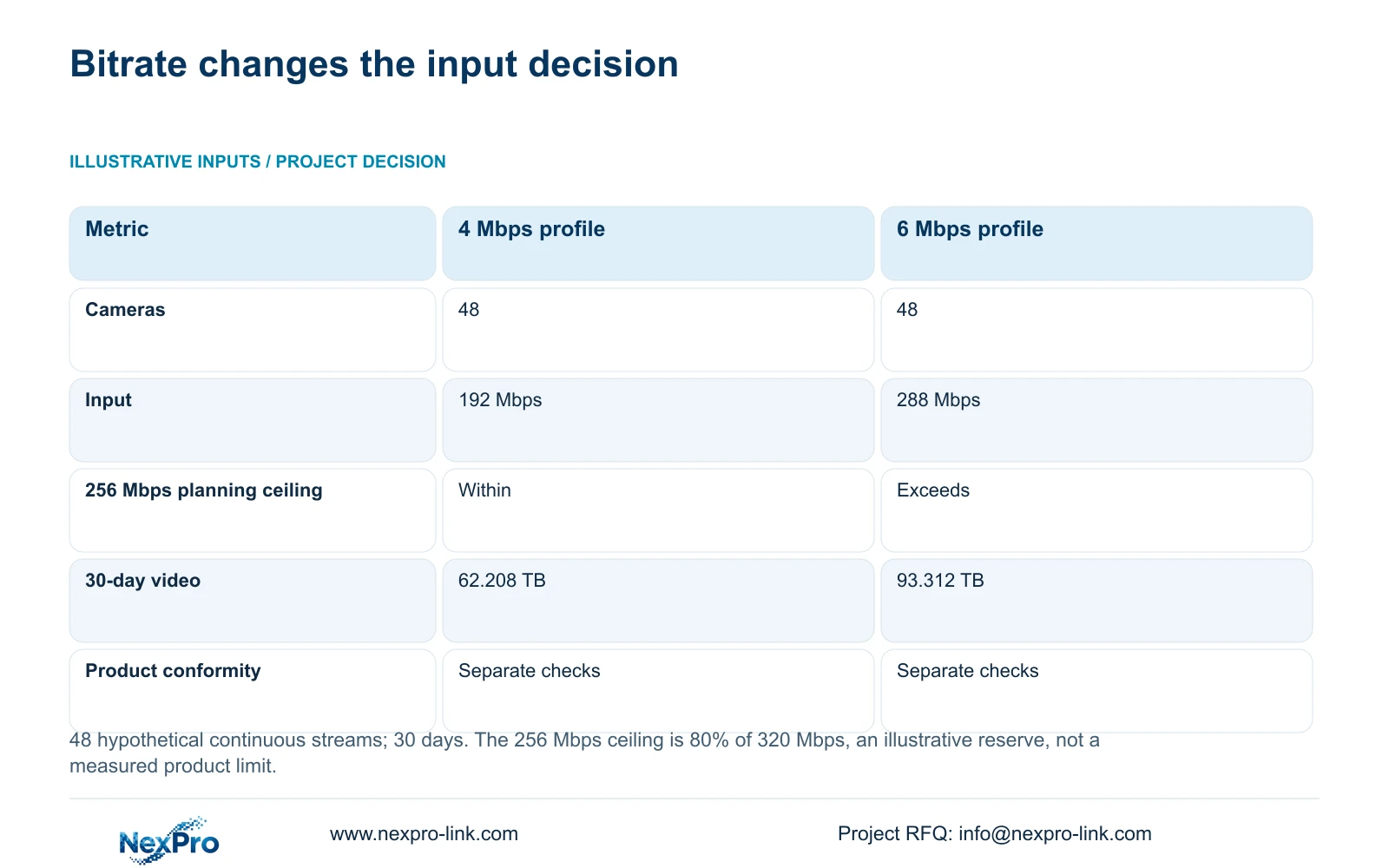
Calculate input by summing the actual camera groups. The topic sensitivity comparison uses 48 hypothetical streams at either 4 or 6 Mbps average. Those profiles require 192 and 288 Mbps respectively. A stated planning ceiling of 80% of a 320 Mbps published input is 256 Mbps. This is an engineering assumption, not a manufacturer throughput test.
The 4 Mbps profile fits that ceiling; the 6 Mbps profile exceeds it even though 288 Mbps is below the published 320 Mbps number. Preserve required image detail when responding. A supported higher-input arrangement or split configuration may be needed. Lowering bitrate is acceptable only when the recorded task remains satisfied.
NexPro-NVR4449-4K and NexPro-NVR8864-4K both list 320 Mbps input. Moving from the 49-channel model to the 64-channel model therefore does not raise the stated input limit. An illustrative equal split would distribute 24 cameras to each recorder, giving 96 or 144 Mbps per unit. Actual allocation must follow tasks and network paths, and each recorder still needs its own mode and playback checks.
| Metric or condition | 4 Mbps per camera | 6 Mbps per camera |
|---|---|---|
| Cameras | 48 | 48 |
| Aggregate video input | 192 Mbps | 288 Mbps |
| Illustrative 256 Mbps ceiling | Within | Exceeds |
| 30-day video data | 62.208 TB | 93.312 TB |
| Modes, decoding and disks | Separate checks | Separate checks |
Section 03
Compare outage impact and maintenance duties
A central recorder concentrates recording duties in one device. A recorder outage or maintenance interruption can affect all assigned streams. Split recording confines a recorder-specific interruption to its assigned group if the other group's cameras, network and power remain independent. Shared switches or power sources can still interrupt both groups.
Write the failure comparison as observable states: recorder unavailable, floor uplink interrupted and access-node power lost. For each state, identify which cameras retain a working path to storage and which operators can retrieve footage. Do not describe two recorders as redundant unless the proposed configuration explicitly provides the required alternative recording behavior.
Maintenance also changes. Two units bring separate configuration and disk records, and may create additional search steps. A common client can simplify operation only when its actual device and version support is confirmed. General ONVIF support does not prove cross-recorder playback, advanced events or account behavior. Keep recording, live decoding, replay and export tests distinct; a passing input calculation does not establish all four.
Section 04
Calculate usable storage at each recording destination
For 48 cameras at 4 Mbps continuously over 30 days, video volume is 0.0108 × 48 × 4 × 30 = 62.208 decimal TB. With 20% free space, required usable capacity is 77.76 TB. CASE03 examines eight 12 TB drives in one NexPro-NVR8864-4K: 96 TB raw, 91.2 TB after the assumed 95% formatting factor, and 72.96 TB available for video after reserve.
That video budget exceeds 62.208 TB, corresponding to 35.19 planning days. The four-bay NexPro-NVR4449-4K lists up to 18 TB per drive, producing 72 TB raw at that limit. Under the same formatting and reserve assumptions, it cannot meet the 77.76 TB usable-space requirement. Its channel count can cover 48 positions while its disk arrangement remains insufficient.
The 6 Mbps sensitivity profile produces 93.312 TB before reserve, so it cannot inherit CASE03's 4 Mbps disk conclusion. For split recording, calculate each assigned group's retention separately; spare capacity elsewhere may be unavailable to an overloaded recorder. The case assumes independent disks with no RAID loss. Array overhead, dedicated spares and supported RAID levels need explicit configuration, and disk tolerance does not replace incident backup.
Section 05
Match floor-network and UPS boundaries to the architecture
CASE03 uses six access nodes with eight cameras each. A group carries 32 Mbps of pure recording traffic at the 4 Mbps profile, or 35.2 Mbps with a 10% allowance. A locally placed split recorder changes which traffic crosses the floor backbone. Identify simultaneous viewing and export routes before comparing uplink capacity.
The case assumes 12 W camera peak, 90% cable delivery and 20% spare output, requiring at least 133.33 W per access group. NexPro SW-POE1618G lacks a confirmed total power figure in the source and has conflicting access-port speed descriptions. It cannot be declared suitable from port quantity alone.
The central case's basic AC estimate is 935.65 W and 1,039.61 VA at PF 0.9, making SP2KR(S) an aggregate capacity candidate under the specified reserve. A split architecture changes recorder count and may redistribute power zones, so recalculate it. Protect every required node locally; fiber does not provide remote AC power. Battery runtime and electrical changeover require supported configuration information and appropriate site execution.
Section 06
Select the architecture the operating team can maintain
For CASE03's 4 Mbps profile, retain the central NexPro-NVR8864-4K candidate with its eight-drive planning arrangement when centralized maintenance and retrieval suit the hotel's interruption policy. Move to independently supported recording groups if continuity requirements demand them. At 6 Mbps, revise input and storage together; splitting bandwidth does not reduce total video volume.
Compare complete quotations, including disks, network changes and any client or support scope. NexPro-Link can discuss model matching and a coordinated BOQ while distinguishing equipment supply from local installation. The supplied main-equipment warranty baseline is 24 months from receipt, with storage and other accessory terms scoped separately.
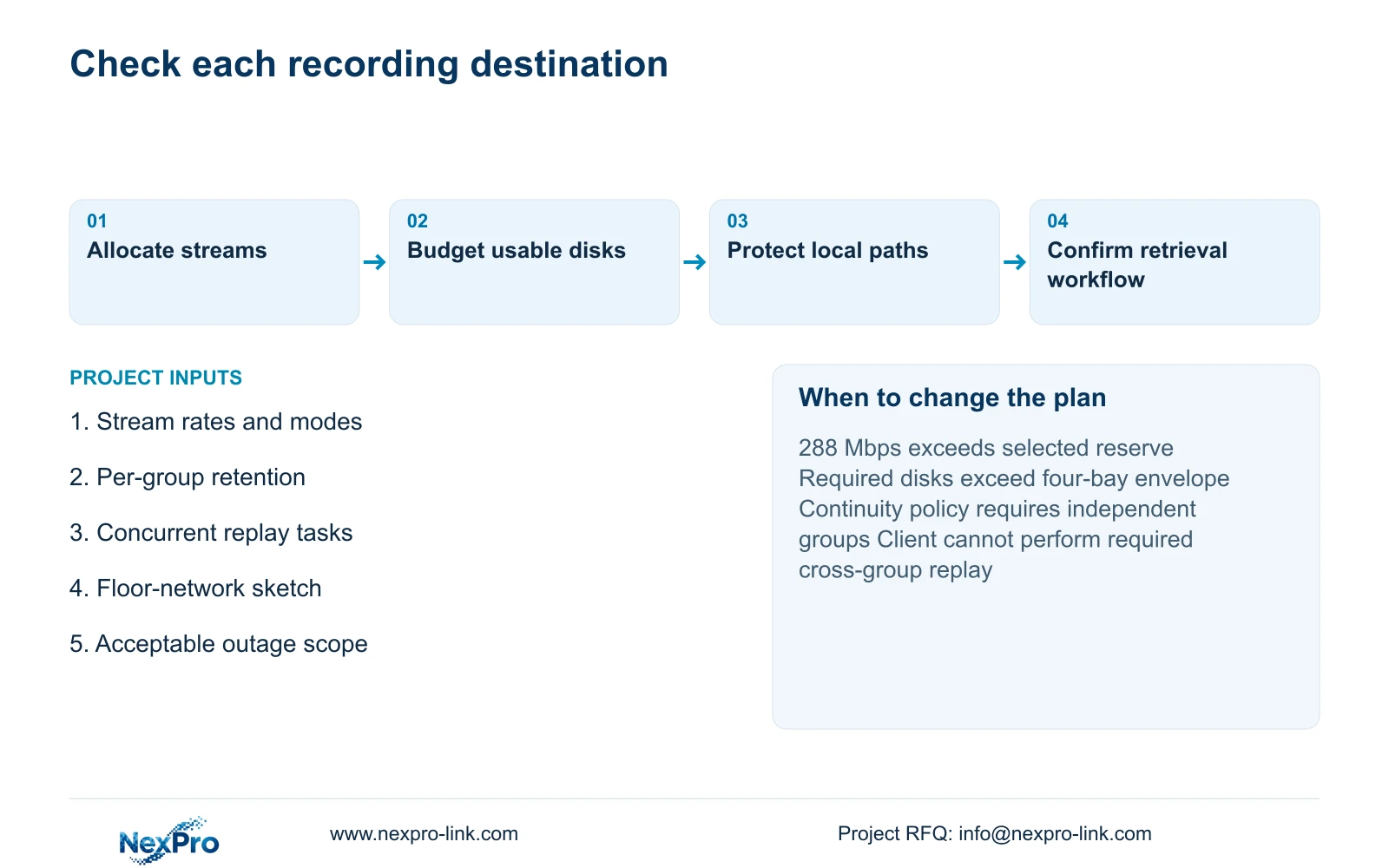
Send the grouped camera stream schedule, retention target, concurrent replay duties and acceptable failure boundary to info@nexpro-link.com. Include a floor-network sketch and destination. These inputs allow the proposal to state whether the central arrangement remains adequate or which split groups need separate equipment.
Section 07
Buyer questions
Does a 64-channel recorder accept more Mbps than the 49-channel model? Not according to these records: both list 320 Mbps input. The 64-channel model provides a different channel and disk arrangement, while actual recording modes remain separate checks.
Can two recorders automatically back each other up? No automatic backup behavior is established here. Specify the required recovery function and confirm hardware and software support before pricing a redundant arrangement.
Can a lower bitrate avoid replacing the recorder? Possibly, but only after checking that required recorded detail survives under relevant conditions. Recalculate retention and input using the accepted profile, without assuming a fixed saving from codec names.
Engineering references
These sources support the general planning principles. Always use the selected product's current datasheet and applicable project standards for final design.