A shared recorder does not make ordinary and classified-location cameras interchangeable. This 40-view chemical-site reference preserves specialist assembly requirements while coordinating the complete security infrastructure.
Section 01
Preserve the issued classification boundary in the camera schedule
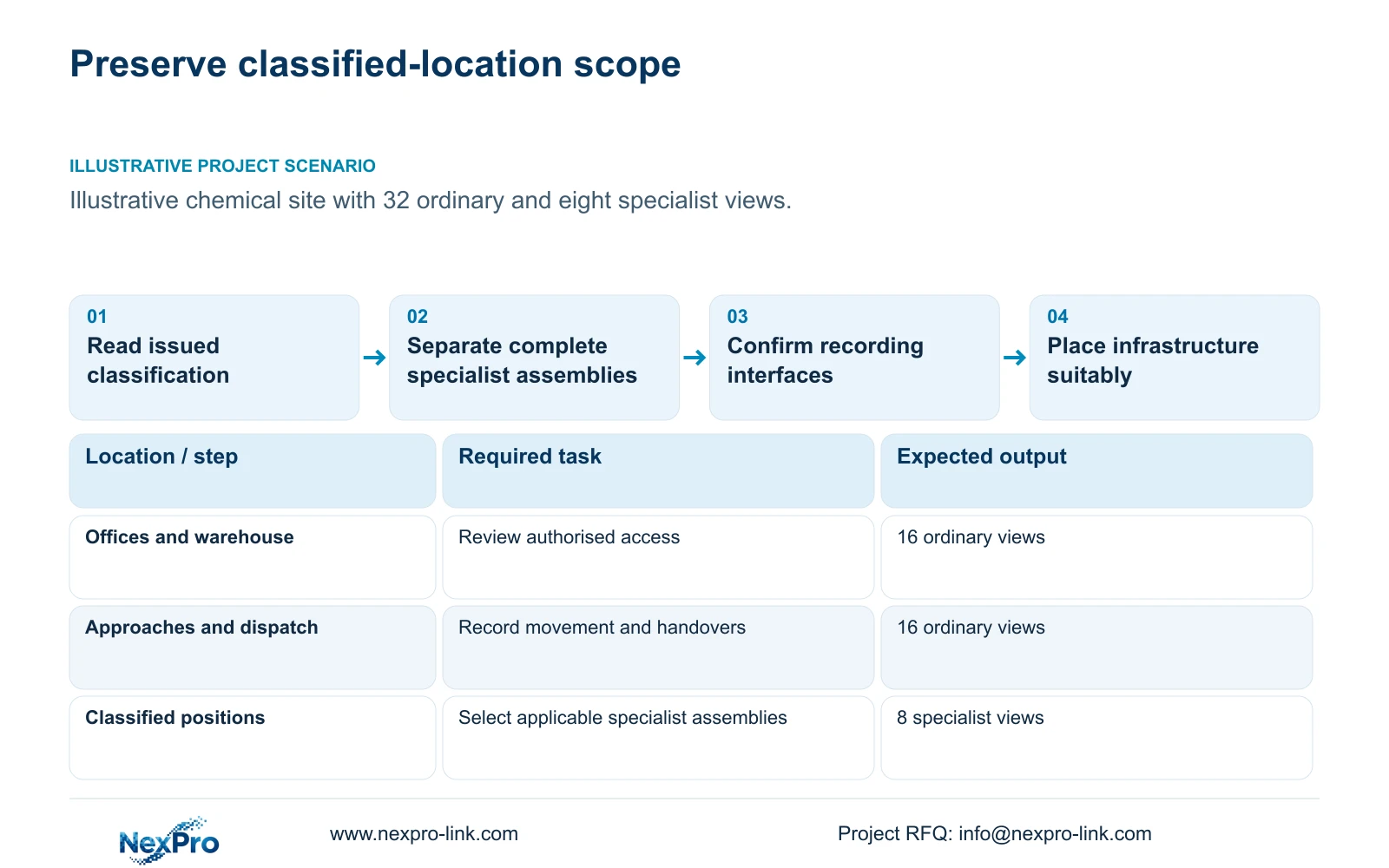
For a 40-camera chemical site, seek value in the thirty-two ordinary-area positions while retaining complete specialist requirements at the eight classified locations. Separate camera suitability from shared recording compatibility. A stream entering the same recorder does not extend certification to other equipment or approve a field installation.
Illustrative project scenario: A chemical site needs thirty-two ordinary-area and eight specialist classified-location views under its issued hazard plan. Eight views each cover offices/common access, ordinary warehouse positions, ordinary approaches, ordinary dispatch and location-certified specialist positions. The reference uses one local recording node and thirty-day continuous retention.
Use the issued drawing to identify each mounting location, connection route and responsible specialist designer. The assumed camera count is not an area classification. Ordinary security footage supports access and handover review, not safety trips or a safety instrumented system. Verify current local requirements and the applicable equipment/installation scope with the responsible team rather than applying an archived regulatory example as a worldwide rule.
Section 02
Check shared recording capacity with specialist formats included
The illustrative storage calculation assumes all forty streams fit supported 5MP-class modes and average 4 Mbps, twenty-four hours per day for thirty days. Input is 40 × 4 = 160 Mbps. Video_TB = 40 × 4 × 10^6 × 86400 × 30 / 8 / 10^12 = 51.84 TB.
Four 18 TB drives provide 72 TB raw. The assumed 95% formatting factor gives 68.4 TB usable, and recording_budget = 72 × 0.95 × 0.80 = 54.72 TB after the 20% reserve. Compare 51.84 TB directly with 54.72 TB. Required usable capacity is 51.84 / 0.80 = 64.8 TB, below 68.4 TB; reserve should not be applied twice.
NexPro-NVR4449-4K is the 320 Mbps, four-bay reference, supporting up to 18 TB per drive. Its summary distinguishes 49×5MP from 9×4K. Confirm specialist stream formats, drive compatibility and playback/export workflows before approval. The modest remaining video budget makes changed average bitrate consequential. Four installed disks neither establish RAID nor guarantee availability after a recorder failure.
Section 03
Qualify the specialist assembly before choosing its power path
N1-SW1 through N1-SW4 each serve eight ordinary cameras at an assumed 12 W device-side demand. N1-SW5 represents eight specialist devices at an assumed 18 W each. Ordinary PD demand is 96 W per group; specialist PD demand is 144 W. This fifth group is a calculation placeholder, not approval that a specialist assembly can use the proposed PoE connection.
Required PSE output = PD_W / 0.90 gives 106.6667 W ordinary and 160 W specialist. Dividing by the 80% budget-utilization target gives 133.3333 W and 200 W respectively. Complete switch_AC_W = (PSE_output_W + 15) / 0.90 gives 135.1852 W ordinary and 194.4444 W specialist. Replace these inputs with selected-equipment data and include separate supplies where needed. Treat these as aggregate-load planning figures. If the verified specialist interface uses PoE, compare its negotiated allocation—and that of each ordinary group—with the proposed switch's actual admission policy; the load-based budget alone does not qualify it.
AXIS P1468-XLE is a specialist reference for its stated Zone 2/22 and Class I/II/III Division 2 applications, subject to complete applicable certification and installation scope. It is not a universal hazardous-location choice. Match the actual assembly, entries, mounting and supply arrangement to the site's requirements. Keep recording and general switching outside unsuitable locations, with security access separated from process-control functions.
Section 04
Size safe-area backup without implying process-safety coverage
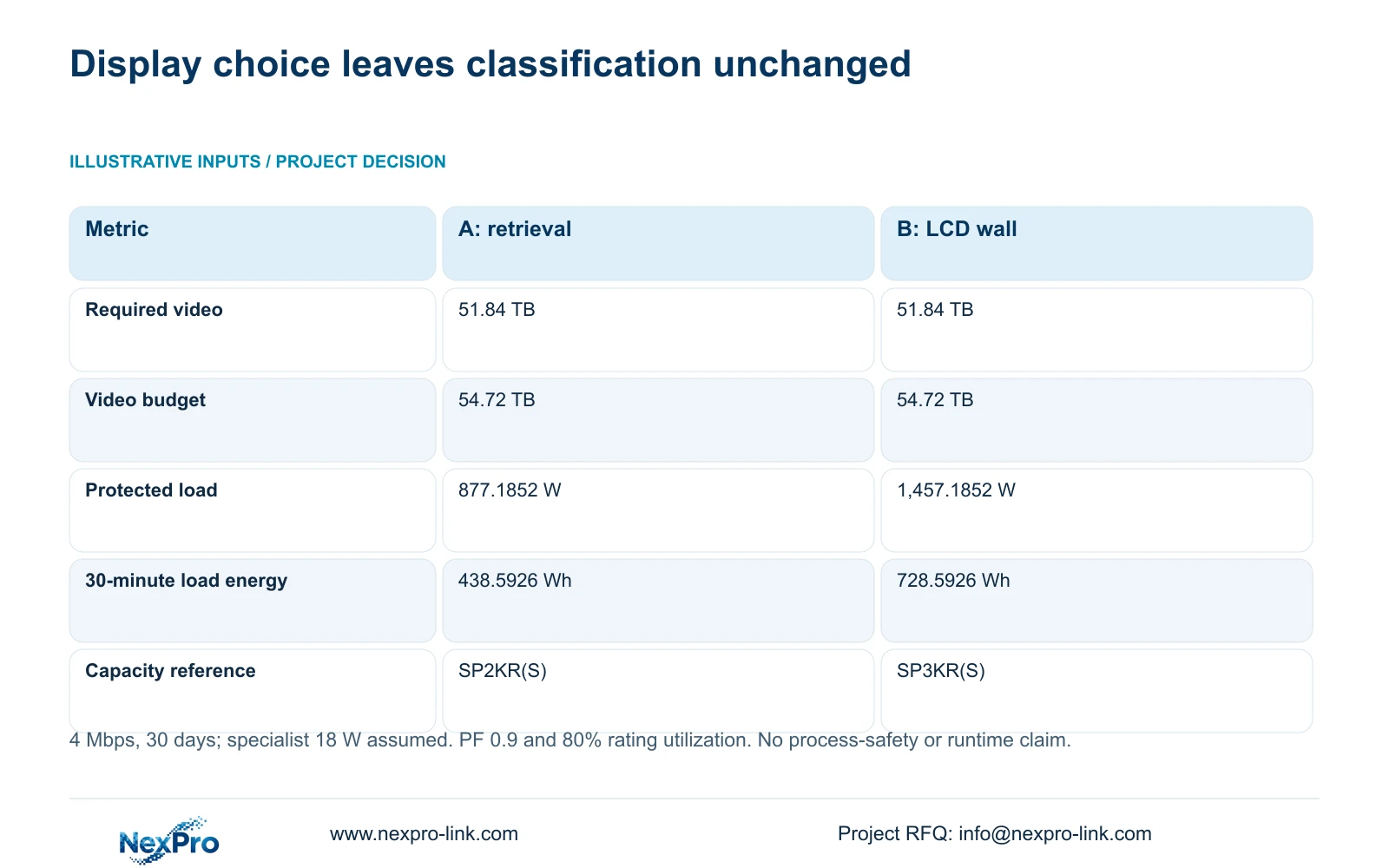
Option A sums four ordinary switch AC inputs and one specialist-group input, a 30 W recorder, four drives at 8 W each, a 25 W core, 15 W router and 40 W retrieval display. Assumed protected demand is 877.1852 W. Camera consumption is included in complete switch AC load and must not be counted again.
Option B adds four LCD panels at an assumed 120 W each and a 100 W decoder, increasing demand to 1,457.1852 W. Both retain the same 51.84 TB video requirement. The display upgrade adds visibility and power demand; it does not alter classified-location suitability or turn security video into process-safety equipment.
Use rated_W ≥ load_W / 0.80 and rated_VA ≥ load_W / 0.72 with assumed PF 0.9. SP2KR(S), rated 2 kVA/1800 W, is A's capacity candidate. B requires SP3KR(S), rated 3 kVA/2700 W, under the stated W and VA utilization targets. Load_Wh = load_W × 30 / 60 gives 438.5926 Wh and 728.5926 Wh. Exact battery curves, voltage and room conditions remain necessary for the runtime objective.
| Metric | A: retrieval display | B: add LCD wall |
|---|---|---|
| Required video | 51.84 TB | 51.84 TB |
| Recording budget | 54.72 TB | 54.72 TB |
| Protected demand | 877.1852 W | 1,457.1852 W |
| 30-minute load energy | 438.5926 Wh | 728.5926 Wh |
| Capacity candidate | SP2KR(S) | SP3KR(S) |
Section 05
Keep classified-route details distinct from ordinary cable quantities
The illustrative takeoff uses forty new continuous runs of 41 to 76 m, including a stated 6 m service/termination allowance. Total cable is 2,340 m. The 305 m reel lower bound is ceil(2,340 / 305) = 8, and the supplied feasible allocation fits eight reels.
Examples include four 76 m cuts totaling 304 m and a reel with 66, 66, 66, 61 and 46 m cuts totaling 305 m. Preserve every camera-to-reel assignment. Cutting residue is distinct from approved reserve stock. This reference's two-module-ended method gives eighty modules and forty occupied cabinet-side ports, but specialist termination arrangements may change those quantities.
A length allocation does not approve cable construction, entries or installation in a classified route. Keep the specialist team's connection requirements on the relevant BOM lines and verify current local installation requirements. SP5648 is an ordinary Cat6 patch-panel reference, not a hazardous-location component or bulk cable SKU. Inter-building fibre, containment, grounding and testing need drawing-based scope and named responsibility.
Section 06
Compare ordinary-area savings without deleting specialist work
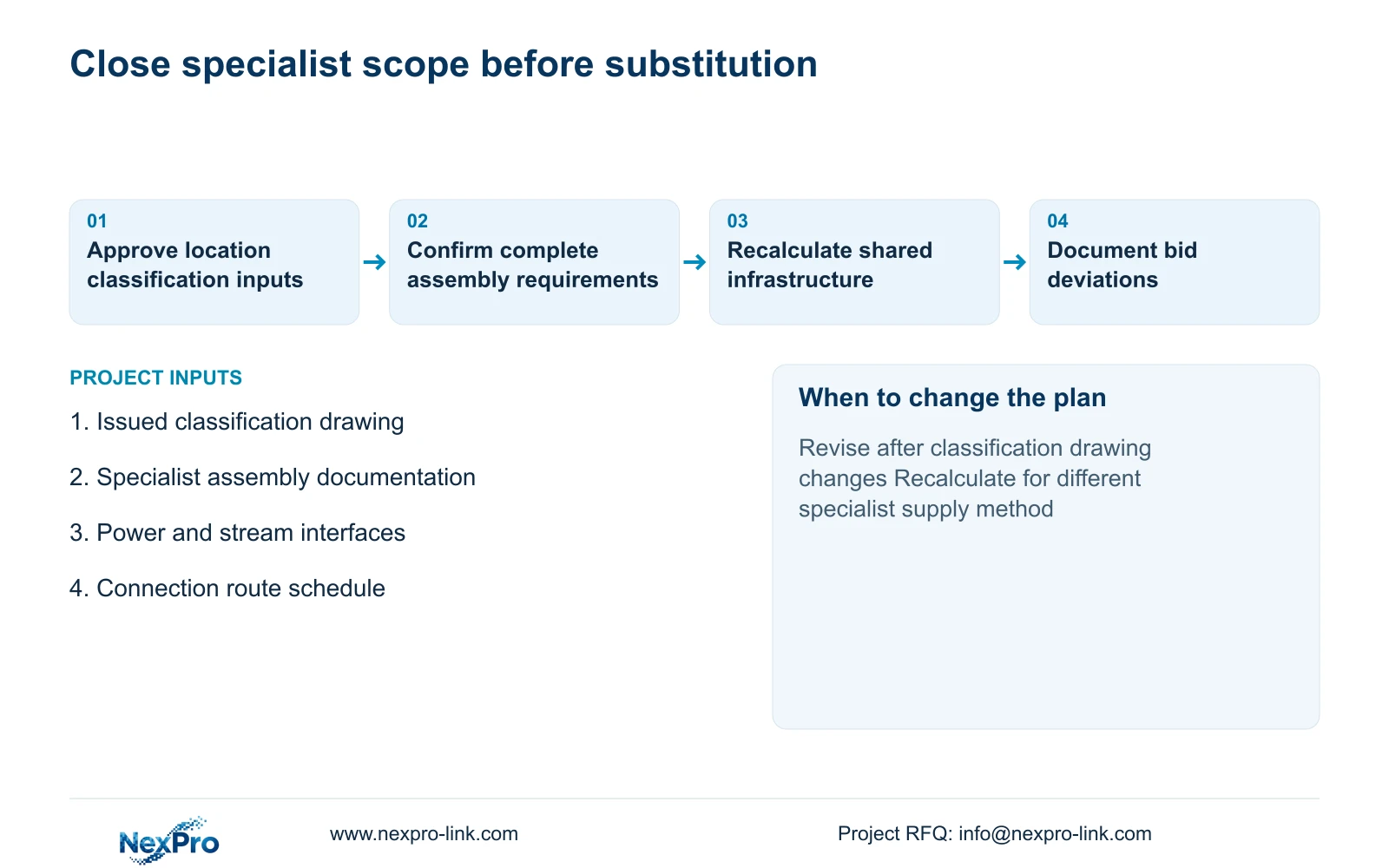
The coordinated BOM starts with thirty-two ordinary cameras and eight separately selected specialist assemblies. Common infrastructure includes one recorder, four compatible 18 TB drives, five qualified power/access groups, one UPS configuration, one retrieval display and eight cable reels. Release specialist connection accessories and installation documentation with the complete assembly scope.
BL/DM ordinary candidates list 2880×1620 output and 2.8-12 mm motorized lenses for suitable ordinary positions. Their IP66 field does not establish explosion protection. A bid comparison may substitute those ordinary lines while preserving specialist requirements, exact recording interfaces and local construction scope. A lower camera subtotal is not a complete project saving if necessary specialist work disappears.
NexPro-Link BOQ support can coordinate ordinary-area model matching, common equipment and explicit deviations. Hold final infrastructure approval where specialist consumption or supply method remains unresolved. Revise the worksheet when selected assemblies change power or stream demand, and change the architecture if the owner requires supported redundancy beyond this capacity-only reference.
Section 07
Buyer questions
Can a specialist camera share an ordinary-area NVR? Potentially, if its exact stream and required recording workflows are supported. Shared recording compatibility does not approve the specialist camera's location, power connection or installation.
Does a protective housing make an ordinary camera equivalent? The housing alone does not establish the complete assembly's suitability. Obtain the applicable assembly documentation and installation requirements from the responsible specialist supplier and designer.
Why is SP3KR(S) the wall-option candidate despite lower watt demand than 1800 W? The illustrative selection checks VA as well as W with an 80% utilization target and PF 0.9. Meeting the watt rating alone does not satisfy that stated design basis.
Section 08
Define ordinary and classified supply boundaries
Send the relevant issued classification drawing, 32/8 camera schedule, specialist assembly/interface requirements, and recording/backup objective to info@nexpro-link.com for a clearly bounded equipment proposal.
Engineering references
These sources support the general planning principles. Always use the selected product's current datasheet and applicable project standards for final design.
- User BL2812M series product specification
- User DM2812M series product specification
- NexPro-NVR4449-4K
- NexPro-Link rack online UPS
- NexPro-Link Structured Cabling
- AXIS P1468-XLE specialist camera
- NexPro-Link BOQ & Tender Support
- NexPro-Link NX-VP-5535 LCD video wall panel
- NexPro-Link NX-VD-4K16 network video decoder
- Microchip: Next-Generation PoE IEEE 802.3bt White Paper