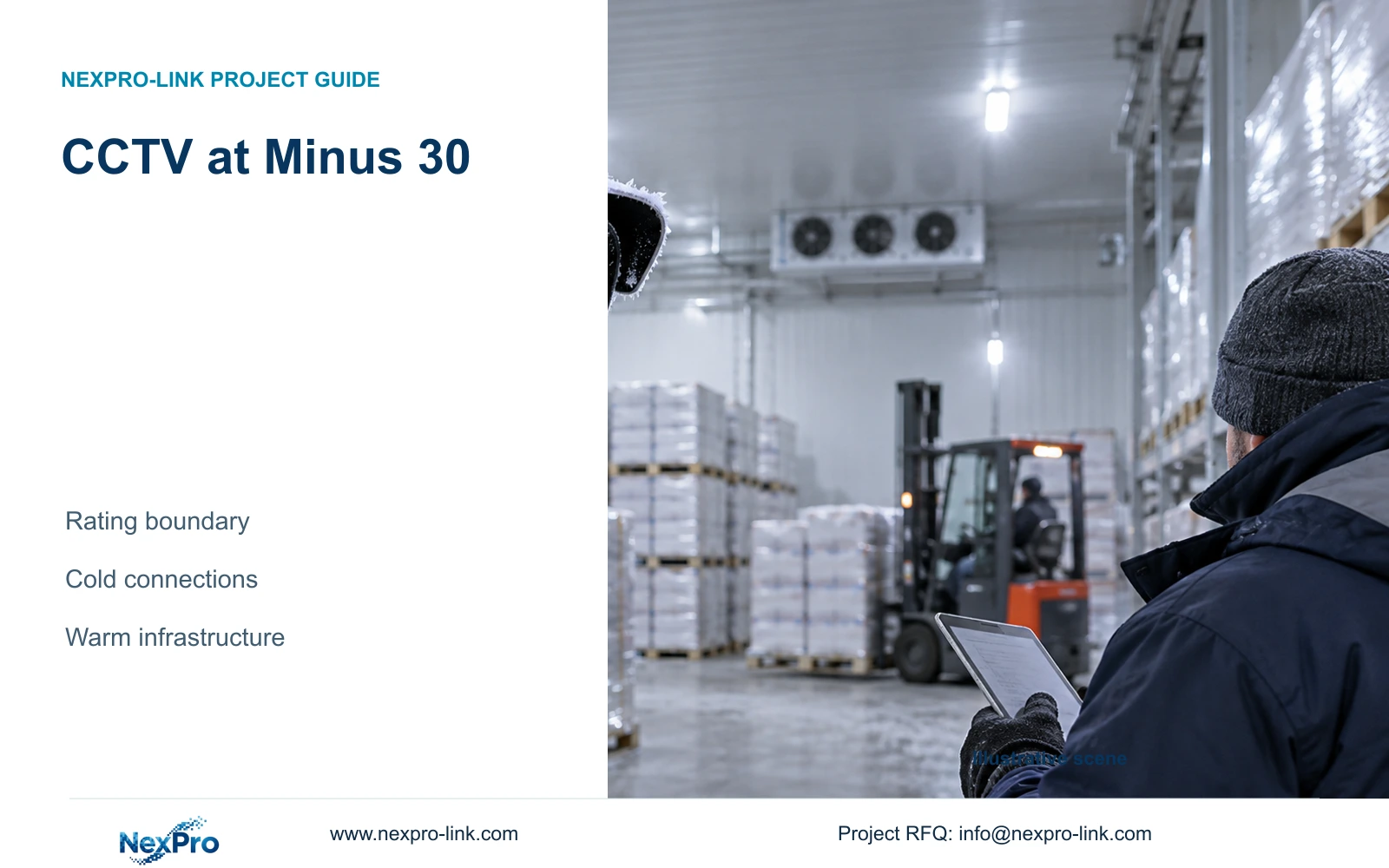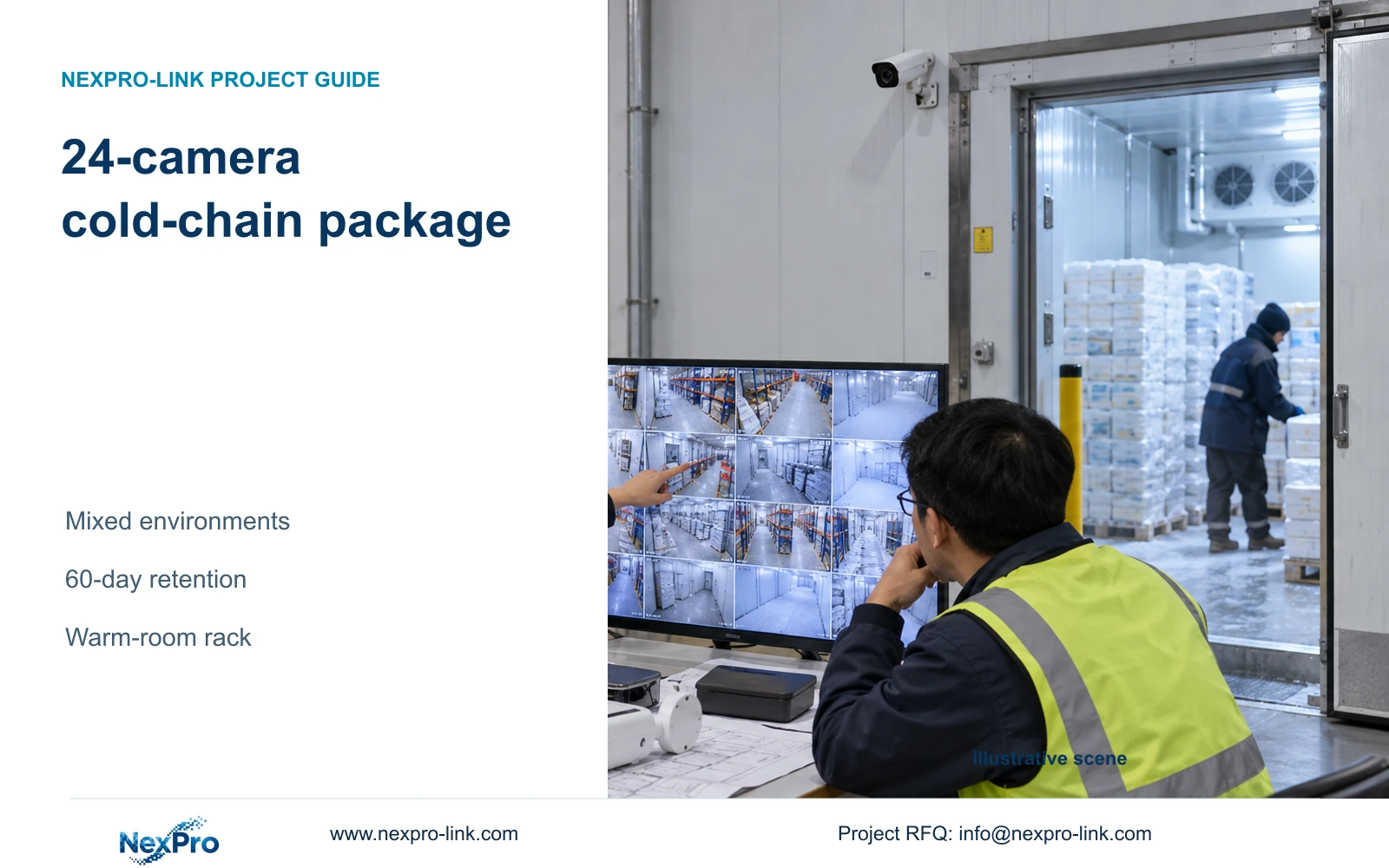
Cold-chain CCTV needs a mixed environmental schedule, not a blanket camera substitution. This 24-view reference coordinates specialist freezer interfaces with an eight-bay recorder, warm-room power and continuous cabling.
Section 01
Separate ambient, transition and freezer mounting conditions
Use ordinary cameras only at suitable ambient positions and separately select the eight cold-area assemblies for a 24-camera cold-chain factory. Obtain their operating, startup and power data before finalizing infrastructure. Keep the recorder, switches and batteries in a suitable warm equipment room. Adding a generic heated housing does not establish a validated cold-rated camera assembly.
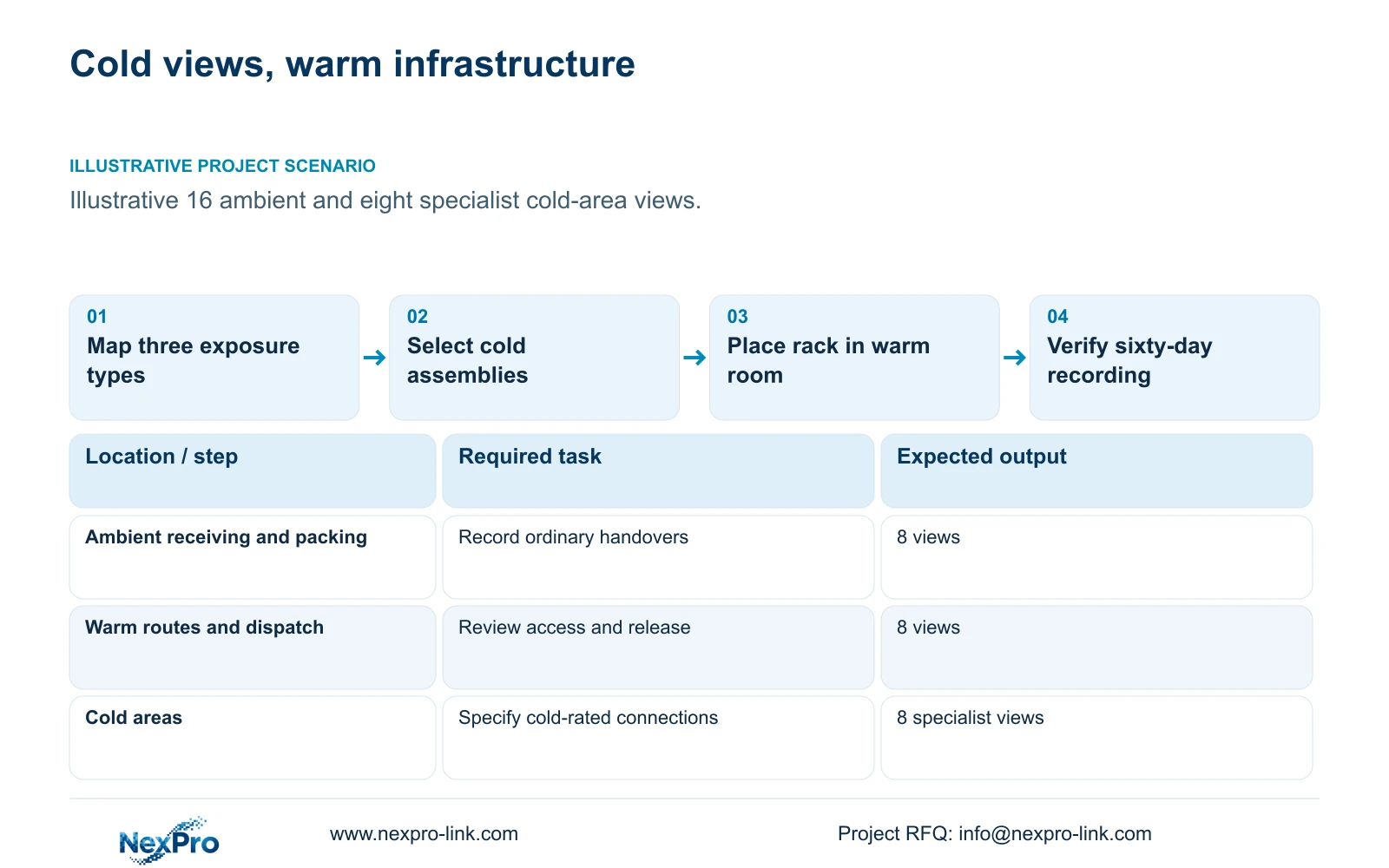
Illustrative project scenario: The factory requires sixteen ordinary-area views and eight specialist cold-area views with a 60-day illustrative target. Four views each cover ambient receiving, packing, warm corridors and dispatch; eight cover specialist cold areas. All twenty-four streams feed one local recording node.
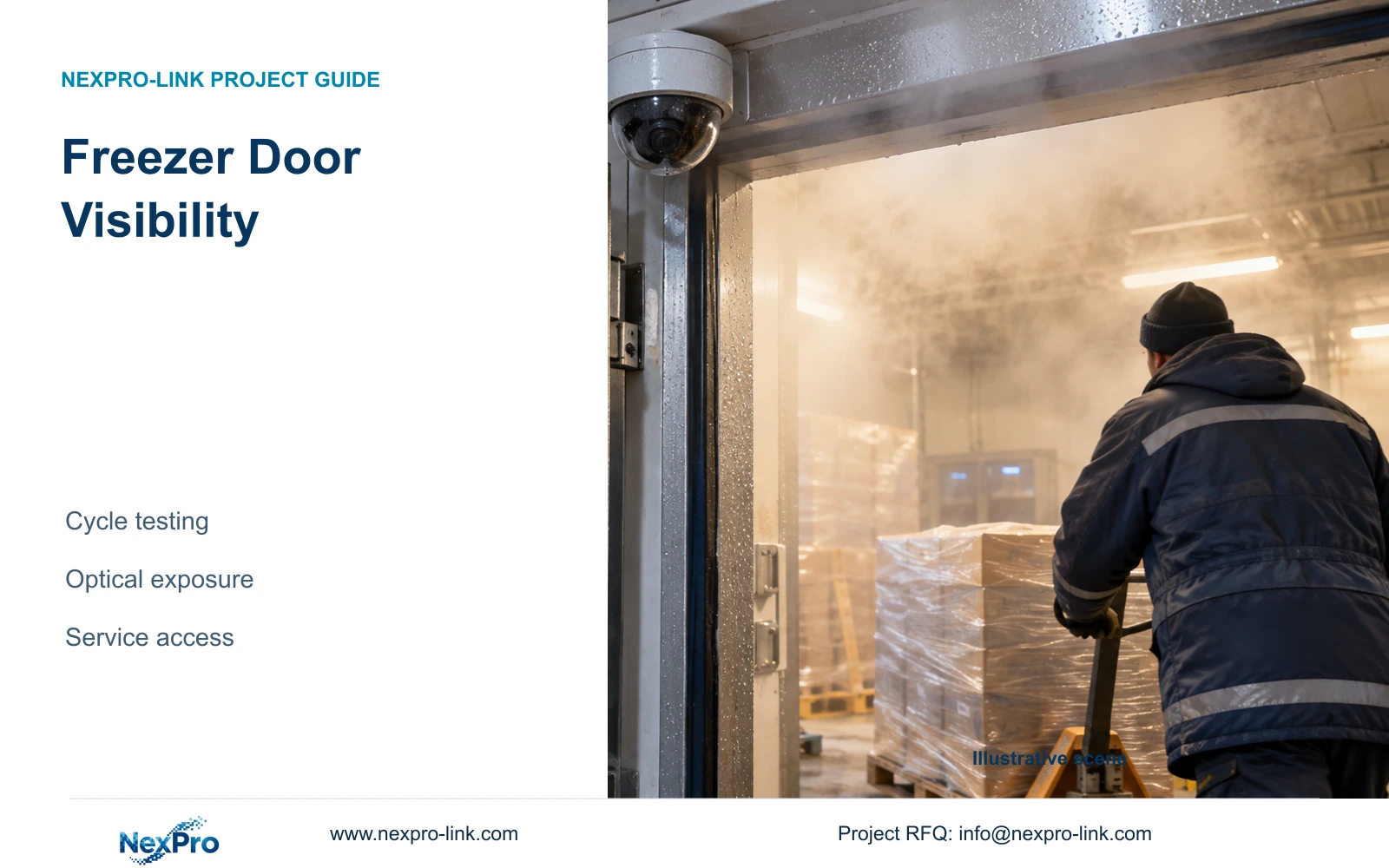
Mark freezer positions and transition points separately on the drawing, documenting operating extremes, defrost conditions, door cycles and maintenance access. A camera's room-side location does not by itself settle condensation exposure. NexPro-BL2812M55-5MP-DIC-AI and NexPro-DM2812M55-5MP-DIC-AI list 2880×1620 output and an operating range from minus 20 to plus 60°C. Those ordinary references provide no below-minus-20°C capability or complete freezer-connection qualification.
Section 02
Let the 60-day requirement drive the recorder's bay count
Assume all twenty-four selected streams fit supported 5MP-class recording modes and average 4 Mbps continuously. Input is 24 × 4 = 96 Mbps. Video_TB = 24 × 4 × 10^6 × 86400 × 60 / 8 / 10^12 = 62.208 TB. The 60-day period is an owner planning input, not an asserted cold-chain legal requirement.
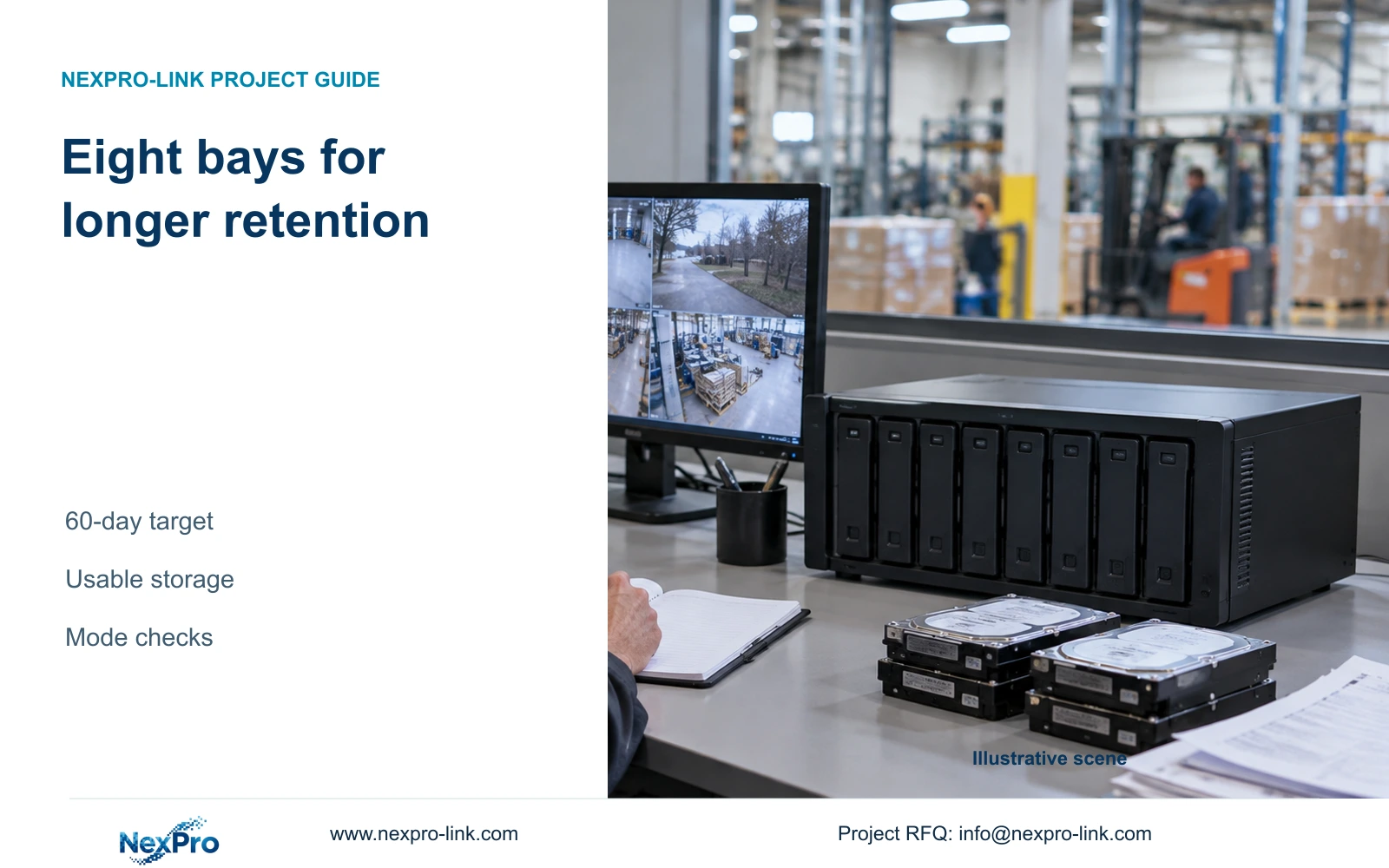
Required usable capacity with 20% free space is 62.208 / 0.80 = 77.76 TB. Eight 12 TB drives give 96 TB raw, 91.2 TB with the assumed 95% formatting factor and 72.96 TB recording budget after reserve. Compare 62.208 TB directly with 72.96 TB. This arrangement shows why storage can determine the recorder choice even with only twenty-four cameras.
NexPro-NVR8864-4K is an eight-bay reference with 320 Mbps input and support up to 18 TB per drive. Its summary distinguishes 64×5MP from 16×4K modes. Confirm specialist codecs, firmware interfaces, compatible drives and playback workload. Eight bays do not establish RAID, and a channel label cannot approve every cold-camera stream format.
Section 03
Keep the specialist power assumption visible until selection
N1-SW1 and N1-SW2 each serve eight ordinary cameras at an assumed 12 W device-side demand. N1-SW3 serves eight specialist devices at an assumed 18 W each. The ordinary groups therefore require 96 W at devices, while the specialist group requires 144 W. These figures do not prove selected-camera maximum demand.
Using PSE_output_W = PD_W / 0.90 and budget_W = PSE_output_W / 0.80, each ordinary group requires 106.6667 W output and 133.3333 W budget; the specialist group requires 160 W output and 200 W budget. With assumed 15 W switch overhead and 90% AC conversion, complete switch loads are 135.1852 W ordinary and 194.4444 W specialist.
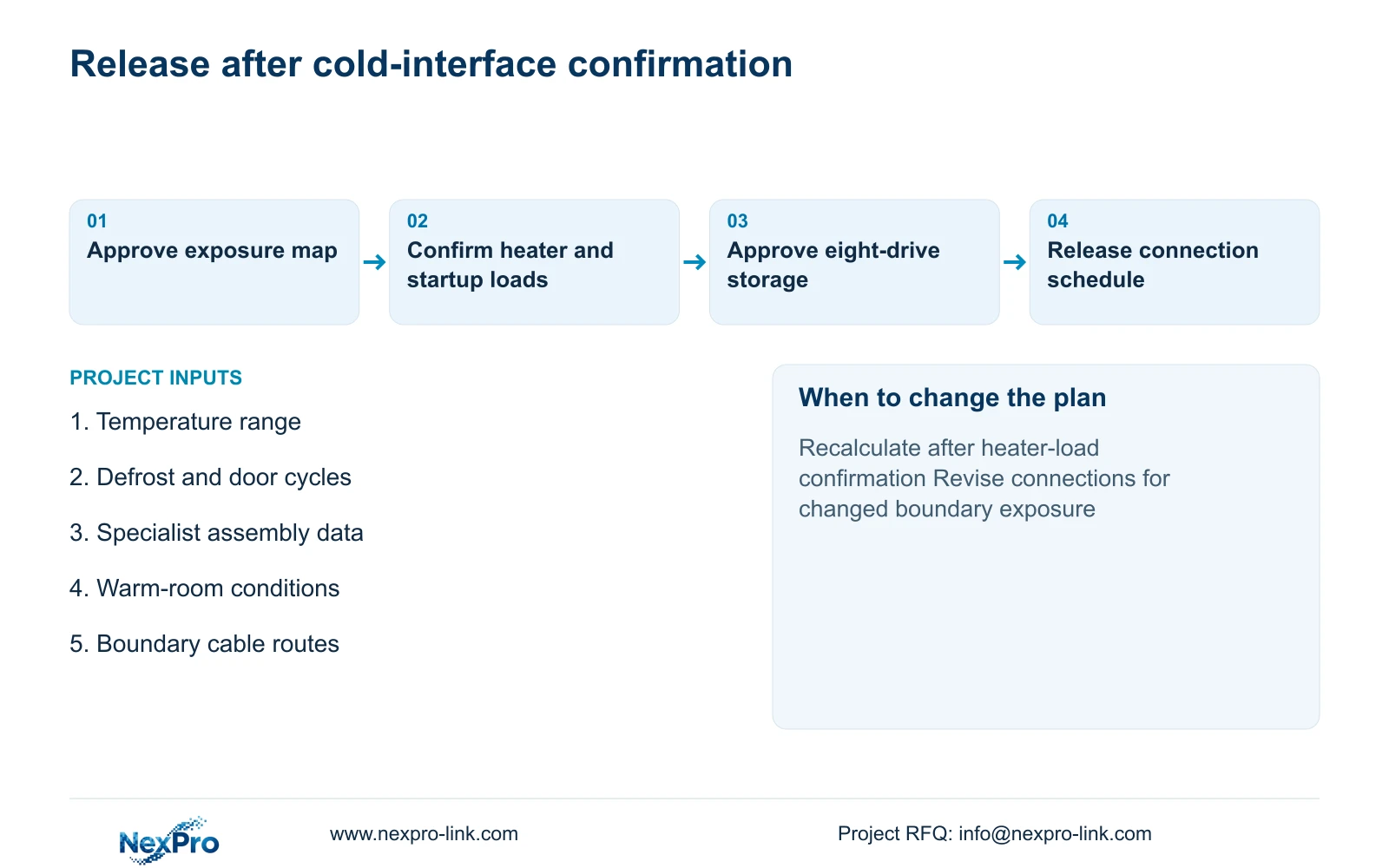
Ask the specialist supplier to identify cold startup, heating and illumination conditions, power interface and any external supply. If the assembly uses separate AC equipment, revise the protected-load list instead of forcing it into the PoE calculation. Keep network switching in the suitable equipment room and preserve security access boundaries from refrigeration-control systems. Test recording, playback and export using the exact selected interface. Once that supply method is confirmed, qualify each proposed PoE group's negotiated allocations and the switch's admission policy. The 133.3333 W and 200 W draw-based targets are not proof that a class-reserving switch accepts the selected devices.
Section 04
Keep backup equipment warm and the display option separate
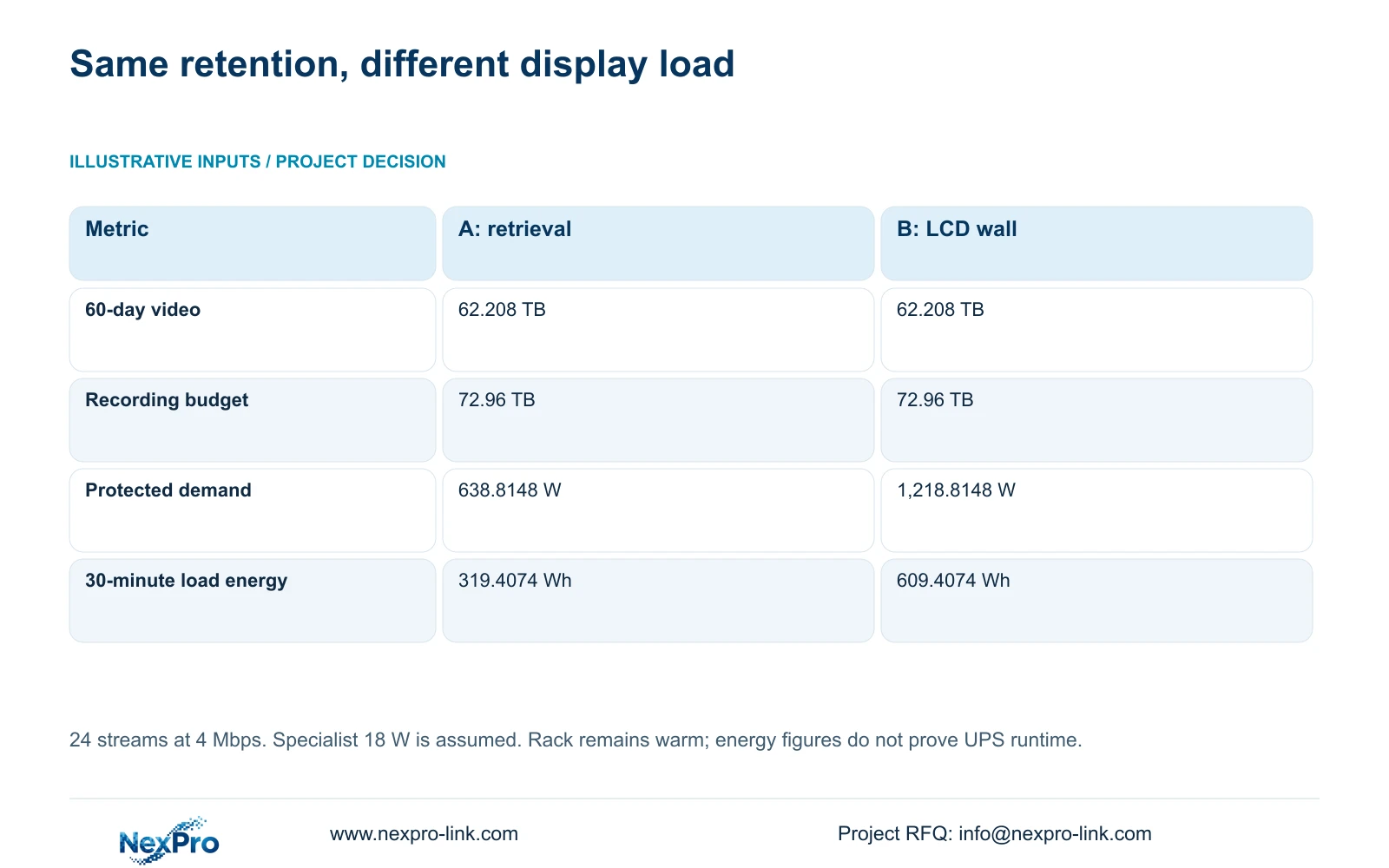
Option A totals 638.8148 W: two ordinary switch AC inputs, one specialist switch AC input, an assumed 30 W recorder, eight drives at 8 W each, a 25 W core, 15 W router and 40 W retrieval display. Camera demand is included through complete switch consumption, so adding it again would overstate the protected load.
Option B retains that equipment and adds four LCD panels at an assumed 120 W each plus a 100 W decoder, reaching 1,218.8148 W. The decisive change is 580 W of display demand; recording capacity remains unchanged. Choose B only for an approved viewing task. NX-VP-5535 is an LCD reference, with decoder concurrency and actual consumption requiring separate confirmation.
At PF 0.9 and 80% rated utilization, check rated_W ≥ load_W / 0.80 and rated_VA ≥ load_W / 0.72. SP1KR(S), rated 1 kVA/900 W, is A's capacity candidate; SP2KR(S), rated 2 kVA/1800 W, is B's. Load_Wh = load_W × 30 / 60 produces 319.4074 Wh or 609.4074 Wh. Obtain exact battery runtime curves and confirm charging, ventilation and maintenance conditions in the warm room.
| Metric | A: retrieval display | B: add LCD wall |
|---|---|---|
| Camera split | 16 ordinary / 8 specialist | 16 ordinary / 8 specialist |
| Required 60-day video | 62.208 TB | 62.208 TB |
| Protected demand | 638.8148 W | 1,218.8148 W |
| 30-minute load energy | 319.4074 Wh | 609.4074 Wh |
| Capacity candidate | SP1KR(S) | SP2KR(S) |
Section 05
Approve boundary connections before cutting cable
The illustrative camera takeoff contains twenty-four new continuous runs from 41 to 76 m, including a declared 6 m service/termination allowance. Total cable is 1,404 m. The lower bound is ceil(1,404 / 305) = 5 reels, and the supplied feasible allocation uses five 305 m reels with used lengths of 299, 274, 305, 265 and 261 m.
One reel combines three 76 m runs and one 71 m run for 299 m. Another combines 66, 61, 61, 61 and 56 m for 305 m. Preserve those complete-run assignments and camera IDs. Residue is not automatically an approved spare, and the reference does not include retained links or additional reserve stock.
Specify cold-boundary cable construction, connection protection, wall entries and suitable supports separately from ordinary warm-room patching. The two-module-ended assumption gives 48 modules and 24 cabinet-side ports, but a specialist direct connection may change that method. SP5648 and DT968MX are cabling references, not proof of freezer suitability. Keep fibre alternatives and the chosen link-test procedure tied to actual routes.
Section 06
Hold specialist interfaces open without losing the complete BOM
The reference BOM contains sixteen ordinary cameras, eight specialist assemblies, one eight-bay recorder, eight compatible 12 TB drives, three qualified access switches, one UPS configuration and one retrieval display. Five reels support the supplied cable allocation. Add mounts, cabinet, distribution, patching and cold-boundary accessories from the approved drawing.
A provisional equipment quotation can proceed while the specialist model remains unresolved, provided its assumptions are visible and priced as a separate scope. Do not release a final switch or battery configuration against an unconfirmed heater demand. The optional wall should remain outside the baseline unless operators can demonstrate a useful concurrent-viewing requirement.
NexPro-Link BOQ support can coordinate relevant ordinary-area equipment and the common infrastructure interfaces. Compare alternatives using the same environmental schedule, sixty-day recording and installation responsibilities. If a different specialist stream, power supply or cold-boundary connection is selected, revise the associated worksheets and acceptance checks before approving the substitution.
Section 07
Buyer questions
Can a camera rated to minus 20°C be specified for a minus 30°C room? The supplied ordinary-camera rating does not support that use. Select a separately documented assembly for the actual operating and startup conditions rather than extending the rating by assumption.
Does a warm equipment room eliminate freezer-camera power uncertainty? No. It gives the rack a suitable location, but remote camera heaters and startup demand still affect the switch or separate supply and the UPS load.
Can sixty days be reduced to fit a smaller recorder? Only after the owner approves the changed evidence requirement. Recalculate the revised period and identify any operational consequence instead of silently lowering retention.
Section 08
Resolve the cold-camera and warm-room interfaces
Email the ambient/transition/freezer point map, temperature and defrost conditions, specialist assembly power/stream data, and 60-day backup brief to info@nexpro-link.com for a coordinated equipment scope.
Engineering references
These sources support the general planning principles. Always use the selected product's current datasheet and applicable project standards for final design.
- User BL2812M series product specification
- User DM2812M series product specification
- NexPro-NVR8864-4K
- NexPro-Link rack online UPS
- NexPro-Link Structured Cabling
- NexPro-Link BOQ & Tender Support
- NexPro-Link NX-VP-5535 LCD video wall panel
- NexPro-Link NX-VD-4K16 network video decoder
- Microchip: Next-Generation PoE IEEE 802.3bt White Paper