Keep a cycle log linking each required pallet transfer to door state, defrost state and observed optical obscuration. Compare the recovered view with the same acceptance task after the approved maintenance action.
Section 01
Specify the doorway cycle as well as minimum temperature
Keep a cycle log linking each required pallet transfer to door state, defrost state and observed optical obscuration. Compare the recovered view with the same acceptance task after the approved maintenance action. Leave cycle-dependent acceptance open when refrigeration is unavailable; connectivity completion cannot substitute for that evidence.
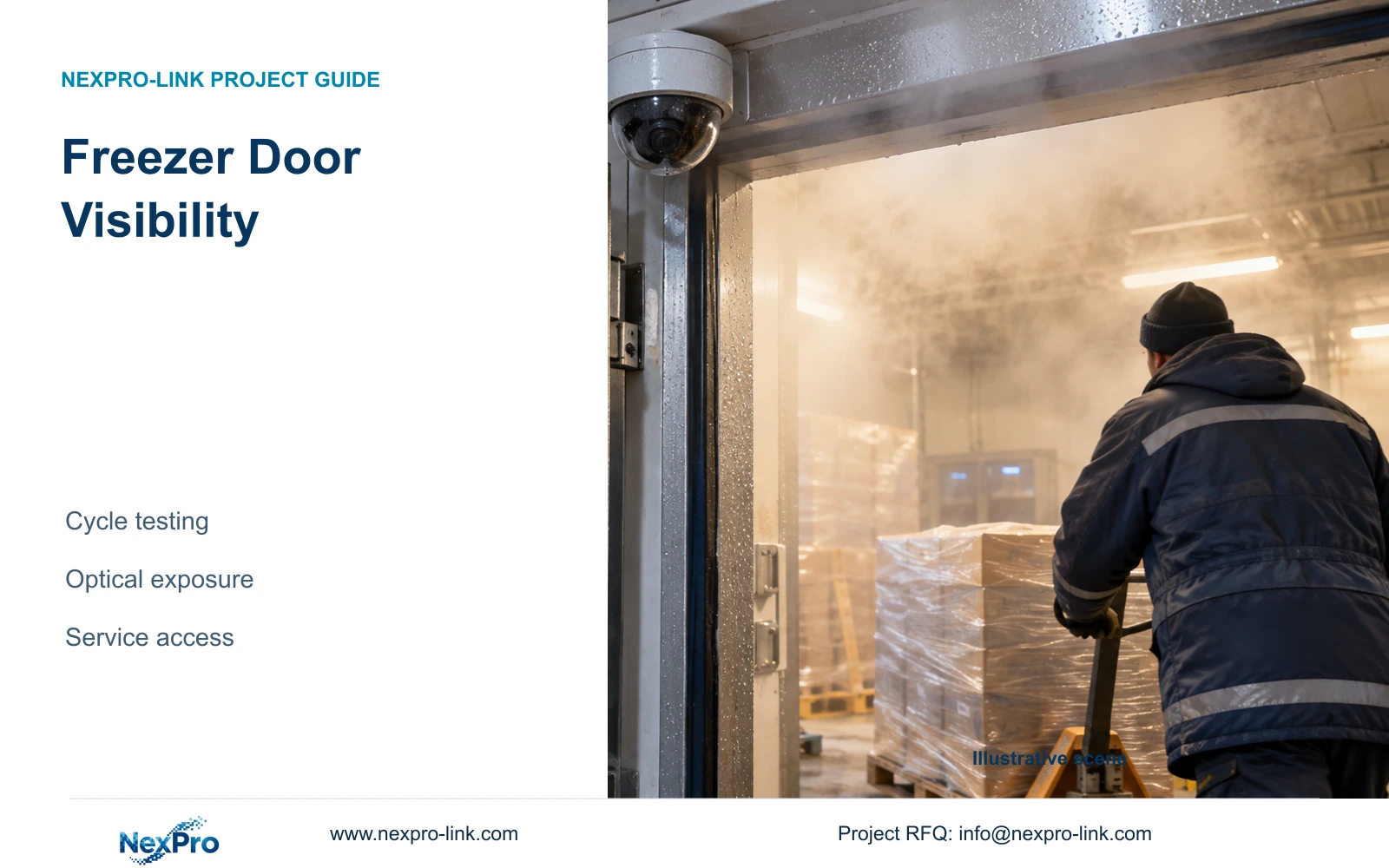
Freezer door CCTV should be selected and accepted through the complete loading, closed-door and defrost cycle. A temperature rating alone does not establish that the recorded image stays useful when moisture obscures the optical surface. Position the camera to avoid unnecessary exposure, then test the intended transfer task and the maintenance access needed to preserve it.
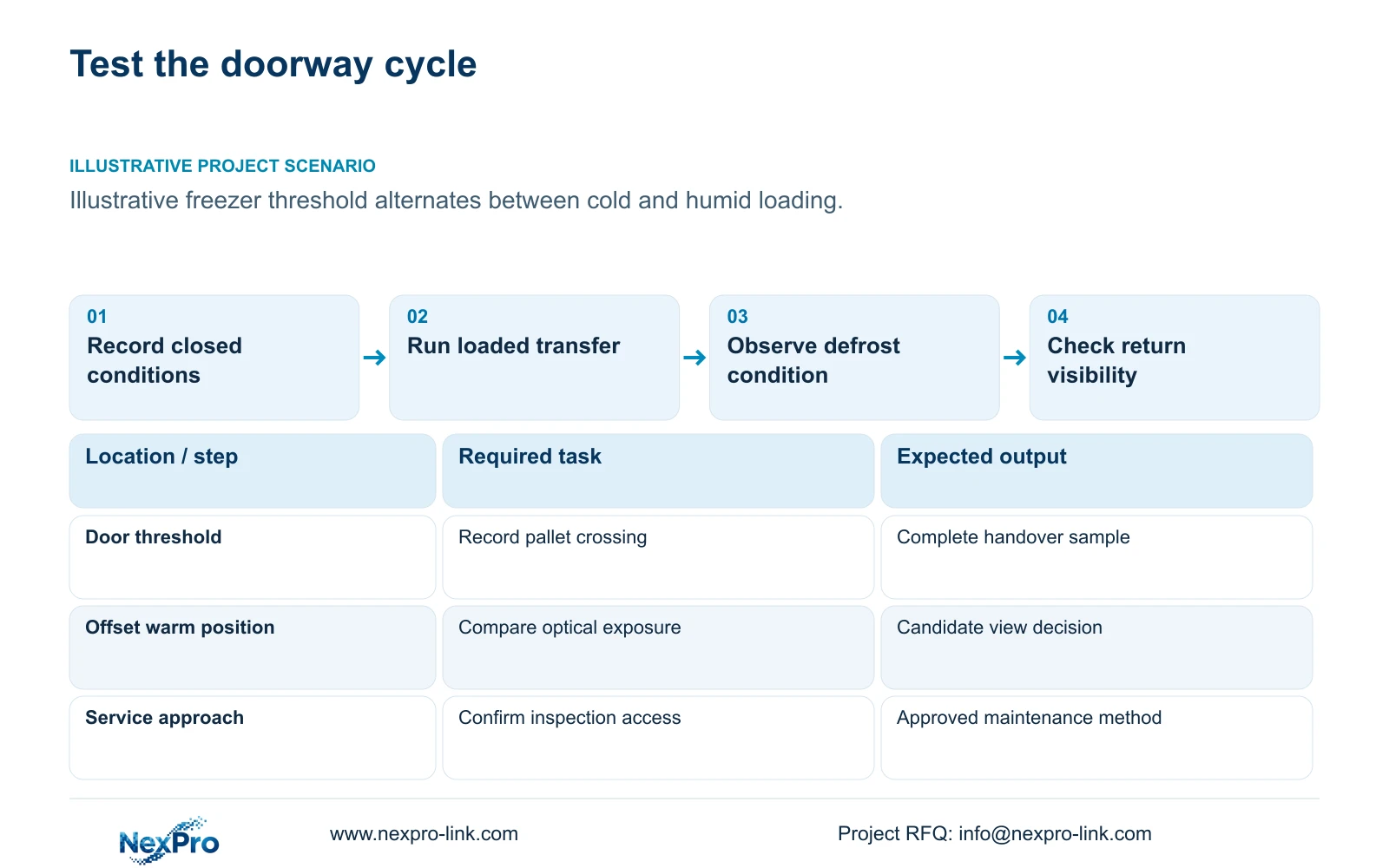
Illustrative project scenario: The freezer door alternates between closed cold conditions and warm humid loading activity. Assume the owner needs a record of pallet transfers across that threshold. The project manager must coordinate operations, refrigeration and installation so the camera is assessed during the conditions that matter, rather than only during a dry commissioning visit.
Document cold-side and warm-side conditions, door opening patterns, defrost arrangements and cleaning practice. Mark the loaded-rack route and the expected forklift position at handover. Identify where camera, connector and cable entry sit relative to the changing boundary. Assign operations to provide the cycle, the designer to propose locations and the installer to confirm service access. Leave unconfirmed conditions visible in the equipment schedule.
Section 02
Move optics away from avoidable exposure
Compare a view directly over the doorway with a suitable offset position on the warmer side. The offset may reduce avoidable exposure and improve access, but it must still show the pallet face and complete crossing. Check door leaves, curtains, moving loads and nearby storage as obstructions. A sheltered position that loses the handover task is not an equivalent alternative.
Assess the connection points separately from the lens. Moving the camera may leave a connector inside a colder or wetter location, and extending the route may change termination and cable requirements. Coordinate any penetration or seal with the responsible cold-store team. An accessory should not be accepted as a complete environmental solution unless the proposed configuration is supported.
The ordinary NexPro-BL2812M55-5MP-DIC-AI and NexPro-DM2812M55-5MP-DIC-AI references list IP66 and minus 20 to plus 60°C, with 2880×1620 output in their 5MP-family specifications. These fields support normal-area candidate selection. They do not establish clear-image performance through a particular condensation cycle, chemical compatibility or operation below the documented minimum.
Section 03
Test the recorded handover through representative conditions
Agree a trial sequence with operations: closed-door conditions, representative loaded transfer, the relevant defrost condition and return to normal use. Record the actual cycle and inspect footage from the intended recorder. Use the same required pallet face and operating route at every candidate position so the comparison answers a location decision.
The test record should state when the target becomes obscured, whether the required transfer remains visible from another view and what cleaning or service is needed. Set acceptance around the event the owner needs, rather than an unsupported universal recovery-time limit. A successful live image at one moment cannot establish that the export contains the full handover.
CASE06 provides a suitable system boundary: 16 ordinary-area cameras and eight separately selected cold-area cameras, with recorder, switches and batteries in a suitable warm room. This article's doorway trial does not qualify all 24 locations at once. Retain each location's environmental status, and ensure the trial uses the selected connection and power arrangement where these affect operation.
Section 04
Compare access effort with declared service assumptions
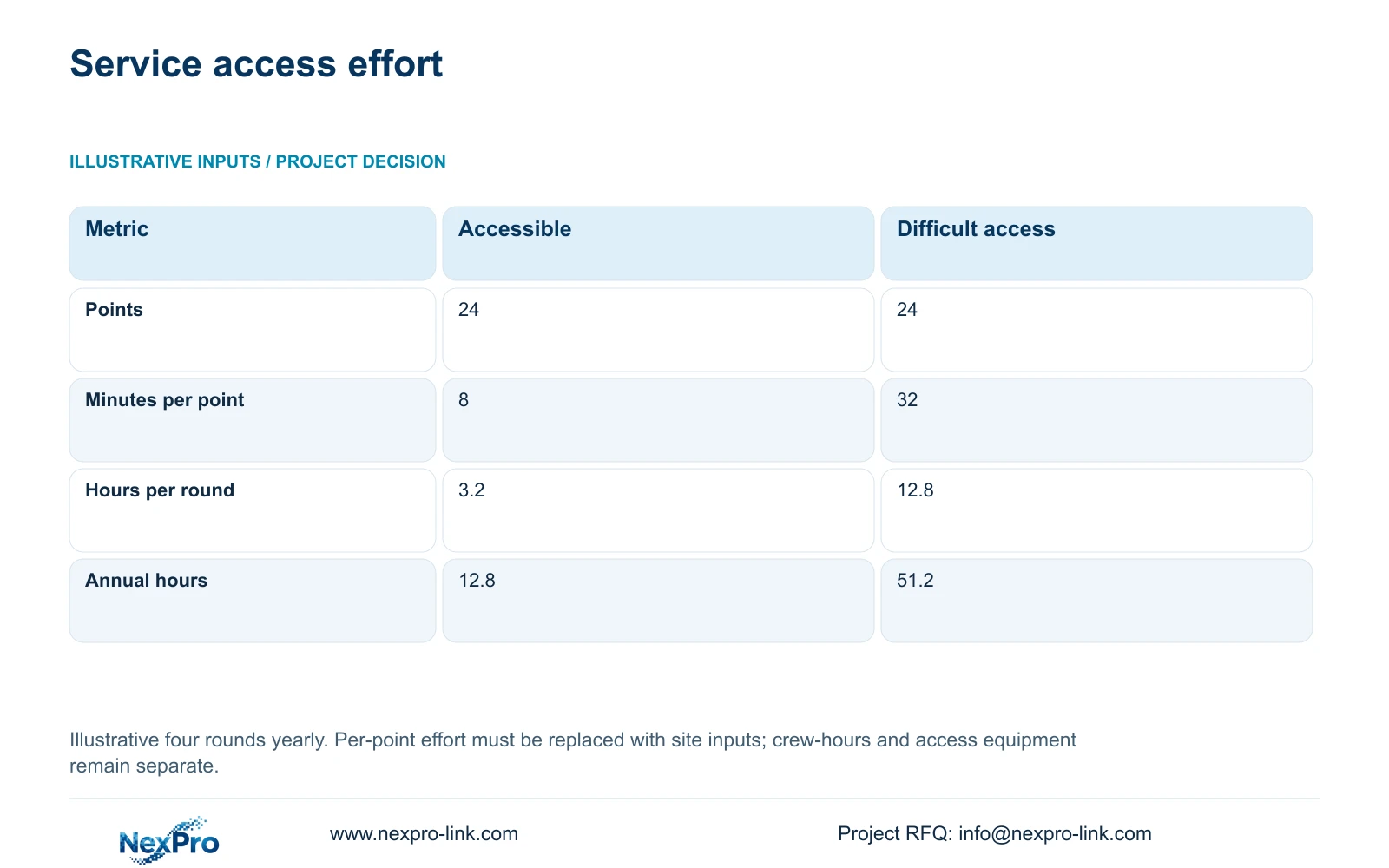
The illustrative maintenance comparison covers 24 cameras, with eight minutes per point for an accessible arrangement versus 32 minutes for a difficult-access arrangement. Four rounds per year are assumed solely for the example. Annual effort is annual_hours = cameras × minutes_per_point × rounds / 60; hours per round use the same formula without the rounds multiplier.
Option A gives 24 × 8 / 60 = 3.2 hours per round and 24 × 8 × 4 / 60 = 12.8 annual hours. Option B gives 24 × 32 / 60 = 12.8 hours per round and 24 × 32 × 4 / 60 = 51.2 annual hours. These figures describe the stated access and inspection assumptions, not measured labour productivity.
The decisive difference is the work needed to reach and inspect each point, even if camera purchase prices are identical. For a commercial comparison, replace the minutes and frequency with the site's safe-access plan and separate individual task duration from crew-hours. Include access equipment, isolation, escorts and restart checks where applicable. This is a whole-system service-round example, not a claim that every camera sits at a freezer door.
| Metric | Accessible arrangement | Difficult-access arrangement |
|---|---|---|
| Cameras | 24 | 24 |
| Assumed minutes per point | 8 | 32 |
| Hours per round | 3.2 | 12.8 |
| Annual hours, four rounds | 12.8 | 51.2 |
Section 05
Choose the position that passes visibility and service checks
Prefer a suitable, accessible position outside avoidable doorway exposure when the recorded trial confirms the handover remains visible. Keep specialist internal equipment where the required cold-side task cannot be seen from that position. The project manager should approve the view and service method together; passing either one alone leaves an unresolved operating dependency.
Change the recommendation if the offset angle hides the relevant pallet face, the door cycle changes or the actual local temperature exceeds the candidate's envelope. A cleaning requirement also needs an approved method and access arrangement. Do not assume operators can wipe a camera during every loading event, or that a generic heater provides a validated substitute for the selected equipment.
Compare bids using the same cycle, recorded task, connection scope and maintenance method. Include the installation access visit and any later retest after refrigeration operation begins. The illustrative annual hours can structure a service estimate once real labour inputs are available, but they establish neither a market cost nor a guaranteed reduction in failures.
Section 06
Assign cycle testing and maintenance ownership before release
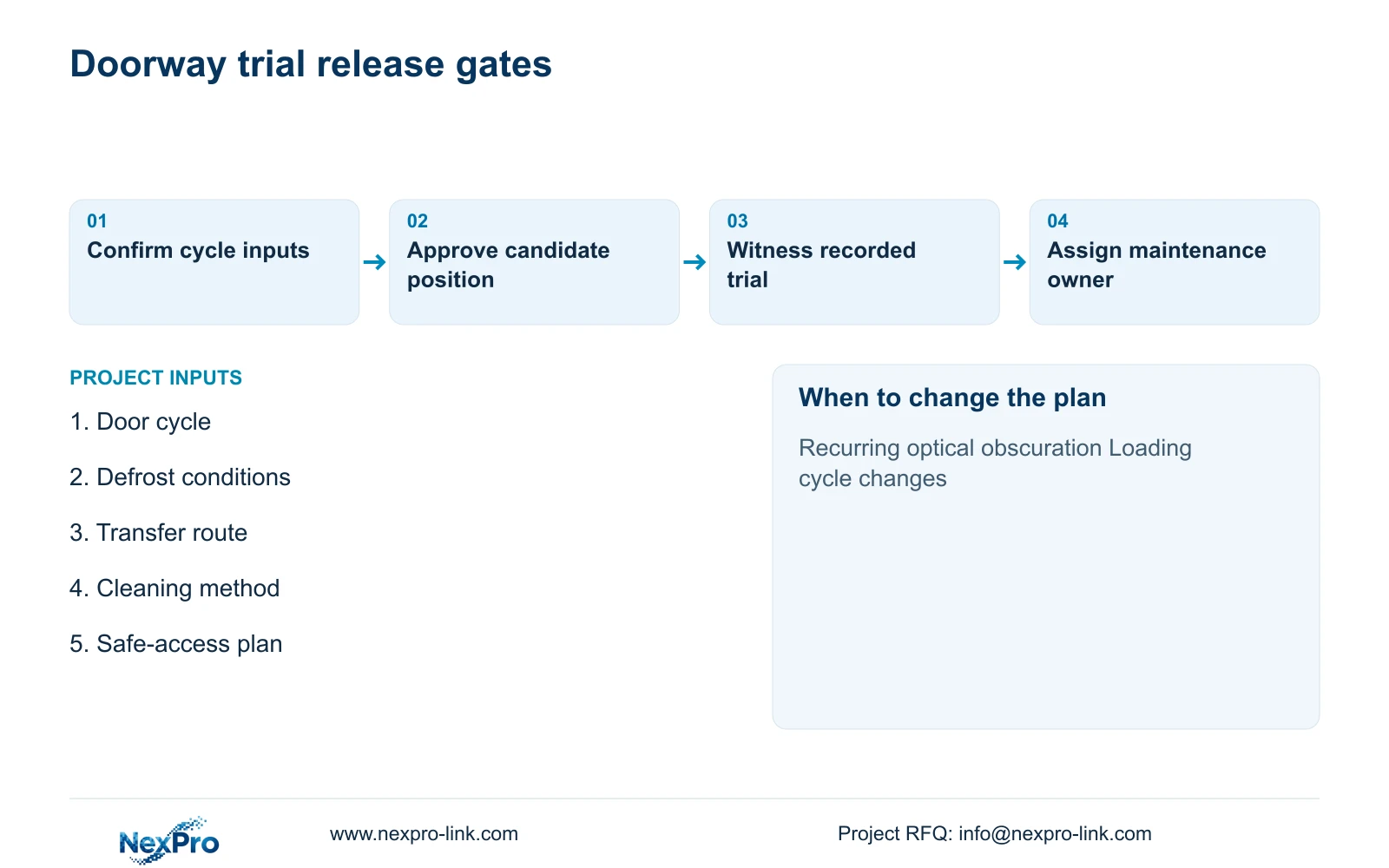
Create a doorway-specific schedule showing the observation task, environmental inputs, proposed camera location, connection arrangement and trial owner. Mark ordinary and specialist equipment separately. The refrigeration team provides operating conditions; the designer accepts the viewpoint; the local installer provides the mounting and service method; operations witnesses a representative transfer.
NexPro-Link can discuss normal-area model matching and coordinated technical submittals through its BOQ and Tender Support scope. Location labels and project packing should retain the doorway IDs and accepted configuration. If the ordinary camera remains provisional pending the cycle trial, record that condition on the purchase-release schedule.
At final handover, provide the accepted sample recording, location photographs, service instructions and the escalation route for recurring obscuration. Keep cabinets accessible in suitable warm locations and test recording recovery after any approved power interruption. If specialist cameras add heater or other power demand, replace the design assumptions and review PoE and backup requirements before approving the revised package.
Section 07
Buyer questions
Should condensation be treated as a camera failure immediately? First establish whether the obscuration is external, whether the selected configuration is being used within its documented conditions, and whether the approved maintenance method restores the view. Record the event before changing equipment.
Can we accept the doorway cameras before refrigeration starts? You can complete connectivity and installation checks, but leave cycle-dependent image acceptance open. Schedule the representative operating trial and its responsible parties before the installation team demobilises.
Does the service-hours example set a quarterly cleaning schedule? No. Four rounds are only a calculation input. Set the actual inspection and cleaning plan from the operating cycle, observed condition and site-approved access method.
Section 08
Prepare a doorway-cycle camera trial
Send the door and defrost cycle, cold/warm operating conditions, required pallet-transfer view, and proposed service-access method to info@nexpro-link.com. NexPro-Link can discuss suitable normal-area candidates and the items that need separate specialist qualification.
Engineering references
These sources support the general planning principles. Always use the selected product's current datasheet and applicable project standards for final design.