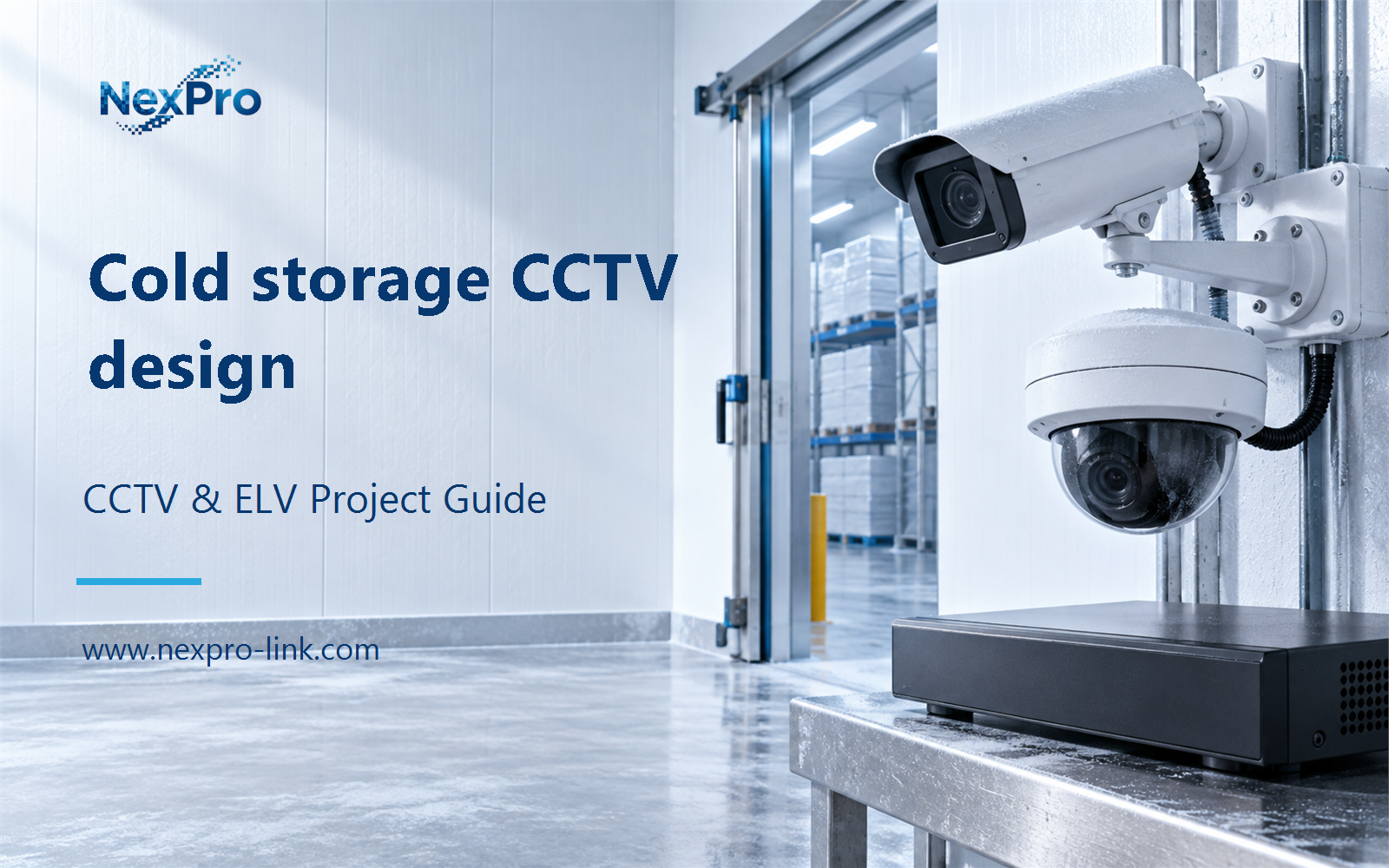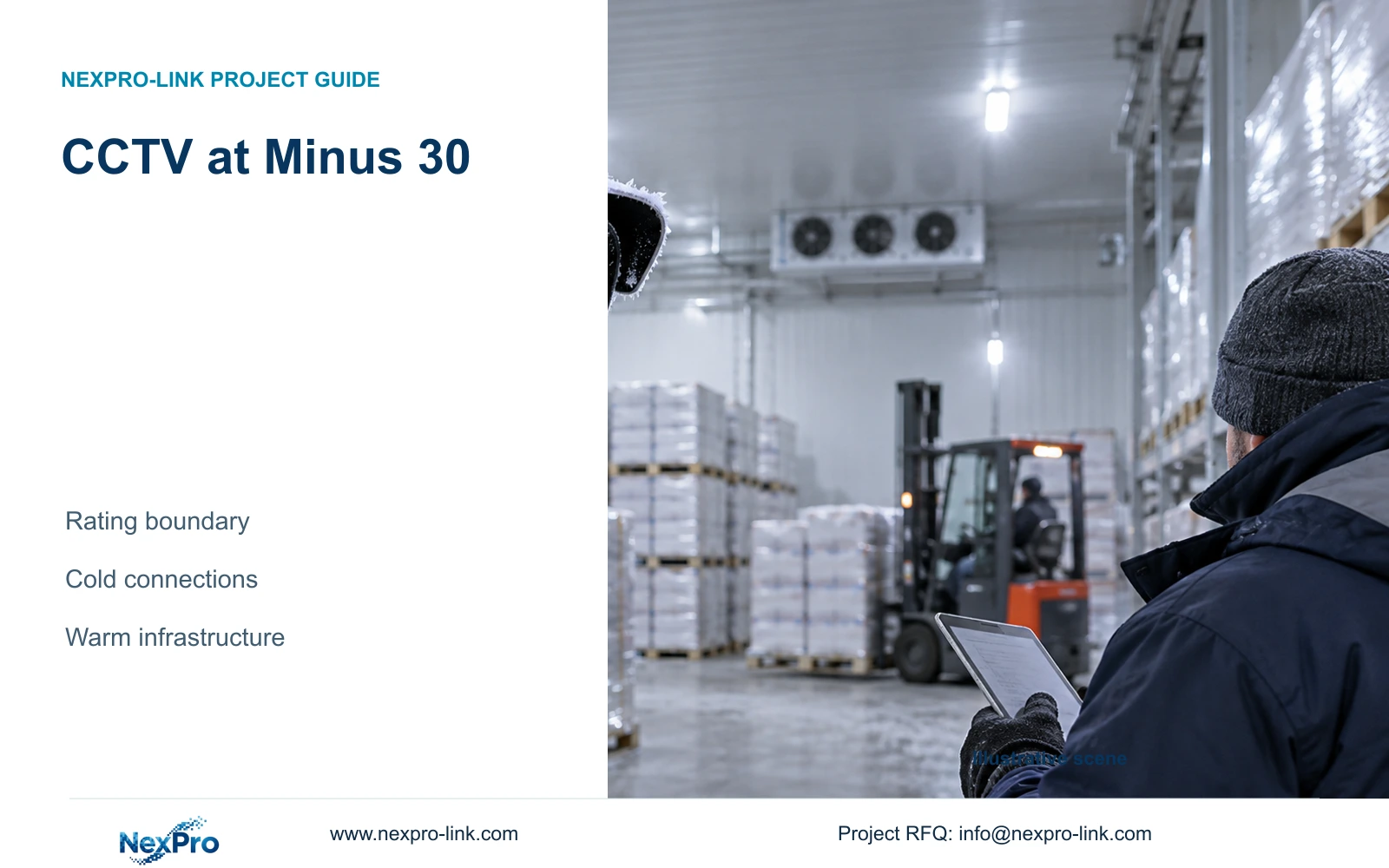
A minus-20 camera rating does not cover a minus-30 chamber. Define the operating envelope, doorway transitions and warm infrastructure before comparing cold-store offers.
Section 01
Exclude ordinary cameras from unsupported cold positions
For cold-room CCTV at minus 30°C, select a camera and complete installation documented for the actual conditions, or use an external view that satisfies the observation task. The ordinary BL2812M and relevant DM2812M references list a minimum of minus 20°C. That documented boundary excludes an unqualified installation inside a minus-30 chamber.
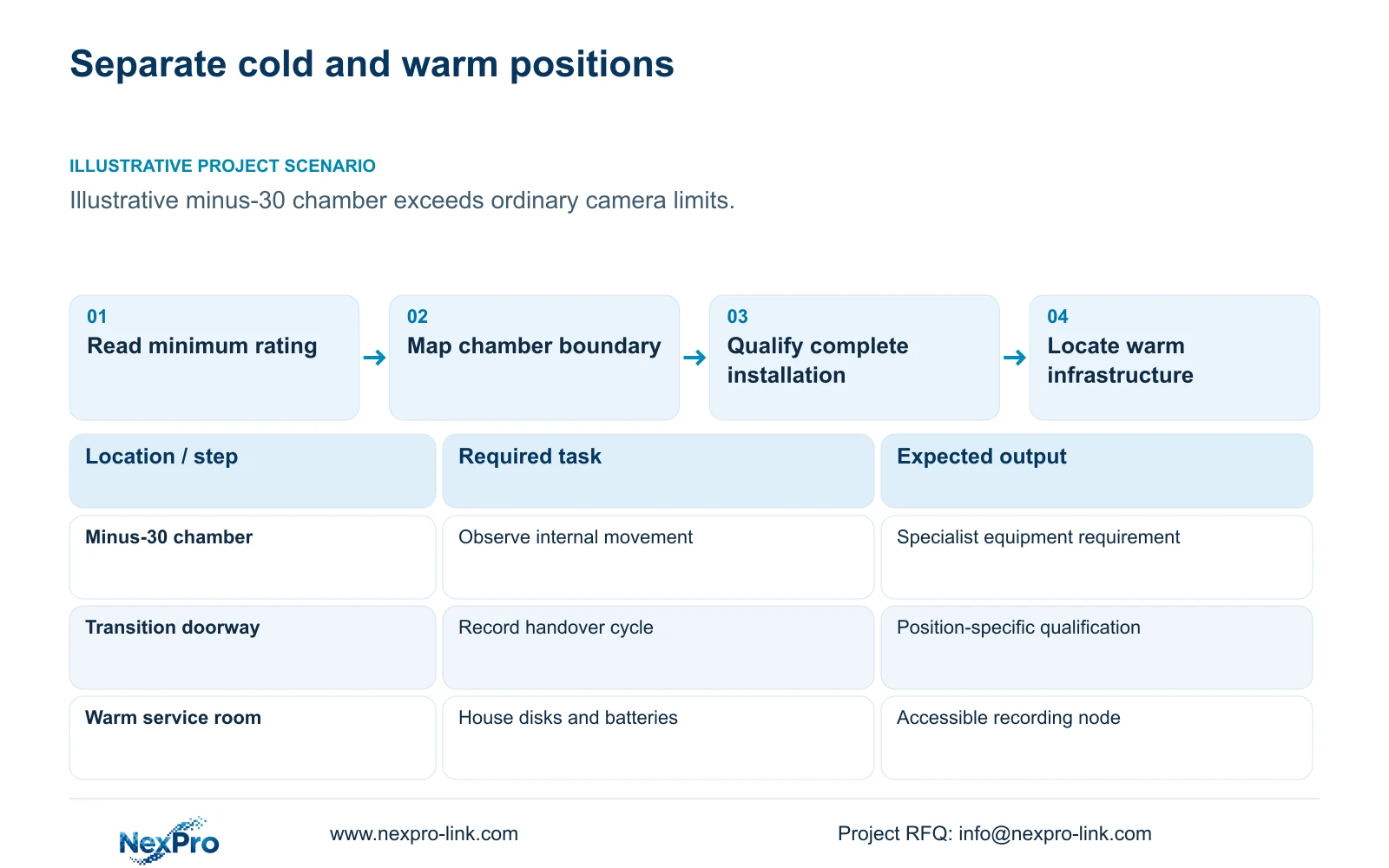
Illustrative project scenario: A cold store operates below the documented minus-20-degree limit of the ordinary varifocal camera family. Assume the owner needs both internal stock-movement views and doorway handover footage. The project team must decide which views genuinely require equipment inside the chamber and which can be achieved from suitable warmer positions.
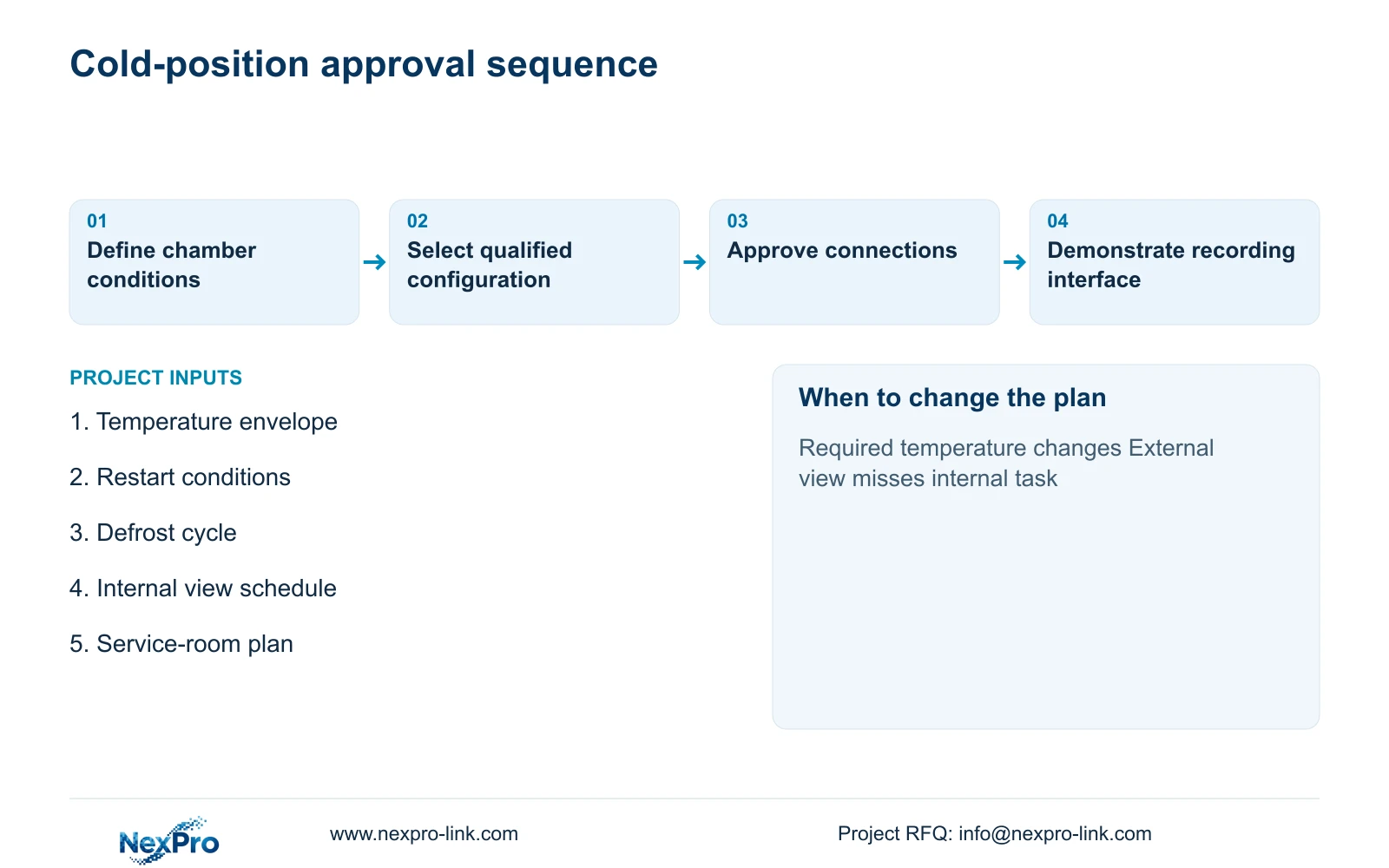
Obtain the chamber operating range, expected conditions at the camera location, defrost cycle and restart requirements from the cold-store team. Check the exact model and supplied configuration rather than a series heading. A generic heater proposal does not establish that the ordinary camera, housing, seals, connectors and power arrangement become a qualified minus-30 solution. Request evidence covering the complete proposed assembly before accepting it.
Section 02
Treat chamber and doorway as different environments
Mark chamber interiors, transition doorways and ordinary warm areas separately on the layout. The chamber view may need to show movement between racks, while the doorway view records transfer into or out of storage. These tasks can require different locations even when they belong to the same event. Retain both where neither alone provides the required context.
At the doorway, identify where the camera and connection points sit during closed-door operation, loading and defrost. A camera nominally on the warm side may still experience a different local envelope from the nearby room. Include moisture exposure and cleaning practice in the assessment; temperature alone cannot approve the position.
An external view is a valid option when it captures the accepted task through a suitable opening or viewing arrangement. Check whether the target remains visible with the door closed and with racks loaded. If the task requires an internal aisle or hidden stock position, a doorway camera cannot substitute for it. Keep those specialist internal views in the BOQ rather than removing them to make a normal-area offer appear complete.
Section 03
Locate recording and batteries in a suitable service room
Use a warm, accessible room for ordinary recorders, disks, switches and batteries where the actual equipment requirements can be met. Define ventilation, maintenance access, power outlets and cable entry before choosing the cabinet. Warm-room placement still requires checking operating and charging conditions; it is not approval based solely on the room's name.
CASE06 illustrates this split with 24 cameras: four each for ambient receiving, packing, warm corridors and dispatch, plus eight specialist cold-area views. Three access groups feed a local recorder. The 16 ordinary candidates remain confined to suitable positions, while the eight specialist devices and their connections need separate selection.
Measure every route from that service room to its endpoint, including approved chamber penetrations and termination locations. CASE06 assumes 41 to 76 m continuous copper links, but these are illustrative routes, not measurements for the proposed cold store. The local refrigeration and installation teams should approve the penetration and sealing method. If a route changes the link architecture, revise the cable, connection and power schedule together.
Section 04
Require every environmental condition to pass
Use a conjunctive qualification rule: location conditions AND complete product scope AND approved installation requirements must fit. Passing the ingress field cannot compensate for an unsupported temperature. Likewise, a cold-rated camera does not establish compatibility with the actual cleaning chemicals, connection materials or doorway cycle.
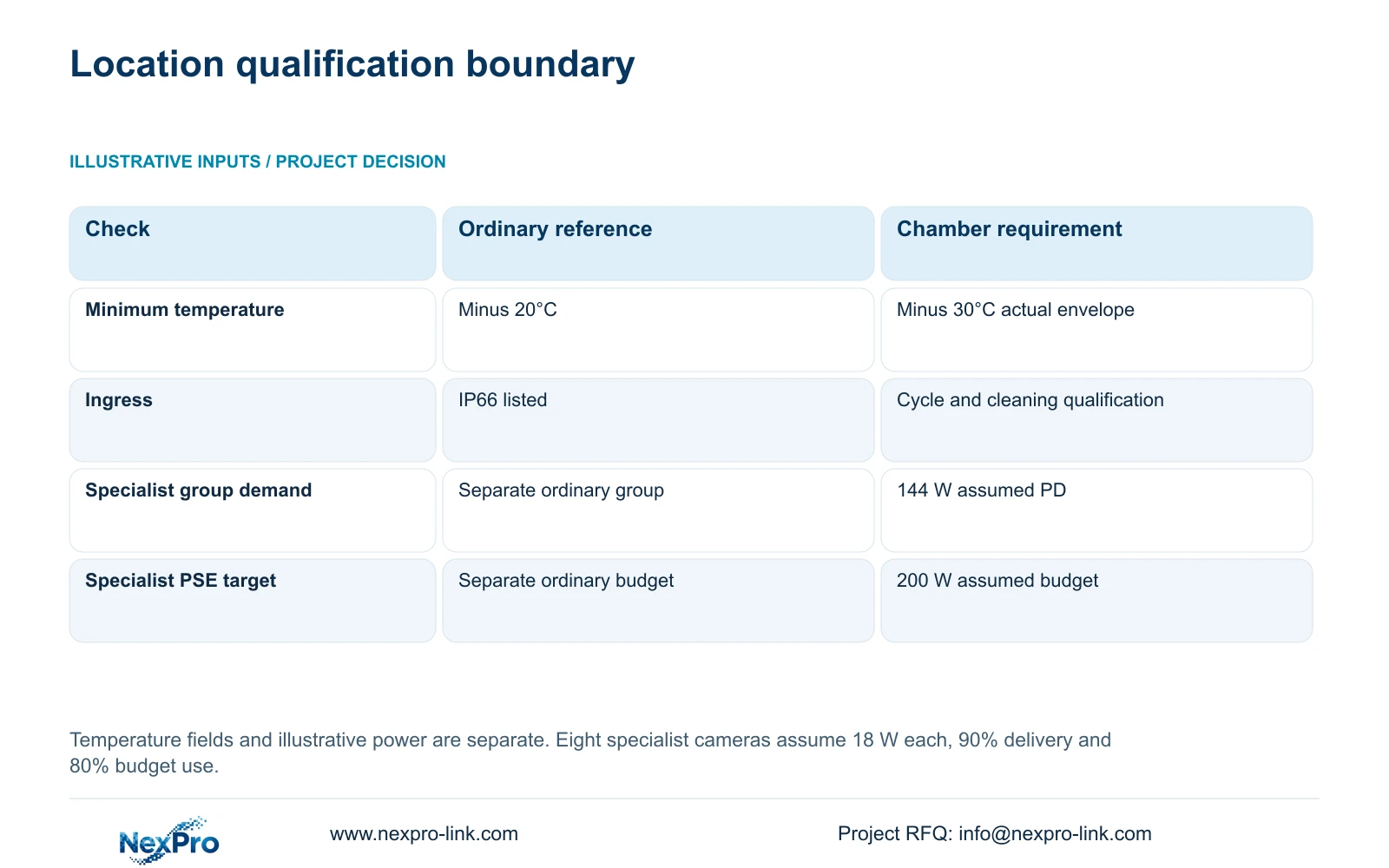
The table separates ordinary-location candidates from equipment selected for the specialist position. The decisive difference is whether evidence covers the full required envelope. The ordinary BL2812M55 reference lists IP66, a 2.8–12 mm motorized lens and 2880×1620 output in its 5MP-family specification. Those useful camera fields do not extend its operating minimum below minus 20°C.
Cold temperature does not by itself establish a hazardous-area classification. If the site's assessment identifies additional protective requirements, use the applicable complete specialist scope and have the responsible team verify local requirements. IP66 and a metal housing do not establish explosion protection, chemical resistance or washdown suitability. Keep these independent checks visible without assigning arbitrary qualification scores.
| Decision | Ordinary warm-area candidate | Minus-30 chamber position |
|---|---|---|
| Temperature | Listed minus 20 to plus 60°C | Documented actual envelope required |
| Moisture and cleaning | IP66 field; assess actual exposure | Qualify cycle and cleaning materials |
| Connections | Selected normal-area termination | Cold-suitable complete connection scope |
| Recording equipment | Accessible suitable service room | Keep ordinary infrastructure outside chamber |
| Additional hazards | No specialist protection established | Retain protection identified by assessment |
Section 05
Keep specialist power demand separate from model ratings
The specialist camera may have power features absent from an ordinary unit. Obtain maximum demand, startup conditions and the accepted supply method for the exact selection. CASE06 uses 12 W device-side demand for ordinary cameras and 18 W for specialist cameras as teaching assumptions, not published measurements. Replace both before final switch and UPS approval.
For its eight specialist devices, the illustrative device load is 8 × 18 = 144 W. At assumed 90% cable delivery, PSE_output_W = 144 / 0.90 = 160 W. With an 80% budget-utilisation target, required PSE budget is 160 / 0.80 = 200 W. Per-port compatibility and any separate supply remain additional checks; a switch without a stated total PoE budget cannot be approved from port count.
CASE06's recording-priority AC load is 638.8148 W, including its complete switch inputs and other listed equipment. Its SP1KR(S) capacity candidate is rated 1 kVA/900 W. The 30-minute load-side energy, 638.8148 × 0.5 = 319.4074 Wh, does not establish runtime. The exact battery configuration and supported curve are required, and the camera demand must not be added again to already complete switch AC loads.
Section 06
Compare offers by retained cold-zone tasks
Prefer qualified internal equipment for tasks that cannot be viewed externally, with ordinary cameras reserved for suitable warm-area work. Change to an external arrangement only after the owner accepts that it captures the same required event. A revised viewpoint that omits internal movement is a scope reduction, even if it removes specialist hardware.
Ask each offer to identify the exact camera configuration, temperature evidence, connections, mounting, maintenance method and recording interface. Compare normal-area and specialist costs separately, then include the shared recording and power dependencies. Do not infer universal compatibility from an IP-stream description; demonstrate the selected specialist stream in the proposed recorder and export workflow.
NexPro-Link can discuss ordinary-area camera matching, the coordinated equipment list and technical deviations through its BOQ support scope. The refrigeration designer and local installer should retain responsibility for chamber interfaces and installation approval. Label specialist items clearly in the supply schedule so normal-area substitutes cannot enter those positions through a later commercial revision.
Section 07
Buyer questions
Does a minus-30 operating rating also prove cold startup? Request the manufacturer's conditions for startup and restart in the proposed configuration. Do not treat a single operating-temperature field as evidence for every power-loss recovery condition.
Can the recorder use video from a separately selected cold-rated camera? Potentially, but the exact stream mode and camera/recorder combination need qualification. Include recording, playback and export in the demonstration rather than checking live video alone.
Must all cameras in a cold-store project be specialist models? No. Apply specialist scope to positions that require it. Ordinary receiving, packing, corridors and dispatch locations can use suitable normal-area equipment after their actual conditions are checked.
Section 08
Separate the chamber and warm-area supply
Email the chamber temperature and restart requirements, doorway/defrost cycle, required internal views, and warm service-room location to info@nexpro-link.com. NexPro-Link can discuss the ordinary-area package and clearly identified specialist interfaces.
Engineering references
These sources support the general planning principles. Always use the selected product's current datasheet and applicable project standards for final design.