What is CCTV? A Complete Guide to
Closed-Circuit Television Surveillance Systems
NexPro Professional Security Camera
CCTV stands for Closed-Circuit Television. Unlike broadcast television, which transmits signals openly to the public, a CCTV system transmits video signals through dedicated cables, private networks, or encrypted internet connections — hence the term "closed-circuit." This closed architecture provides inherently higher security and privacy, making CCTV the backbone of modern surveillance for businesses, hotels, factories, and public spaces worldwide.
But what exactly makes up a CCTV system? What are its core functions? Where is it used? And what should you know before installing one? In this guide, NexPro — your integrated surveillance solution partner — answers all these questions and shows how our complete product ecosystem brings professional-grade CCTV to any project.
◆ What is a CCTV surveillance system?
◆ Core components of a NexPro CCTV system
◆ Key functions and AI-powered capabilities
◆ Common application scenarios
◆ Installation considerations and best practices
What is a CCTV Surveillance System?
A CCTV surveillance system is a closed-circuit video monitoring solution consisting of multiple hardware and software components working together: cameras, lenses, transmission media, monitors, storage devices, and control systems. While most people simply call it a "security camera system," the term CCTV specifically refers to the closed, private nature of the signal transmission — whether over coaxial cable, twisted pair Ethernet, fibre optic, or wireless networks.
Modern CCTV systems have evolved far beyond simple analogue cameras and VCRs. Today's IP-based systems — like those built on the NexPro + Seetong platform — deliver 5MP and 4K ultra-high-definition video, full-colour night vision, built-in AI analytics, and instant mobile access via the cloud. NexPro provides the complete hardware ecosystem, while Seetong Cloud and Seetong Client provide the unified software platform for live view, playback, and device management.
Core Components of a NexPro CCTV System
A complete NexPro CCTV system comprises the following components. Each can be customised to your project requirements — from a small retail shop with 8 cameras to a large hotel or industrial campus with 200+ cameras.
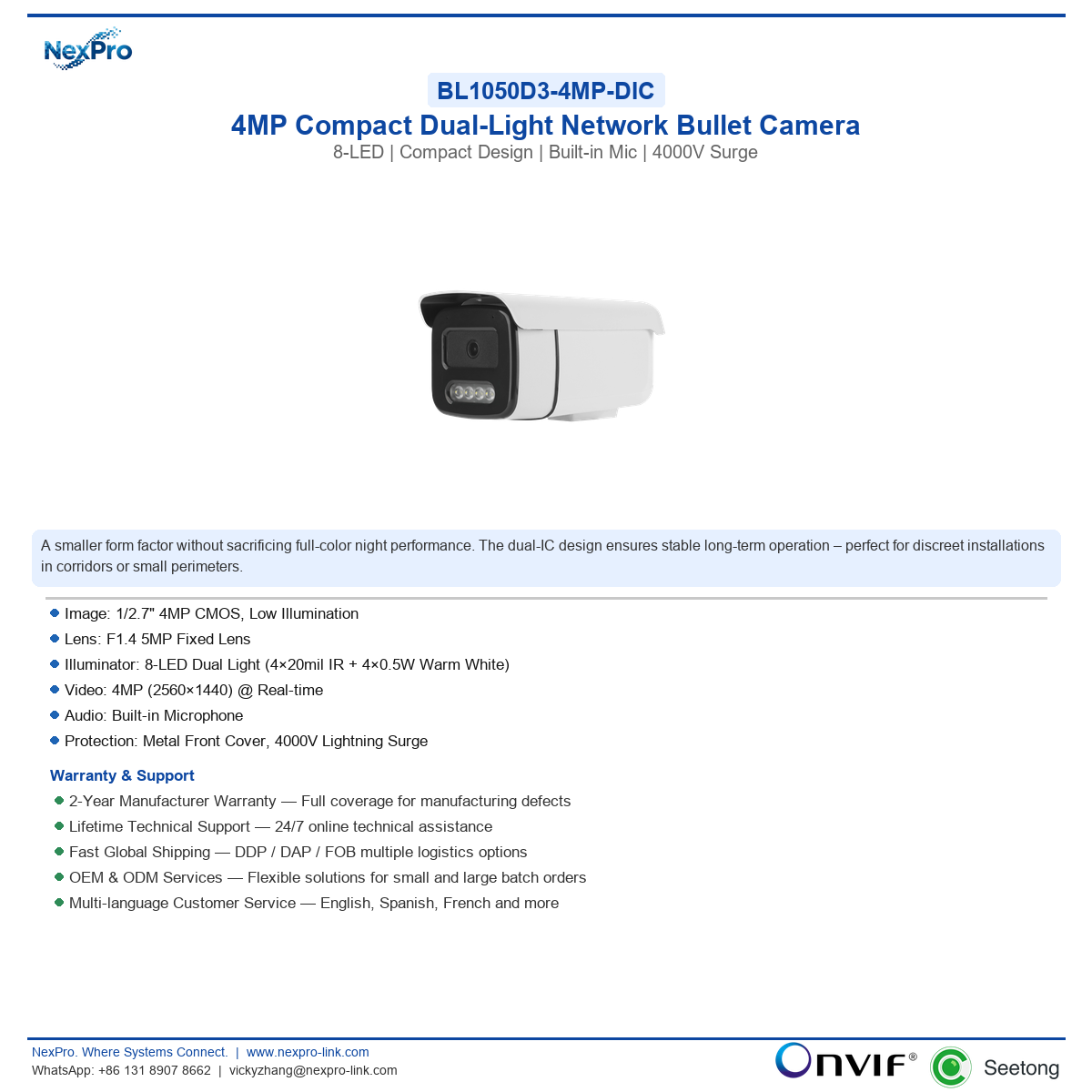
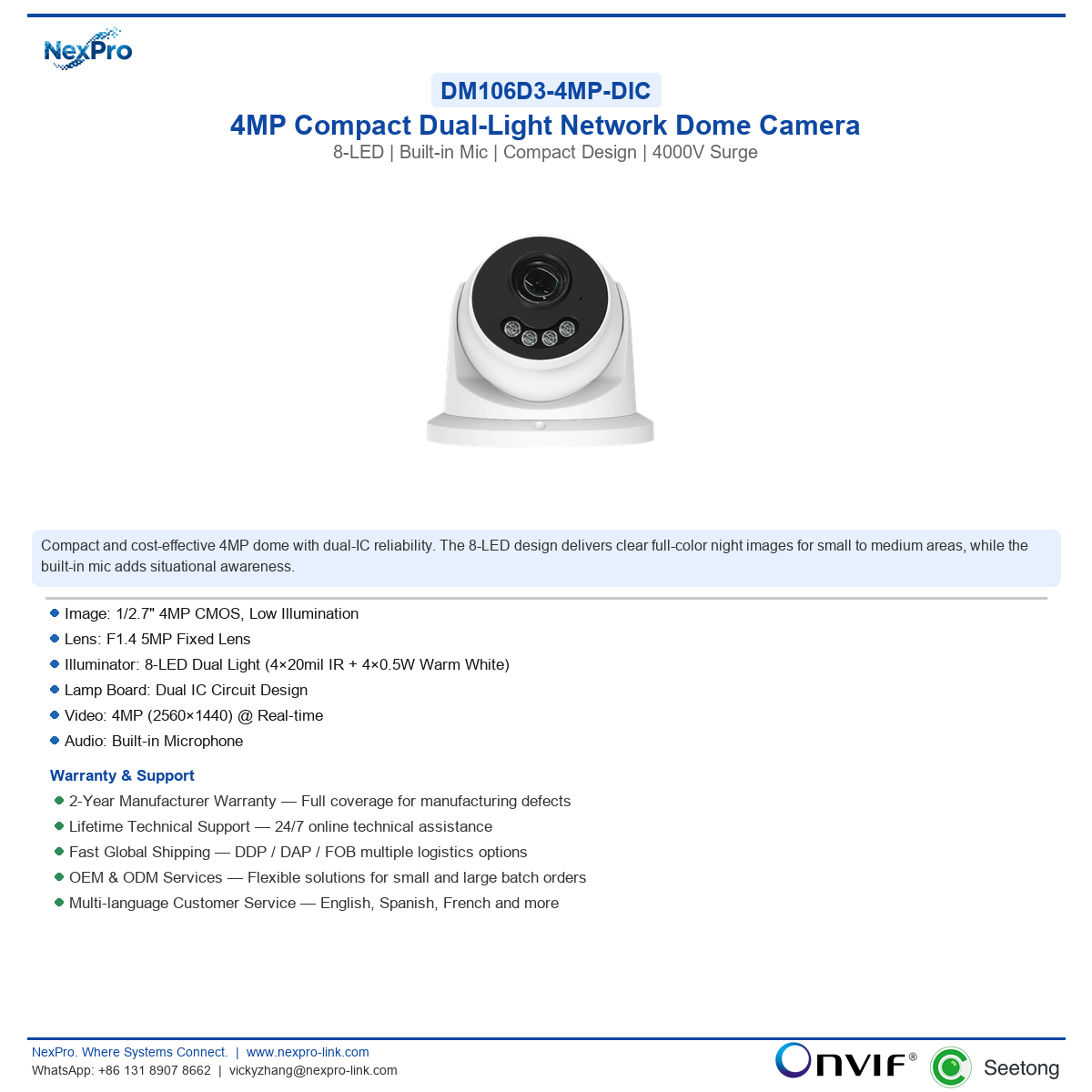
| IP Cameras | Responsible for capturing video and audio in specific areas. NexPro offers a complete range: bullet cameras (NexPro-BL9013M55-5MP-TRI), dome cameras (NexPro-DM106MQ5-5MP-DIC-DJ), PTZ cameras (NexPro-PT736X-5MP with 36× zoom), laser PTZ (NexPro-PTL10-5MP-25X with 200m range), ANPR cameras (NexPro-ANPR9017CP40Y), and specialty anti-flicker cameras (NexPro-SC550LED-4MP). All support H.265+ encoding and dual-light full-colour night vision. |
| Lenses | Control the field of view and focal length. NexPro cameras feature F1.0–F1.4 large-aperture fixed or motorised zoom lenses, optimised for low-light performance. PTZ models offer 25×–40× optical zoom for long-range detail. |
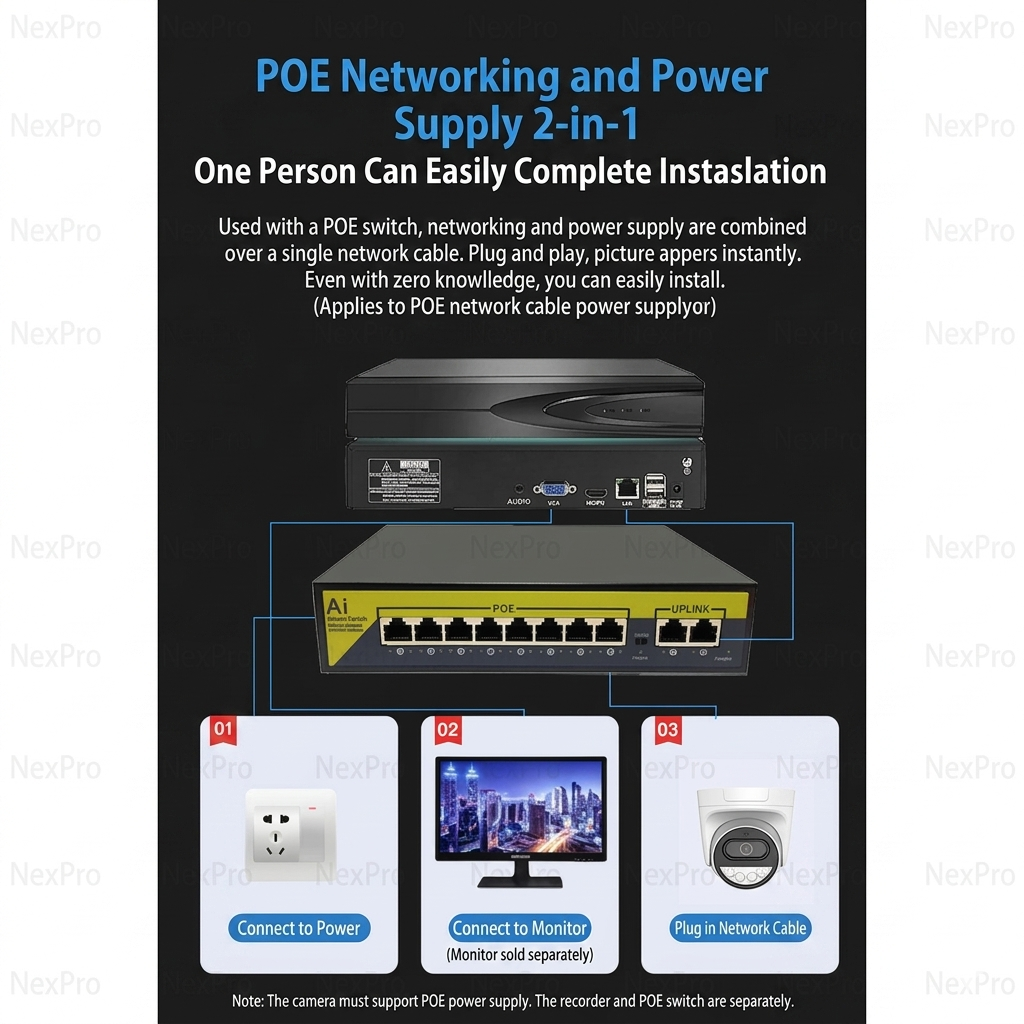
| Transmission | Video data travels from cameras to the NVR via dedicated network infrastructure. NexPro SW-POE series switches (SW-POE1010B / SW-POE1618G / SW-POE2426G) provide both data and power over a single Cat5e/Cat6 cable, with Extend mode supporting distances up to 250 metres without repeaters. |
| Storage | All video is recorded and stored on NexPro NVRs (NVR2232-4K / NVR4449-4K / NVR8864-4K) with RAID-capable SATA bays supporting up to 18TB per drive. H.265+ compression reduces storage consumption by up to 90% compared to H.264. Cameras also support onboard TF card recording for edge storage redundancy. |
| Monitor / Display | Live and recorded video is displayed on HDMI/VGA monitors at the front desk, security office, or dedicated video wall. NexPro NVRs support dual-HDMI independent output for simultaneous overview and detail screens. |
NexPro CCTV System + Alarm Integration
If you need proactive deterrence, NexPro cameras with built-in alarm capabilities can be integrated with external sensors, sirens, strobe lights, and warning bells. The NexPro-PT6100JT40Y-4MP features a built-in strobe light and alarm speaker. The NexPro-BL406Y51-4MP-TRI-AUD supports custom voice alerts and perimeter intrusion detection. When the camera detects motion or a line-crossing event, it can trigger visible strobe flashes, audible warnings, and push notifications to the Seetong APP — all without additional external controllers.
NexPro CCTV System + Two-Way Audio
Two-way audio enables real-time conversation between the monitoring centre and people at the camera location. NexPro cameras with the -AUD or -DJ suffix (e.g., NexPro-DM106MQ5-5MP-DIC-DJ, NexPro-BL106M55-5MP-DIC-AUD) feature built-in microphones and speakers. This is widely used in hotel elevator emergency intercom, visitor gate communication, and retail customer service scenarios.
What Are the Functions of a NexPro CCTV System?
A NexPro CCTV system goes far beyond passive recording. It serves four essential roles:
- Deterrence: Visible cameras with warm white LED illumination and strobe capabilities actively discourage criminal activity before it happens.
- Detection: Built-in AI analytics — human detection, vehicle detection, line crossing, area intrusion — automatically identify genuine threats and filter out false alarms.
- Evidence: High-resolution 5MP/4K recording with full-colour night vision captures faces, clothing colours, vehicle plates, and fine details that grainy black-and-white footage simply cannot provide.
- Real-Time Response: Instant push notifications to Seetong APP, email alerts with snapshots, and NVR pop-up video enable security personnel to respond within seconds of an event.
AI-Powered Capabilities
As artificial intelligence technology advances, NexPro CCTV systems have gained powerful smart features:
| Face Recognition | AI-powered cameras can detect and capture human faces, enabling identity verification when integrated with access control databases. Ideal for hotel VIP welcome systems and staff attendance management. |
| License Plate Recognition | The NexPro-ANPR9017CP40Y features a built-in ANPR engine. It captures plate numbers, supports blacklist/whitelist management, and provides vehicle entry/exit statistics. Perfect for hotel parking, factory gates, and gated communities. |
| Object Detection | AI algorithms can identify specific objects or behaviours — abandoned luggage, vehicles in pedestrian zones, or items removed from designated areas. |
| Behaviour Analysis | Advanced analytics detect unusual behaviours such as loitering, falls, wrong-way movement, or crowd gathering. The NexPro-SC1040M15-GK specialises in high-altitude object trajectory detection for tower blocks and high-rise buildings. |
Common Application Scenarios
NexPro CCTV solutions are deployed across a wide range of environments:
| Hotels & Resorts | Lobby, corridors, parking, swimming pool, perimeter — unified monitoring with NexPro-NVR4449-4K, PT736X-5MP PTZ in lobbies, BL9013M55-5MP-TRI in corridors, ANPR9017CP40Y at parking gates. |
| Retail & Commercial | Shops, restaurants, shopping malls — anti-theft monitoring, POS transaction verification with NexPro-SC550LED-4MP anti-flicker cameras, customer flow analysis. |
| Industrial & Factories | Production lines, warehouses, loading docks — 24/7 operation monitoring, safety compliance, perimeter security with NexPro-PTL10-5MP-25X laser PTZ (200m range). |
| Schools & Campuses | Classrooms, corridors, playgrounds, gates — student safety, access control, anti-bullying monitoring. |
| Residential & Gated Communities | Entrance gates, underground parking, lift lobbies, perimeter fences — access control, visitor management, property safety. |
| Logistics & Warehousing | Sorting areas, conveyor belts, parcel label inspection — operational oversight, theft prevention, process optimisation with NexPro-SC550LED-4MP anti-flicker cameras for label reading. |
Installation Considerations for NexPro CCTV Systems
1. Define Your Requirements First
Before installation, clearly identify: which areas need coverage, what level of detail is required (general overview vs. facial identification), whether audio is needed, lighting conditions at night, and your budget. NexPro offers free system design consultation — contact us with your floor plan for a tailored camera placement plan.
2. Choose the Right Equipment
Match camera types to each location's specific needs. For example: corridors use compact bullet cameras (NexPro-BL9013M55-5MP-TRI), elevators use dome cameras with two-way audio (NexPro-DM106MQ5-5MP-DIC-DJ), parking entrances use ANPR cameras (NexPro-ANPR9017CP40Y), and large perimeters use laser PTZ cameras (NexPro-PTL10-5MP-25X). All powered by NexPro SW-POE switches for single-cable installation.
3. Plan Camera Mounting Positions Carefully
Camera position directly affects monitoring effectiveness. General principles: mount cameras at height to prevent tampering; avoid direct sunlight into the lens; ensure no blind spots at critical choke points (entrances, exits, stairways); for ANPR cameras, maintain a 30–45° angle to the vehicle path; for anti-flicker cameras (POS/kitchen), install ≤4 metres from the target and at ~45° tilt.
4. Respect Privacy Regulations
When installing CCTV systems, always comply with local privacy laws and regulations. Avoid pointing cameras directly into private spaces such as guest room interiors, changing rooms, or neighbouring properties. NexPro NVRs support privacy masking zones that can be configured per camera to permanently block out sensitive areas from both live view and recording.
NexPro delivers complete, pre-configured CCTV solutions for hotels, factories, retail chains, and enterprise campuses — from 8 cameras to 200+. All hardware ships with Seetong-compatible firmware pre-loaded. Contact your NexPro integration specialist today for a free system design and quotation.
Powered by Seetong Cloud Platform.
For more information on NexPro CCTV solutions: contact your NexPro representative.
Ready to Build Your NexPro CCTV System?
Our experts can help you design the right solution — from a small retail shop to a large industrial campus.
Request a Consultation