Plan VMS vs NVR with practical guidance on identify the missing workflow and check integration at function level. NexPro-Link project guide.
Section 01
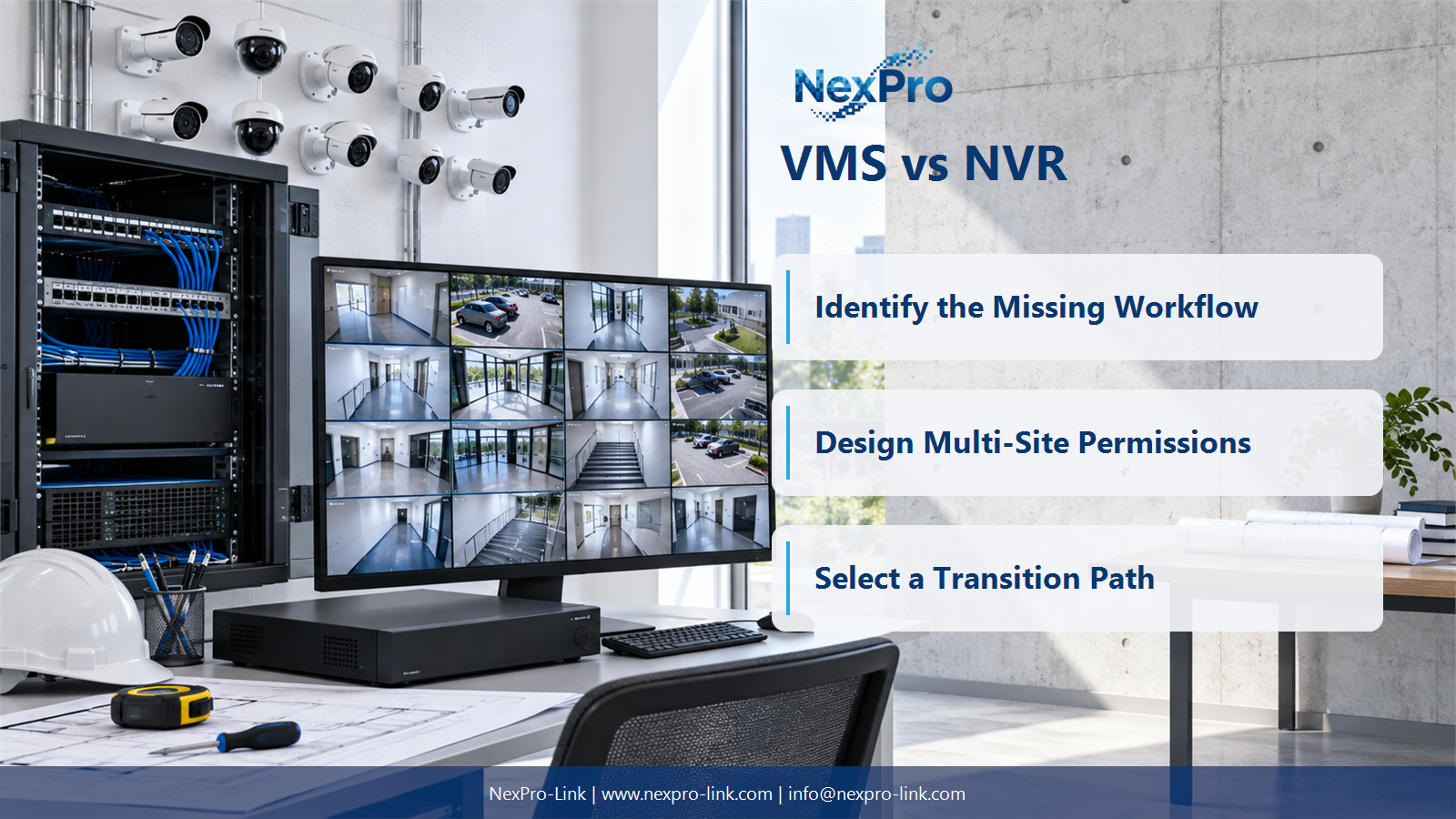
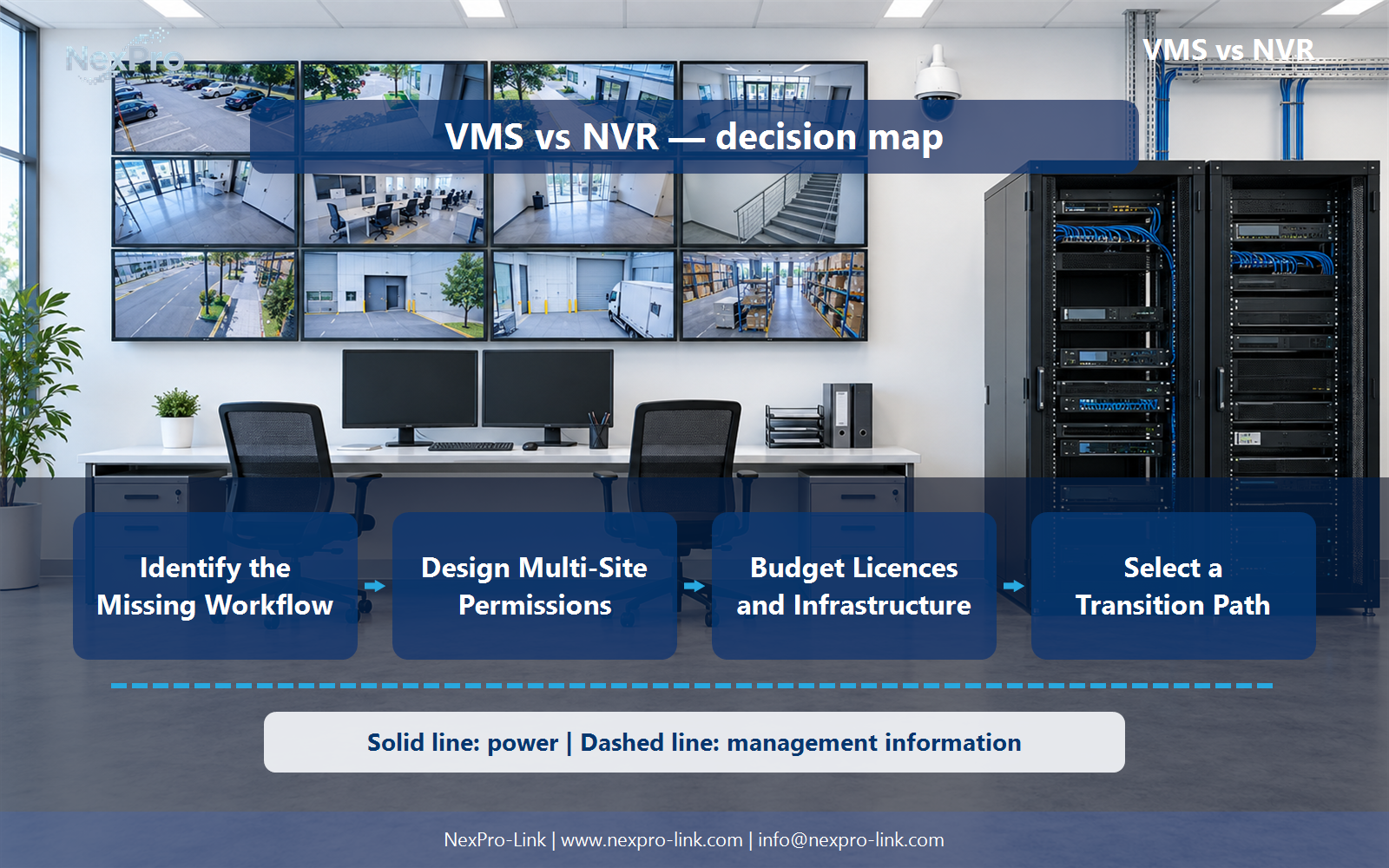
Identify the Missing Workflow
It outgrows the available recorder workflow when required permissions, site management, integrations or operator actions cannot be delivered adequately. Camera quantity is only one factor. Describe the missing functions before deciding whether a VMS, a different client or another recorder configuration is necessary.
Turn the answer into a working record using User task, Current limitation, Required outcome, Option.
| Decision area | Buyer question | Required output |
|---|---|---|
| Identify the Missing Workflow | What makes a project outgrow an NVR? | It outgrows the available recorder workflow when required permissions, site management, integrations or operator actions cannot be delivered adequately. |
| Separate Management from Recording | Does installing a VMS replace every NVR? | Not necessarily. |
| Design Multi-Site Permissions | What permissions should a multi-site VMS define? | Define which users can view, replay, export and administer each camera group. |
Section 02
Separate Management from Recording
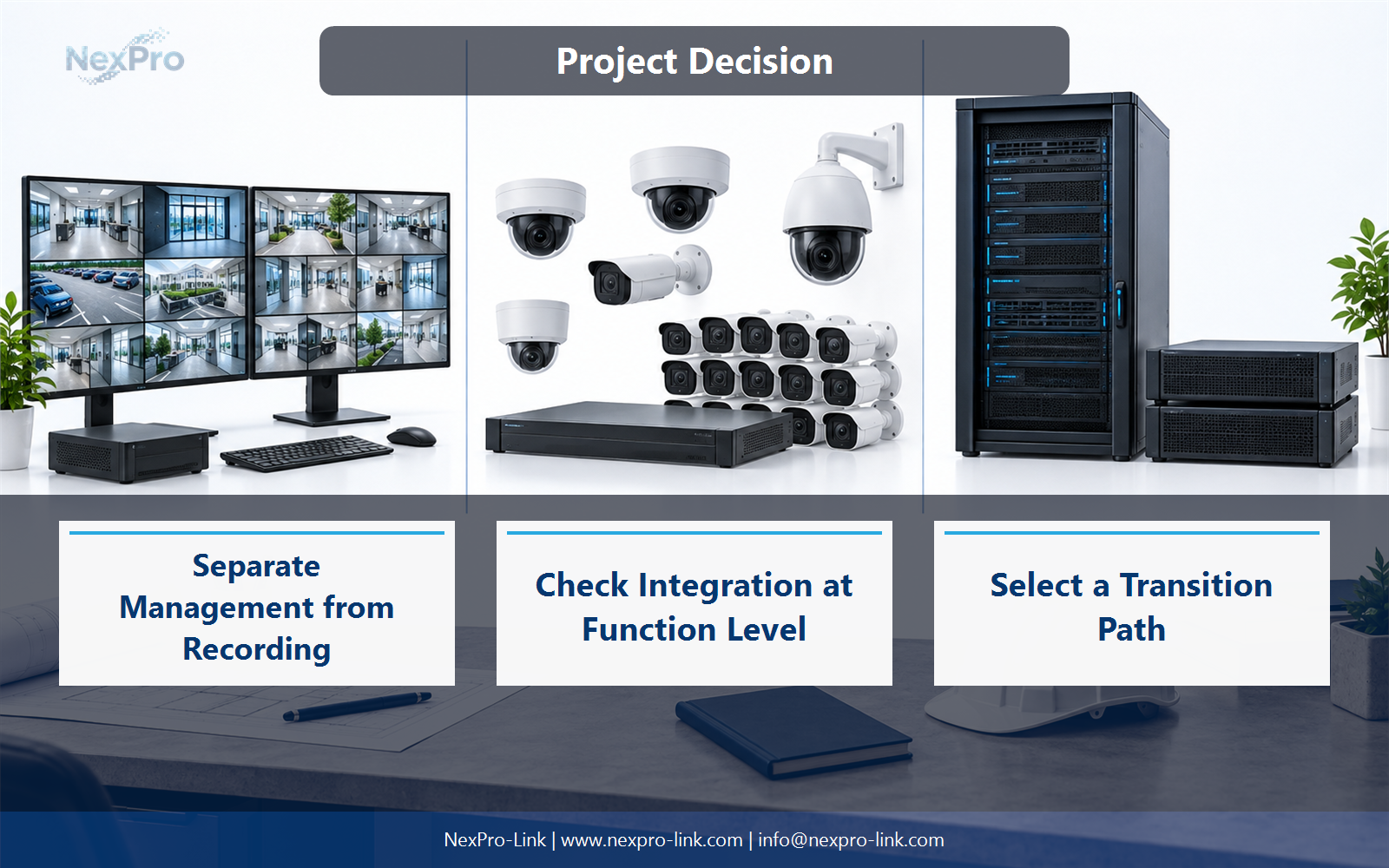
Not necessarily. Some architectures retain local recording while a management platform coordinates viewing and permissions. Others place recording services on servers. Define the role of each component and confirm supported functions rather than assuming VMS means all video must move to one central server.
Use Component, Recording role, Management role, Data location to compare options on the same basis. Keep product capability, project assumption and operating responsibility in separate columns.
Section 03
Design Multi-Site Permissions
Define which users can view, replay, export and administer each camera group. Consider local operators, central security and temporary service access separately. Central visibility should not automatically grant every user full access to every site's recordings or device settings.
The project output should make Role, Site group, Live, Playback, Export, Administration traceable from input to acceptance.
- Confirm the answer to: What permissions should a multi-site VMS define?
- Record the project fields: Role / Site group / Live / Playback / Export / Administration.
- Keep product capability, project assumptions and site responsibility in separate records.
Section 04
Check Integration at Function Level
No. Basic streaming support does not establish compatibility for all analytics, events, audio, configuration or edge-recording functions. Match the specific camera and platform versions to the functions needed by the project. Avoid describing a general protocol statement as unrestricted interoperability.
Record Function, Device version, VMS version, Interface, Behavior before selecting a product family. That makes later substitutions possible without silently changing the operational requirement.
Section 05
Budget Licences and Infrastructure
Include licences, recording servers, client workstations, storage, support and relevant integrations, as well as ongoing administration. Compare the same retained footage and operator workflow. A low software licence price can obscure infrastructure that was previously included in a recorder appliance.
Review Cost item, Initial scope, Recurring scope, Owner with the party that will operate or maintain the system.
Section 06
Select a Transition Path
Start with a defined site or camera group and preserve essential recording during the transition. Test the required client actions, events and recovery behavior before widening the deployment. Document which platform owns configuration and where recordings remain so operators do not lose track of the authoritative system.
Use Stage, Camera group, Recording owner, Operator test, Rollback as the handoff between design and procurement.
Engineering references
These sources support the general planning principles. Always use the selected product's current datasheet and applicable project standards for final design.