
Model running, startup, growth, and post-fault states separately instead of summing power-supply nameplates by node count.
Section 01
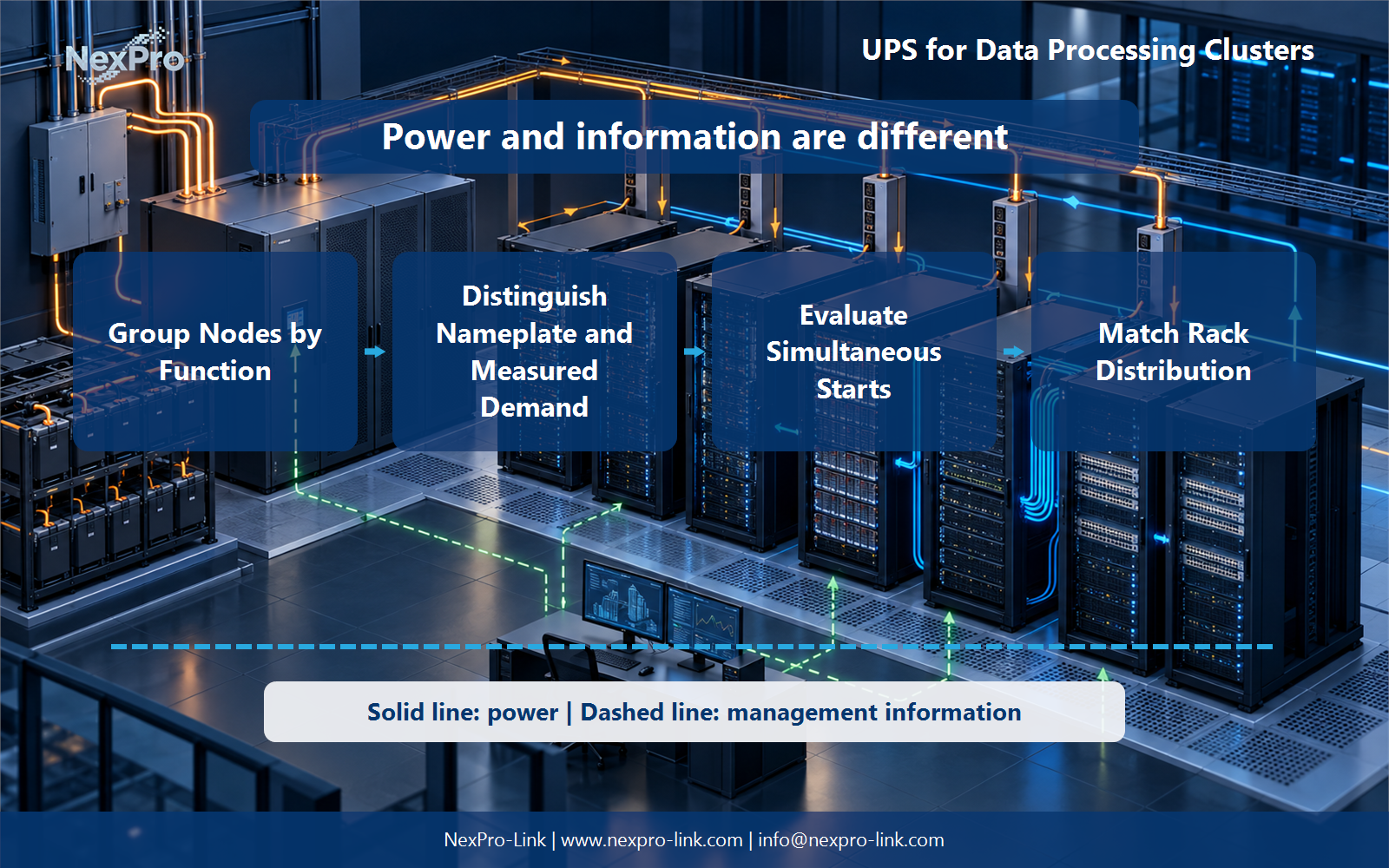
Group Nodes by Function
For Big data platform operations teams, the first project decision is this: Why group cluster nodes by role? Management, compute and storage roles can have different loads and restart dependencies. A functional rack schedule supports more useful power planning than a single average for every node. Keep shared switches and service hosts visible in the same model. The practical output is node table: role / count / demand / dependency, supported by cluster rack schedule and approved startup sequence.
Model running, startup, growth, and post-fault states separately instead of summing power-supply nameplates by node count.
The working question is simple: Why group cluster nodes by role? Record the answer as a service requirement before comparing UPS ratings or battery options.
| Decision area | Project question | Required output |
|---|---|---|
| Group Nodes by Function | Why group cluster nodes by role? | Approved service objective |
| Distinguish Nameplate and Measured Demand | Should PSU nameplate ratings be added as normal demand? | Defined load and dependency boundary |
| Evaluate Simultaneous Starts | Why analyze a simultaneous restart? | Reviewed power-path decision |

Section 02
Distinguish Nameplate and Measured Demand
They provide an equipment limit, not necessarily operating consumption. Use measured or supported design demand for the selected workload while retaining startup and maximum constraints separately. Record the basis so a later hardware or workload change can be evaluated consistently.
Keep the load list, operating state and supporting dependencies in the same schedule. This makes omissions visible before runtime or capacity is discussed.
- Confirm the answer to: Should PSU nameplate ratings be added as normal demand?
- Separate measured demand, nameplate limits and committed growth.
- Identify the owner of each external service or approval.
Section 03
Evaluate Simultaneous Starts and Match Rack Distribution
A cluster restart can create a different electrical state from steady processing. Compare supported device startup behavior and the distribution limits. Staging may be an operational option, but it should follow the platform's requirements and not be assumed as a substitute for adequate capacity.
A UPS can have sufficient total output while one branch, outlet group or rack distribution element is constrained. Map demand to actual routes. This prevents total-capacity arithmetic from hiding a local bottleneck or an unbalanced arrangement.
Draw power delivery as a solid path and management information as a separate dashed path. That distinction prevents an alarm or software command from being mistaken for an electrical protection function.
Section 04
Keep Recovery Dependencies Available
Retain the management and communication components needed to complete the approved sequence, as well as required storage paths. Assign a finite action plan for unfinished work. A UPS cannot by itself coordinate distributed application state or prove the cluster is ready to restart.
Assign the action, acknowledgement, timeout and escalation owner before commissioning. The useful battery interval is the time needed for this approved sequence plus reserve, not an arbitrary marketing duration.
Section 05
Create a Capacity-Phase Request
Provide rack demand by role, growth phases, fault-state objectives and electrical interfaces. NexPro-Link can discuss UPS and distribution options on that basis. Keep the software recovery plan and site electrical implementation as explicit responsibilities alongside hardware supply.
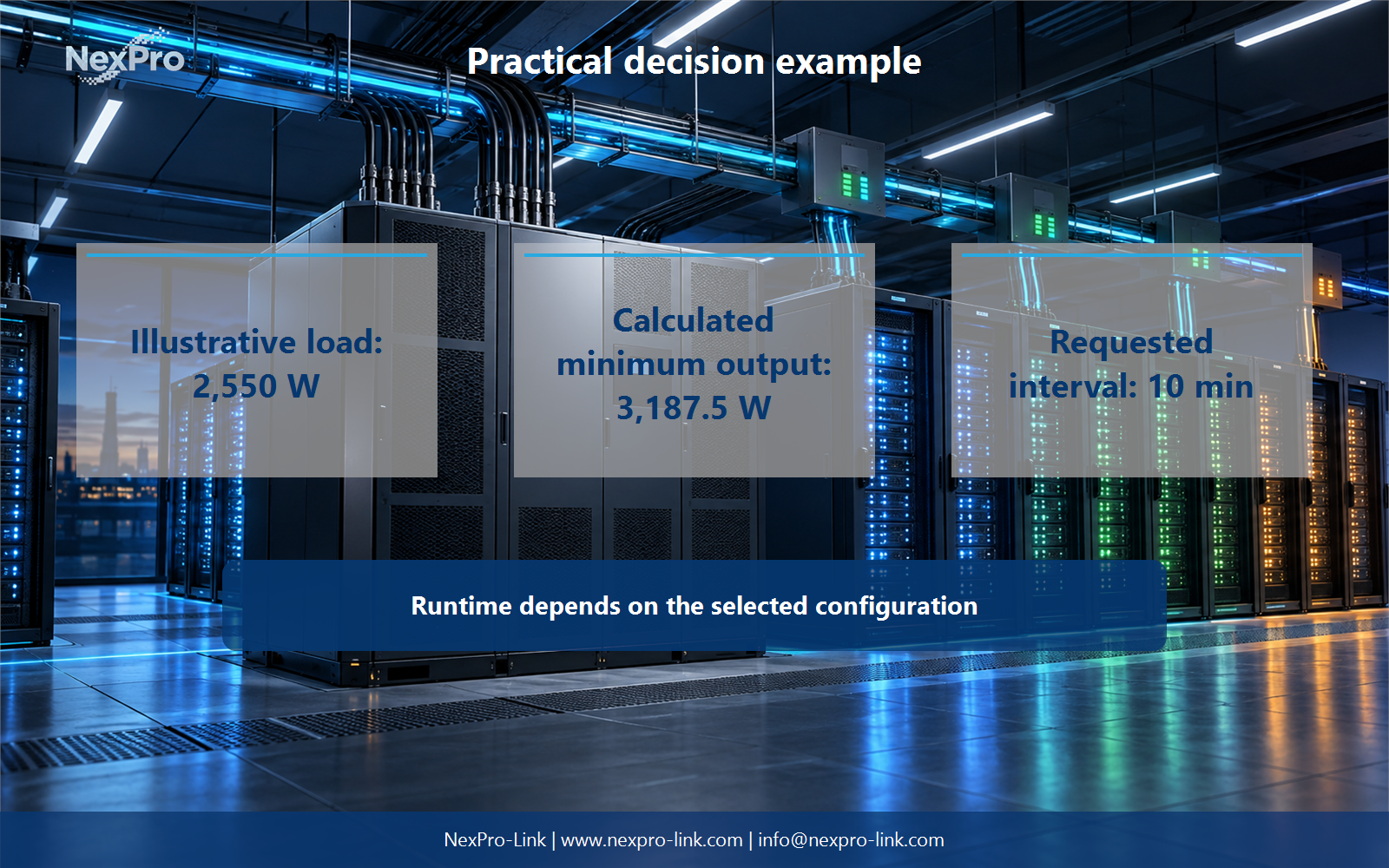
For the article's practical example, the stated teaching inputs are: Illustrative load: 2,550 W. Calculated minimum output: 3,187.5 W. Requested interval: 10 min. Runtime depends on the selected configuration. Treat these figures as planning assumptions, then replace them with measured or manufacturer-supported project data.
Engineering references
These sources support the general planning principles. Always use the selected product's current datasheet and applicable project standards for final design.