
Use the platform load envelope and electrical limits; do not describe every peak as exceeding the nameplate. Plan the project from the approved rack power envelope, workload profile and infrastructure limits.
Section 01
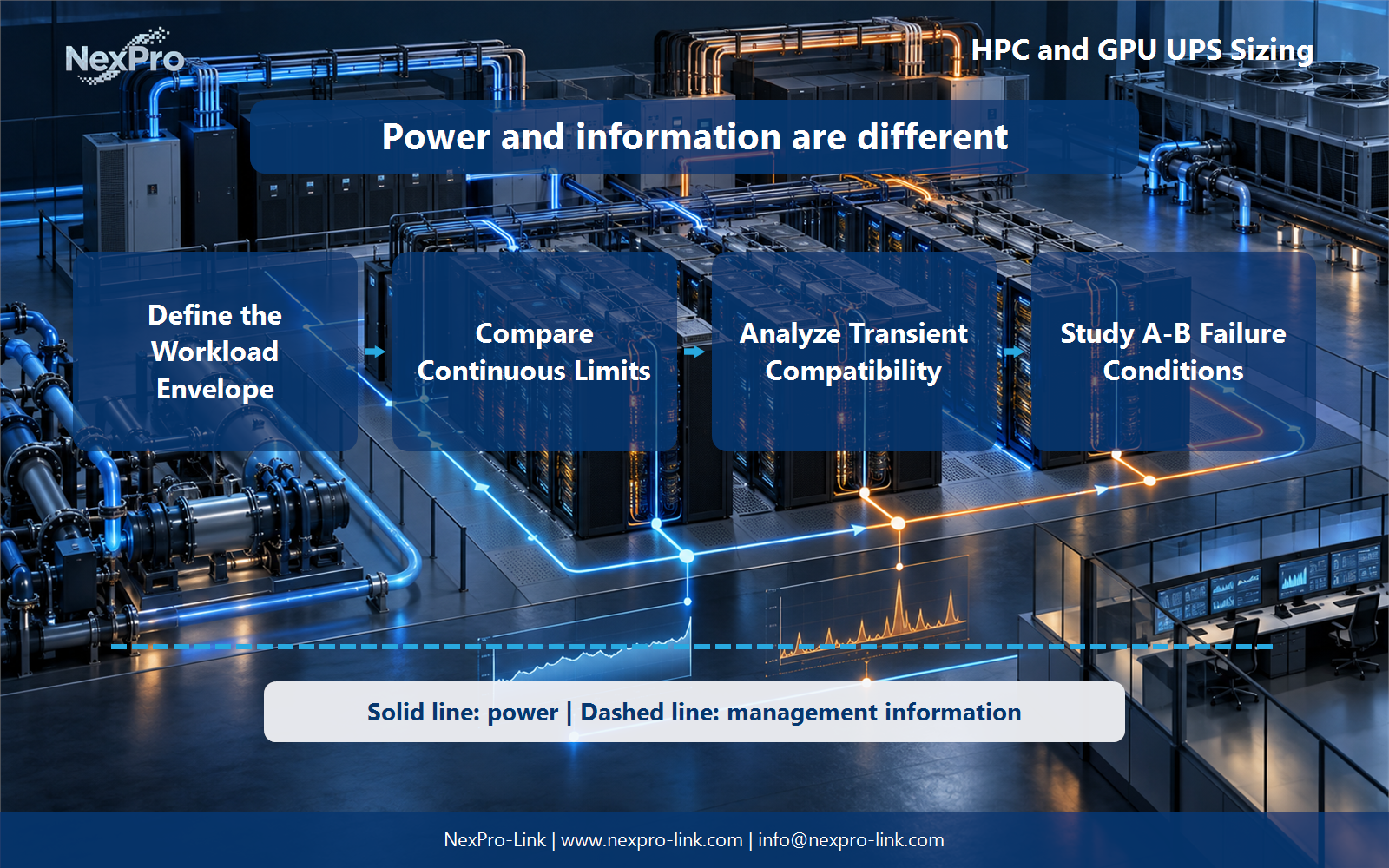
Define the Workload Envelope
Use the platform load envelope and electrical limits; do not describe every peak as exceeding the nameplate.
No. Use the platform's operating envelope and representative workload states, including relevant transients and restart conditions. Distinguish component values from rack input demand. For a project-specific decision, record idle, compute, transient and rack input in the envelope table. This keeps the equipment inputs and intended service outcome aligned.
The working question is simple: Should GPU demand be represented by one average number? Record the answer as a service requirement before comparing UPS ratings or battery options.
| Decision area | Project question | Required output |
|---|---|---|
| Define the Workload Envelope | Should GPU demand be represented by one average number? | Approved service objective |
| Compare Continuous Limits | Which continuous limits should be checked? | Defined load and dependency boundary |
| Analyze Transient Compatibility | How should transient demand affect selection? | Reviewed power-path decision |

Section 02
Compare Continuous Limits
Compare useful watts and VA with the actual UPS configuration, distribution and site derating. Include committed growth separately. A high kVA label does not resolve a lower output-watt limit or a constrained rack branch.
Keep the load list, operating state and supporting dependencies in the same schedule. This makes omissions visible before runtime or capacity is discussed.
- Confirm the answer to: Which continuous limits should be checked?
- Separate measured demand, nameplate limits and committed growth.
- Identify the owner of each external service or approval.
Section 03
Analyze Transient Compatibility and Study A-B Failure Conditions
Compare its magnitude, duration and recovery with the specified UPS behavior and platform requirements. A percentage of generic spare capacity is not a universal transient solution. Keep measurement conditions visible so a design decision can be revisited when workload or hardware changes.
Follow the platform's supported power-sharing and failover behavior to determine demand on the surviving route. Check each route and distribution element under that state. Normal shared-load readings alone can understate what one path must carry.
Draw power delivery as a solid path and management information as a separate dashed path. That distinction prevents an alarm or software command from being mistaken for an electrical protection function.
Section 04
Coordinate Thermal Continuity
No. Thermal conditions and cooling availability can limit the useful operating interval. Coordinate power and cooling objectives through the facility design, and define a supported reduction or shutdown policy. For a project-specific decision, record compute, cooling, controls and time constraint in the dependency map. This keeps the equipment inputs and intended service outcome aligned.
Assign the action, acknowledgement, timeout and escalation owner before commissioning. The useful battery interval is the time needed for this approved sequence plus reserve, not an arbitrary marketing duration.
Section 05
Prepare a Platform-Specific RFQ
Provide the engineered rack demand, transient requirements, distribution interface and continuity objective. NexPro-Link can discuss supply configurations or functional requirements without claiming universal GPU compatibility. Keep final platform and facility acceptance tied to the complete project design.
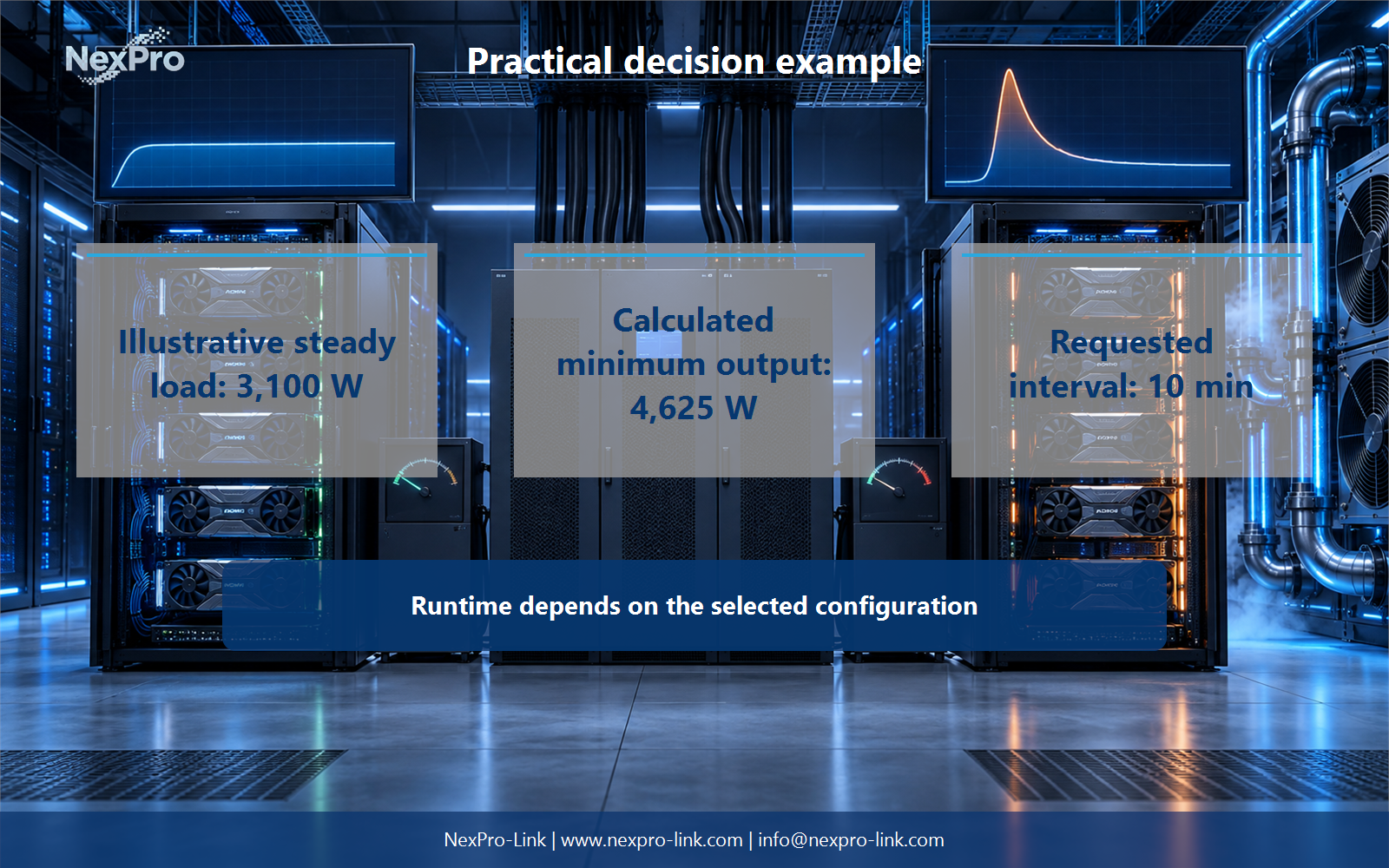
For the article's practical example, the stated teaching inputs are: Illustrative steady load: 3,100 W. Calculated minimum output: 4,625 W. Requested interval: 10 min. Runtime depends on the selected configuration. Treat these figures as planning assumptions, then replace them with measured or manufacturer-supported project data.
Engineering references
These sources support the general planning principles. Always use the selected product's current datasheet and applicable project standards for final design.