Write space, power interface, remote alarm and controlled restart into an unattended-node plan. Plan the project from the edge-cabinet dimensions, device loads and remote-service policy.
Section 01
Define the Local Service
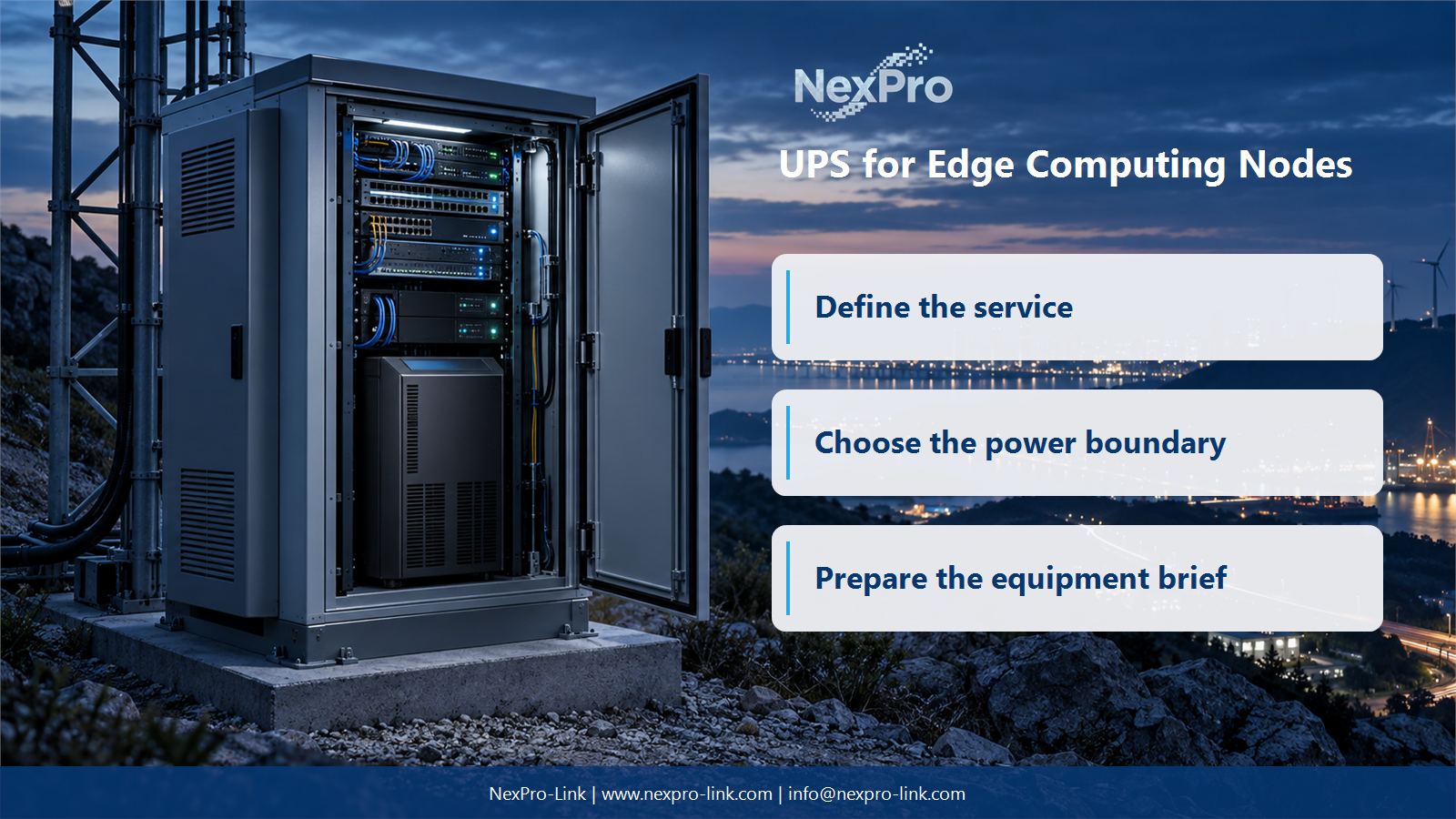
What should an edge node preserve during an outage? Identify whether it must continue local processing, buffer data, maintain a link or shut down cleanly. Edge locations have different service roles, so runtime and protected devices should follow the task rather than a universal compact UPS kit. Edge computing and IoT architects can use that boundary to build the function map: compute / data / link / stop objective and prepare edge-cabinet dimensions, device loads and remote-service policy before selection.
Write space, power interface, remote alarm and controlled restart into an unattended-node plan
The working question is simple: What should an edge node preserve during an outage? Record the answer as a service requirement before comparing UPS ratings or battery options.
| Decision area | Project question | Required output |
|---|---|---|
| Define the Local Service | What should an edge node preserve during an outage? | Approved service objective |
| Fit the Cabinet Honestly | Does a 1U or 2U label prove an edge-cabinet fit? | Defined load and dependency boundary |
| Choose the Power Boundary | When should AC and DC options be compared? | Reviewed power-path decision |
Section 02
Fit the Cabinet Honestly
No. Check usable depth, connectors, airflow, weight and service clearance. A shallow cabinet can be limited by rear cable space even when the rack height fits. For a project-specific decision, record height, depth, plugs, airflow and access in the fit table. This keeps the equipment inputs and intended service outcome aligned.
Keep the load list, operating state and supporting dependencies in the same schedule. This makes omissions visible before runtime or capacity is discussed.
- Confirm the answer to: Does a 1U or 2U label prove an edge-cabinet fit?
- Separate measured demand, nameplate limits and committed growth.
- Identify the owner of each external service or approval.
Section 03
Choose the Power Boundary and Plan Local Action Without Connectivity
Compare them when the protected devices' input interfaces allow a practical choice. Include conversion losses and any network equipment in the selected boundary. Match voltage, polarity, current and supported connectors rather than treat all compact backup devices as interchangeable.
Define supported local behavior for confirmed battery operation, communication loss and low reserve. A remote dashboard should not be the only place where shutdown decisions can occur. Keep the policy bounded so transient loss of monitoring does not repeatedly cycle the node.
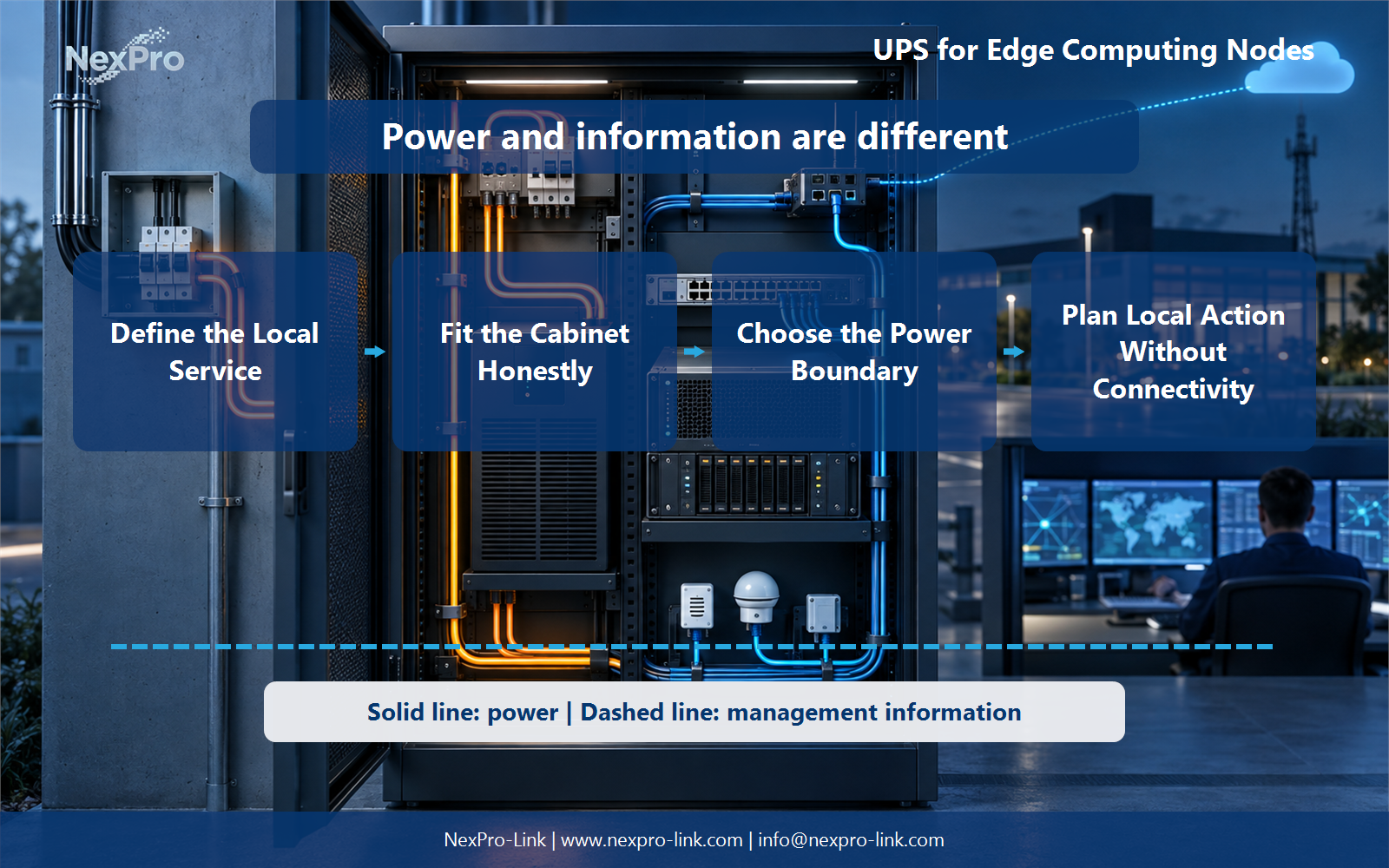
Draw power delivery as a solid path and management information as a separate dashed path. That distinction prevents an alarm or software command from being mistaken for an electrical protection function.
Section 04
Manage Restart and Data Recovery
Use stable-power conditions, sequencing and application readiness checks appropriate to the node. Confirm stored data and external synchronization before declaring recovery. Remote control features must be supported and secured; they do not automatically make every edge application self-recovering.
Assign the action, acknowledgement, timeout and escalation owner before commissioning. The useful battery interval is the time needed for this approved sequence plus reserve, not an arbitrary marketing duration.
Section 05
Build a Repeatable Edge Package
Provide a base equipment list, enclosure constraints and service policy, then identify environmental or interface exceptions. NexPro-Link can discuss suitable backup options without inventing a particular 1U product. Keep variation controlled so the package is repeatable but not blindly copied to incompatible sites.
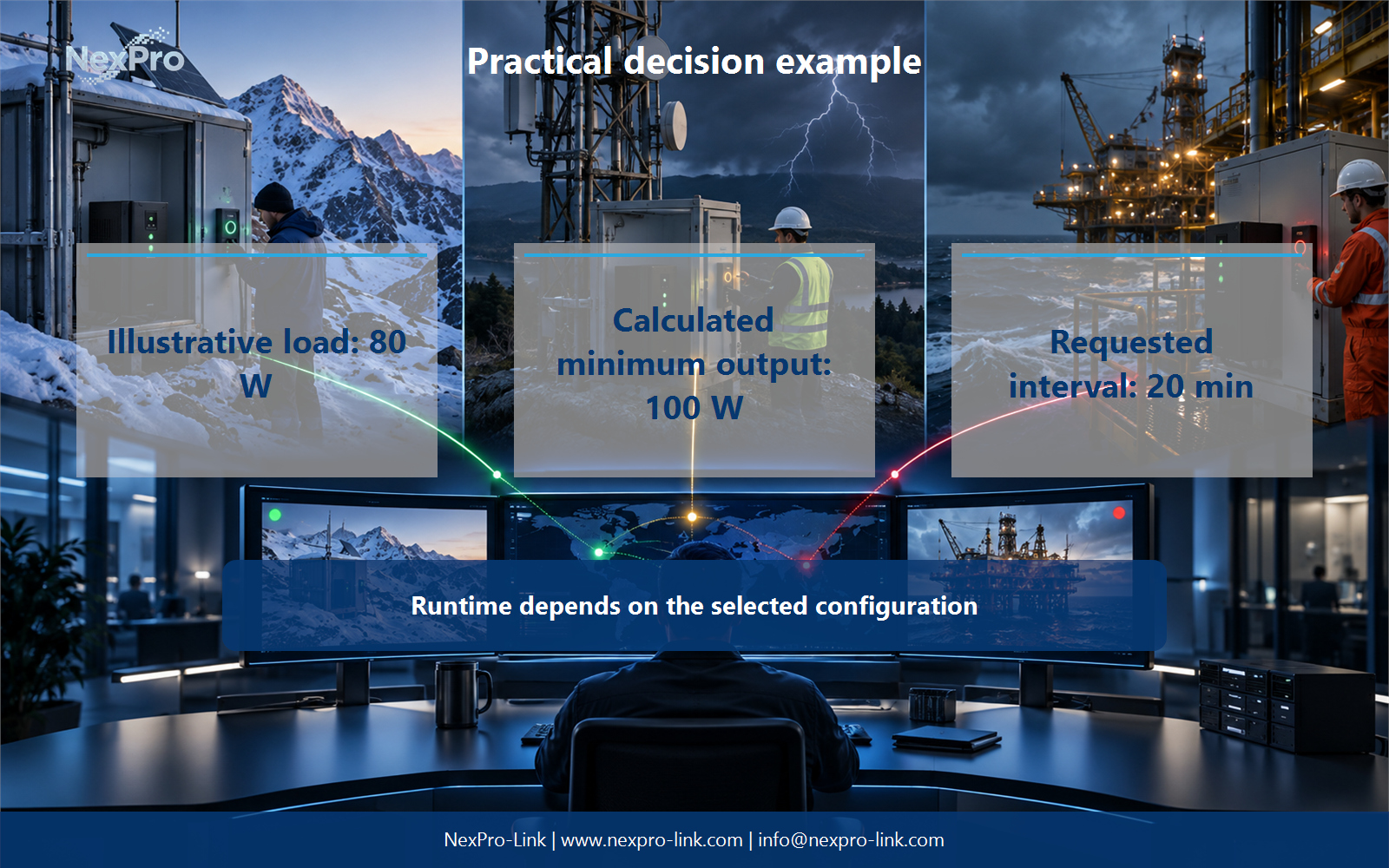
For the article's practical example, the stated teaching inputs are: Illustrative load: 80 W. Calculated minimum output: 100 W. Requested interval: 20 min. Runtime depends on the selected configuration. Treat these figures as planning assumptions, then replace them with measured or manufacturer-supported project data.
Engineering references
These sources support the general planning principles. Always use the selected product's current datasheet and applicable project standards for final design.