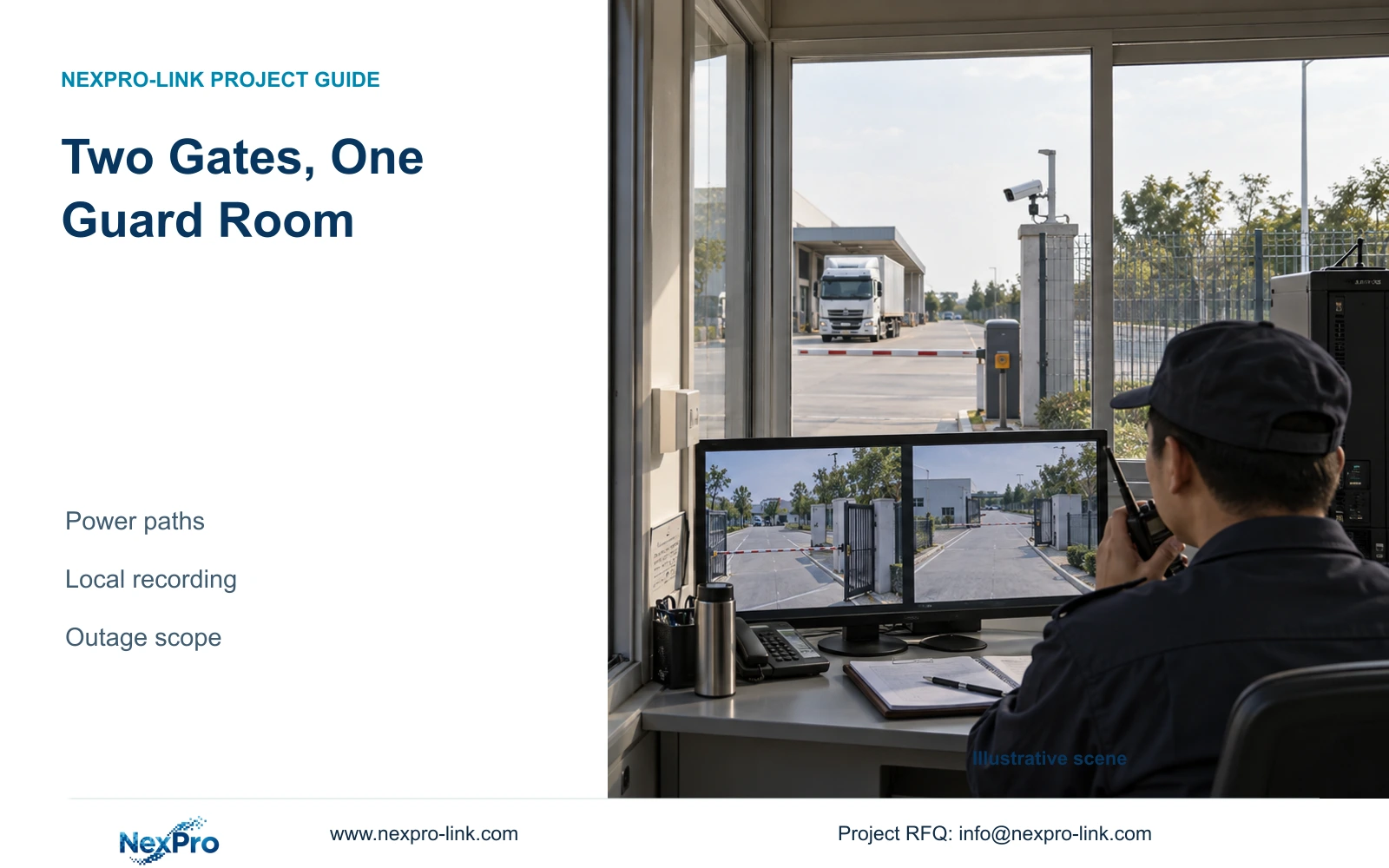
A protected guard-room recorder still loses a remote gate view when the camera or its local switch loses power. Map each electrical and data dependency before sizing backup.
Section 01
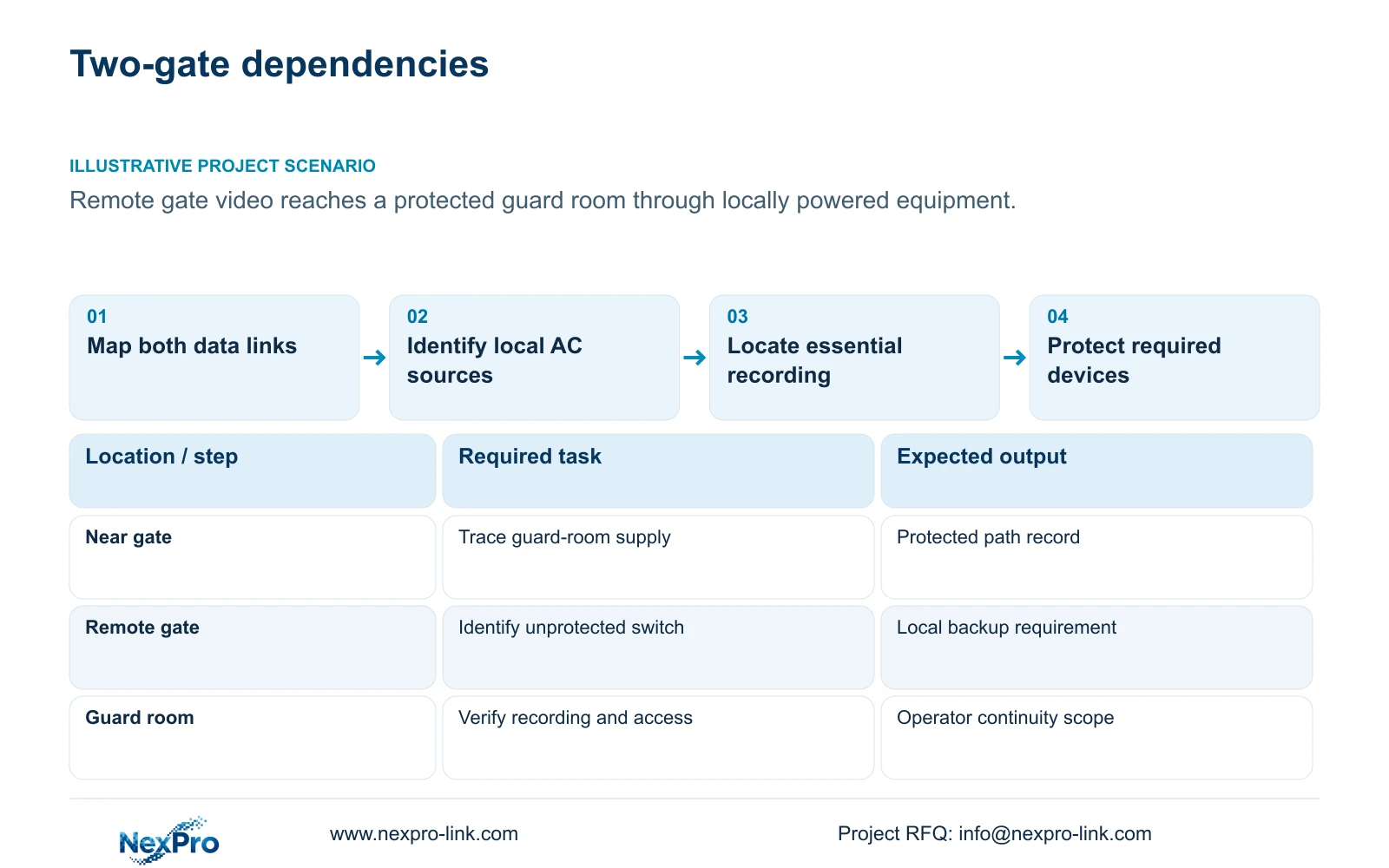
Map the data path and power source for each gate
For two factory gates served by one guard room, protect every powered component needed to sustain the required recording path. Backing up the guard-room NVR alone leaves a remote camera unavailable if its local switch or power supply stops. Start with a gate-by-gate dependency drawing that distinguishes data connections from electrical supply circuits, then define which failures the owner expects the system to withstand.
Illustrative project scenario: The remote gate is linked to the guard room but has its own unprotected local power. Assume the nearer gate's cameras use guard-room equipment, while the remote gate has a local access switch and a backbone endpoint. These are planning assumptions. The quantity surveyor must establish the actual circuit sources and cable routes before treating either gate as protected.
Label each camera group, switch, fibre endpoint, recorder and essential operator device. Record where it receives power, who maintains it and whether it remains necessary during an outage. Keep plate-reading, overview and barrier safety responsibilities separate. A functioning CCTV link does not establish that the gate's access or safety systems remain operational.
Section 02
Choose where evidence must survive a link failure
Central recording suits an owner who accepts dependence on the remote gate's link and wants a single retrieval location. It still needs protected camera power and active link equipment at both ends. If evidence must continue when the backbone is unavailable, examine a qualified local recording arrangement. State how authorised staff will recover that footage after the link returns; do not assume automatic synchronisation or failover.
CASE08 illustrates four independent 32-camera nodes with local recorders, rather than one recorder receiving every stream centrally. That reference supports separating local evidence continuity from remote viewing. Its shared fibre does not grant tenants access to one another, and its local recording arrangement does not establish hot standby. Apply the same distinction to the remote gate's ownership and retrieval responsibilities.
The NexPro-NVR4449-4K is a recorder candidate with published 320 Mbps input and four SATA bays, up to 18 TB per drive. Its listed modes distinguish 49×5MP from 9×4K. Check the actual gate streams, storage and playback task before selecting it. Neither multiple disks nor channel count establishes RAID or unrestricted simultaneous decoding.
Section 03
Build the protected load list at each electrical node
At the remote gate, include complete switch AC demand, any separate camera supply and powered backbone equipment required by the selected architecture. At the guard room, include the recorder, disks, receiving network equipment and necessary operator access. When switch AC demand already includes the PoE cameras, adding camera watts again would overstate the load. Conversely, a separately powered device must not disappear from the schedule.
Locate UPS protection where those circuits are actually supplied. Fibre transfers data, not the guard-room UPS output. If a protected AC circuit is proposed to the remote gate, the electrical designer must establish its route and installation scope. Otherwise, price a suitable local backup arrangement, including the environment, distribution, service access and battery configuration.
W and VA are separate selection constraints, as described in the APC/Schneider buying guide. Record measured or declared device demand and the intended loading margin before choosing capacity. Runtime requires the selected compatible battery system and operating conditions. Keep the load list and desired duration separate so procurement can compare capacity and energy provisions accurately.
Section 04
Compare outage durations without promising runtime
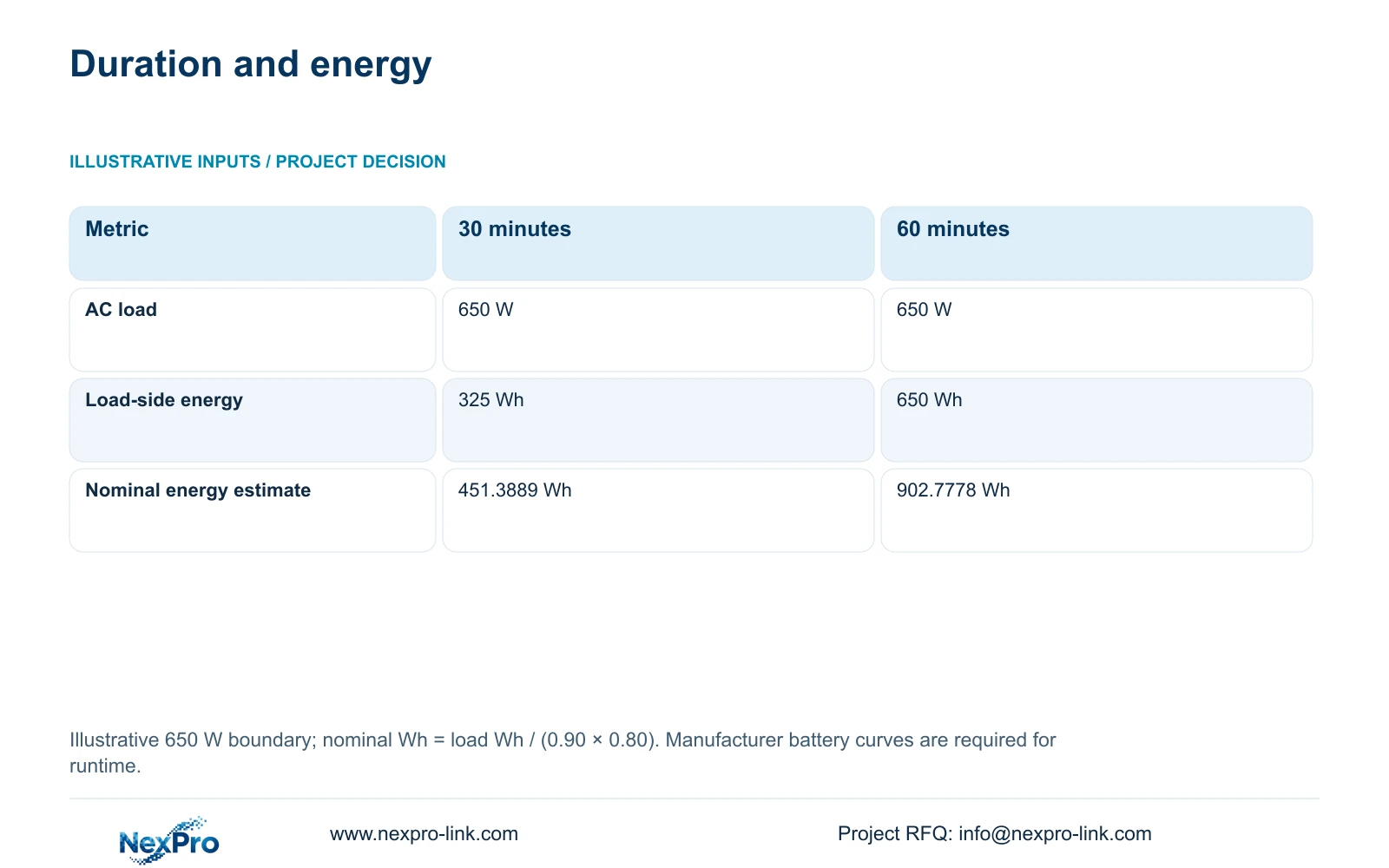
Use the supplied illustrative protected AC load of 650 W to compare 30 and 60 minutes. This is one declared load boundary, not a measured combined two-gate load. The formula load_Wh = P_W × minutes / 60 gives 325 Wh for 30 minutes and 650 Wh for 60 minutes. With assumed battery-to-load conversion of 0.90 and usable stored-energy fraction of 0.80, nominal_battery_Wh = load_Wh / (0.90 × 0.80).
The theoretical nominal requirements are therefore 451.3889 Wh and 902.7778 Wh. Doubling the operating duration doubles the energy requirement under these fixed assumptions, while the protected operating demand stays 650 W. The comparison helps the owner decide whether the objective is a short operational bridge or a longer period of continued gate observation.
Neither result proves a UPS will achieve the target duration. Request a manufacturer-supported battery configuration and runtime curve at the actual load. Temperature, ageing, discharge rate, BMS limits, UPS self-consumption, initial charge and recharge conditions remain relevant. If the project uses separate gate and guard-room batteries, calculate each node individually; a combined energy total cannot compensate for an undersized remote battery.
| Metric | Option A | Option B |
|---|---|---|
| Protected AC demand | 650 W | 650 W |
| Target duration | 30 minutes | 60 minutes |
| Load-side energy | 325 Wh | 650 Wh |
| Theoretical nominal energy | 451.3889 Wh | 902.7778 Wh |
Section 05
Compare complete protection with recorder-only backup
Prefer end-to-end protection for every gate view the owner requires during an outage. Recorder-only backup can preserve recorder operation, but it is an incomplete offer when remote cameras depend on unprotected local power. The quantity surveyor should expose that difference before comparing prices. Separate local UPS units, compatible batteries, backbone power, distribution and installation rather than burying them in an unspecified backup allowance.
Use local recording when a failed data link must not stop local evidence capture, subject to equipment and workflow qualification. Retain central recording when the owner accepts the link dependency and the complete powered path is protected. A longer battery target does not address a severed fibre, failed switch or unavailable recorder. Show these remaining failure domains alongside the backup duration.
The published SP1KR(S) rating is 1 kVA / 900 W; it is a capacity reference, not proof of 30 or 60 minutes at 650 W. Evaluate both W and VA against the chosen margin, then obtain the exact battery configuration. Do not transfer a webpage's selected-variant energy field to every model or infer outdoor suitability from a rack-mounted product description.
Section 06
Price the outage demonstration and recovery work
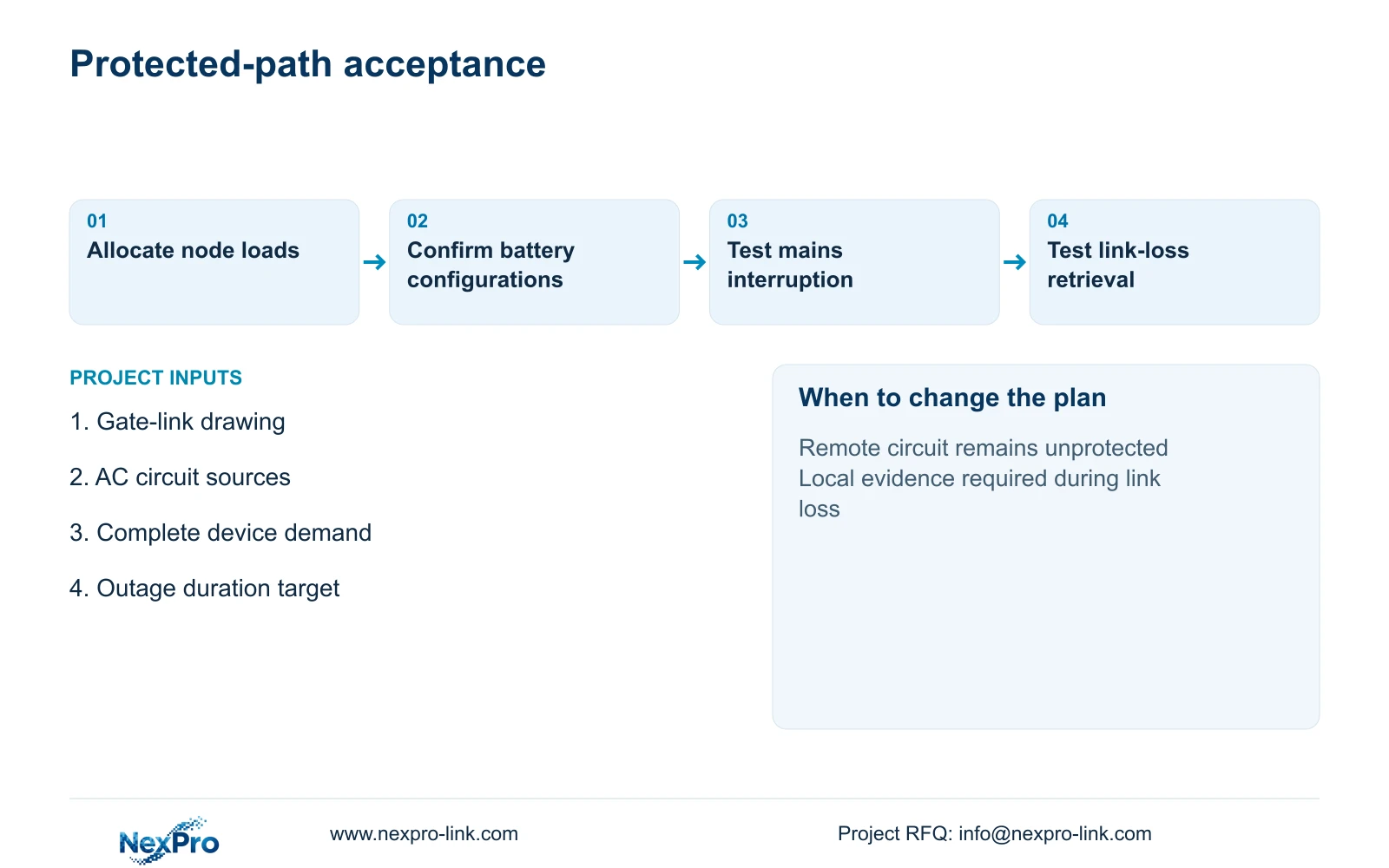
Issue a gate/perimeter task map with a distributed-node schedule listing the required service, power source, backup target and recording destination at each location. Identify retained equipment and new electrical or network work. Require bidders to state which operator functions remain available during an outage and how local recordings will be retrieved if the remote link fails.
The acceptance method should exercise the agreed outage boundary under a controlled project procedure. Verify both gate views, recording continuity, operator access and recovery after power returns. Test a link interruption separately from a mains interruption because the consequences differ. Record gaps and recovery steps rather than accepting a UPS front-panel status as evidence that every dependency stayed operational.
NexPro-Link can coordinate relevant CCTV, recorder and UPS selection with technical submittals and project packing. Local electrical design, circuit installation and final acceptance belong to the assigned project parties. A complete quotation should also identify battery support, replacement access and any environmental equipment, allowing the buyer to distinguish supply from site work.
Section 07
Buyer questions
Does fibre make the remote gate independent of local power? No. Powered switches or link endpoints still need an electrical source. Passive fibre does not deliver backup power to the remote camera group.
Should both gates receive the same battery configuration? Only if their actual protected demand, environment and duration objectives match. Similar camera counts can conceal different backbone, recorder and operator loads.
Can local recording remove the need for a protected backbone? It may preserve local footage during link loss, but remote live viewing and central retrieval remain unavailable while the backbone is down. Protect the backbone if those services are required.
Section 08
Compare the two-gate protection scope
Send the gate-link drawing, power-source map, protected device list and required outage duration to info@nexpro-link.com for a node-by-node recording and backup quotation.
Engineering references
These sources support the general planning principles. Always use the selected product's current datasheet and applicable project standards for final design.