Plan around service and data continuity; do not infer uniform localization or security certification from public-sector status.
Section 01
Define the Public Service
Plan around service and data continuity; do not infer uniform localization or security certification from public-sector status.
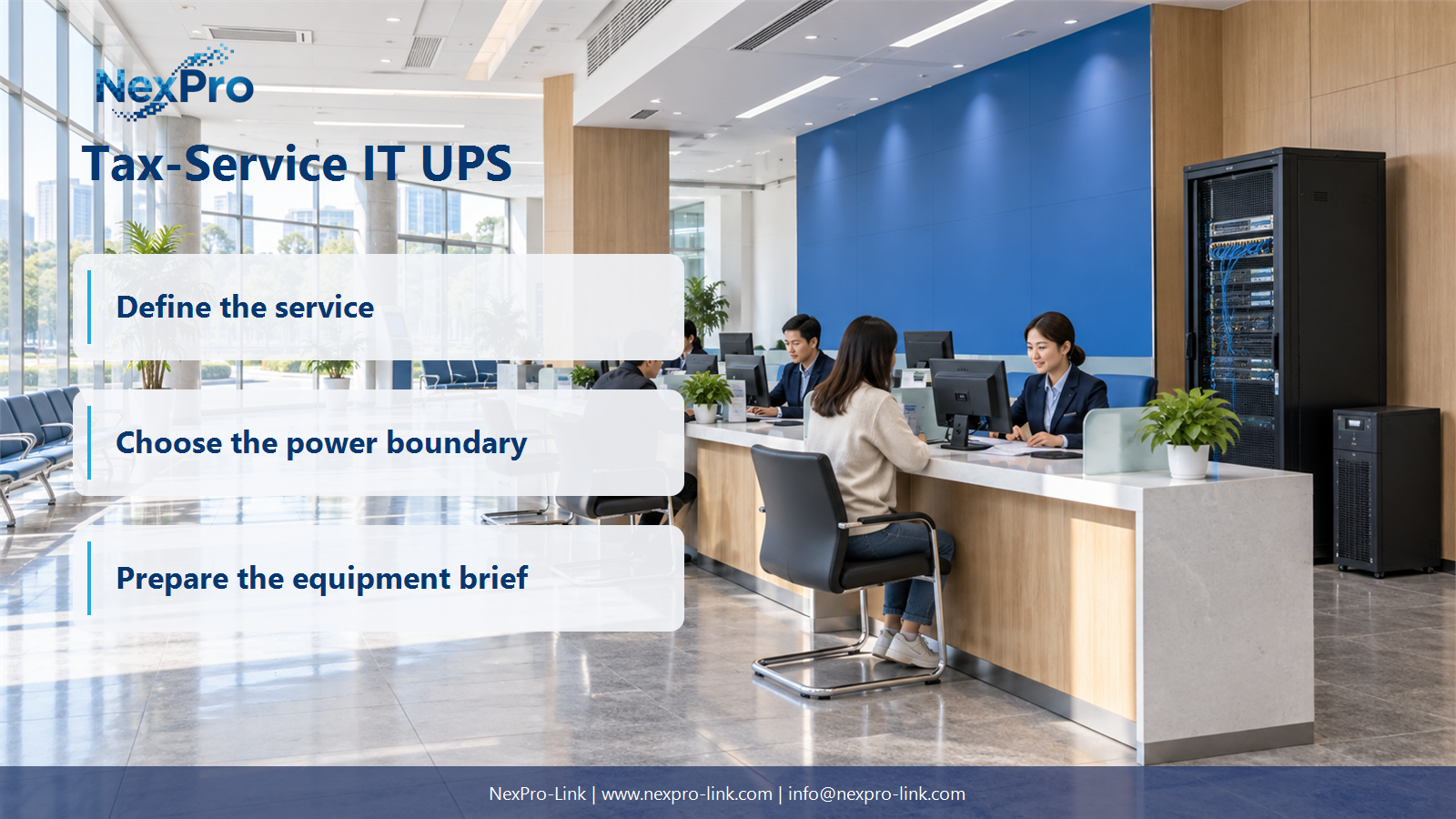
Start by writing the service in terms a power design can use. Name the application, the records, and the communication paths the office must provide during its agreed hours. Then separate what happens at a counter from what happens in a central data center.
A counter terminal can be fully powered and still unable to help a visitor when the backend is down. A healthy backend helps no one if the counters have lost their network. Each side needs its own continuity plan, and each plan has its own equipment boundary.
The service map below shows one way to fill this in. It is an illustrative example, not a standard tax-office template.
The table forces a useful ordering. The first three rows can be protected by office equipment. The last two are owned elsewhere, so the office plan has to state what happens when they are unavailable.
| Decision area | Project question | Required output |
|---|---|---|
| Define the Public Service | What should a tax-service backup plan protect? | Service map: counter / network / application / record / external |
| Separate Record and Terminal Power | Why should counter devices and backend services be listed separately? | Boundary table: terminal / local network / backend / permitted fallback |
| Protect Data Without Broad Claims | Does UPS power replace backup or access control? | Layer map: power / persistence / backup / access |
Section 02
Separate Record and Terminal Power
Counter devices and backend services differ in three ways: where they sit, where their power comes from, and what continuity they promise. A desk terminal runs on the office supply. The central application runs in a facility the office does not control. Putting them on one line hides that difference.
When the counters stay powered but the backend fails, the terminal may show only a cached state. What the office may do in that state is an operating decision, not an engineering guess. Some platforms allow a case to be queued locally. Others require the counter to wait for the connection. Write the permitted fallback down.
This table keeps the UPS scope honest. It tells the integrator which devices to include and which outcomes sit outside the electrical design.
Section 03
Protect Data Without Broad Claims
UPS power does not replace backup, and it does not replace access control. The layers solve different problems, and each one has to be designed on its own terms.
Power continuity keeps equipment alive long enough to act. Persistence makes sure a committed record survives a crash. Backup restores data after loss. Access control decides who may read or change a record. A UPS covers only the first of these.
Recording all four layers in the project brief keeps the equipment inputs aligned with the service outcome. It also prevents a common error: treating the UPS as the primary data defense when it is only the power layer.
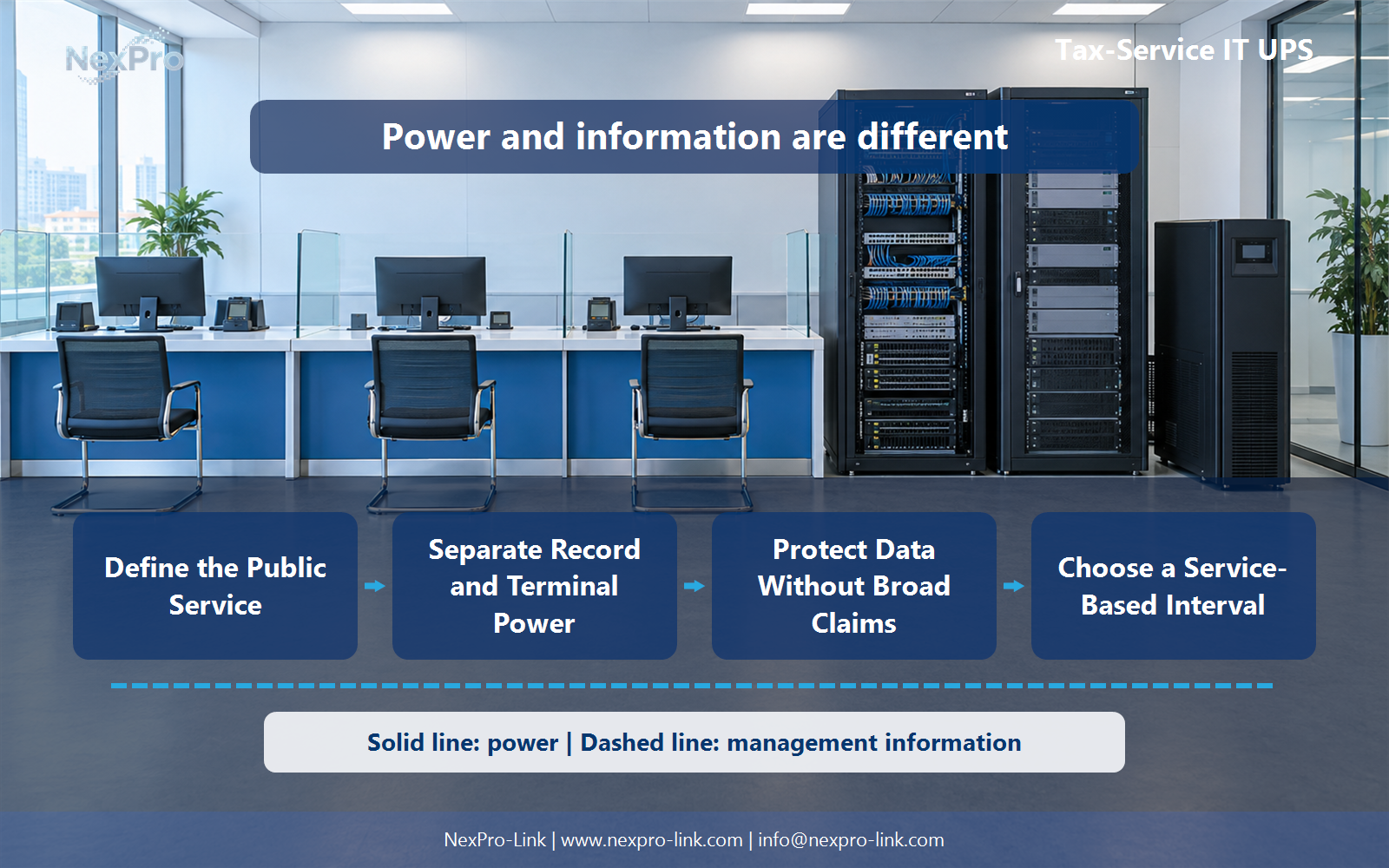
!Functional diagram connecting define the public service with protect data without broad claims, using separate power and information paths.
- Confirm the answer to: Does UPS power replace backup or access control?
- Draw electrical power as a solid path and management information as a separate dashed path.
- Keep external services and specialist approvals outside the UPS equipment claim.
Section 04
Choose a Service-Based Interval
Battery runtime should follow the objective, not a number copied from another office. Two objectives produce different sizes. If the goal is to finish the current counter step and shut down cleanly, the interval covers that action plus its dependencies. If the goal is to bridge to a generator, the interval covers the transfer and the load the generator must then carry.
Include every dependency the action needs. A shutdown routine that calls the application server and the network switch cannot complete from a UPS that powers only the terminals. The timeline below shows one sequence for the clean-shutdown objective.
The minutes are a planning target, not a product guarantee. Actual runtime changes with load, battery temperature, age and inverter efficiency.
Section 05
Plan Controlled Restoration
The office does not reopen the moment utility power returns. The local network has to come up, the WAN link has to reach the platform, and the application has to report ready. Interrupted work then needs a reconciliation step through the platform's procedures.
Electrical restoration is a power event. Transaction reconciliation is an operational one. Keep them on separate lines and hand each to the right team.
A written restart order avoids the mistake of reopening counters on a network that is still settling.
Section 06
Prepare the Public-Service RFQ
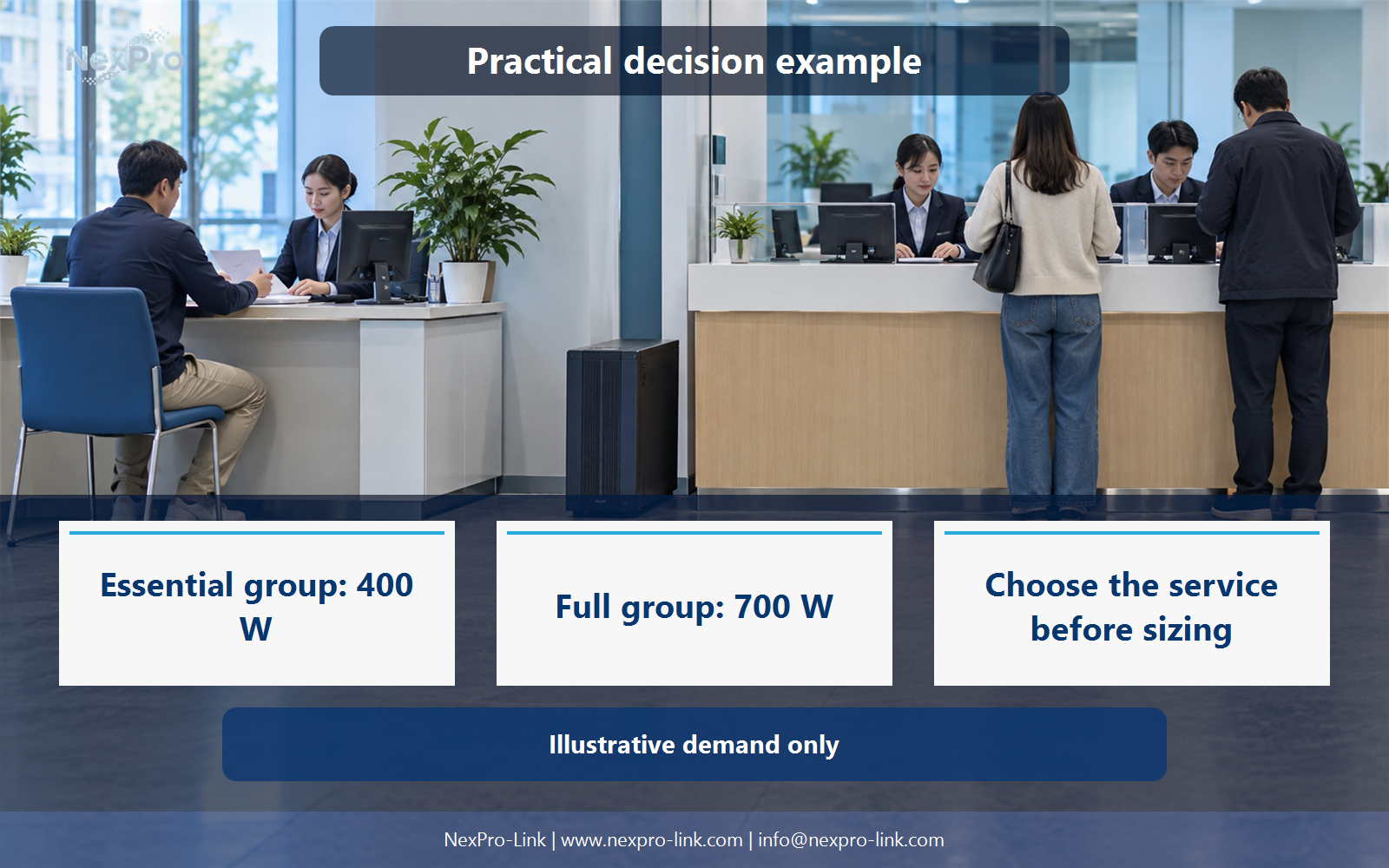
What NexPro-Link needs is the service description and the load schedule, not a public-sector label. Provide the authorized scope, the demand in watts, the interfaces and the continuity objective. State any procurement-origin, security or certification rules that apply to this project. Do not infer them from the fact that the site is a tax office.
With these inputs, NexPro-Link can discuss UPS options that match the load and the interfaces. The discussion stays on equipment scope. System design and final approval remain with the responsible parties.
Engineering references
These sources support the general planning principles. Always use the selected product's current datasheet and applicable project standards for final design.