Plan public space CCTV system design with practical guidance on define the public-space purpose and design the field backbone and power. NexPro-Link project guide.
Section 01
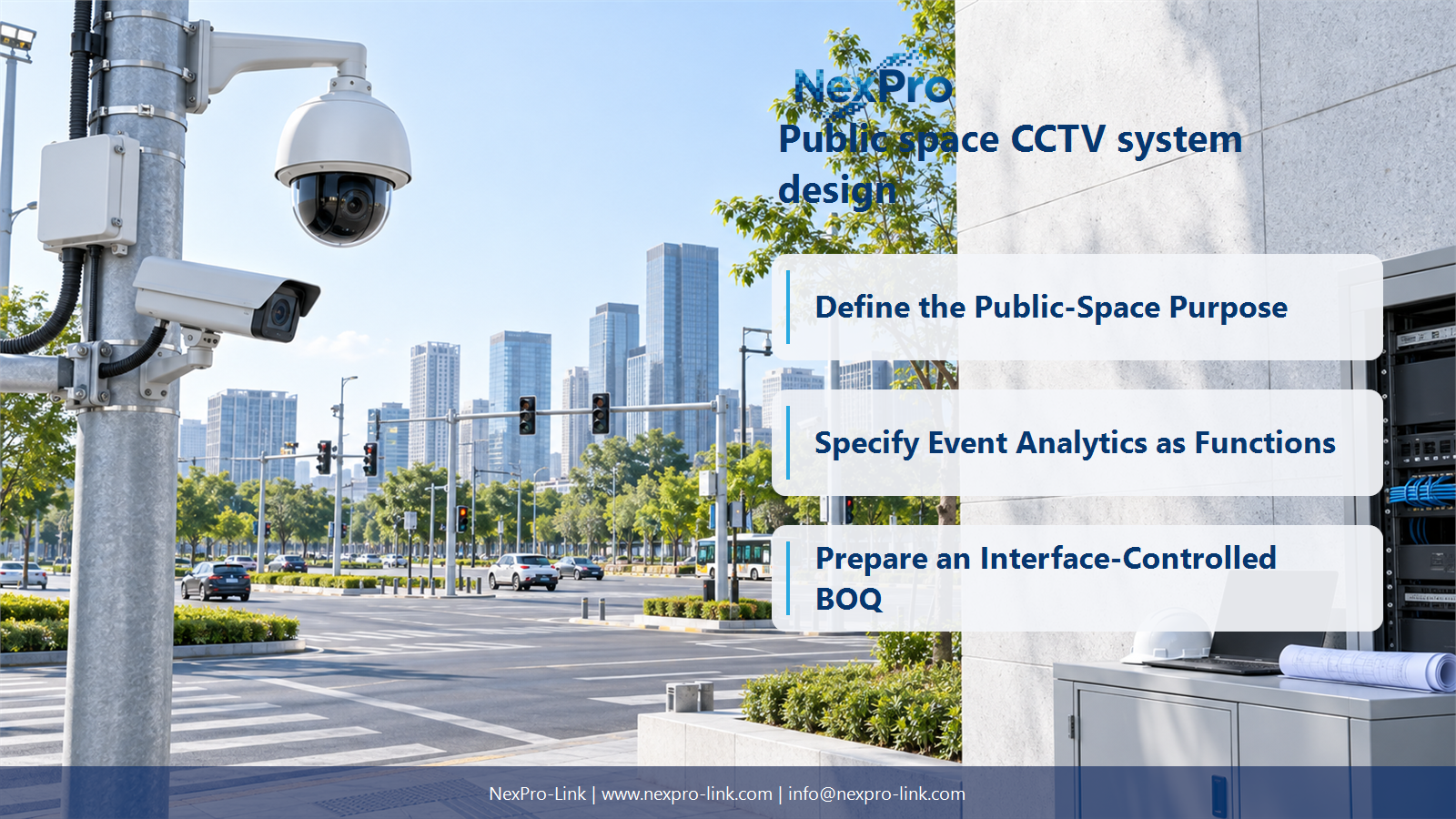
Define the Public-Space Purpose
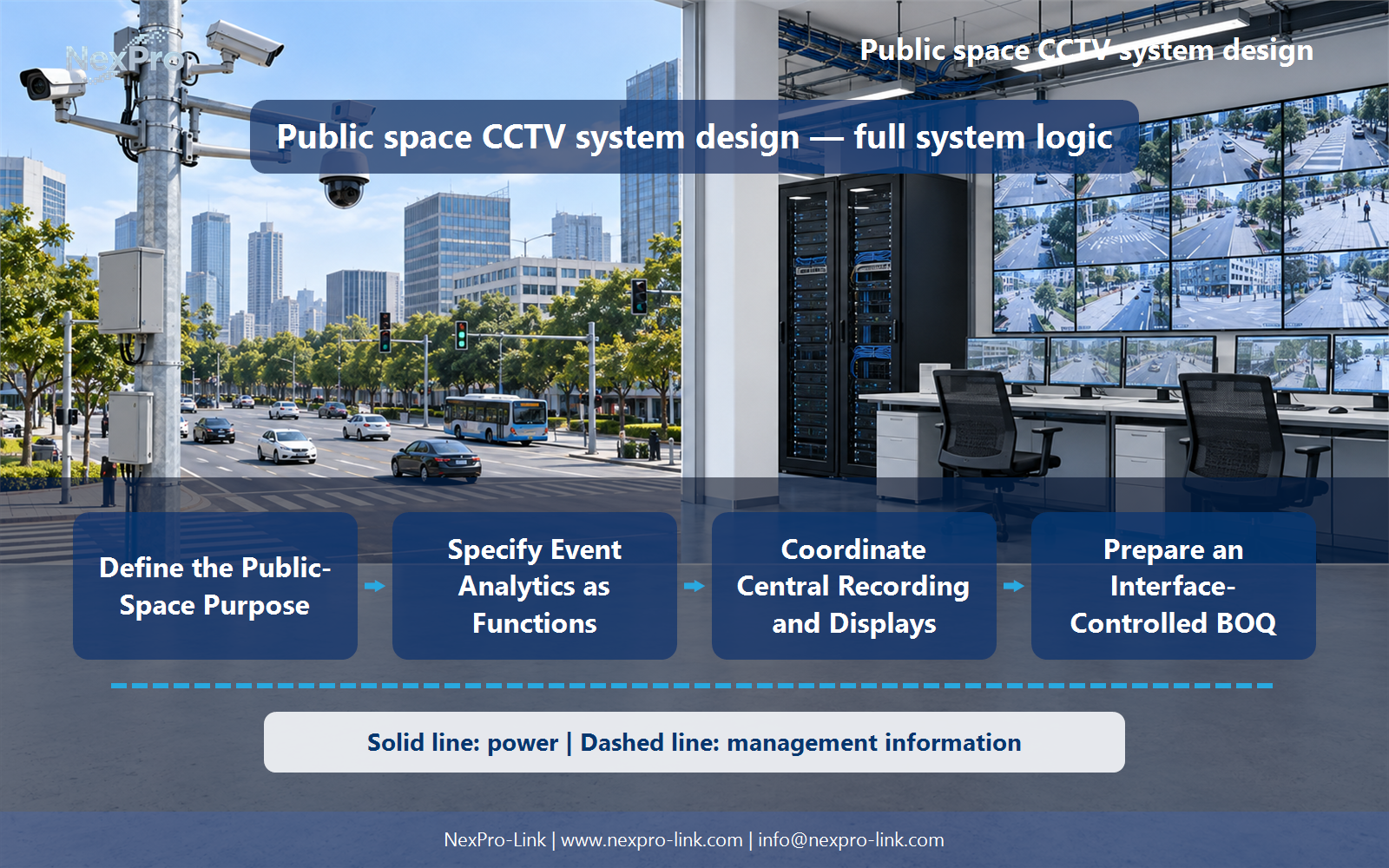
Specify the authorized monitoring purpose, the operating organization and the actions supported by the footage. Traffic observation, incident review and enforcement are different applications. Do not assume that a general surveillance camera is approved for regulated enforcement or unrestricted identity tracking.
Turn the answer into a working record using Purpose, Authority, Operator, Action, Excluded use.
| Decision area | Buyer question | Required output |
|---|---|---|
| Define the Public-Space Purpose | What should a public-space CCTV brief specify first? | Specify the authorized monitoring purpose, the operating organization and the actions supported by the footage. |
| Separate Fixed and PTZ Coverage | How should intersections use fixed cameras and PTZ? | Fixed views can preserve required approaches or areas continuously, while PTZ supports selected inspection. |
| Specify Event Analytics as Functions | Are traffic-event functions included in every AI camera? | No. |
Section 02
Separate Fixed and PTZ Coverage
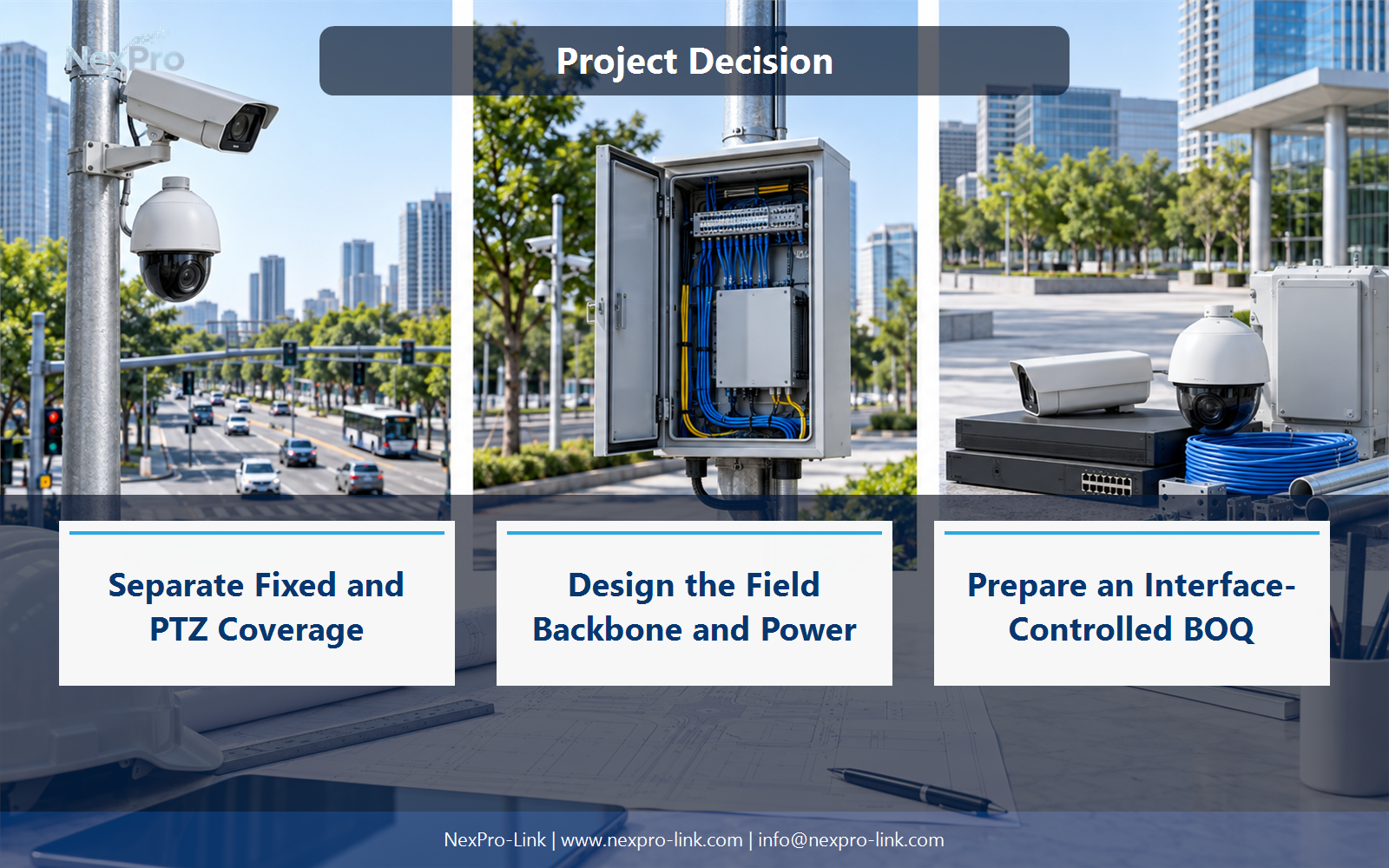
Fixed views can preserve required approaches or areas continuously, while PTZ supports selected inspection. Identify what remains visible when the PTZ moves. Scene congestion, vehicle speed and lighting should drive view design rather than relying on a headline optical-zoom ratio.
Use Approach, Fixed view, PTZ task, Motion, Lighting to compare options on the same basis. Keep product capability, project assumption and operating responsibility in separate columns.
Section 03
Specify Event Analytics as Functions
No. Different functions need particular camera or platform capabilities and deployment conditions. Specify the exact event, detection location and operator response. Human or vehicle classification alone does not establish queue measurement, incident detection or enforcement evidence functions.
The project output should make Event, Processing location, Required input, Response traceable from input to acceptance.
- Confirm the answer to: Are traffic-event functions included in every AI camera?
- Record the project fields: Event / Processing location / Required input / Response.
- Keep product capability, project assumptions and site responsibility in separate records.
Section 04
Design the Field Backbone and Power
Long routes, outdoor exposure, maintenance access and shared utility conditions affect the design. Use appropriate backbone links and local power, with protection coordinated by the responsible specialists. Central UPS capacity does not remove field-cabinet or pole dependencies.
Record Field node, Link, Local supply, Exposure, Service access before selecting a product family. That makes later substitutions possible without silently changing the operational requirement.
Section 05
Coordinate Central Recording and Displays
Not necessarily. Choose distributed or centralized recording and management according to the supported platform, retention and service requirements. Define authorized display and retrieval workflows. A large command-center wall is a viewing component, not proof of resilient or compliant recording.
Review Recording node, Management, Retention, Display, Recovery with the party that will operate or maintain the system.
Section 06
Prepare an Interface-Controlled BOQ
Link field views to network, recording, storage, display, backup and cabling roles, with interfaces to existing city systems. Separate ordinary supply from specialist analytics, civil works and electrical design. NexPro-Link model examples should not imply approval for uses outside their stated capabilities.
Use Function, Equipment role, Interface, Contractor, Quantity as the handoff between design and procurement.
Engineering references
These sources support the general planning principles. Always use the selected product's current datasheet and applicable project standards for final design.