Separate scanning and intake from archive storage, indexing and access; a UPS is not long-term digital preservation by itself.
Section 01
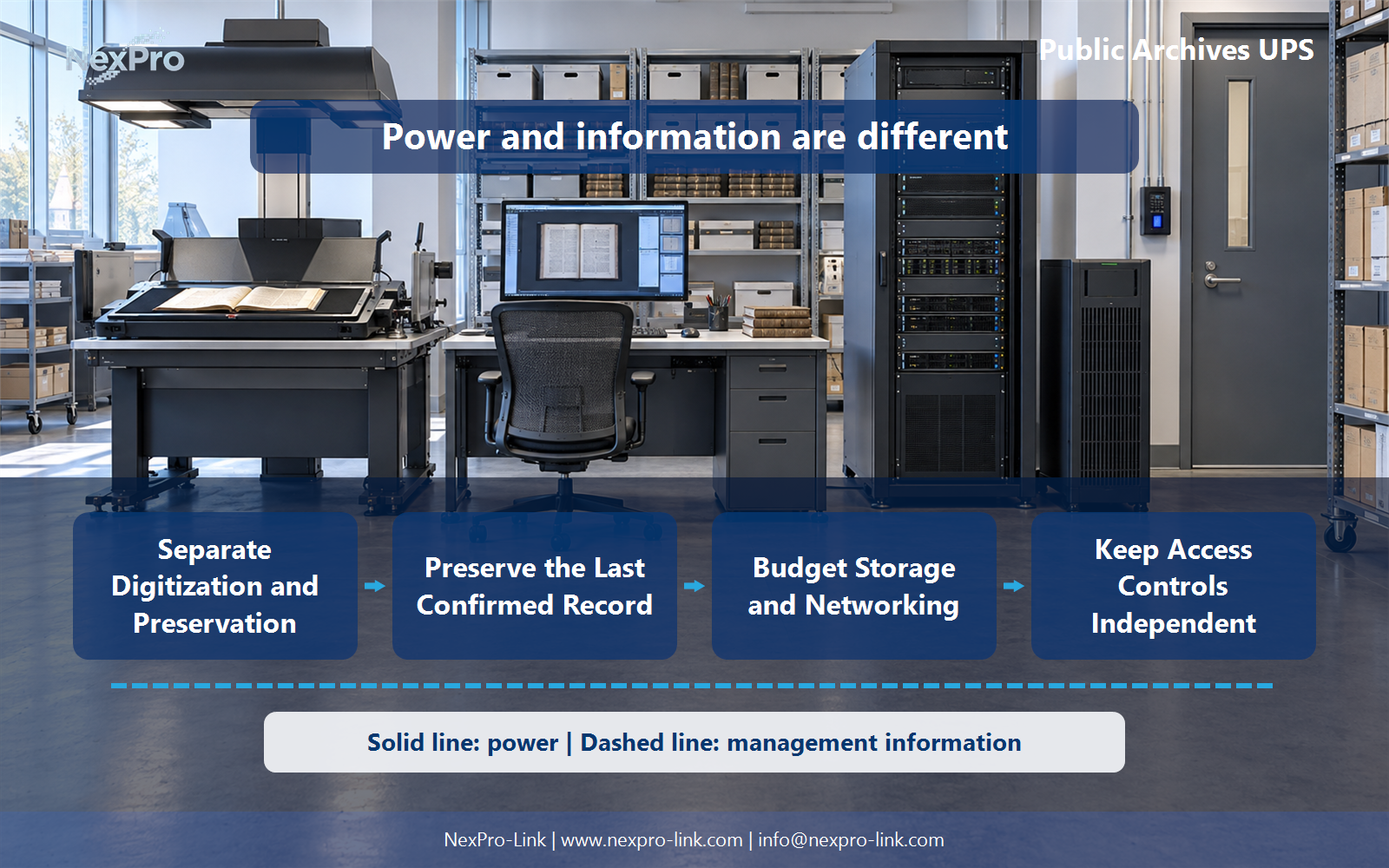
Separate Digitization and Preservation
Separate scanning and intake from archive storage, indexing and access; a UPS is not long-term digital preservation by itself.
Scanning a record and preserving it for the long term are different jobs, and they sit on different equipment. A room that is digitizing paper needs workstations and scanners. A room that is storing and serving records needs storage, an index, and an access service. Each stage can have its own backup objective, and a UPS supports the current operation of each stage without becoming the preservation plan itself.
The scanning room may only need enough time to finish the page in the feeder and stop cleanly. Storage and indexing may need to run longer so the queue already received is written and searchable. Long-term digital preservation is a separate task. It depends on backup copies, format migration, and periodic integrity checks, none of which a UPS supplies. Drawing the stage map first keeps the power scope honest: the UPS protects the operation, not the archive's permanent record of it.
| Decision area | Project question | Required output |
|---|---|---|
| Separate Digitization and Preservation | What is the power boundary of an archive project? | Stage map: scan / ingest / store / index / access |
| Preserve the Last Confirmed Record | What should happen to an interrupted ingestion batch? | Batch table: submitted / confirmed / uncertain / responsible action |
| Budget Storage and Networking | Which shared devices should be included? | Load schedule: acquisition / network / storage / management / growth |
Section 02
Preserve the Last Confirmed Record
An ingestion batch rarely fails as one clean unit. Some files are confirmed, some are still being written, and some have not been checked. After a power interruption the team needs to know which is which before it resumes scanning.
Use the archive application's supported checkpoint or reconciliation method rather than a manual guess. The UPS buys time for storage and index services to finish the queue. It cannot promise that every in-progress scan or metadata update completes, so those items stay in the uncertain state until the application confirms them. A controlled stop shrinks the uncertain set; it does not remove the need to check it.
Section 03
Budget Storage and Networking
A load list that counts only the scanning workstation will under-size the UPS. The storage array, the network switch, and the management or monitoring host all participate in the stop or continuity objective, and each has to be included.
The operating rows total 600 W in this example. The 120 W growth figure stays outside that total; it is a planning note, not today's load. Keep input demand separate from supply nameplates for the same reason. A 2,000 VA unit does not mean 2,000 W of usable load, and a planned expansion does not mean the equipment is already drawing it. Each number answers a different question.
- Confirm the answer to: Which shared devices should be included?
- Draw electrical power as a solid path and management information as a separate dashed path.
- Keep external services and specialist approvals outside the UPS equipment claim.
Section 04
Keep Access Controls Independent
Backup power does not decide who can read a record. Identity, access, and records handling stay with the application and the organization, and the UPS only keeps the supporting systems available.
Do not expand the UPS contribution into a claim about confidentiality, authenticity, or regulatory compliance. The power system holds the equipment up; the archive's own controls decide what a record is and who may see it. Keeping that line clear prevents a power proposal from quietly turning into a records-management promise.
Section 05
Plan Recovery and Search Readiness
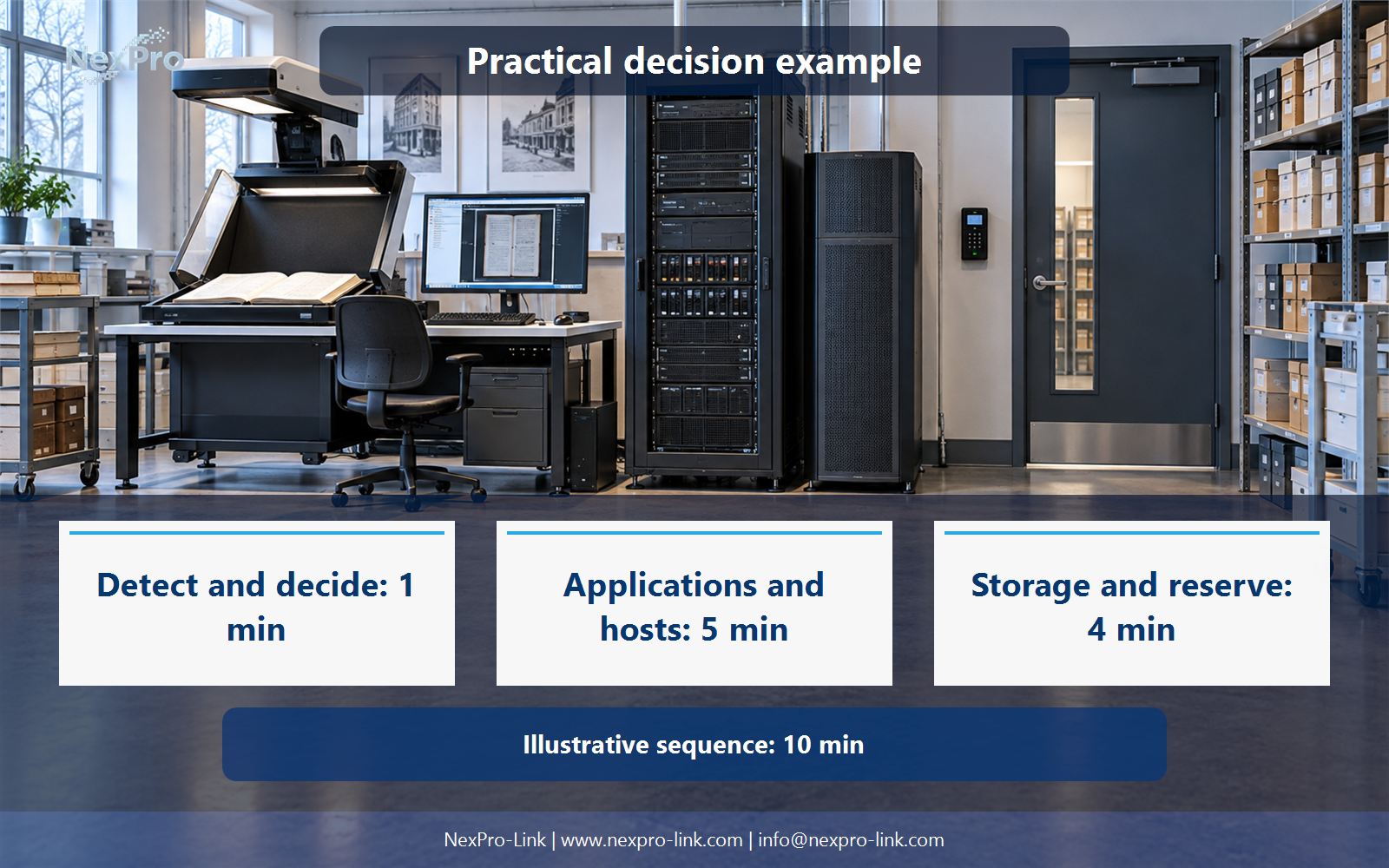
Power returning does not make the archive ready. Storage must mount, the index must pass its checks, access must be re-enabled, and the interrupted ingestion work must be reconciled.
The responsible archive team decides how uncertain records or interrupted batches are handled. The UPS and the site power plan set the conditions for a clean return; they do not make the records-management decision. Power is one condition among several, and it is usually the first one to recover.
Section 06
Prepare an Archive RFQ
A supplier can quote equipment once it knows the stages, the loads, the interfaces, the growth, and the objective. Send those items rather than a phrase like "protect the archive."
NexPro-Link can use those inputs to discuss equipment and supply scope. On the catalog, the rack-mounted online series NX-UP-RM-001 includes configuration C2KR(S) rated 2,000 VA and 1,800 W with internal VRLA batteries. That line shows how a series, a configuration, and a rating sit together. It is not a preselected answer for this project. The load and the controlled-stop objective determine the fitting, not the rating alone.
Engineering references
These sources support the general planning principles. Always use the selected product's current datasheet and applicable project standards for final design.