The UPS supports record-keeping and service, but does not automatically establish evidence authenticity or legal admissibility.
Section 01
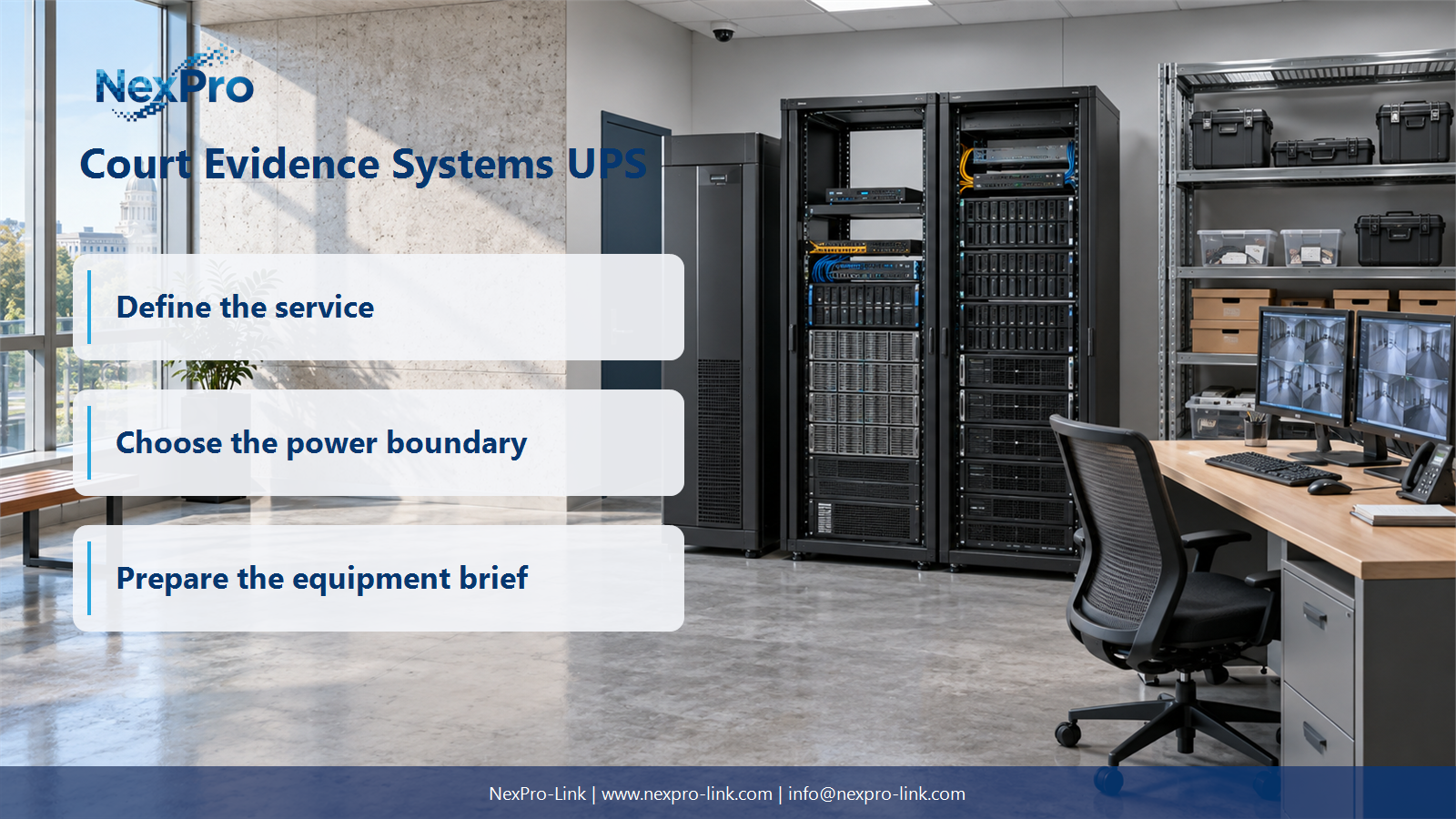
Define the Evidence-System Service
The UPS supports record-keeping and service, but does not automatically establish evidence authenticity or legal admissibility.
Start with the functions before you list hardware. Four functions matter in most court evidence systems: intake, storage, indexing and authorized access. Intake covers the devices that capture or receive material. Storage covers the servers and arrays that hold it. Indexing covers the search and metadata services that make it findable. Access covers the endpoints and applications staff use to retrieve material under policy.
Trace each function to its devices and interfaces before you size anything. A capture appliance may need its own network path. A storage server may need a shutdown agent that can quiesce its file system. An index node may need to flush before the database underneath it stops. Once the functions sit on paper, the UPS role becomes clearer. It keeps the required parts running through a short interruption, or it gives each part enough time to stop cleanly during a longer one.
The record row is easy to overlook. It carries the power events and timestamps you will need later, so it belongs in the same service map as the storage it describes.
| Decision area | Project question | Required output |
|---|---|---|
| Define the Evidence-System Service | What should the power plan protect? | Service map: intake / store / index / access / record |
| Separate Integrity Layers | Does continuous power establish a chain of custody? | Layer table: power / storage / access / handling / audit |
| Keep Event Times Useful | Why compare power and system timestamps? | Time map: source / UPS / server / application / record |
Section 02
Separate Integrity Layers
Continuous power does not establish a chain of custody. A UPS keeps equipment running, which helps the system record events without interruption, but custody depends on who handled the material, what access was granted, and what the audit log shows. Those controls live outside the power path.
Keep the layers apart when you write the project requirements. Each row below answers a different question and has a different owner.
The UPS adds one input to the audit layer. It does not replace the other four. In a project brief, describing backup power as an evidentiary guarantee would overstate what the equipment can do. It would also blur the boundary between an infrastructure item and an evidence-control process.
Section 03
Keep Event Times Useful
Comparing power timestamps with system timestamps helps you locate the interval an interruption affected. Say the UPS logs a transfer to battery at 09:41:12 and a return to mains at 09:52:40. The storage server shows write activity stopping at 09:51:03. The overlap tells the review team where to look, even when the two clocks differ by a few seconds.
To make that comparison possible, record which clock each log uses and how it is synchronized.
UPS logs are one input to that merged timeline. They do not tell you who opened a file, changed it, or moved it. Those facts come from the application and access layers. When the review owner asks for an affected interval, the time map gives them a defensible way to compute it instead of a guess.
- Confirm the answer to: Why compare power and system timestamps?
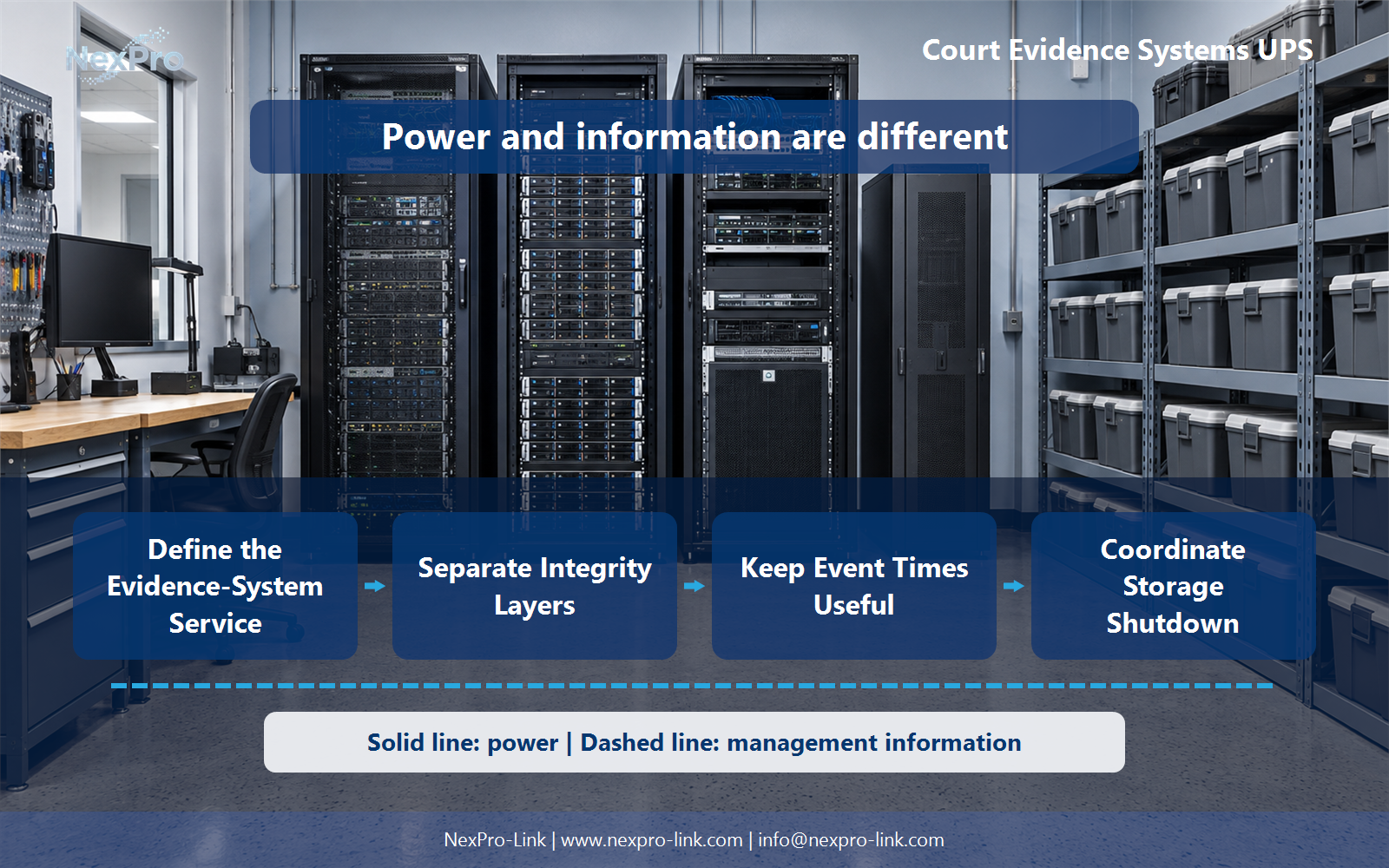
- Draw electrical power as a solid path and management information as a separate dashed path.
- Keep external services and specialist approvals outside the UPS equipment claim.
Section 04
Coordinate Storage Shutdown
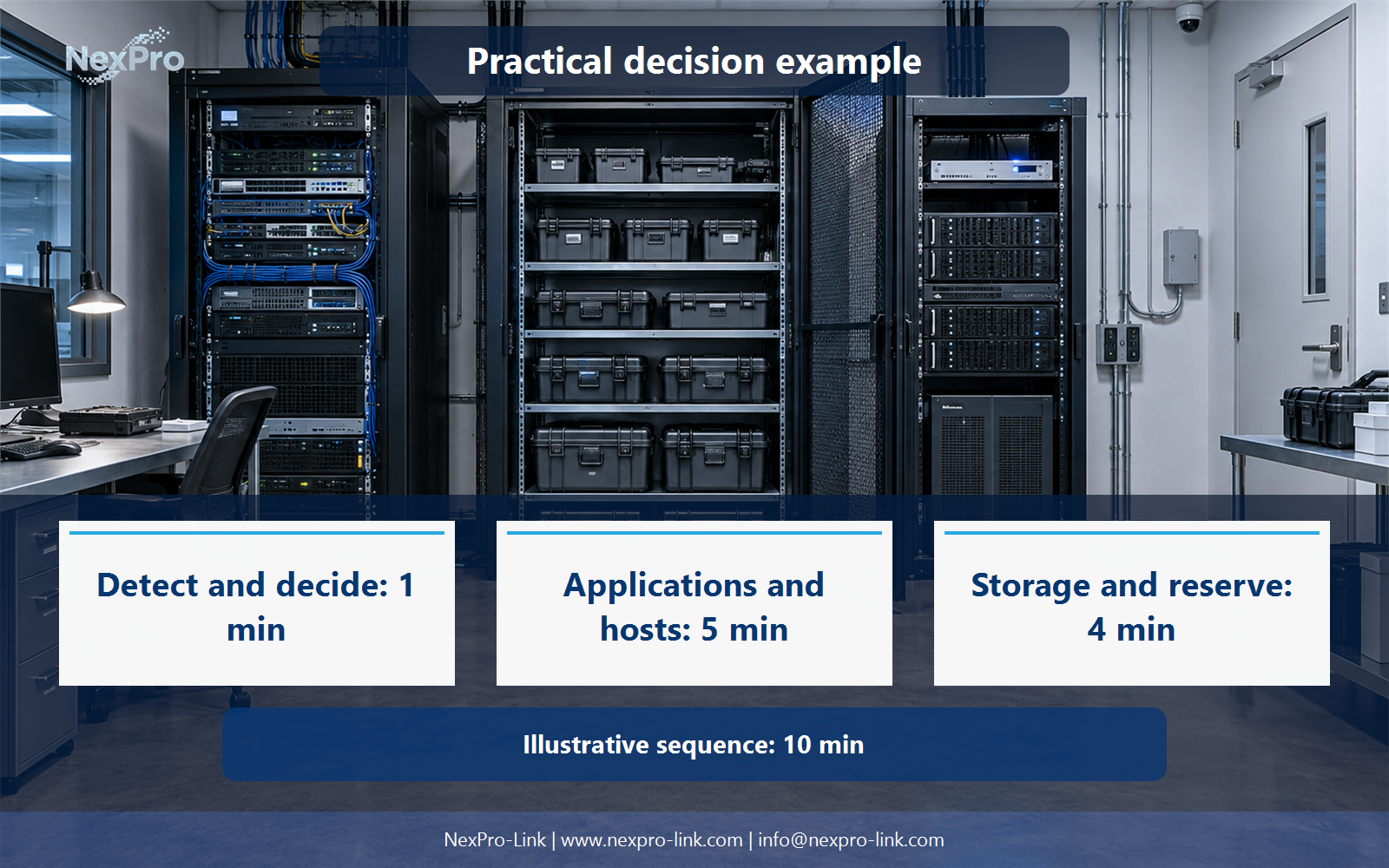
An extended outage changes the question from ride-through time to clean stopping. The order matters. Stop intake first so no new material arrives while dependencies are closing. Then stop the application so it can commit or roll back to a known state. Then release storage dependencies and shut the host down. Keep a small reserve so the last write can finish if a step runs long.
The sequence below is illustrative, with teaching durations only.
The serial total is 10 minutes. Real shutdowns are rarely this clean. Some steps run in parallel, others wait on a dependency, and every platform has its own supported sequence. Use the vendor's documented procedure for the recorder, the storage array and the management network. Do not assume every device accepts the same UPS signal or runs the same command. A generic shutdown script can be the wrong tool in a system where the order of stops is part of the design.
[Figure 02: mechanism and dependency diagram]
Section 05
Plan Recovery and Authorized Access
Power returning does not mean the material is complete or ready to use. Before users regain access, the owner should confirm the required services through the approved procedure. Storage must be mounted and checked. The index must rebuild or verify what it served before the outage. Access controls must come back in the correct state.
The affected interval row is where the time map from section three pays off. If the logs show a gap that cannot be explained, the owner reviews it before service resumes. Power restoration is one condition for recovery. It is not proof that every record survived intact.
Section 06
Prepare a Storage-Service RFQ
When the design is clear, the equipment discussion becomes specific. Send NexPro-Link a brief that separates the service chain, the load, the interfaces, the runtime objective and the access constraints. That split keeps legal and evidence controls with the system owner, while the UPS scope stays on backup equipment and interfaces.
As a catalog reference, the NexPro-Link NX-UP-RM-001 series lists the C2KR(S) configuration at 2,000 VA and 1,800 W with internal VRLA batteries. Use it to read the series, configuration and rating structure. The battery line does not convert into a measured runtime for a specific load, so treat the reference as a starting point for discussion.
Engineering references
These sources support the general planning principles. Always use the selected product's current datasheet and applicable project standards for final design.