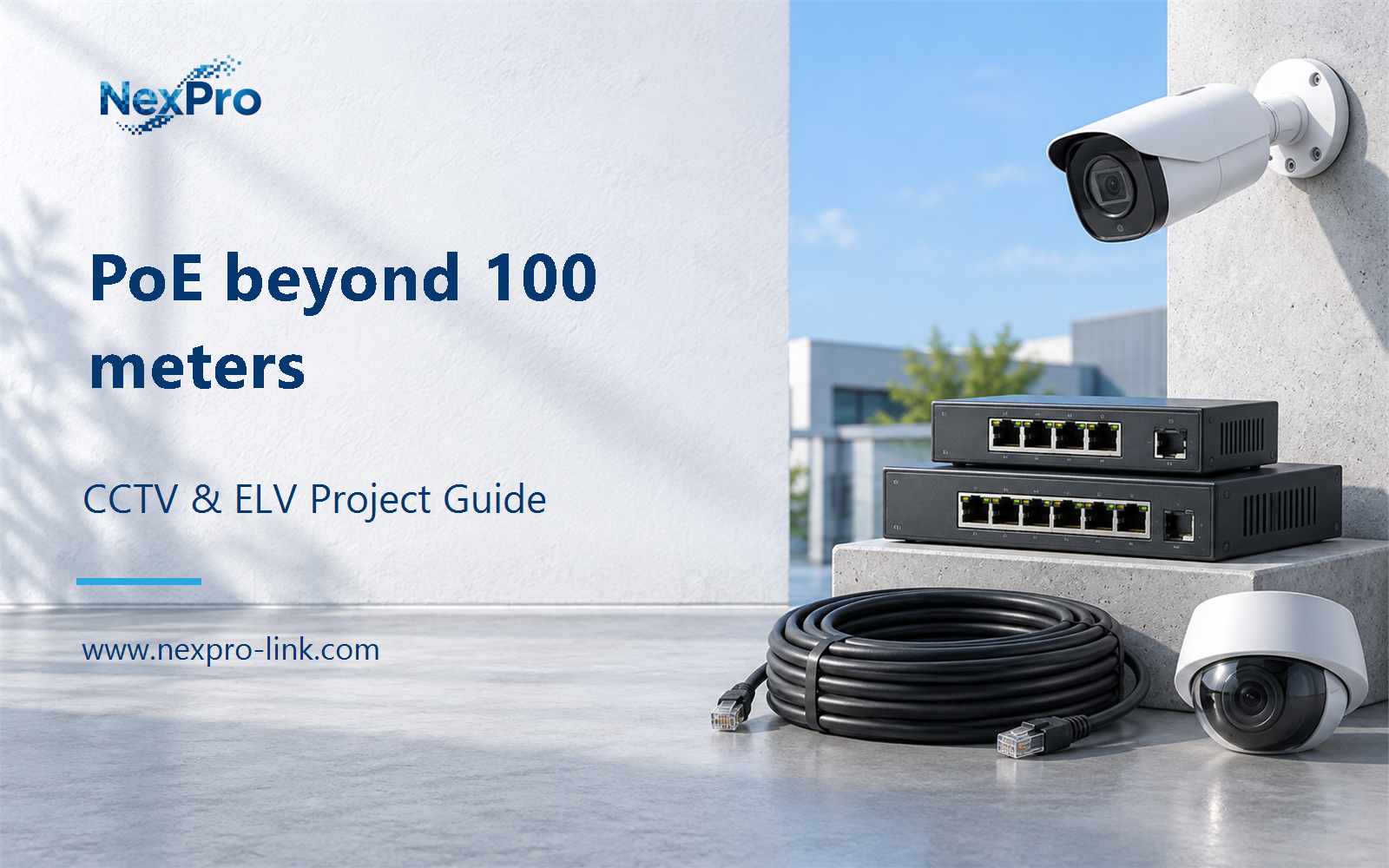
Plan PoE beyond 100 meters with practical guidance on measure the actual channel and use fiber with local power. NexPro-Link project guide.
Section 01
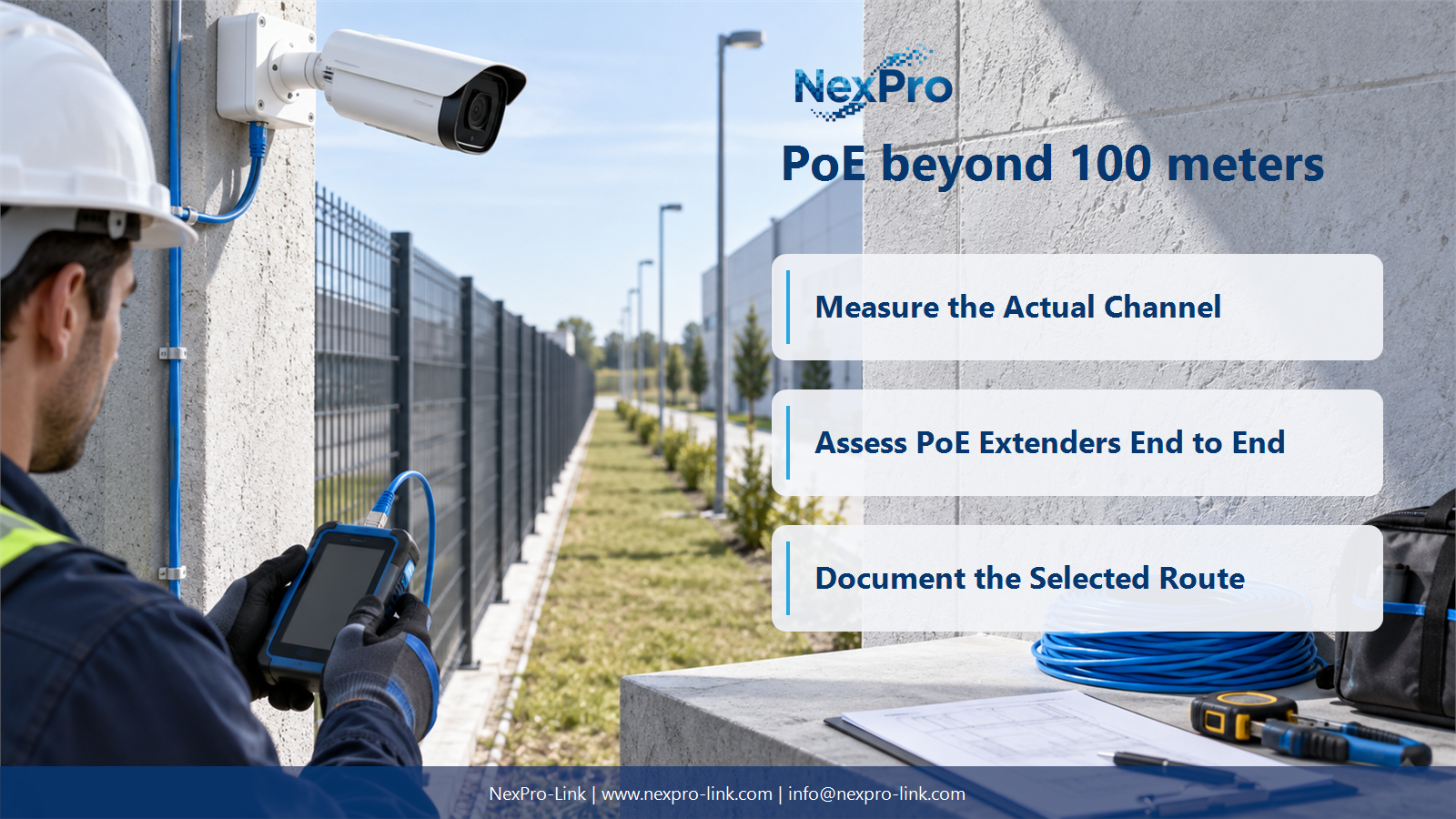
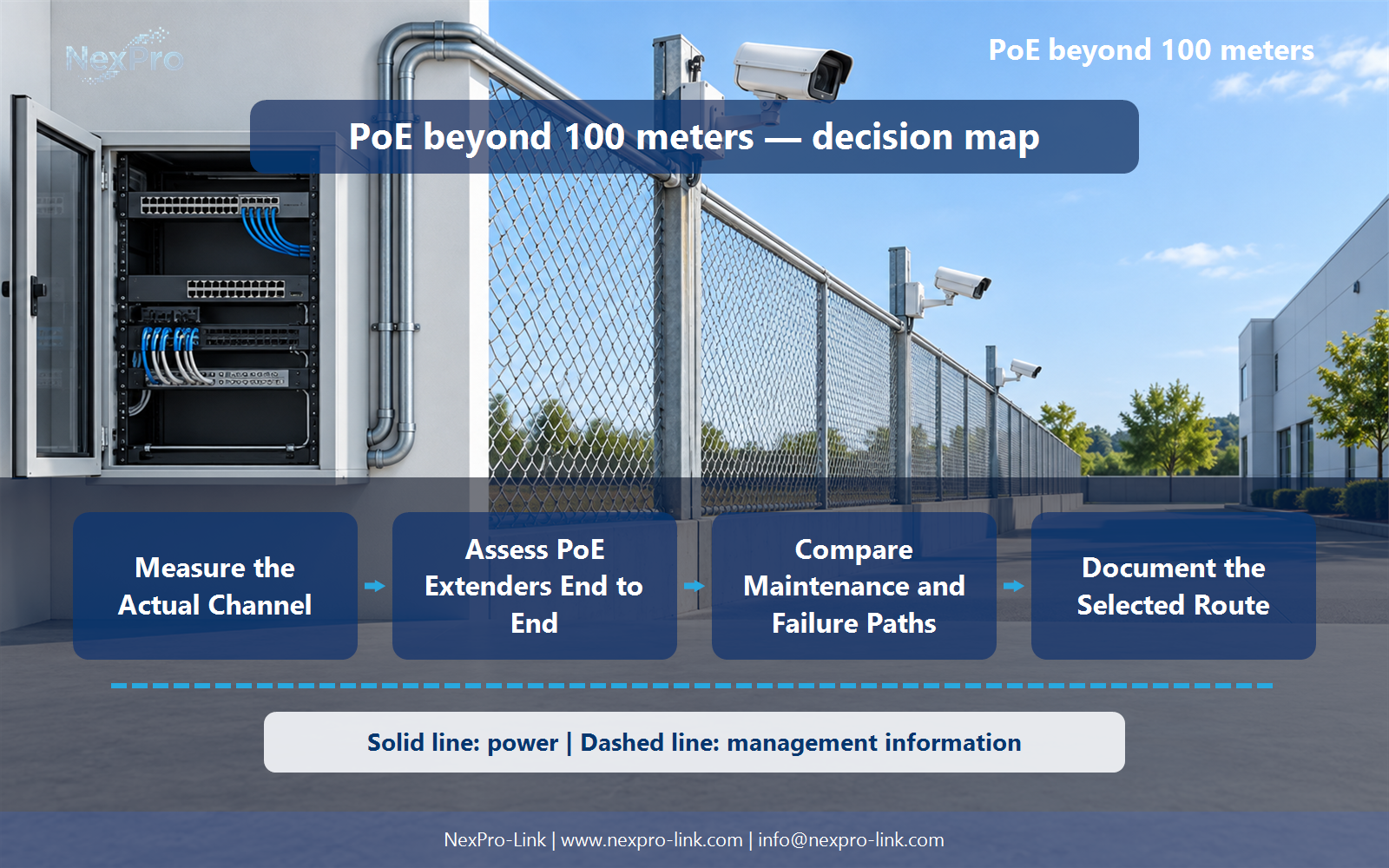
Measure the Actual Channel
It refers to the applicable conventional balanced-copper channel arrangement, including connecting cords, rather than a universal rule for every proprietary long-range product. Measure the routed cable path and terminations. Straight-line distance on a plan can understate the installed channel length.
Turn the answer into a working record using Route, Fixed cable, Patch cords, Total channel.
| Decision area | Buyer question | Required output |
|---|---|---|
| Measure the Actual Channel | What does the usual 100-metre Ethernet channel refer to? | It refers to the applicable conventional balanced-copper channel arrangement, including connecting cords, rather than a universal rule for every proprietary long-range product. |
| Evaluate an Intermediate Switch | When can an intermediate switch solve a distance problem? | It can create separate supported network segments when there is a suitable powered location and acceptable maintenance access. |
| Assess PoE Extenders End to End | Does a PoE extender preserve full camera power? | Not automatically. |
Section 02
Evaluate an Intermediate Switch
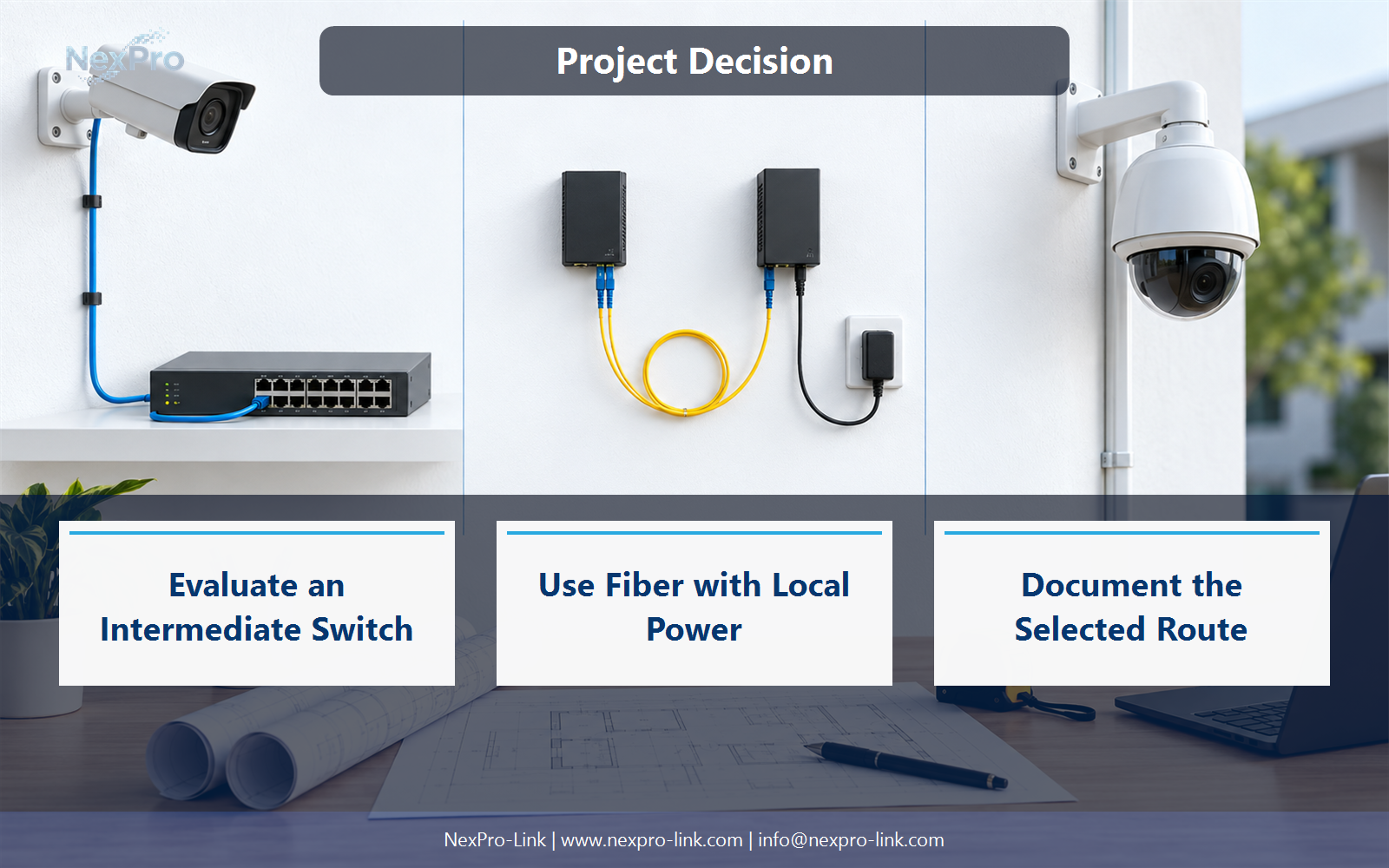
It can create separate supported network segments when there is a suitable powered location and acceptable maintenance access. That switch becomes another dependency for downstream cameras. Include its enclosure, uplinks and power backup instead of drawing it as a cost-free extension point.
Use Segment, Length, Intermediate power, Downstream impact to compare options on the same basis. Keep product capability, project assumption and operating responsibility in separate columns.
Section 03
Assess PoE Extenders End to End
Not automatically. The extender and cable arrangement consume part of the available budget, and supported distance or speed may change with the load. Check the complete supported combination and camera operating modes. Do not assume a quoted maximum distance applies at maximum power simultaneously.
The project output should make Source budget, Extender demand, Cable loss, Camera allowance traceable from input to acceptance.
- Confirm the answer to: Does a PoE extender preserve full camera power?
- Record the project fields: Source budget / Extender demand / Cable loss / Camera allowance.
- Keep product capability, project assumptions and site responsibility in separate records.
Section 04
Use Fiber with Local Power
Optical fiber carries data, not standard copper PoE power. A distant camera still needs an appropriate local supply, often through a local PoE switch or injector. Plan the fiber endpoints, local power and backup together; converting the data link does not remove the power requirement.
Record Optical link, Local supply, PoE endpoint, UPS zone before selecting a product family. That makes later substitutions possible without silently changing the operational requirement.
Section 05
Compare Maintenance and Failure Paths
Compare available power, access for maintenance, environmental exposure, supported bandwidth and the views affected by a failure. The lowest initial cable cost may create more inaccessible active devices. Explain those trade-offs for the actual route rather than recommending one extension method everywhere.
Review Option, Powered nodes, Access, Data rate, Failure impact with the party that will operate or maintain the system.
Section 06
Document the Selected Route
Record each segment, its medium and length, endpoint equipment and power arrangement. Include any product-specific operating limits and the intended test condition. This gives installers a usable route plan and prevents a general distance claim from becoming an unsupported acceptance requirement.
Use Segment ID, Medium, Length, Endpoints, Power, Test as the handoff between design and procurement.
Engineering references
These sources support the general planning principles. Always use the selected product's current datasheet and applicable project standards for final design.