Center the batch and state recovery, and separate compressor, heating and conveyor power from the control and identification loads.
Section 01
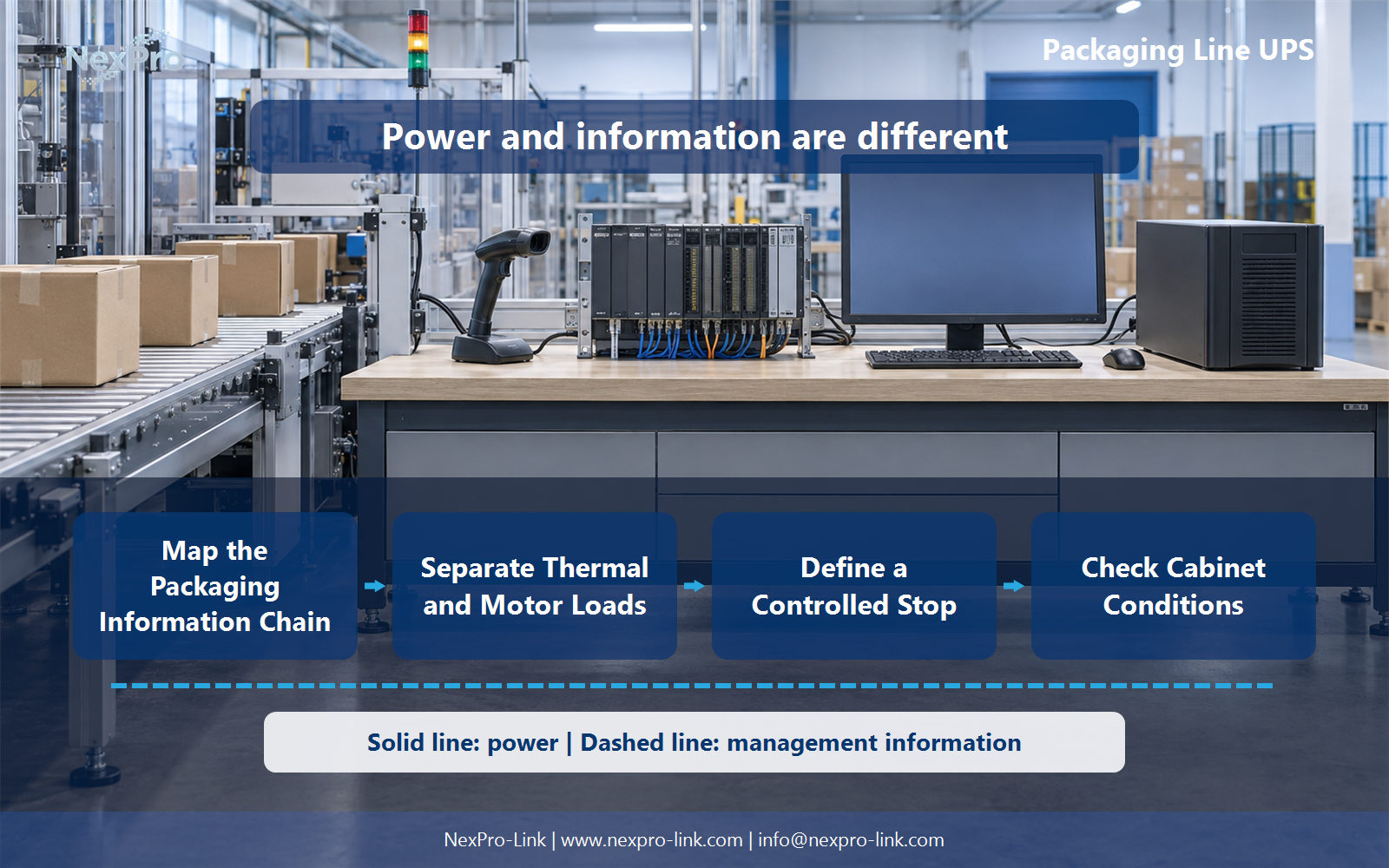
Map the Packaging Information Chain
What information should survive an outage? Identify the batch, item and process-state records required for recovery. Trace coding, scanning and local control dependencies. UPS support should be linked to these functions rather than presented as a guarantee that every package remains correctly processed. Packaging line engineers and production-line IT can use that boundary to build the information map: batch / coding / scan / control / record and prepare packaging control map, coding devices and approved stop-and-restart sequence before selection.
Center the batch and state recovery, and separate compressor, heating and conveyor power from the control and identification loads.
The first job is to name the information the line needs after a stop. Batch identity, item identity, and the process state all matter, but they live in different places. The controller holds the line state and counters. The coder holds the last code it applied. The scanner holds the last verified read. The production system holds counts and quality flags.
A UPS supports these functions by keeping the devices that store them alive long enough to stop cleanly. It does not guarantee that every carton was processed correctly. Power continuity and process correctness are separate claims. The map below lists the layers on a packaging line and the recovery question each one answers.
The recovery question for each layer sets the UPS boundary. A coder that only prints a batch number may need a few seconds of hold time. A scanner that is the only record of a verified code may need longer. Record the dependencies per layer before choosing any rating.
| Decision area | Project question | Required output |
|---|---|---|
| Map the Packaging Information Chain | What information should survive an outage? | Information map: batch / coding / scan / control / record |
| Separate Thermal and Motor Loads | Should sealers and motors share the control UPS? | Scope table: controller / printer / heater / motor / included |
| Define a Controlled Stop | What should happen after confirmed source loss? | Stop map: detection / supported actions / state / operator |
Section 02
Separate Thermal and Motor Loads
Sealers, heaters, and conveyor motors draw differently from control electronics. A heater pulls a steady thermal load for as long as it runs. The conveyor motor draws a starting current well above its running current. The controller and its I/O draw a small, stable load. Put them all on one UPS and the rating reflects the biggest load, which is often the one that does not need protecting.
The clean approach is a scope table. Mark what the engineered equipment scope includes and what it leaves off. The example below shows a typical split, not a universal rule.
The point of the table is the split itself. A controls-oriented rating applied to the full machine overstates the requirement. A full-machine rating applied to the controls alone undersells what the brief should say. State each load separately, then decide.
Section 03
Define a Controlled Stop
A controlled stop follows the equipment's supported process for halting, retaining state, and alerting the operator. The stop map records what the line detects, what it can do, what state it holds, and who acts.
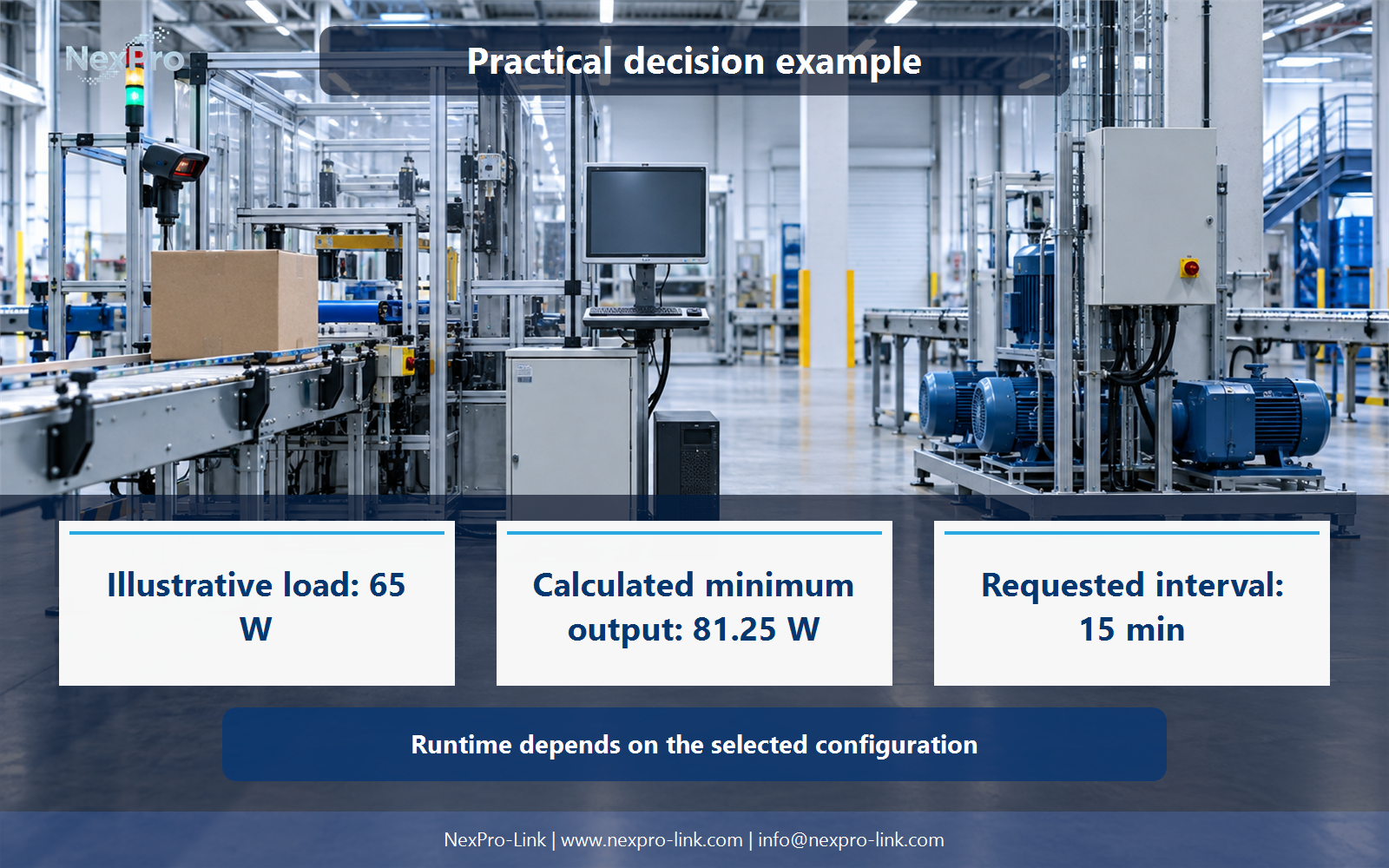
The required duration comes out of this map. If the line can finish the current code in a few seconds and hold state for fifteen minutes while the operator records the stop, those fifteen minutes become the objective. Dependencies matter more than the label "industrial UPS." A device that needs a network shutdown signal needs a different interface from one that only needs a contact closure.
- Confirm the answer to: What should happen after confirmed source loss?
- Draw electrical power as a solid path and management information as a separate dashed path.
- Keep external services and specialist approvals outside the UPS equipment claim.
Section 04
Check Cabinet Conditions
The cabinet, more than a generic industrial label, decides whether a given configuration fits. Record the ambient temperature, contamination, ventilation, and service access. Nearby process conditions matter even when the UPS sits in its own enclosure. A washdown line, for example, can put moisture and overspray in the air around the cabinet.
Describing the actual conditions produces a requirement the supplier can act on. Relying on a broad label leaves the enclosure, filter, and clearance questions unanswered, and those questions change the bill of materials.
Section 05
Reconcile Work in Progress
Restored power does not confirm that codes, counts, or seals are correct. The production system's own rules decide which items are uncertain and where the restart begins. The recovery table captures the last confirmed item, the uncertain range, the action, and the owner.
The UPS keeps the control and scanning records available so the team can make that determination. It does not make the determination. The owner and the action stay with production and quality, which is where the mechanical and product decisions belong.
Section 06
Prepare a Packaging Brief
A supplier cannot quote "protect the line." It needs the device list, the source interfaces, the load, the stop time, and the environment. The brief below turns the earlier sections into fields a supplier can act on.
NexPro-Link can discuss UPS equipment within that scope. On its catalog, the rack-mounted online range NX-UP-RM-001 includes configuration C1KR(S) rated 1,000 VA and 900 W with internal VRLA batteries, which shows how a series, a configuration, and a rating line up. It is not a preselected answer for this line. The load, stop time, interfaces, and environment determine the fitting. Mechanical process behavior and product-quality decisions stay with the equipment and production teams.
Engineering references
These sources support the general planning principles. Always use the selected product's current datasheet and applicable project standards for final design.