Frame packaging-film custody events around visible labels, carriers and people, then test glare and compare actual output dimensions before buying higher resolution.
Section 01
Choose a visible reference for the custody event
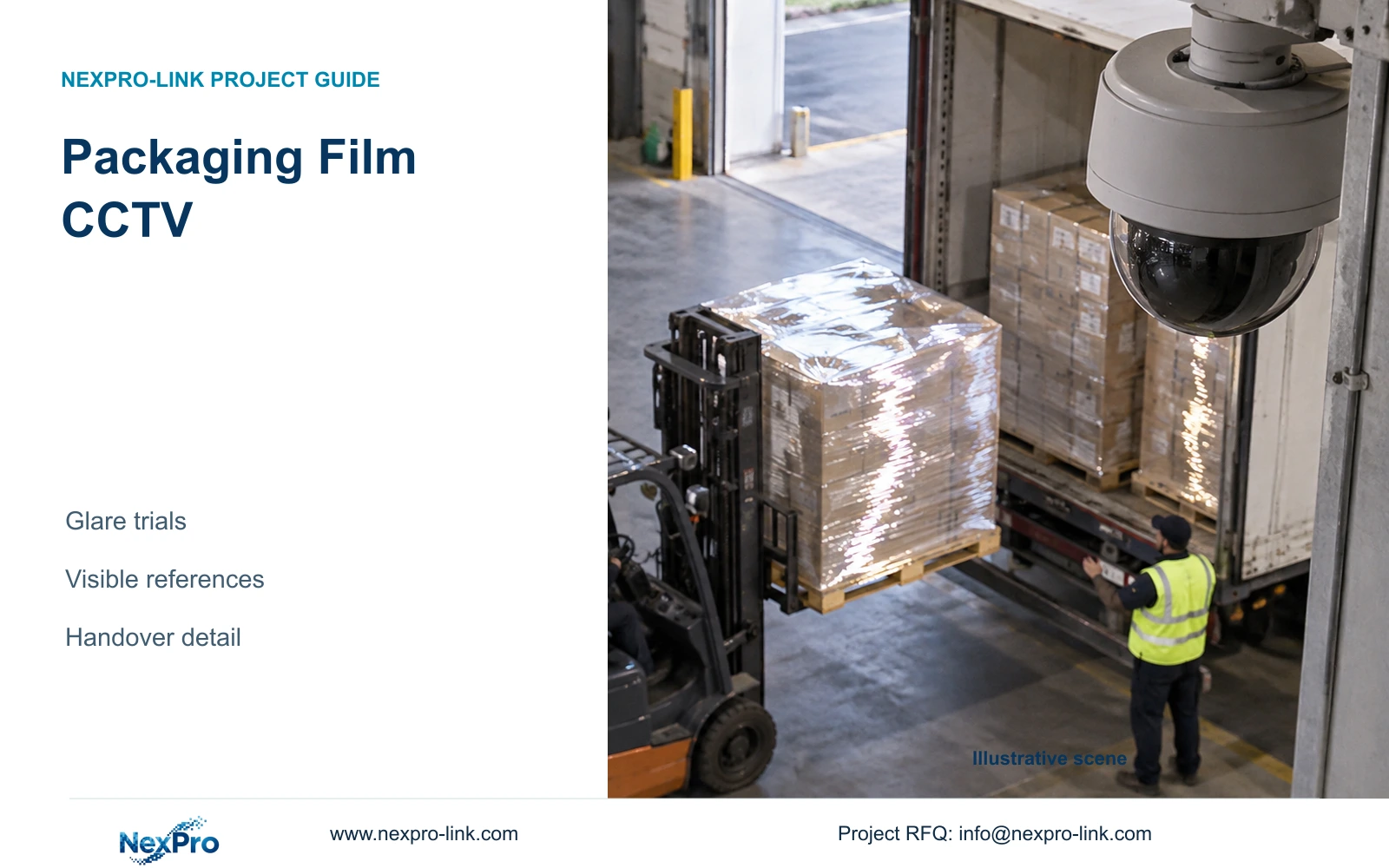
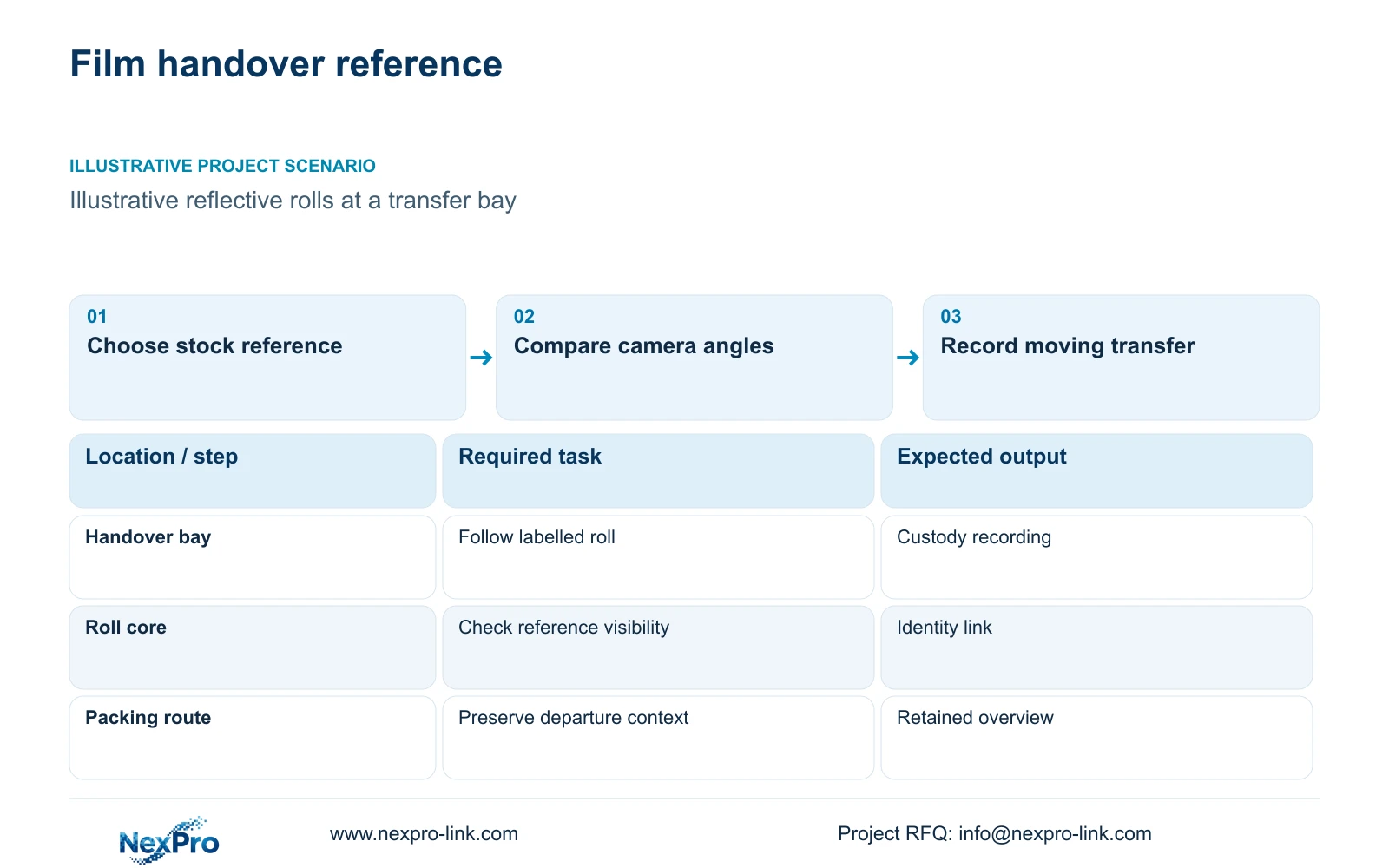
Packaging film CCTV should frame the handover around something a reviewer can reliably locate, such as a roll core label, pallet identity or collection position. Test the film against the actual background before increasing resolution. Transparent and reflective material can make the product boundary difficult to interpret even when the surrounding scene is clear. The security requirement should describe who transferred which recorded item at which location, without promising film-defect inspection.
Illustrative project scenario: Transparent and reflective film makes a high-mounted overview difficult to interpret. Assume rolls pass through a designated handover bay before packing, with labels attached to an identifiable carrier or core. The engineer asks the owner which reference connects the movement to its stock record. The proposed view then includes that reference and the transfer action. These assumed arrangements require confirmation; they are not a claimed customer installation or proof that the label is readable from the original mounting point.
Section 02
Test camera angle and background before resolution
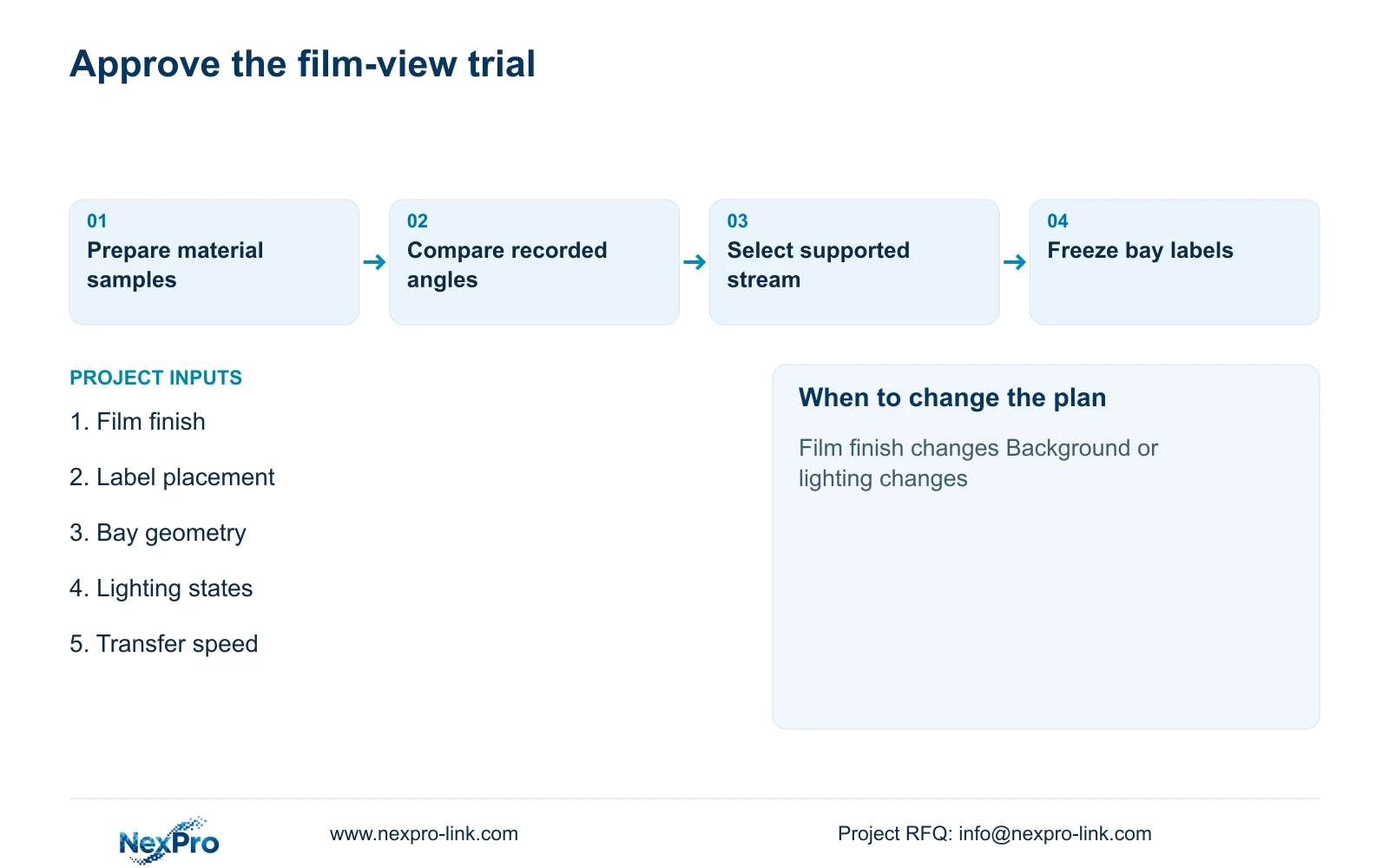
Compare candidate positions using the same sample material and normal lighting states. Include the actual roll orientation, carrier, operator and transfer speed. A side view may reveal a label that disappears in a steep overhead view, while a changed angle may introduce a different reflected light source. Keep the original overview available during the trial so the owner can judge whether improved detail loses arrival or departure context.
Document the background, lighting state, exposure settings and selected stream for each test recording. Where production permits a stable contrasting background, evaluate it as part of the scene arrangement rather than claiming a camera feature removes transparency. Do not alter safety, hygiene or process arrangements solely to make footage attractive. Dust, cleaning and any solvent-area information also affect mounting suitability. If the camera must move to obtain an acceptable angle, update its cable route, support and service-access requirements before treating the sample result as the final equipment decision.
Section 03
Give surveillance and film inspection separate outputs
Define a surveillance acceptance task such as following a labelled roll from the handover bay onto its outgoing carrier. Film thickness, pinholes, surface defects or print quality require separately specified inspection tasks. A security camera's image may provide context for a production review, but its presence does not establish detection limits or automatic rejection capability. Keep inspection equipment and machine-protection interfaces under their own suppliers and approval process.
The security handover map should identify the supplied camera, retained overview, optional detail view and separately scoped specialist positions. Assign the stock-record reference to the owner, scene preparation and mounting to the installer, and model and stream documentation to the equipment supplier. This division matters when a trial improves label visibility but the reviewer still cannot identify the stock item. The missing identity link may belong in the transfer procedure rather than in another camera upgrade.
Section 04
Compare listed output widths at the same plane
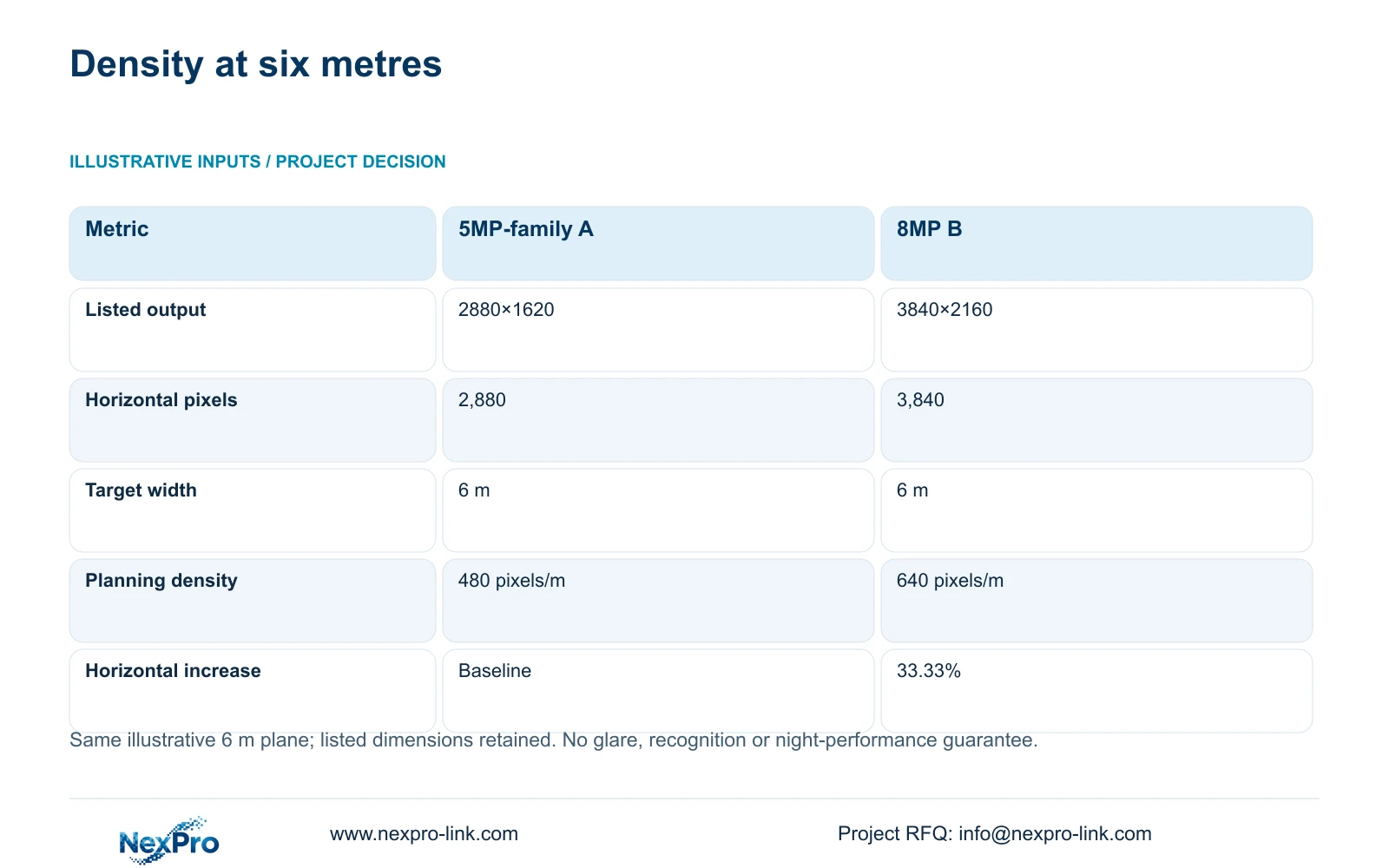
The BL2812M source lists 2880×1620 for the 5MP-family reference and 3840×2160@25fps for the 8MP reference. Preserve those dimensions as supplied. For the illustrative arithmetic, both views cover a 6 m target plane. Use ppm = horizontal_pixels / 6: 2,880 / 6 = 480 pixels/m, while 3,840 / 6 = 640 pixels/m. The relative increase is (3840 / 2880 - 1) × 100 = 33.33%.
This comparison quantifies horizontal planning density only. The 5MP and 8MP labels do not provide a 60% usable-detail guarantee, and the calculation establishes no comparative night performance. Lens geometry, focus, motion, exposure and compression remain separate inputs. Most importantly, more pixels do not recover a label hidden by a carrier or saturated by reflection. Approve the camera angle and background first, then determine whether the additional recorded density resolves a remaining security-detail requirement under representative conditions.
| Metric | Option A: listed 5MP family | Option B: listed 8MP |
|---|---|---|
| Listed output | 2880×1620 | 3840×2160 |
| Horizontal output | 2,880 pixels | 3,840 pixels |
| Target width | 6 m | 6 m |
| Planning density | 480 pixels/m | 640 pixels/m |
| Horizontal-density increase | Baseline | 33.33% |
Section 05
Upgrade only where the recorded trial supports it
Recommend an adjusted handover view using the visible stock reference, with the overview retained where movement context matters. Choose higher resolution at positions where the recorded comparison demonstrates useful additional detail. Change the recommendation when the reference is too small, the view must cover a wider target plane or the operating lighting cannot support the accepted image. If a specialist inspection task emerges, open that scope independently instead of adding it to CCTV acceptance.
CASE01 assumes 32 streams within selected supported 5MP-class recorder modes. Its 4 Mbps per-camera bitrate is a teaching input, not a bitrate for either film-view candidate. Replacing those streams with 8MP cannot inherit the original all-channel mode assumption. Check actual recorder support, input bandwidth, playback and storage after selecting the streams. The BL2812M camera source also lacks maximum power figures, so update the PoE and protected-load schedule using confirmed demand. A normal review monitor may meet the handover task without adding a wall or separate decoder.
Section 06
Put the scene trial into the procurement package
Include the approved sample recordings, camera positions and stream settings in the quotation basis. A resolution-only BOQ line leaves suppliers free to offer different framing and recording assumptions. For comparison with another brand, hold target width, material sample, lighting and retrieval task constant. List any required integration or special environmental scope separately, and obtain matching quotations before making a price conclusion.
NexPro-Link's model-matching and BOQ support can translate the approved scene into a location-based equipment list and technical submittal. Project labels should connect each detail camera to its transfer bay and accepted stock reference. The local team still owns final alignment and testing under operating conditions. At handover, replay a full transfer and export the relevant recording on the intended review workstation. Retest when film finish, label placement, background or lighting changes, because those changes can invalidate the accepted view without changing the camera model.
Section 07
Buyer questions
Must the camera see the transparent film edge? Only if that edge is part of the agreed security task. A visible carrier, core label or handover position may provide a better link to the stock record, provided the full transfer remains clear.
Can a camera trial use a still sample? Use still samples to explore framing, then record actual handling at representative speeds. A still image cannot establish whether the required reference remains usable during movement.
Does choosing 8MP automatically require more cameras? No. Camera quantity follows the accepted views and obstructions. Higher resolution may improve density at the same width, but it does not resolve hidden transfers or replace missing movement context.
Section 08
Test your film-handover view
Email a representative material and label description, transfer-bay geometry, normal lighting and background conditions, and handling speeds to info@nexpro-link.com to discuss a focused camera trial and equipment scope.
Engineering references
These sources support the general planning principles. Always use the selected product's current datasheet and applicable project standards for final design.