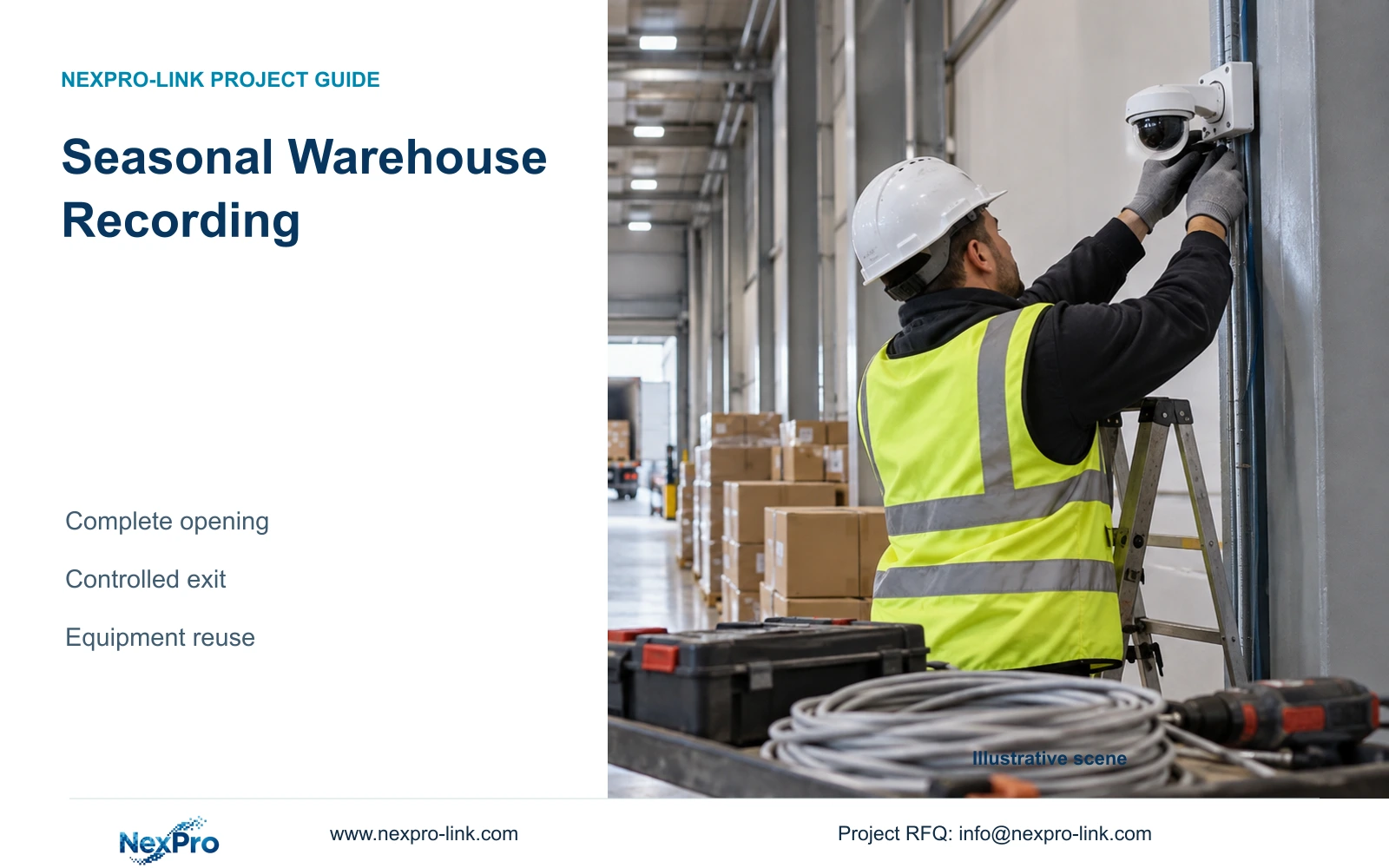
A three-month warehouse still needs complete recording and a controlled exit plan. Separate reusable equipment from site-specific cabling and preserve access to retained footage.
Section 01
Define a complete service for the temporary site
Overflow warehouse CCTV needs a complete recording, power and authorised review path for the occupied period, followed by a planned removal and data-handover process. Temporary use can justify reusable equipment and limited optional features. It does not remove the need for agreed retention, suitable cable installation or controlled access to recordings.
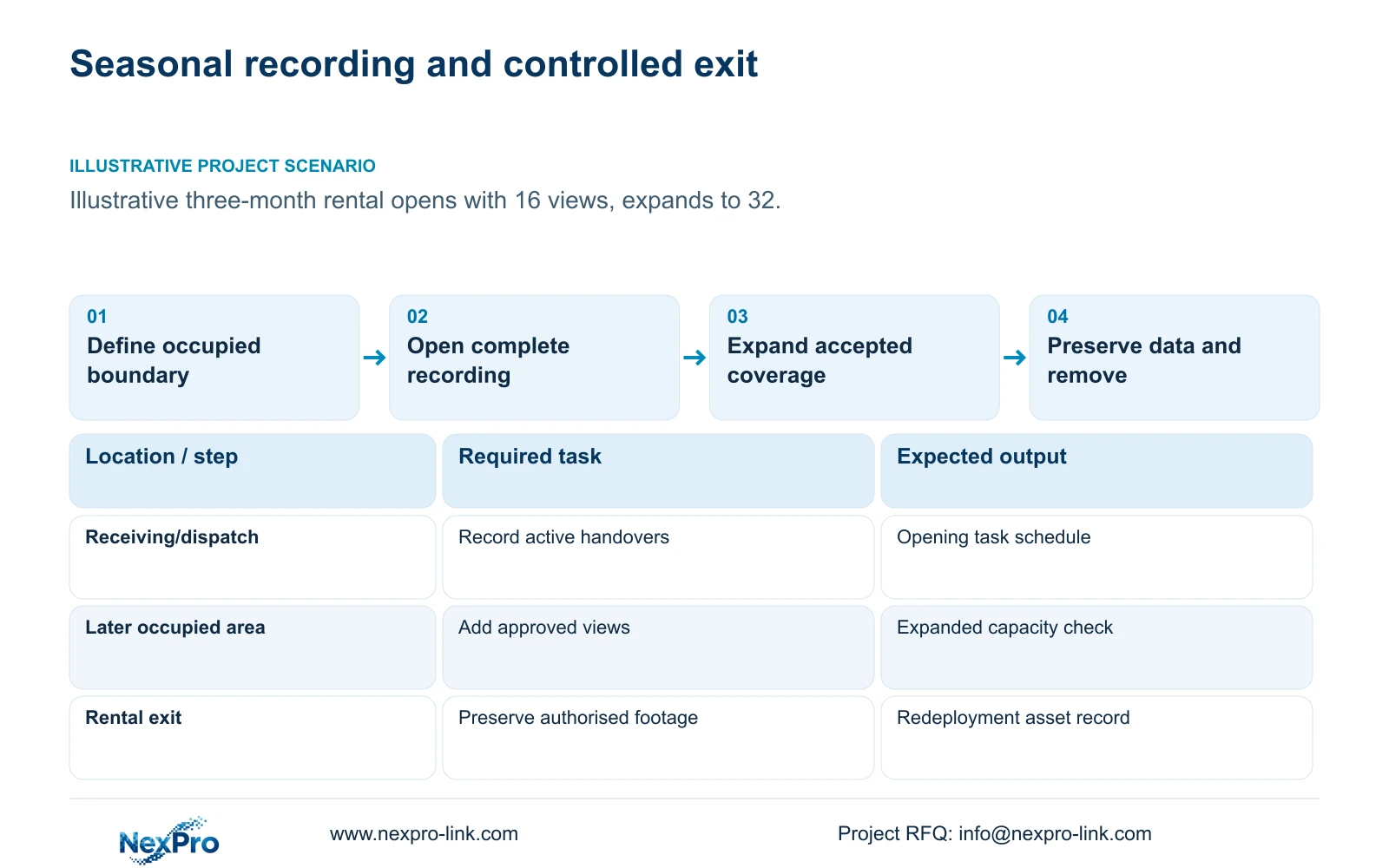
Illustrative project scenario: Seasonal production requires a rented warehouse for three months. Assume the first operating area opens with 16 cameras and a later occupied area expands the schedule to 32. The project manager must make the first phase usable while avoiding equipment and data being stranded when the rental ends.
Define the receiving and dispatch tasks, loaded storage arrangement, operating dates and who controls the site. Record any cold-zone temperatures, available network rooms and landlord restrictions affecting installation or removal. State the retention objective independently from the lease duration. A three-month rental does not automatically require storing every recording for three months, nor does the end of the rental automatically end the owner's need to access footage.
Section 02
Separate reusable equipment from site-specific installation
Package cameras, recorder, compatible disks and approved network equipment as identified assets that can be redeployed after inspection. Keep mounts, cable routes, penetrations and restoration work as site-specific items. A camera can be reusable while its installed cable or bracket needs replacement; quote those possibilities separately instead of assuming the whole installation moves intact.
The NexPro-BL2812M55-5MP-DIC-AI is a normal-area candidate with a listed 2.8–12 mm motorized lens and 2880×1620 output in its 5MP-family specification. The adjustment range may support different accepted views at a later site, but does not guarantee suitability for a new environment. Confirm temperature, mounting and the actual recorded task each time the unit is reassigned.
For copper links, distinguish the selected permanent-link arrangement from the complete channel and its patch cords. The supplied Fluke guidance distinguishes typical 90 m permanent links and 100 m channels, with the actual test type governing verification. Temporary routes need appropriate protection and approval too. Any reused cable requires inspection and the agreed testing; it should not be declared suitable merely because it worked before removal.
Section 03
Plan footage access before dismantling the recorder
Create the exit plan when the system is ordered. Name the last recording date, who approves shutdown, what footage must remain accessible and where the recorder or authorised archive will reside afterward. Include playback tools and the responsible account owner. A box of removed disks does not by itself provide an agreed operational review service.
Before resetting accounts or formatting storage for another project, confirm that authorised exports and any required retained material are complete and usable. Keep a record of shipment or event references associated with those files. If the recorder moves while retaining historical footage, establish who can access it and how the previous site's permissions are separated from the next deployment.
Assign the local installer the removal, inspection and packing tasks, with the site team approving safe access and restoration. Record serial numbers against old and new location IDs. Label inspected equipment, unresolved defects and site-specific accessories distinctly. This gives the next installer a usable asset list rather than an assumption that every item in the returning carton is ready for service.
Section 04
Size each occupied phase for its recording policy
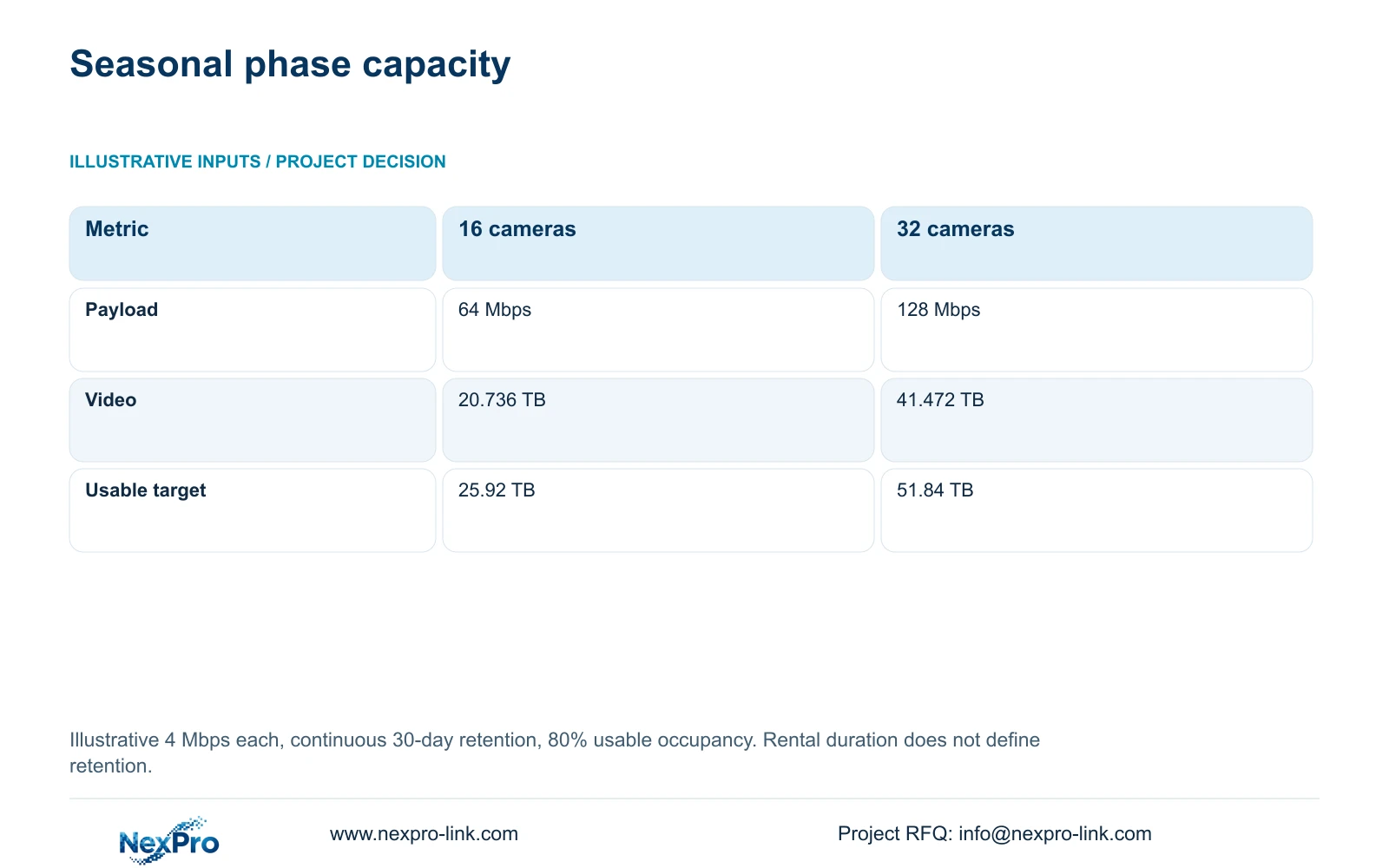
The supplied phase example uses 16 opening cameras and 32 final cameras, each at an assumed average 4 Mbps, recording continuously for 30 days. Required_Mbps = 4 × n gives 64 Mbps and 128 Mbps. Decimal video_TB = 0.0108 × 4 × n × 30 gives 20.736 TB and 41.472 TB.
At an 80% usable-capacity occupancy target, usable_required = video_TB / 0.80 gives 25.92 TB for opening and 51.84 TB for full operation. These targets already incorporate the declared empty-space allowance. They are not raw disk capacities; formatting overhead and any supported protection arrangement must be accounted for separately when choosing the installed disks.
The decisive difference is that final operation doubles the required recording payload and video volume. Reserve expansion capability before buying later cameras, but do not defer storage or network dependencies required by the first occupied phase. NexPro-NVR4449-4K lists 320 Mbps input and four SATA bays up to 18 TB each. Confirm the disk combination, actual stream modes and review workload independently; its channel label does not establish all-4K decoding or RAID.
| Metric | Opening phase | Expanded phase |
|---|---|---|
| Cameras | 16 | 32 |
| Recorder payload | 64 Mbps | 128 Mbps |
| Video capacity | 20.736 TB | 41.472 TB |
| Required usable capacity | 25.92 TB | 51.84 TB |
Section 05
Retain working local dependencies throughout the rental
Prefer a local recording node where the temporary site must continue recording without an external connection. Qualify any remote review path separately and define who provides internet service. Select the backup objective from the owner's operating need, then calculate the complete protected load, including PoE switch AC input, recorder and approved supporting equipment.
CASE06 offers a separate 24-camera cold-chain reference, with 16 ordinary views and eight specialist cold views. It places access switches, recorder and batteries in a suitable warm room. Its 1,404 m of new continuous cabling and five-reel cut plan are a route-defined example, not quantities for this seasonal site. Use the same location-based method while preserving the different camera count and retention boundary.
If the rented space includes a freezer, qualify those camera positions and connections independently rather than redeploying ordinary equipment there by default. Where the warehouse expands across separate electrical nodes, each protected node needs a reachable supply. A UPS at the recorder does not protect a remotely powered switch. Keep optional walls or additional review stations outside the essential package unless the operating task requires them.
Section 06
Compare the opening package and exit work together
Compare offers across opening, expansion and removal rather than equipment purchase alone. Request separate amounts for reusable hardware, site-specific routes, commissioning, later additions, data handover and reinstatement. Do not assign a resale value or assumed future savings to returned equipment without an accepted commercial basis.
NexPro-Link's project-supply scope includes equipment selection, preparation, packing and export coordination. For this project, a useful handover is a phase-labelled BOM, technical assumptions, location labels and reusable packing records. Local installation and later removal remain explicit responsibilities rather than an implied part of equipment supply.
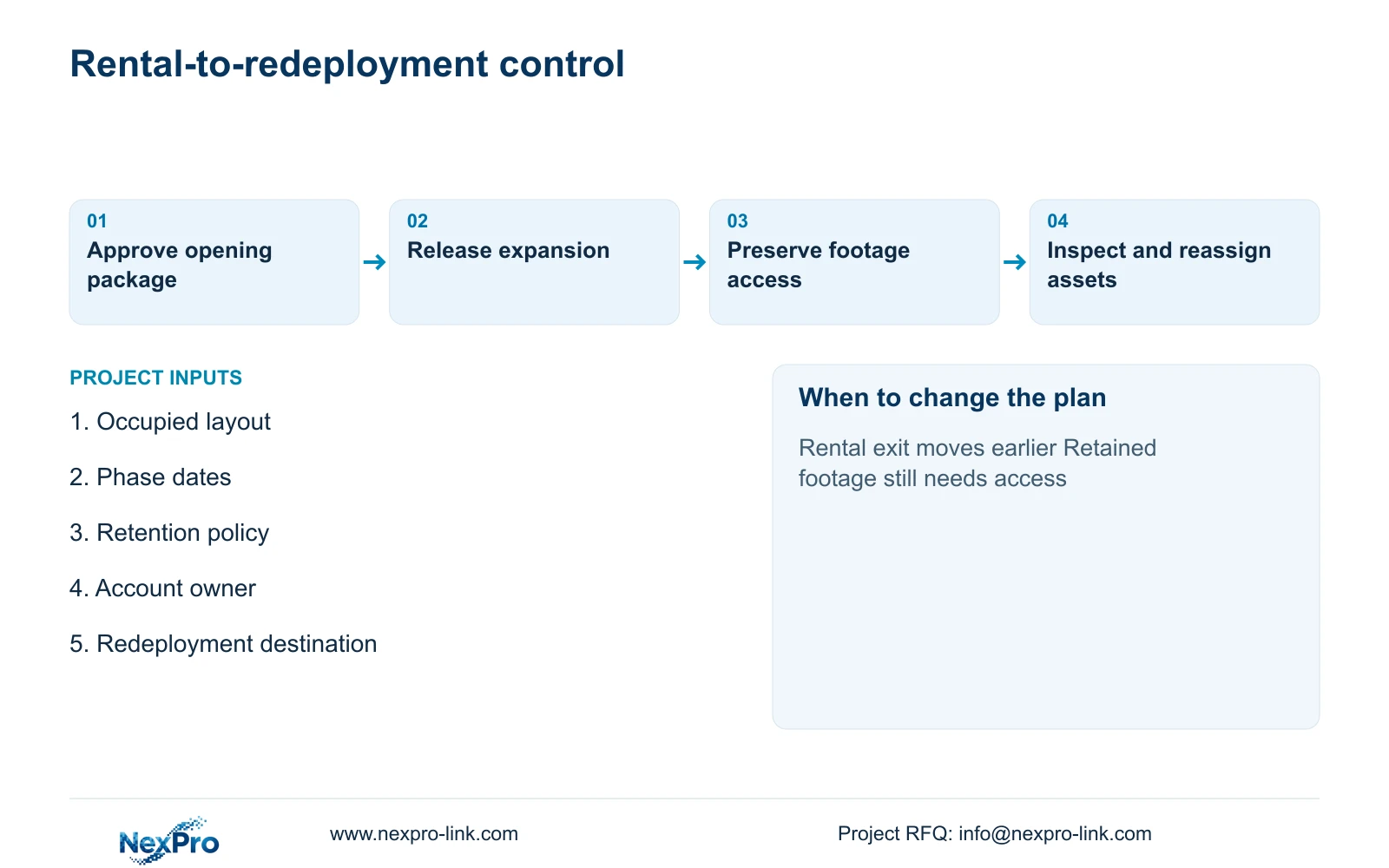
Release the opening package only when each required view has its recording, permissions, power and review path in place. Before the next phase, confirm remaining resources and revised routes. At rental exit, verify retained material and revoke or transfer access deliberately, then inspect the equipment for its next destination. These release checks preserve continuity across a short-lived site without treating its recording needs as informal.
Section 07
Buyer questions
Does a three-month rental require 90 days of rolling video? No automatic relationship is established. Set retention from the owner's review needs and applicable project requirements, then size storage for that period. The article's phase comparison uses 30 days.
Can the same recorder be used immediately at the next site? Only after the historical-footage access plan, account transition and equipment checks are complete. Confirm that the new configuration will not overwrite material the owner still needs.
Should temporary cabling be priced as reusable? Separate recovery from proven reuse. Route protection, removal damage, termination changes and retesting can alter whether a cable is suitable for the next installation.
Section 08
Scope the seasonal system and its exit
Send the occupied-area layout, opening and expansion dates, retention/access requirements, and removal or redeployment destination to info@nexpro-link.com. NexPro-Link can discuss a phased equipment package with clear reusable and site-specific boundaries.
Engineering references
These sources support the general planning principles. Always use the selected product's current datasheet and applicable project standards for final design.