Decide power configuration by cabinet environment and maintainability rather than by an outdoor label. Plan the project from the outdoor cabinet thermal profile, loads and service-access limits.
Section 01
Define the Installation Environment
Decide power configuration by cabinet environment and maintainability rather than by an outdoor label.
State temperature, moisture, solar exposure, contamination and physical access at the actual installation. The enclosure and internal equipment must work together. A generic outdoor label or weather rating does not establish explosion protection, tamper resistance or compatibility with every ATM cabinet.
The working question is simple: What does outdoor suitability need to cover? Record the answer as a service requirement before comparing UPS ratings or battery options.
| Decision area | Project question | Required output |
|---|---|---|
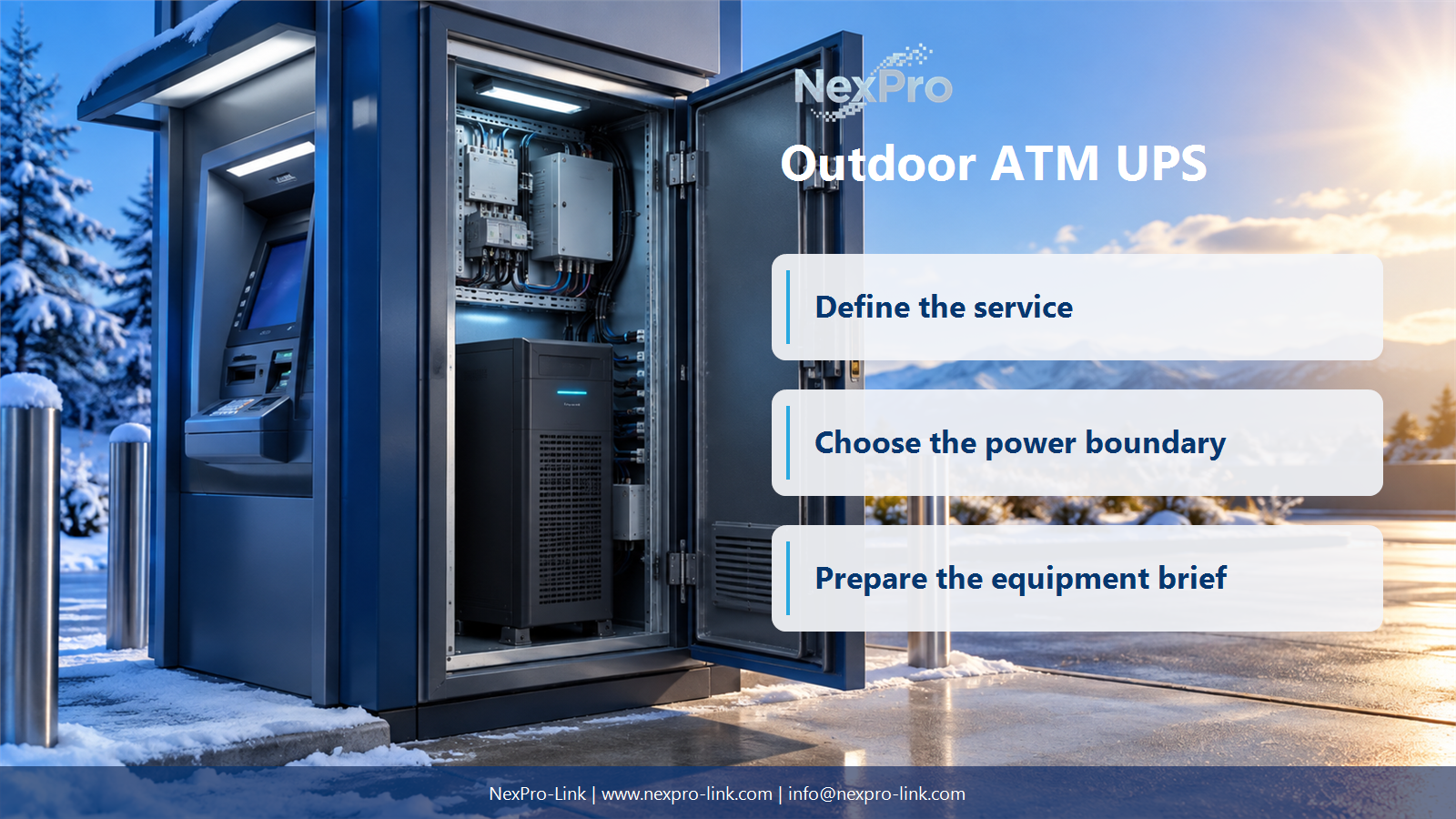
| Define the Installation Environment | What does outdoor suitability need to cover? | Approved service objective |
| Use Internal Temperature | Should battery selection use only the city's weather range? | Defined load and dependency boundary |
| Separate Auxiliary Loads | Must cabinet heaters and fans be included in UPS load? | Reviewed power-path decision |
Section 02
Use Internal Temperature
No. The cabinet interior can differ from ambient conditions because of solar gain, equipment heat and ventilation. Describe the expected internal range and outage condition, then use the selected battery and UPS operating limits. A weather average is not a thermal design basis.
Keep the load list, operating state and supporting dependencies in the same schedule. This makes omissions visible before runtime or capacity is discussed.
- Confirm the answer to: Should battery selection use only the city's weather range?
- Separate measured demand, nameplate limits and committed growth.
- Identify the owner of each external service or approval.
Section 03
Separate Auxiliary Loads and Coordinate Electrical Protection
Include them when they must operate during the protected interval or are supplied through the same backed-up path. Their duty and starting behavior should be explicit. Otherwise a proposal may calculate the terminal load correctly while missing essential enclosure support.
Not automatically. Define incoming power, communication exposure and the installation protection responsibilities through qualified design. For a project-specific decision, record power, data, enclosure and bonding responsibility in the interface map. This keeps the equipment inputs and intended service outcome aligned.
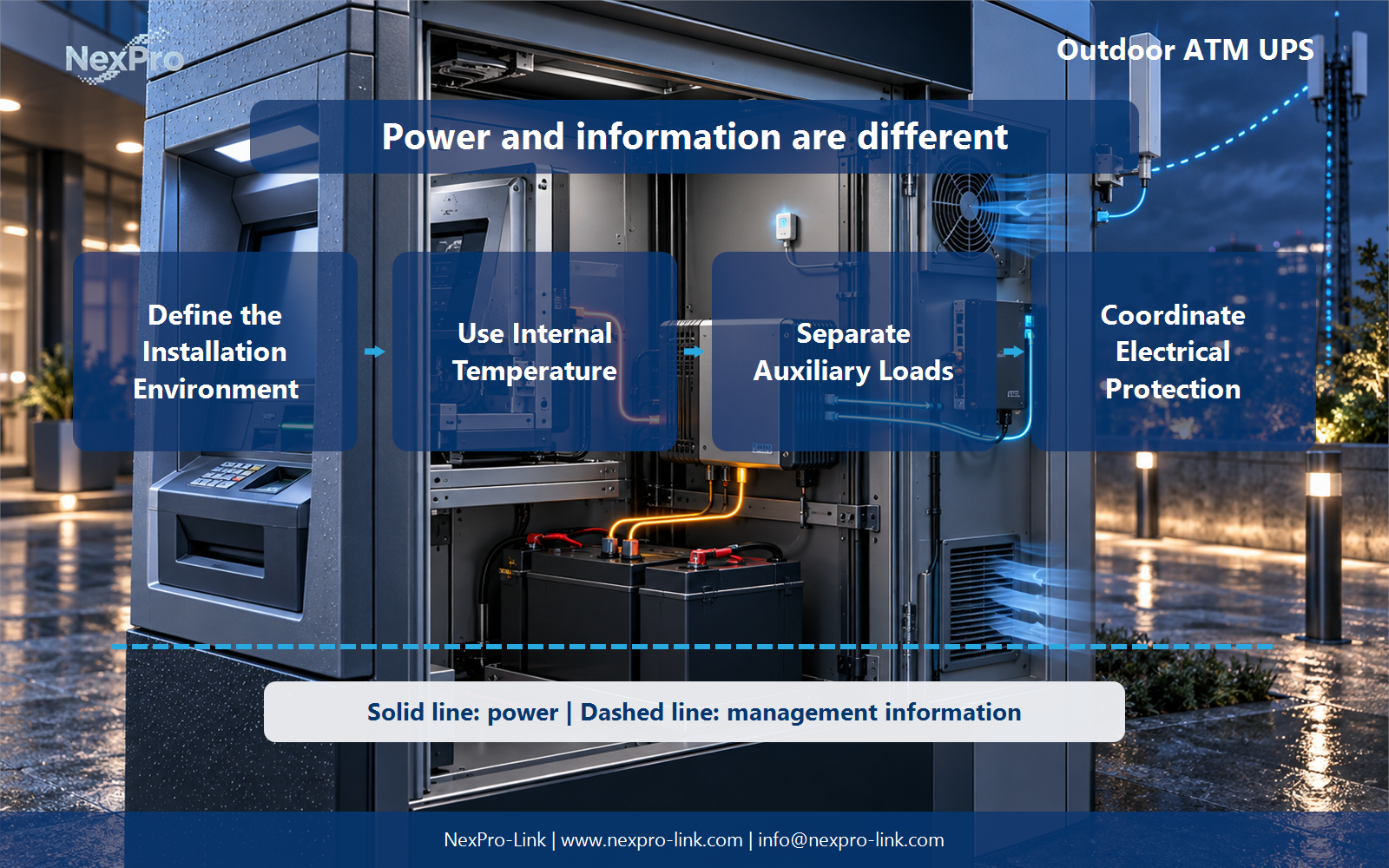
Draw power delivery as a solid path and management information as a separate dashed path. That distinction prevents an alarm or software command from being mistaken for an electrical protection function.
Section 04
Plan Remote Fault Response
It needs actionable alarms, a working communication route and an assigned service response. Show what can be diagnosed remotely and what needs a visit. Avoid equating a network card with guaranteed remote recovery or permitting disruptive control without role restrictions.
Assign the action, acknowledgement, timeout and escalation owner before commissioning. The useful battery interval is the time needed for this approved sequence plus reserve, not an arbitrary marketing duration.
Section 05
Build a Site-Specific Supply Brief
Provide the cabinet conditions, required loads, local interfaces and continuity objective. NexPro-Link can discuss the equipment and integration scope without claiming an unspecified standard product is already outdoor-qualified. Treat enclosure work and specialist requirements as explicit project items.
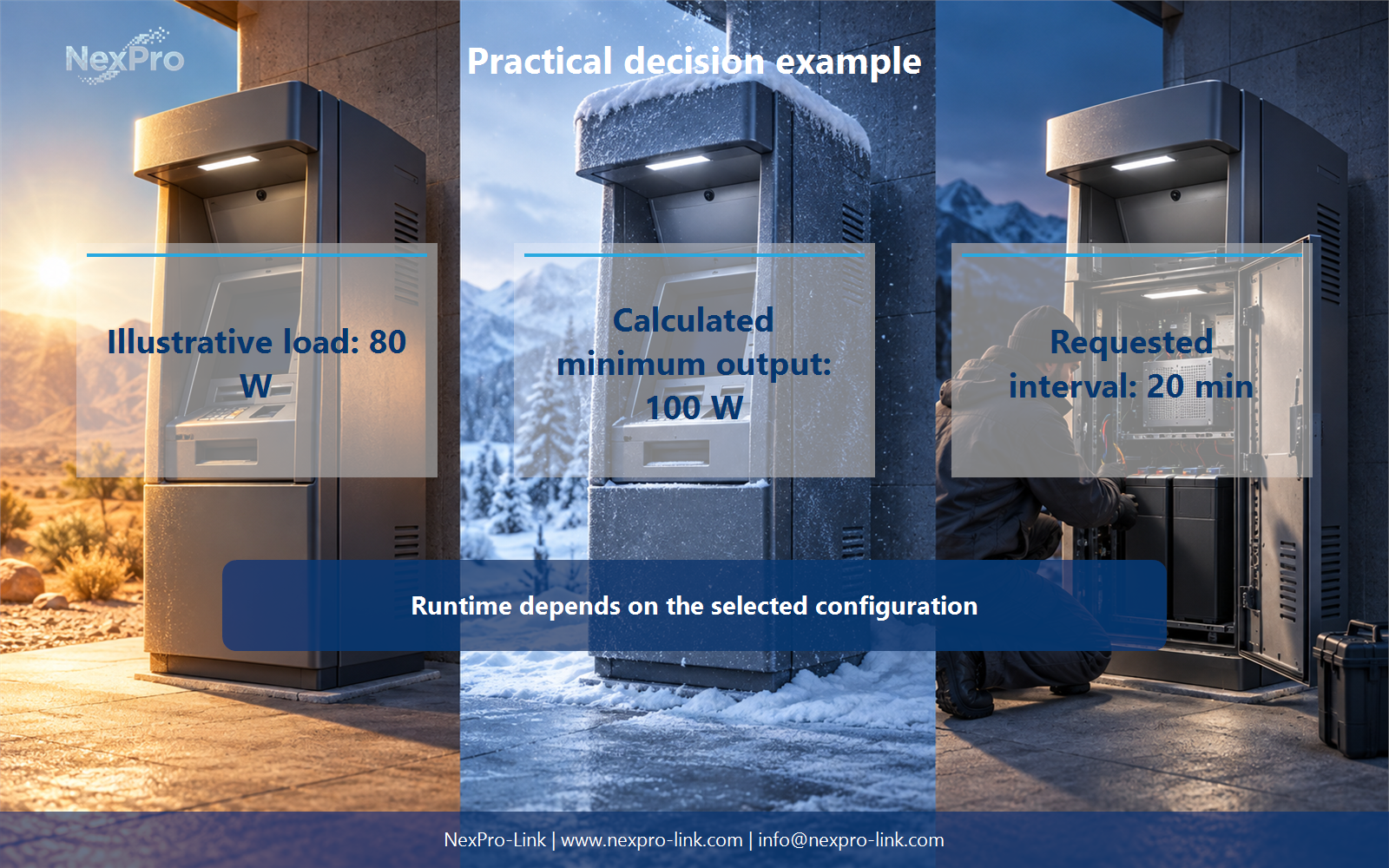
For the article's practical example, the stated teaching inputs are: Illustrative load: 80 W. Calculated minimum output: 100 W. Requested interval: 20 min. Runtime depends on the selected configuration. Treat these figures as planning assumptions, then replace them with measured or manufacturer-supported project data.
Engineering references
These sources support the general planning principles. Always use the selected product's current datasheet and applicable project standards for final design.