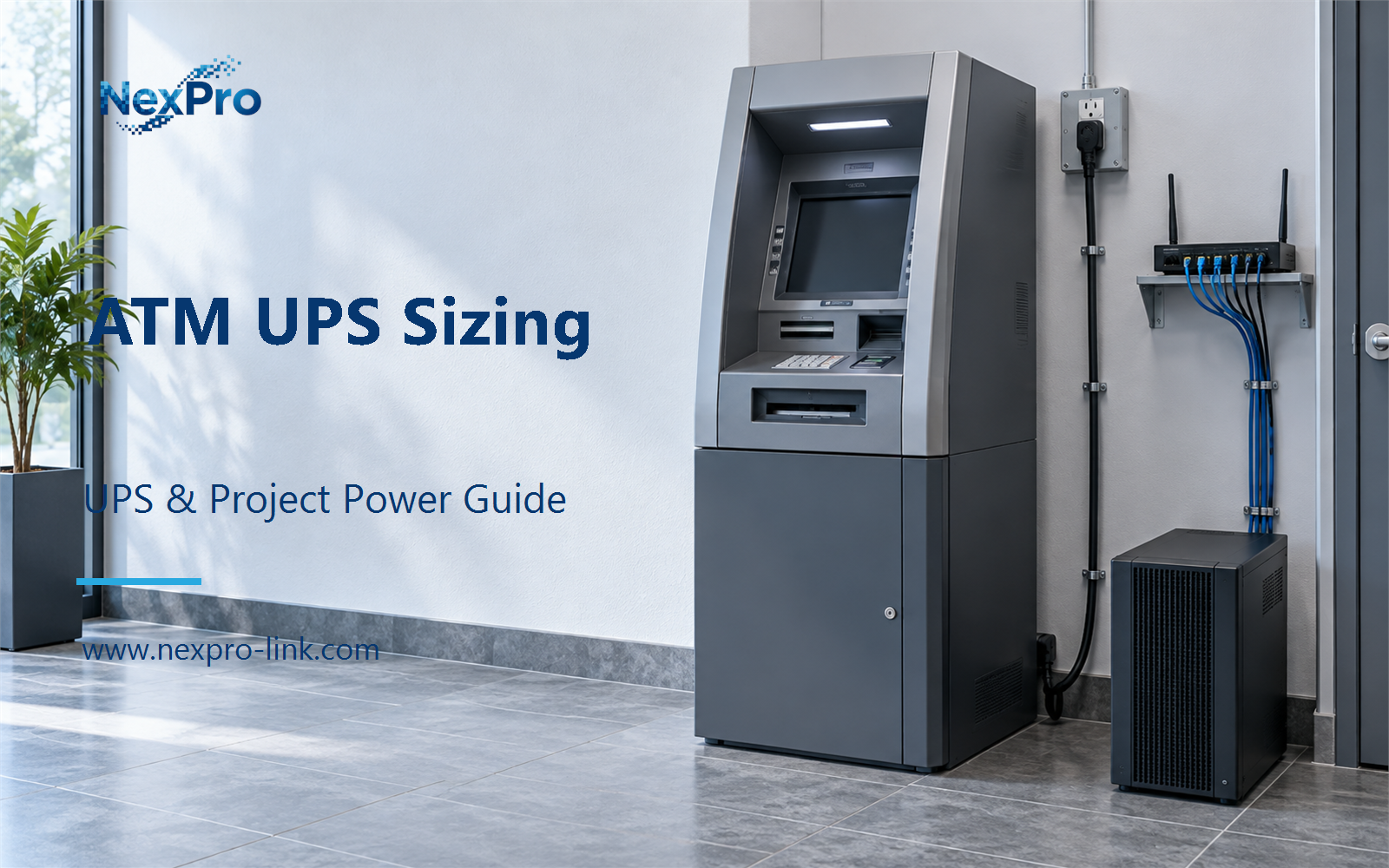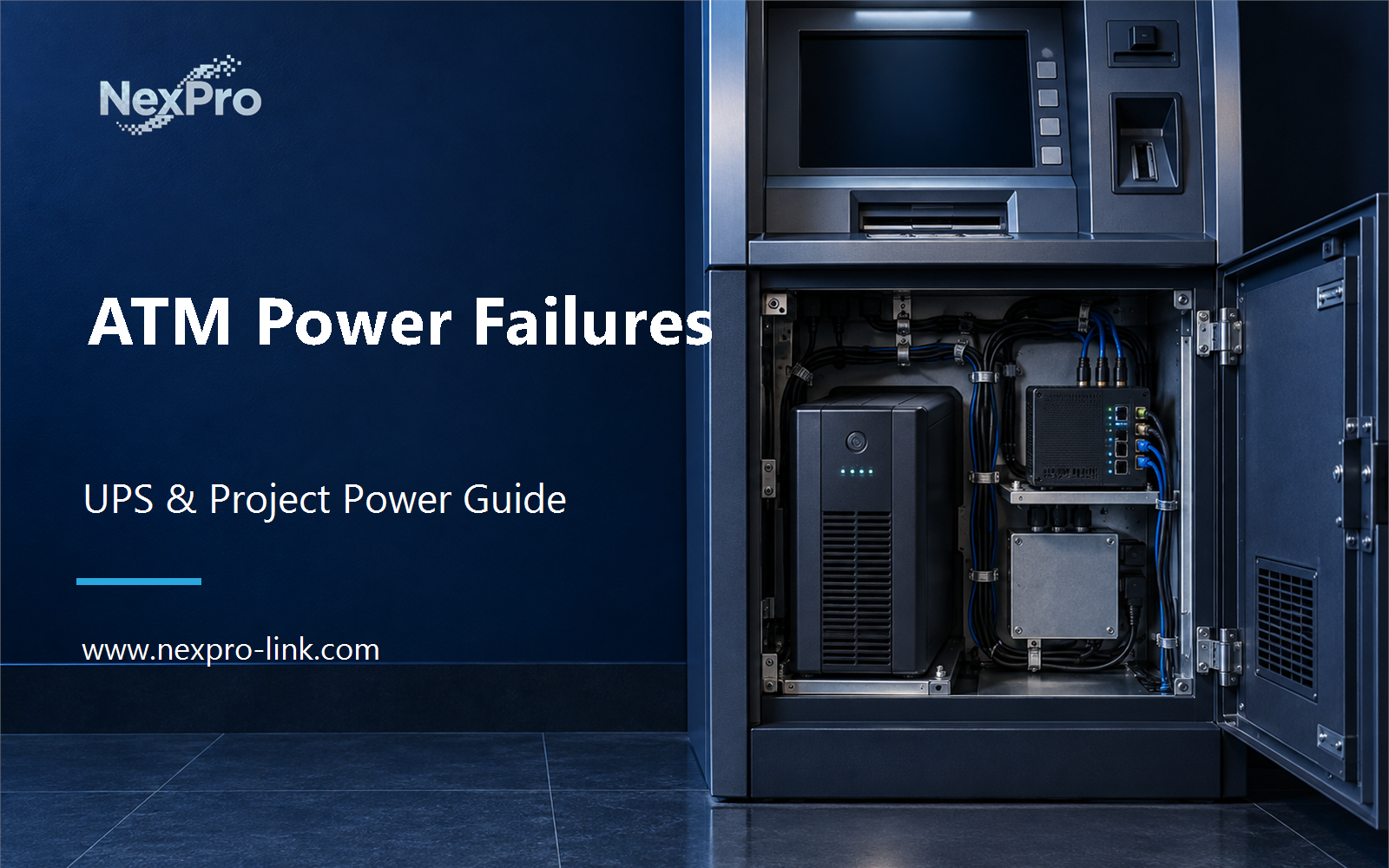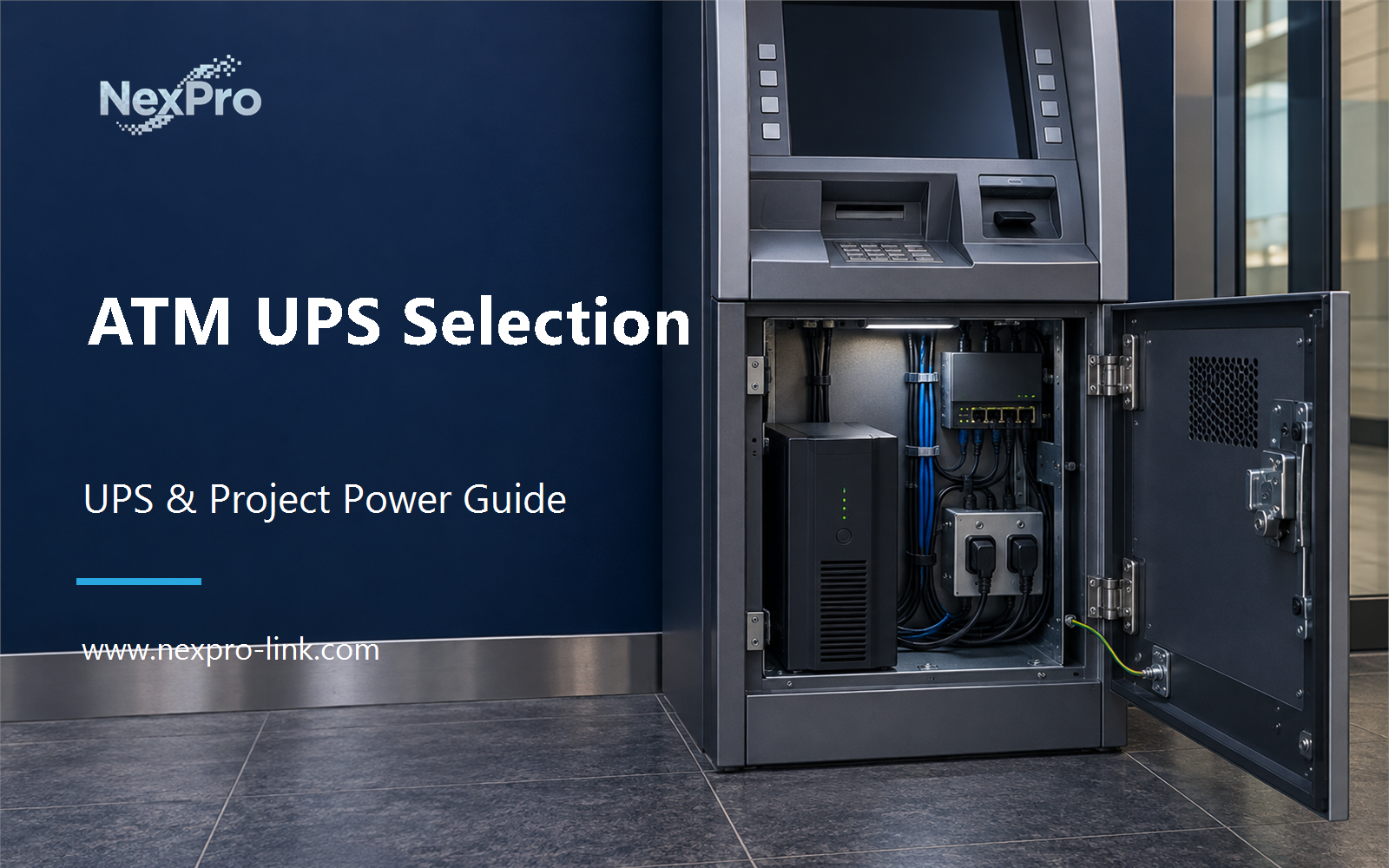
Which ATM load should you use for sizing? The useful answer is not one number pulled from a nameplate. A terminal idles, runs a transaction, drives a dispenser or cash acceptor, prints a receipt and then restarts after.
Section 01
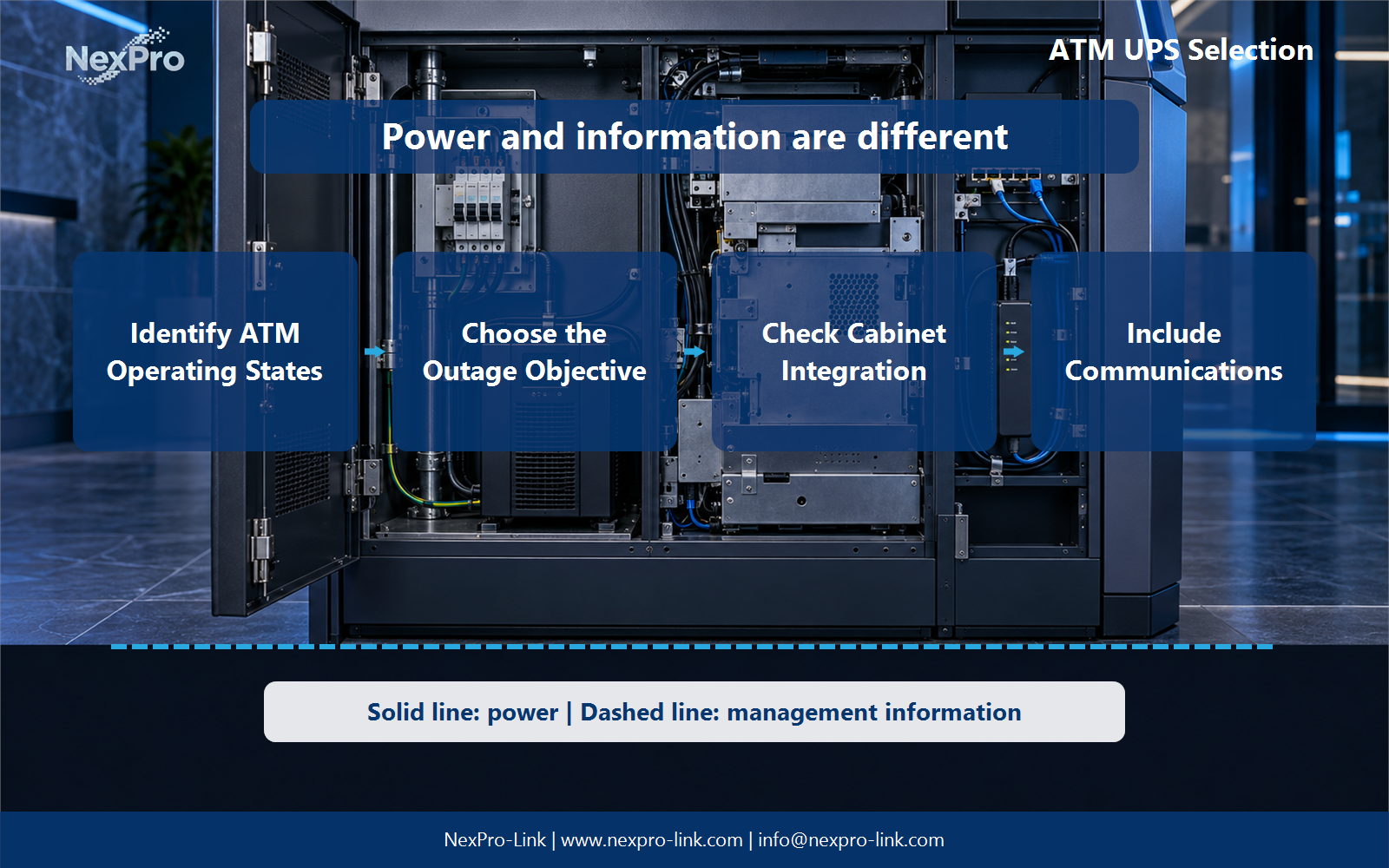
Measure the ATM operating states
Which ATM load should you use for sizing? The useful answer is not one number pulled from a nameplate. A terminal idles, runs a transaction, drives a dispenser or cash acceptor, prints a receipt and then restarts after a power return. Each state draws a different current, and the state that decides sizing may be a short peak that never shows up on an idle meter. This article turns those states into a sizing decision, works through a small example and lists what to send NexPro-Link for a defined equipment discussion.
An ATM does not draw one constant load. Record idle, customer transaction, receipt printing, cash handling, service and restart states. Include the local router or communications device only once when it belongs to the protected group.
Use measured watts and VA where the project allows. A cabinet nameplate can support a first screen, but it does not describe every operating state or the demand of added communications hardware.
| Input | What to record | Why it matters |
|---|---|---|
| Operating load | Watts, VA and peak state | Output capacity |
| Outage objective | Close, ride through or continue | Runtime target |
| Cabinet | Space, lock, airflow and access | Integration and service |
| Communications | Router, modem and alarm path | Transaction and monitoring continuity |
Section 02
Choose the outage objective
Decide whether the ATM should finish an active transaction, reach a known closed state or continue for a defined interval. The target should include detection, application response, communications delay and a reserve.
Long runtime is not automatically safer. The operating procedure must define how transactions are handled, who receives the alarm and what happens when the battery threshold is reached.
- Name the event that starts the timer.
- Keep required communications powered through the closing action.
- Define restart checks after stable supply returns.
Section 03
Check cabinet integration and communications
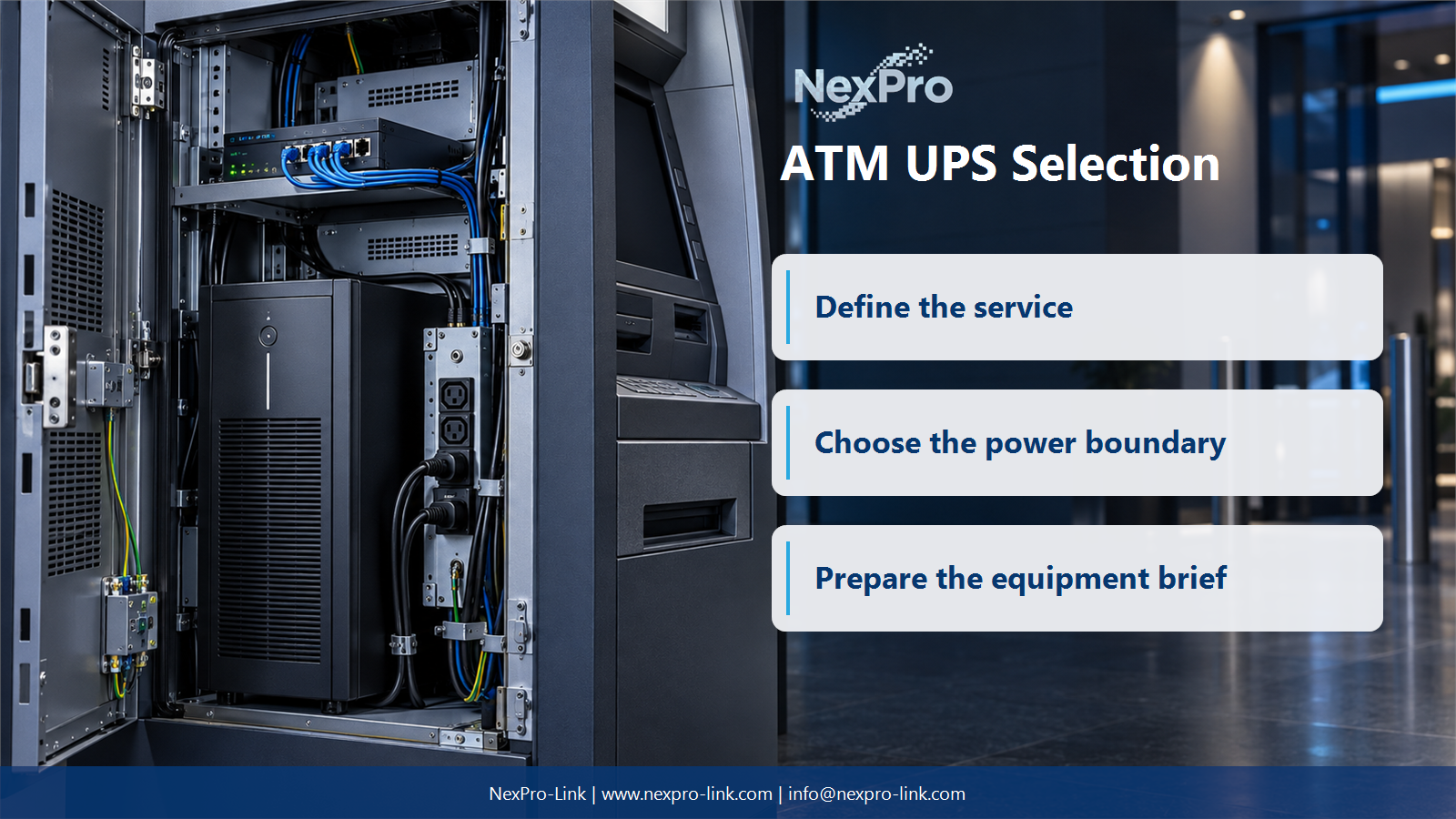
Confirm the UPS dimensions, orientation, ventilation, battery access, cable routing and physical security. The service arrangement should prevent accidental disconnection while allowing authorized battery and UPS work.
Map the router, modem and monitoring interface separately from the ATM power path. Remote alarms are useful only while the local network and the receiving system remain available.
Section 04
Make alarms actionable and issue a supply schedule
Define which events are sent, who owns them and what response is expected. Avoid a long list of unowned notifications that operators learn to ignore.
The supply schedule should state UPS format, output, battery configuration, monitoring, secure mounting, cables, labels, commissioning and service responsibilities. Keep customer transaction data outside the monitoring scope.
Section 05
Buyer questions for ATM UPS Selection: Load, Runtime, Cabinet Security and Monitoring
For Bank self-service equipment integrators, these six checks separate ATM UPS load measurement decisions from assumptions that belong to the wider project.
| Buyer question | Practical answer | Project output |
|---|---|---|
| Which ATM load should be used for sizing? | Record idle, active transaction, cash-handling, printing and startup states where relevant. Use the equipment maker's input requirements and a representative measurement basis. A single idle reading may miss the state that determines output compatibility or overload behavior. | State table: idle / transaction / mechanism / print / startup |
| Is fifteen to thirty minutes mandatory for every ATM? | No universal requirement is established by the source. Treat that interval as a candidate project objective and decide whether the terminal should finish work, close service or continue operating. Battery sizing then follows the actual load and approved policy. | Objective matrix: complete / suspend / continue / required interval |
| How can UPS placement affect ATM servicing? | Battery access, ventilation, cable routing and enclosure security must work together. Define which access zone contains the UPS and who may service it. A power device can support an enclosure plan, but it does not by itself certify resistance to tampering or forced entry. | Cabinet table: access / airflow / cables / service responsibility |
| Does the ATM's network connection need backup too? | Include the local router and communication equipment when the desired transaction or shutdown process requires them. Distinguish local connectivity from the availability of the bank's external service. This gives a complete local load scope without promising end-to-end transaction continuity. | Dependency map: ATM / router / local link / bank service |
| Which UPS alarms are useful for ATM operations? | Prioritize events that lead to action, such as battery operation, low reserve, overload or unavailable communication. Assign recipients and response rules through the bank's operations process. Avoid exposing disruptive controls to every monitoring user or assuming a card automatically integrates with an existing platform. | Alarm map: event / recipient / action / escalation |
| What should an ATM integrator send to NexPro-Link? | Provide load states, cabinet constraints, duration objective and interface needs. NexPro-Link can discuss equipment configurations and project documentation against those inputs. Keep security enclosure work, transaction software and final bank approval outside a generic UPS capacity promise. | Supply schedule: UPS / battery / interface / mounting / exclusions |
Section 06
Calculate an illustrative ATM requirement
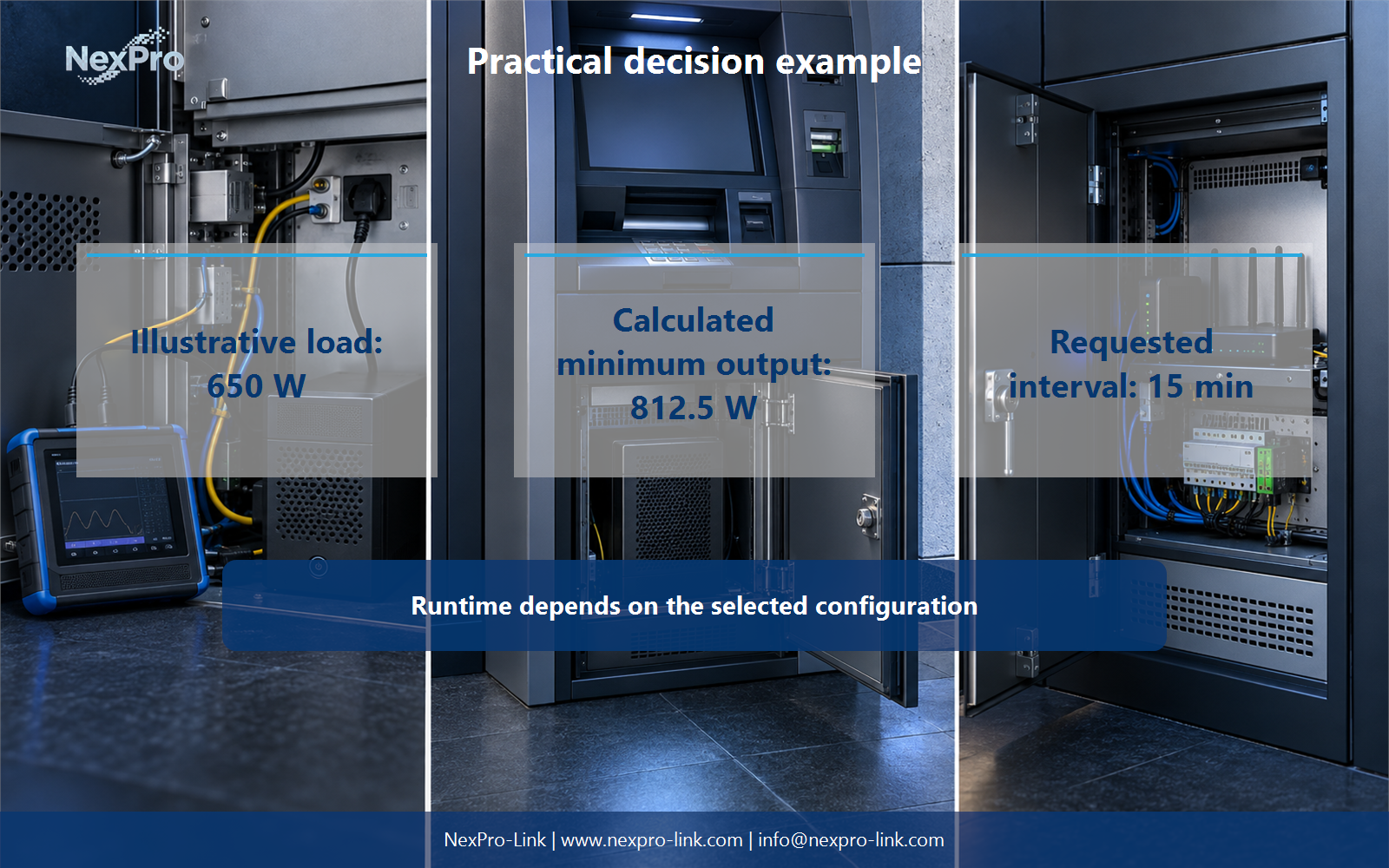
Assume 600 W for the ATM and 50 W for local communications, giving 650 W. At 0.90 power factor, the group is 722.22 VA. At an 80 percent operating ceiling, the planning minimum is 812.5 W and 902.78 VA.
A 15-minute idealized energy requirement is 162.5 Wh before losses, battery limits, aging and reserve. Verify actual runtime and cabinet compatibility using the selected configuration.
Engineering references
These sources support the general planning principles. Always use the selected product's current datasheet and applicable project standards for final design.