Plan NVR recording throughput with practical guidance on map the write path and evaluate external storage protocols. NexPro-Link project guide.
Section 01
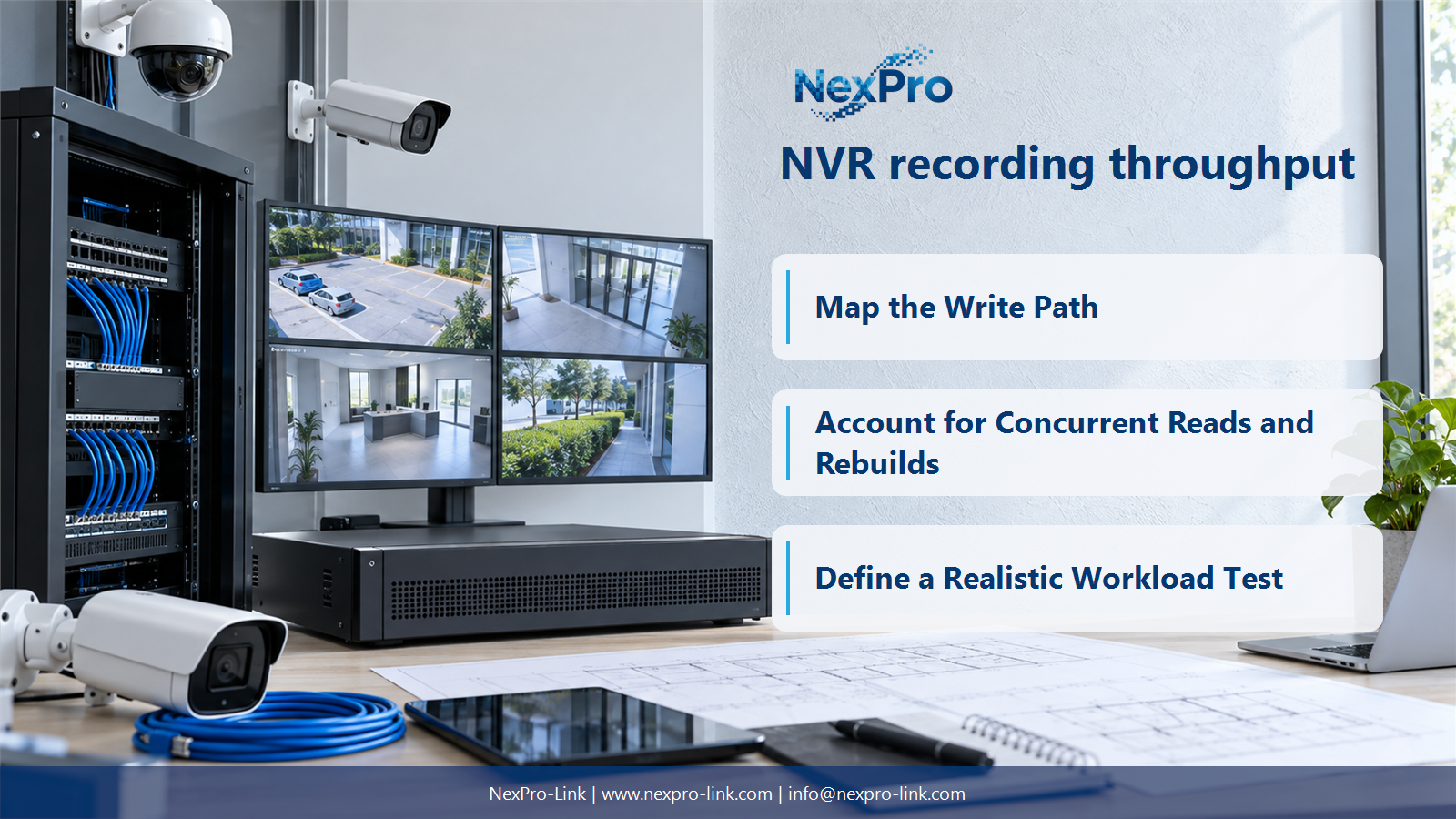
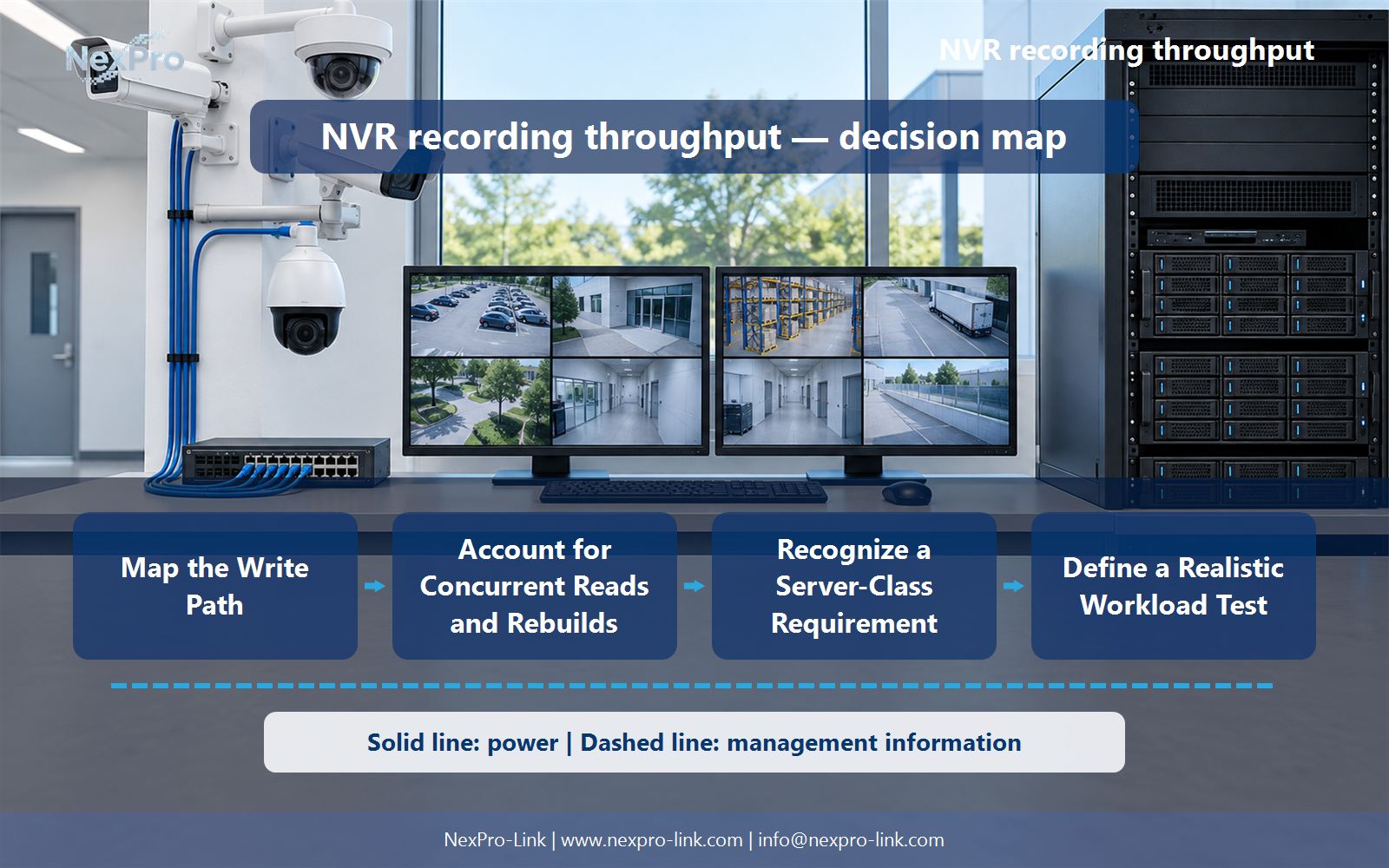
Map the Write Path
It can occur at the network interface, recording service, storage controller, disk array or an external storage link. Map each stage before changing hardware. Increasing disk capacity does not automatically increase sustained write performance, and a faster uplink cannot remove a recorder software limit.
Turn the answer into a working record using Stage, Unit, Limit, Concurrent workload, Symptom.
| Decision area | Buyer question | Required output |
|---|---|---|
| Map the Write Path | Where can a recorder throughput bottleneck occur? | It can occur at the network interface, recording service, storage controller, disk array or an external storage link. |
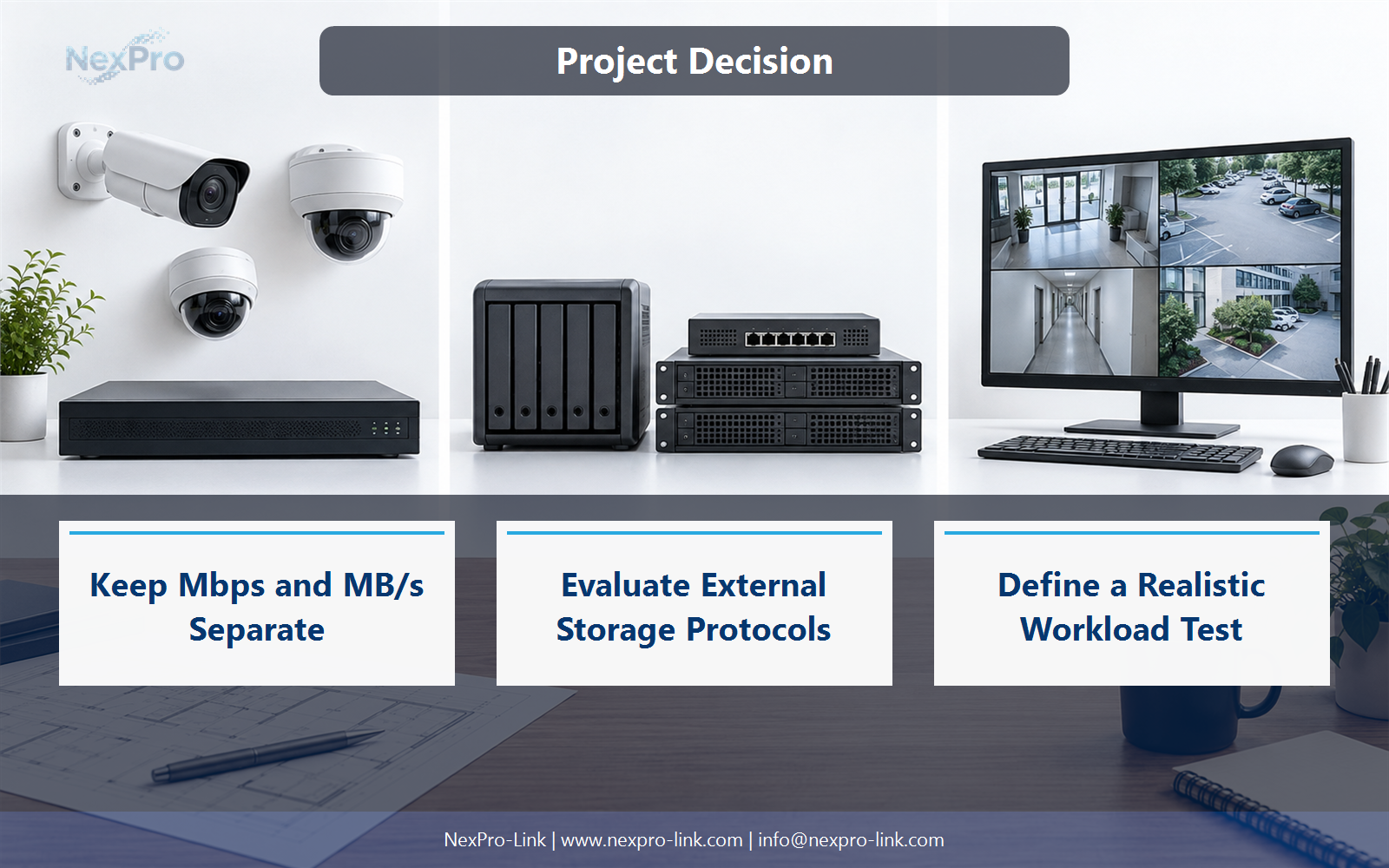
| Keep Mbps and MB/s Separate | How is camera bitrate converted to a storage data rate? | Divide the total megabits per second by eight to express megabytes per second in the same decimal convention. |
| Account for Concurrent Reads and Rebuilds | Why can playback affect recording performance? | Recording writes may compete with playback, export or rebuild activity for storage resources. |
Section 02
Keep Mbps and MB/s Separate
Divide the total megabits per second by eight to express megabytes per second in the same decimal convention. That conversion describes compressed payload, not guaranteed disk performance. Protocol overhead, metadata, buffering and concurrent operations still need consideration in the platform design.
Use Camera Mbps, Aggregate Mbps, Payload MB, s, Additional activity to compare options on the same basis. Keep product capability, project assumption and operating responsibility in separate columns.
Section 03
Account for Concurrent Reads and Rebuilds
Recording writes may compete with playback, export or rebuild activity for storage resources. The effect depends on the platform and disk arrangement. Describe the simultaneous workload and its acceptance conditions instead of checking only a recorder's headline incoming bandwidth.
The project output should make Operation, Read or write, Concurrency, Recording priority traceable from input to acceptance.
- Confirm the answer to: Why can playback affect recording performance?
- Record the project fields: Operation / Read or write / Concurrency / Recording priority.
- Keep product capability, project assumptions and site responsibility in separate records.
Section 04
Evaluate External Storage Protocols
No. The recorder or VMS must support the intended external storage protocol and configuration. Check access ownership, connection recovery and recording behavior during interruption. An Ethernet port alone does not establish support for iSCSI, NFS or shared recording volumes.
Record Protocol, Supported endpoint, Ownership, Failure behavior before selecting a product family. That makes later substitutions possible without silently changing the operational requirement.
Section 05
Recognize a Server-Class Requirement
Consider it when the required sustained workload, retention, resilience or management exceeds the supported recorder configuration. Specify the actual traffic and operational requirements first. A server label or more drive bays does not by itself prove suitability for the recording application.
Review Requirement, Recorder limit, Server option, Remaining dependency with the party that will operate or maintain the system.
Section 06
Define a Realistic Workload Test
Run the agreed number of streams at representative settings while exercising required playback and export functions. Observe recording continuity, resource use and recovery behavior over a meaningful period. Report the test conditions; a short synthetic disk benchmark is not equivalent to complete CCTV operation.
Use Streams, Test duration, Concurrent tasks, Continuity, Result as the handoff between design and procurement.
Engineering references
These sources support the general planning principles. Always use the selected product's current datasheet and applicable project standards for final design.