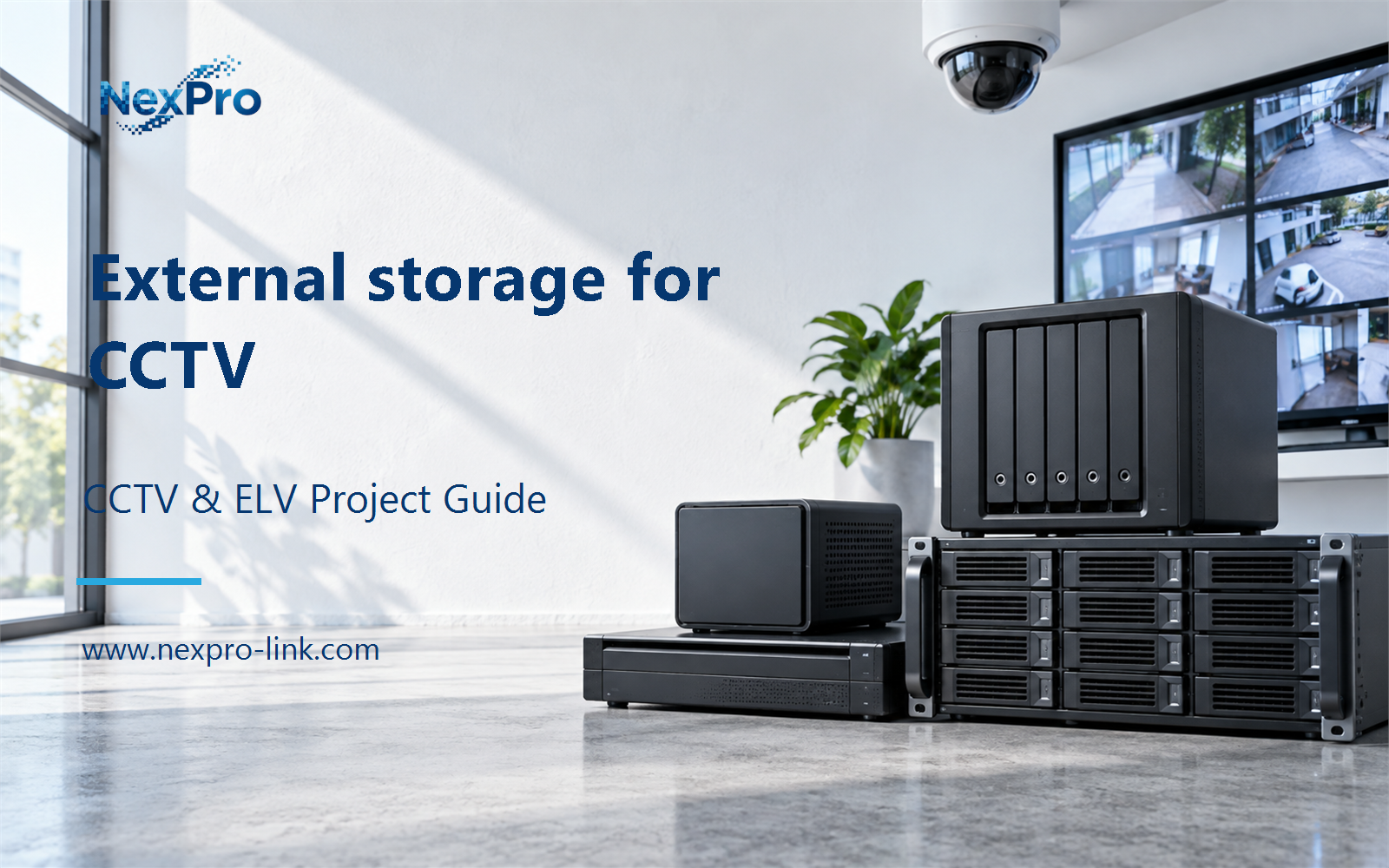
Plan external storage for CCTV with practical guidance on identify the limit to be solved and block storage and volume ownership. NexPro-Link project guide.
Section 01
Identify the Limit to Be Solved
It is useful when local supported storage cannot meet capacity, management or resilience requirements and the recording platform supports an appropriate expansion method. Establish the actual limit first. External capacity will not resolve an unrelated recorder input, decoding or software bottleneck.
Turn the answer into a working record using Current limit, Required change, Supported expansion.
| Decision area | Buyer question | Required output |
|---|---|---|
| Identify the Limit to Be Solved | When is external CCTV storage useful? | It is useful when local supported storage cannot meet capacity, management or resilience requirements and the recording platform supports an appropriate expansion method. |
| Direct-Attached Expansion | What should be checked for eSATA storage? | Check the recorder's documented external-storage support, enclosure arrangement and allowed use. |
| File-Based Network Storage | How does NAS change the recording design? | It adds a network path and file-service dependency between recording and storage. |
Section 02
Direct-Attached Expansion
Check the recorder's documented external-storage support, enclosure arrangement and allowed use. A visible connector does not specify every compatible enclosure or recording mode. Include cable, power and recovery behavior so expansion is treated as part of the recording path.
Use Port, Enclosure, Supported role, Power, Recovery to compare options on the same basis. Keep product capability, project assumption and operating responsibility in separate columns.
Section 03
File-Based Network Storage
It adds a network path and file-service dependency between recording and storage. Confirm the supported protocol, authentication, write ownership and behavior when the share is unavailable. Size the network for concurrent recording and other agreed operations rather than assuming any office file server will suffice.
The project output should make Recording service, Protocol, Share, Credentials owner, Load traceable from input to acceptance.
- Confirm the answer to: How does NAS change the recording design?
- Record the project fields: Recording service / Protocol / Share / Credentials owner / Load.
- Keep product capability, project assumptions and site responsibility in separate records.
Section 04
Block Storage and Volume Ownership
Not safely merely because they can connect to it. Shared block access requires a supported architecture that manages ownership and filesystem consistency. Use the recording platform's approved arrangement, such as separate assigned volumes or a supported clustered design, rather than uncontrolled simultaneous writers.
Record Initiator, Assigned volume, Ownership, Coordination before selecting a product family. That makes later substitutions possible without silently changing the operational requirement.
Section 05
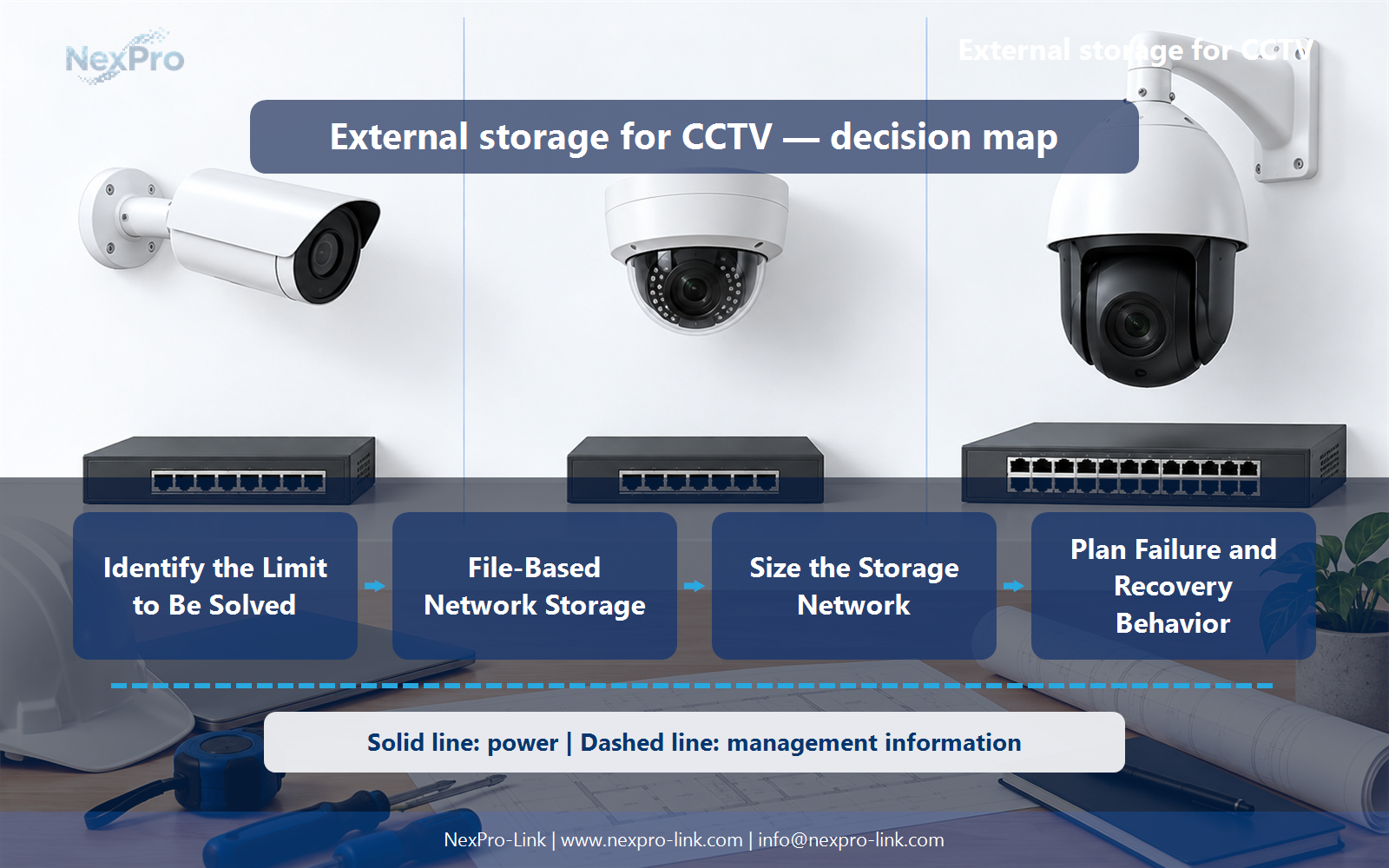
Size the Storage Network
No. Calculate recording, playback, export and recovery traffic on each relevant link. Gigabit may fit some workloads, while larger or concentrated workloads can justify faster links. The storage service and disks must also sustain the workload; link speed alone is not a solution.
Review Link, Write traffic, Read traffic, Recovery, Capacity with the party that will operate or maintain the system.
Section 06
Plan Failure and Recovery Behavior
The answer depends on the recording platform and its buffering, local fallback and recovery features. Define the required behavior and test it with the intended configuration. Do not assume that missing footage is automatically reconstructed when a share or storage network returns.
Use Failure, Recording behavior, Local fallback, Restoration as the handoff between design and procurement.
Engineering references
These sources support the general planning principles. Always use the selected product's current datasheet and applicable project standards for final design.