Plan NVR channel selection with practical guidance on start with sites and recording zones and large recorder and failure concentration. NexPro-Link project guide.
Section 01
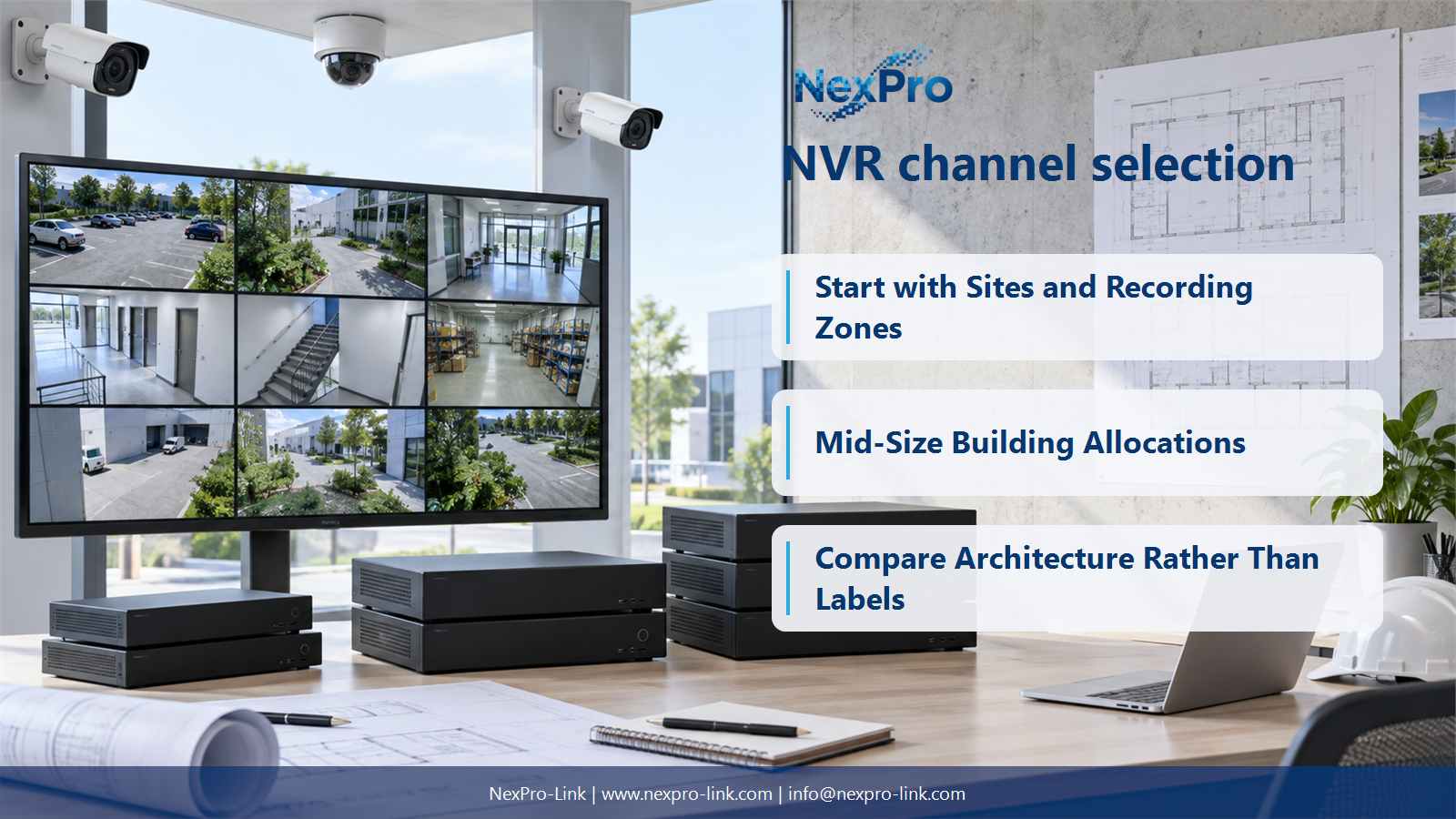
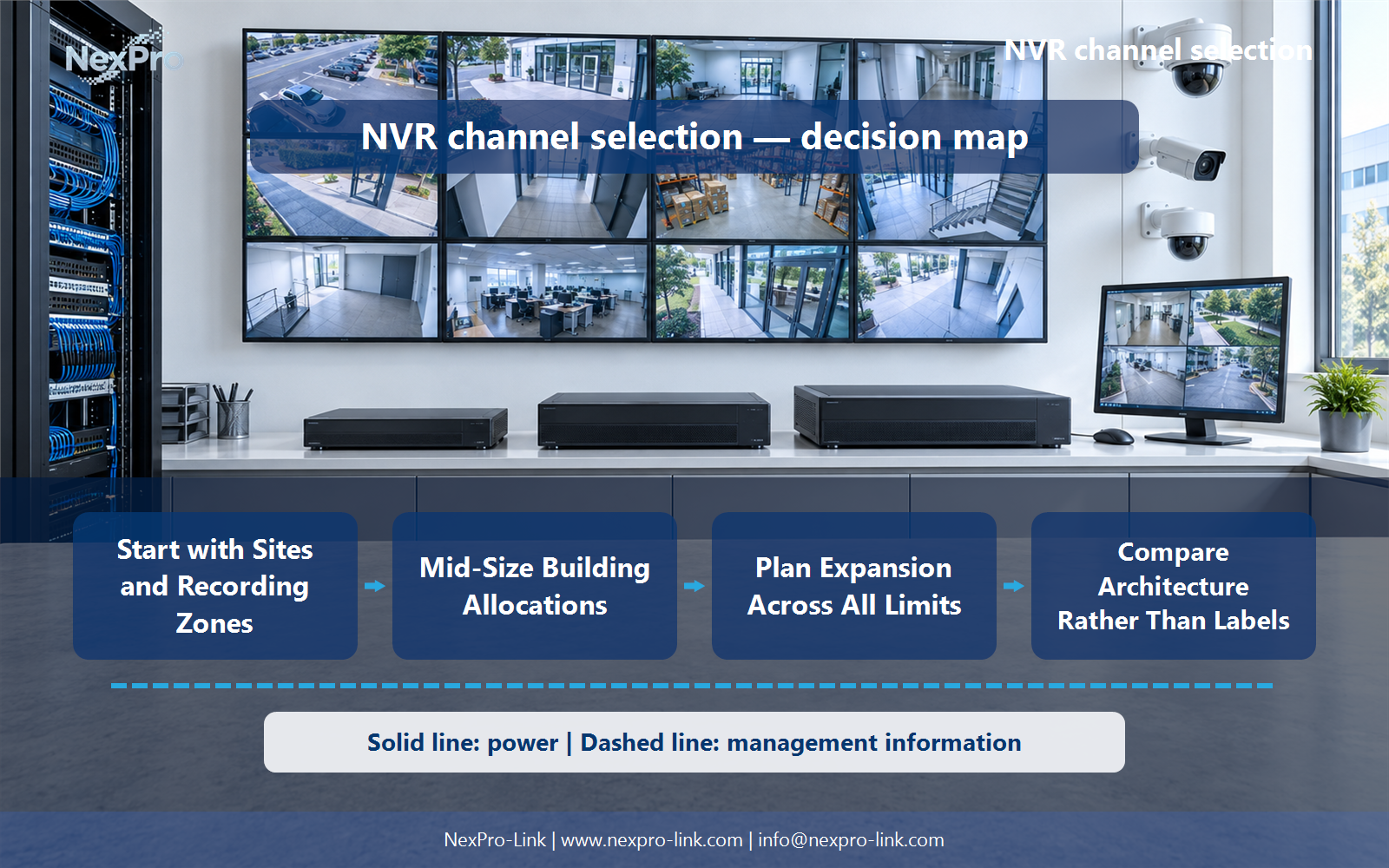
Start with Sites and Recording Zones
Not automatically. Cameras at separate sites may need independent local recording even when the company manages them centrally. Identify each recording zone, network dependency and outage requirement before combining all channels into one recorder size.
Turn the answer into a working record using Site, Cameras, Local recording need, Network dependency.
| Decision area | Buyer question | Required output |
|---|---|---|
| Start with Sites and Recording Zones | Should recorder size follow the total company camera count? | Not automatically. |
| Small Recorder or Larger Entry Tier | When is a small-channel recorder appropriate? | A small recorder suits a genuinely limited site when its bandwidth, disk capacity and viewing features meet the brief. |
| Mid-Size Building Allocations | How should a 24-camera building be allocated? | Compare a suitable single recorder with divided recording zones based on floor layout, maintenance and failure impact. |
Section 02
Small Recorder or Larger Entry Tier
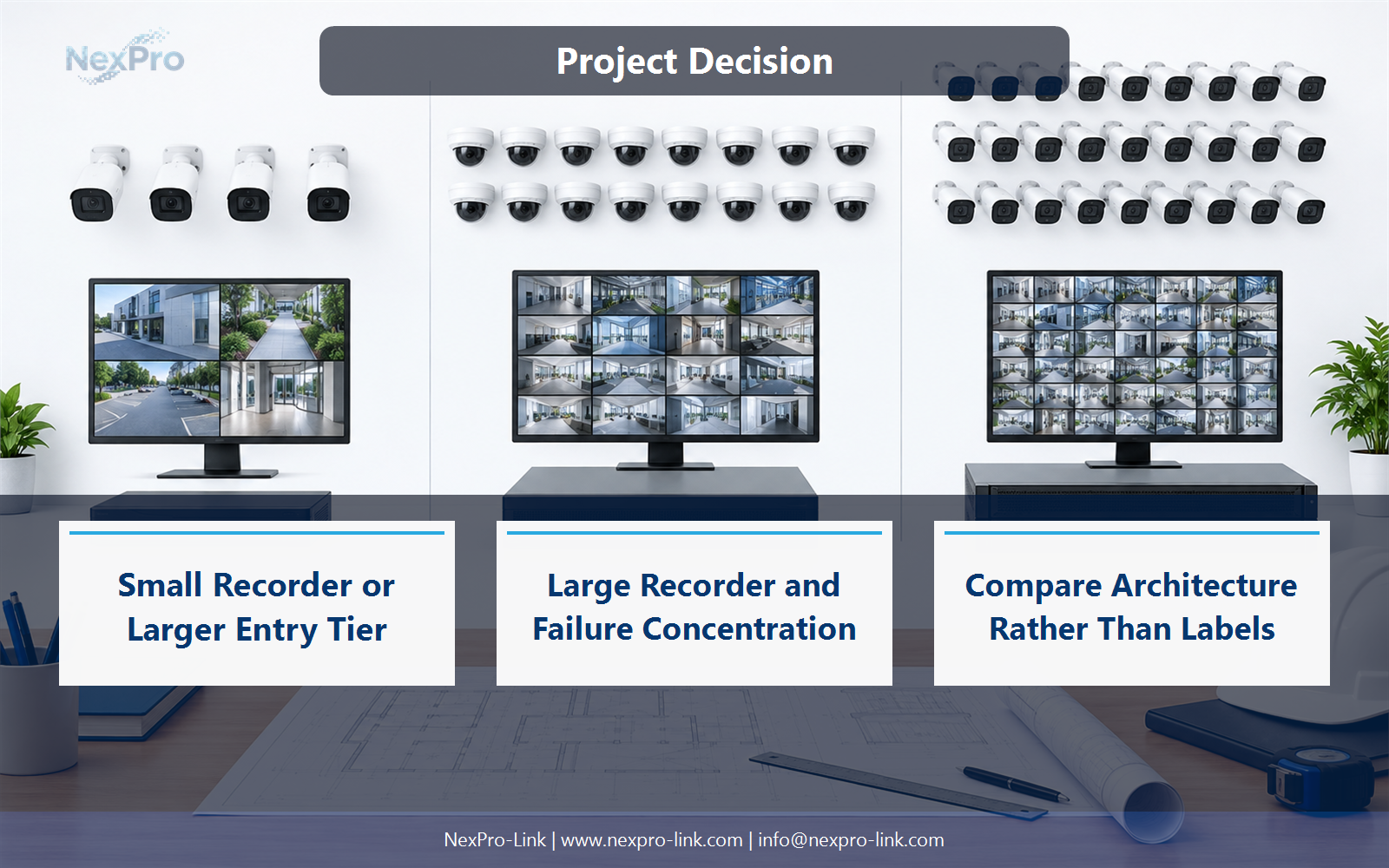
A small recorder suits a genuinely limited site when its bandwidth, disk capacity and viewing features meet the brief. Leave realistic expansion space, but do not assume that every small project needs the smallest marketed channel tier or that every supplier offers identical tier sizes.
Use Current views, Planned additions, Ports, Disk requirement to compare options on the same basis. Keep product capability, project assumption and operating responsibility in separate columns.
Section 03
Mid-Size Building Allocations
Compare a suitable single recorder with divided recording zones based on floor layout, maintenance and failure impact. The comparison must include disks, switch connections and operator access. Two smaller recorders are not automatically cheaper or more resilient once shared dependencies are included.
The project output should make Zone, Recorder allocation, Shared dependency, Operator access traceable from input to acceptance.
- Confirm the answer to: How should a 24-camera building be allocated?
- Record the project fields: Zone / Recorder allocation / Shared dependency / Operator access.
- Keep product capability, project assumptions and site responsibility in separate records.
Section 04
Large Recorder and Failure Concentration
More streams and retention capacity are concentrated in one platform, increasing the importance of throughput, drive configuration and service recovery. Check the actual workload and supported options. The channel number does not establish RAID, failover, decoding performance or a particular retention duration.
Record Channels, Peak input, Usable storage, Recovery arrangement before selecting a product family. That makes later substitutions possible without silently changing the operational requirement.
Section 05
Plan Expansion Across All Limits
Base it on credible additions and the cost of the next expansion step, not a universal percentage. Reserve matching switch ports, recording throughput, disk capacity and rack power. Spare recorder channels are useful only when the rest of the system can support the added cameras.
Review Added cameras, Ports, Mbps, TB, Power, Rack space with the party that will operate or maintain the system.
Section 06
Compare Architecture Rather Than Labels
Use the same scenario and list every necessary recorder, drive, licence and network connection. Separate current cost from the next planned expansion. Retain actual SKU spelling and read the stated channel count, since numbers embedded in a model code may not directly equal usable channels.
Use Configuration, Present scope, Expansion step, Included items as the handoff between design and procurement.
Engineering references
These sources support the general planning principles. Always use the selected product's current datasheet and applicable project standards for final design.