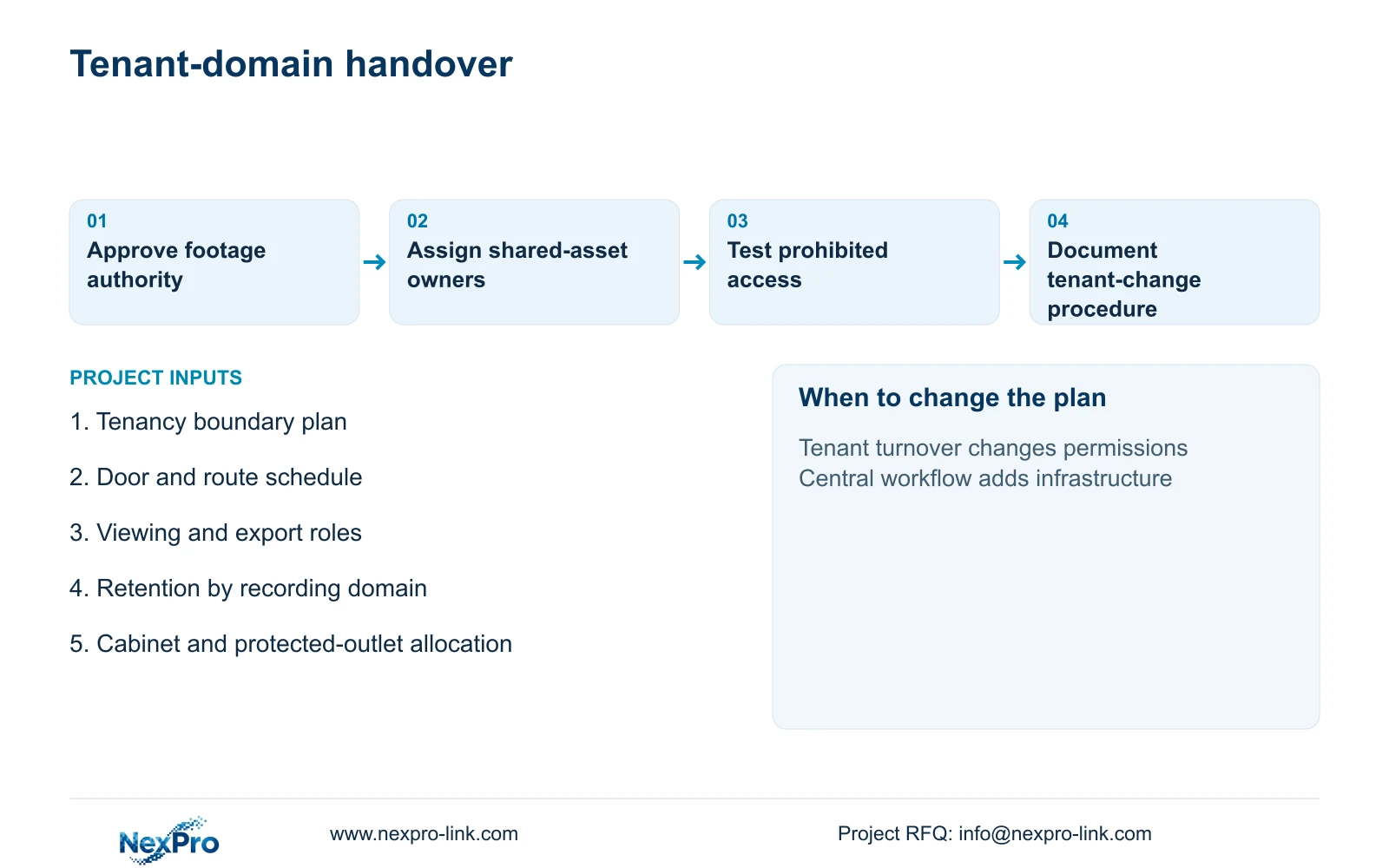
When a tenant leaves, freeze its footage-release authority before reallocating shared equipment. Record retained footage duties, account removal and the new tenant's accepted views as separate tasks.
Section 01
Allocate footage authority before sharing infrastructure
When a tenant leaves, freeze its footage-release authority before reallocating shared equipment. Record retained footage duties, account removal and the new tenant's accepted views as separate tasks. Verify the new allocation without granting access to earlier tenant recordings. Shared cabinet ownership alone cannot settle historical footage rights.
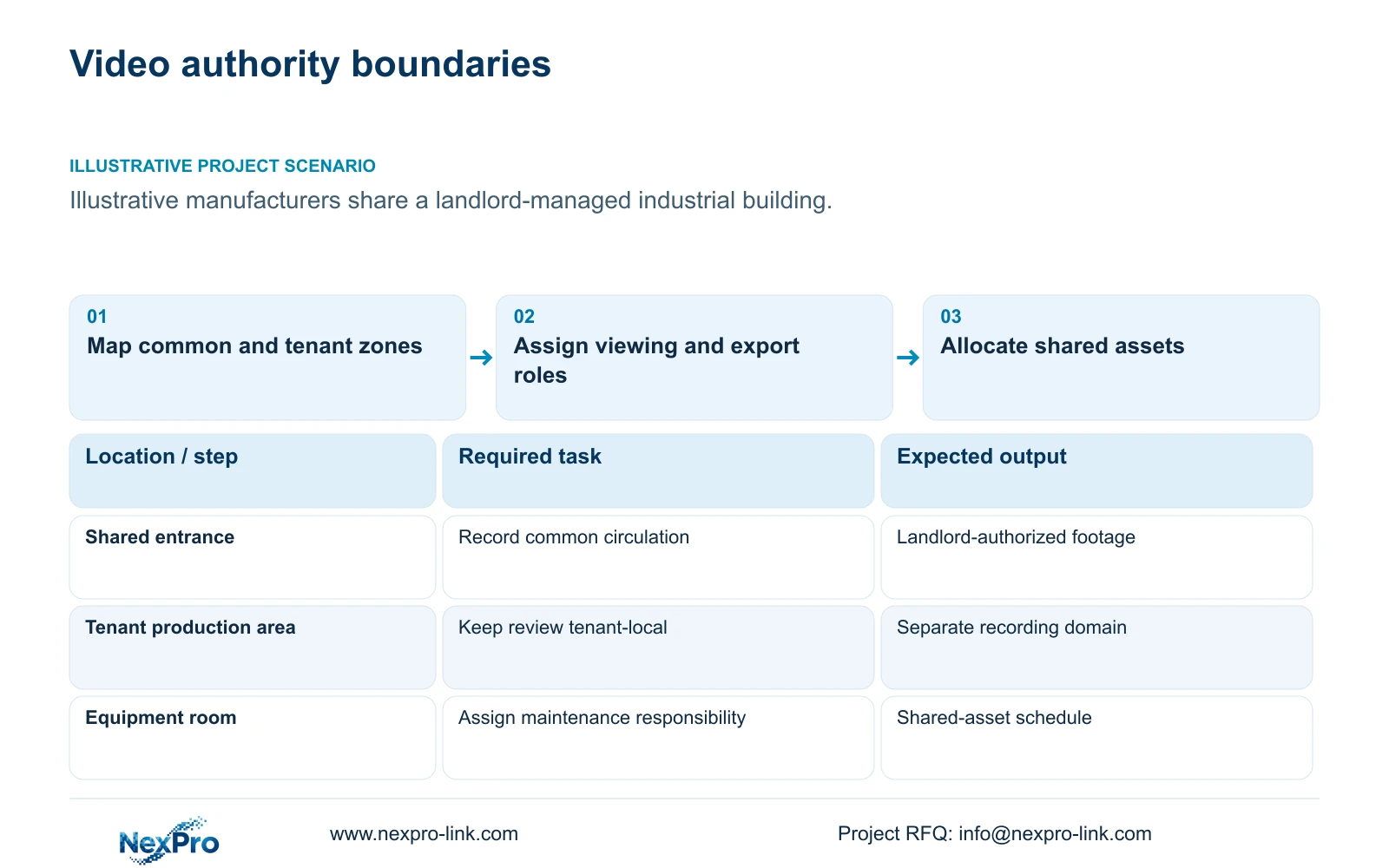
For multi-tenant industrial buildings, divide common-area and tenant production views before selecting the recording architecture. Assign footage authority, retention decisions and maintenance responsibilities separately. A shared fibre route or equipment room should give tenants only the connectivity needed for their authorized tasks, without access to another occupier's production video.
Illustrative project scenario: Several manufacturers occupy one industrial building under a common landlord. Assume the landlord manages shared entrances and circulation, while each manufacturer controls its production-area footage. These are planning assumptions. A camera near a shared loading route may capture a tenant threshold, so the engineer must agree its framing and review authority rather than classify it solely by the wall supporting its mount.
Annotate the route plan and door schedule with landlord, tenant and disputed-boundary views. For every camera, record who approves the view, who can retrieve footage and which recorder holds it. CASE08's four independent 32-camera nodes provide a reference for separated recording domains, although its original scenario spans four buildings. Adapting that structure to one building requires actual cabinet, cable and electrical information.
Section 02
Distinguish footage access from technical support access
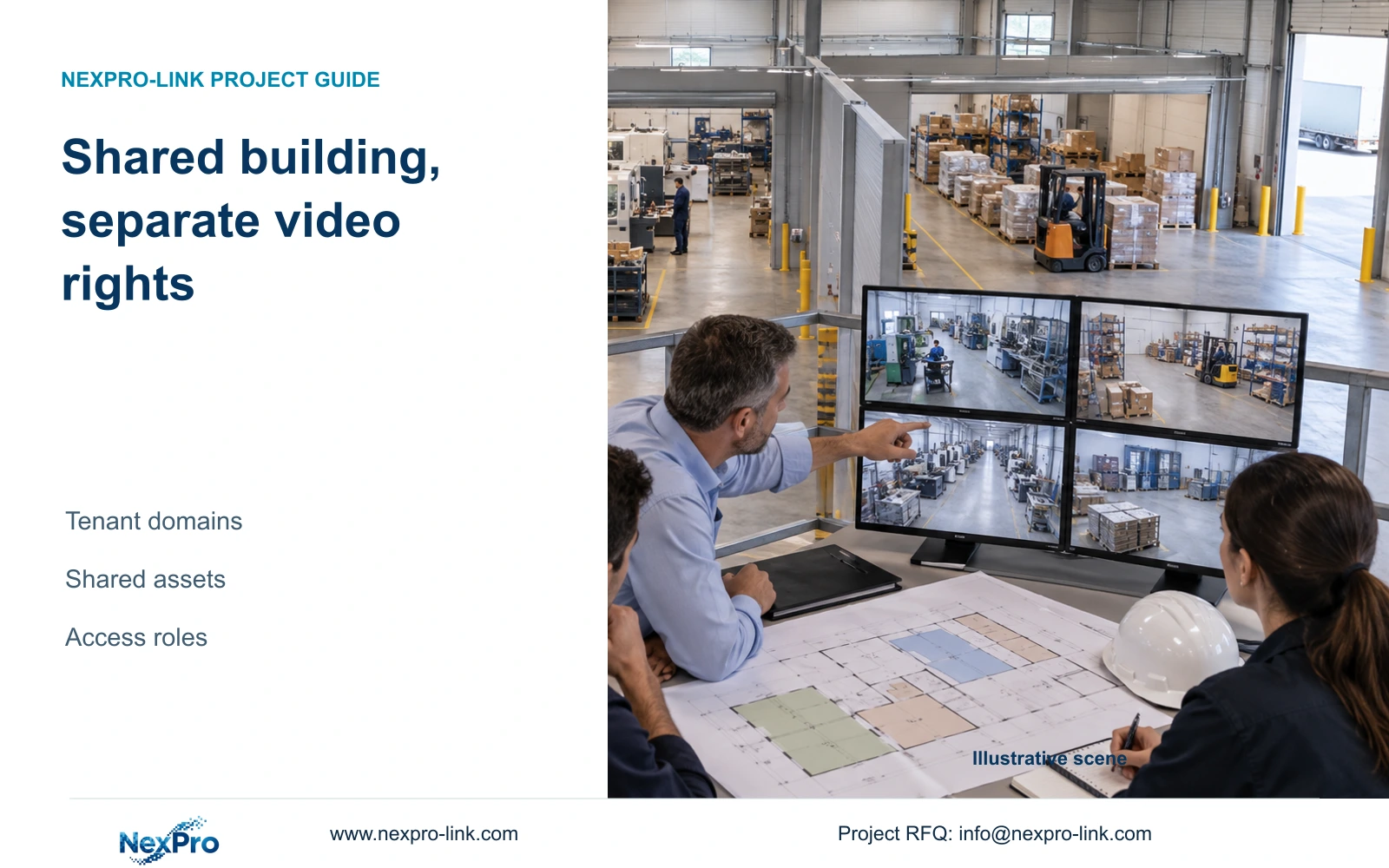
Define live viewing, playback, export and administration as separate permissions. A landlord guard may need common-entrance views without access to production interiors. A tenant reviewer may need playback and export for its own cameras without authority to change the site's shared network. A maintenance contractor needs a defined service process, including who authorizes access and who restores the approved configuration afterward.
Produce a role schedule using named project roles rather than personal credentials. Specify the relevant cameras, allowed operations and approval route for each role. Then test both permitted and prohibited workflows. A useful acceptance demonstration includes a tenant retrieving its own footage and being unable to open another tenant's channels through the proposed client.
Shared connectivity also needs an agreed network implementation and a person responsible for maintaining it. Confirm actual device, client and firmware behavior where equipment is mixed. ONVIF profile applicability must be checked for the exact device/client combination; successful basic video connection does not establish every search, audio or event function. Keep production-control networks outside the security-video scope unless an approved interface is explicitly required.
Section 03
Give every shared asset one procurement owner
Price common infrastructure through one asset schedule, then allocate its use to the recording domains. A shared backbone should appear once in the procurement total even when several tenants use it. Tenant-specific optics, access switches or configuration services still need their own lines. Separate purchasing responsibility from any commercial cost-sharing arrangement so the same item does not enter several quotations unnoticed.
Apply the supplied method: assign each row to supplied, retained, installer-provided or optional, with one accountable owner per interface. Record cabinet space, patch-panel capacity, uplink termination and protected outlets at their actual locations. A total site port count cannot establish whether a particular cabinet has enough termination capacity or whether its UPS reaches the equipment allocated to it.
CASE08 assumes 128 new copper links totalling 7,488 m, with a feasible 26-reel cutting plan using 305 m reels. Its 25-reel total-length lower bound is not an executable cutting schedule. Those quantities cannot be transferred to this building without route measurement. Retained links require appropriate testing and approval before their replacement quantity is removed; inter-node fibre remains a separate procurement scope.
| Item | Required task | Supply status | Responsible party |
|---|---|---|---|
| Common fibre backbone | Carry approved inter-node traffic | Supplied | Landlord network contractor |
| Tenant recorder and disks | Store tenant-authorized footage | Supplied | Tenant security contractor |
| Shared equipment room | Provide agreed cabinet access and space | Retained | Landlord facilities team |
| Local electrical feeds | Power each allocated equipment node | Installer-provided | Appointed electrical contractor |
| Central viewing service | Provide approved cross-domain workflow | Optional | Named platform integrator |
Section 04
Compare local operation with a defined management addition
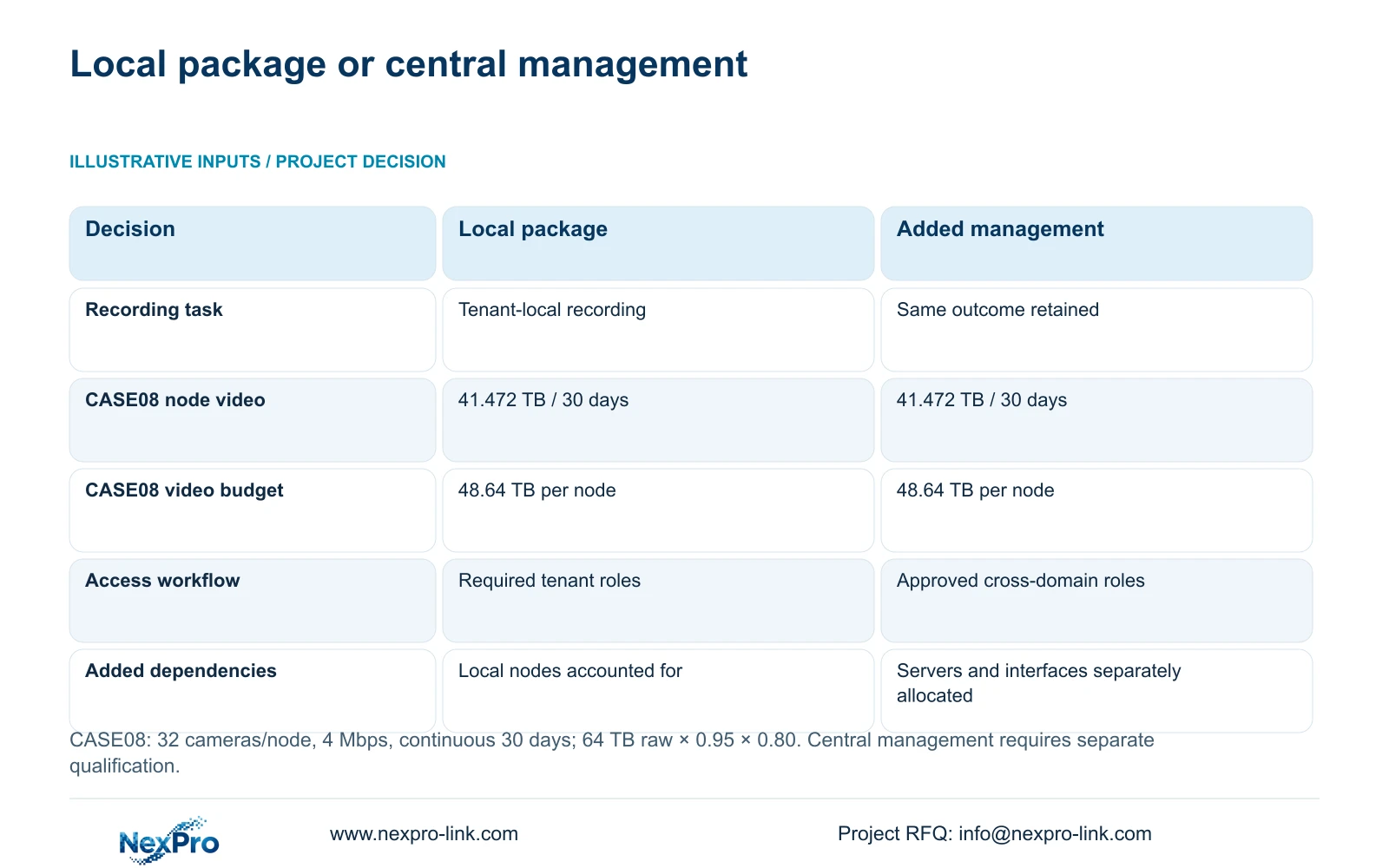
Start with a complete package that can record, retrieve and export within each authorized domain. Option A uses local recording and the necessary viewing roles. Option B retains that outcome and adds central management only for a defined task, such as landlord oversight of approved common-area views. The added platform must preserve the agreed permissions and identify its servers, interfaces, support and power dependencies.
The decisive difference is the added workflow and responsibility. Option B may introduce configuration, software or infrastructure that Option A does not need. An empty quotation field is neither a zero-cost item nor evidence that an interface is impossible. Ask the bidder to resolve it before comparing totals.
For CASE08's illustrative recording boundary, each of four nodes has 32 cameras at an average 4 Mbps, continuously recording for 30 days. Using video_TB = cameras × average_Mbps × 10^6 × 86400 × days ÷ 8 ÷ 10^12 gives 41.472 TB per node and 165.888 TB overall. Four 16 TB disks per node provide 64 TB raw; 64 × 0.95 × 0.80 gives a 48.64 TB video budget. Compare 41.472 TB directly with that budget. Another tenant's unused capacity does not resolve a shortfall in an independently allocated node.
| Decision | Option A: local package | Option B: added management |
|---|---|---|
| Recording outcome | Defined tenant-local recording | Same recording outcome retained |
| Hardware identity | Exact models and domain tags | Same plus approved interface equipment |
| Network and power | All recording nodes accounted for | Added server and interface dependencies counted |
| Software and access | Required viewing and retrieval roles | Justified central workflow with tested permissions |
| Procurement basis | Complete local BOM and responsibilities | Added scope, support and accountable integrator |
Section 05
Choose independent nodes without implying independent failures
Independent local recorders are a useful starting point when tenants need separate footage authority and maintenance windows. The NexPro-NVR4449-4K reference provides 49-channel catalogue capacity, 320 Mbps input and four SATA bays supporting up to 18 TB per drive. CASE08 assumes compatible 5MP-class streams. Its published summary distinguishes 49×5MP and 9×4K; neither the channel count nor the disk bays establish all-4K decoding or RAID.
Local recording can reduce dependence on an inter-node viewing path, but shared electrical feeds, cabinets or network services may still create common failure points. CASE08's recording-priority assumed loads are 682.7407 W at node 1 and 617.7407 W at each remaining node. SP1KR(S), rated 1kVA/900W, is a capacity reference under the case's stated power-factor and headroom assumptions. Actual backup duration requires the selected battery configuration and runtime evidence.
Change the architecture when the owner requires supported central administration, cross-domain investigation or verified recovery behavior that the local package cannot provide. Keep equivalent permissions, retention and support scope when comparing brands. If a central display is proposed, restrict its views to authorized cameras and specify decoding separately. One-stop equipment coordination does not establish a shared software platform or include local installation automatically.
Section 06
Prepare handover for tenant changes and service visits
Deliver an interface schedule linking every camera tag to its domain, recorder, network allocation and responsible administrator. Separate common assets from tenant assets in packing lists and as-built records. NexPro-Link's BOQ and tender-support scope can help align models, deviations and equipment documentation; project-labelled packing can keep separate node kits identifiable during staged installation.
Define a tenant-departure procedure before commissioning. Identify who disables access, who authorizes footage preservation or removal and who approves reuse of equipment. Obtain project-specific advice on applicable local requirements rather than treating the illustrative retention period as a legal rule. A new tenant or revised partition may change camera framing, recording allocation and support permissions even when the hardware remains.
Acceptance should cover recording, authorized export, denied cross-tenant access and the agreed service-access process. Preserve a controlled configuration record so replacement equipment can be checked against the approved arrangement. Common-area security should have an identified handover owner throughout tenant changes; otherwise an apparently complete equipment package may leave nobody responsible for its daily operation.
Section 07
Buyer questions
Must every tenant purchase its own physical recorder? Not necessarily. A shared platform is an option if its supported configuration can enforce the required permissions, capacity allocations and administrative boundaries. Include evidence of those workflows and an accountable platform operator before replacing independent recording domains.
Can the landlord maintain equipment without routine production-video access? Make that an explicit requirement and verify whether the selected equipment supports it. Where service needs broader access, define temporary authorization and restoration procedures instead of assuming a technician's account has no footage privileges.
Who pays when central management is added later? The commercial agreement determines payment. The technical variation should separately identify added software, servers, interfaces, configuration, protected power and support so the parties can allocate the complete change without duplicating existing assets.
Section 08
Define the shared and tenant package boundaries
Send the tenancy and door-boundary plan, footage-access role schedule, required retention periods and shared equipment-room allocation to info@nexpro-link.com. NexPro-Link can discuss a domain-labelled equipment list and interface schedule for your industrial building.
Engineering references
These sources support the general planning principles. Always use the selected product's current datasheet and applicable project standards for final design.