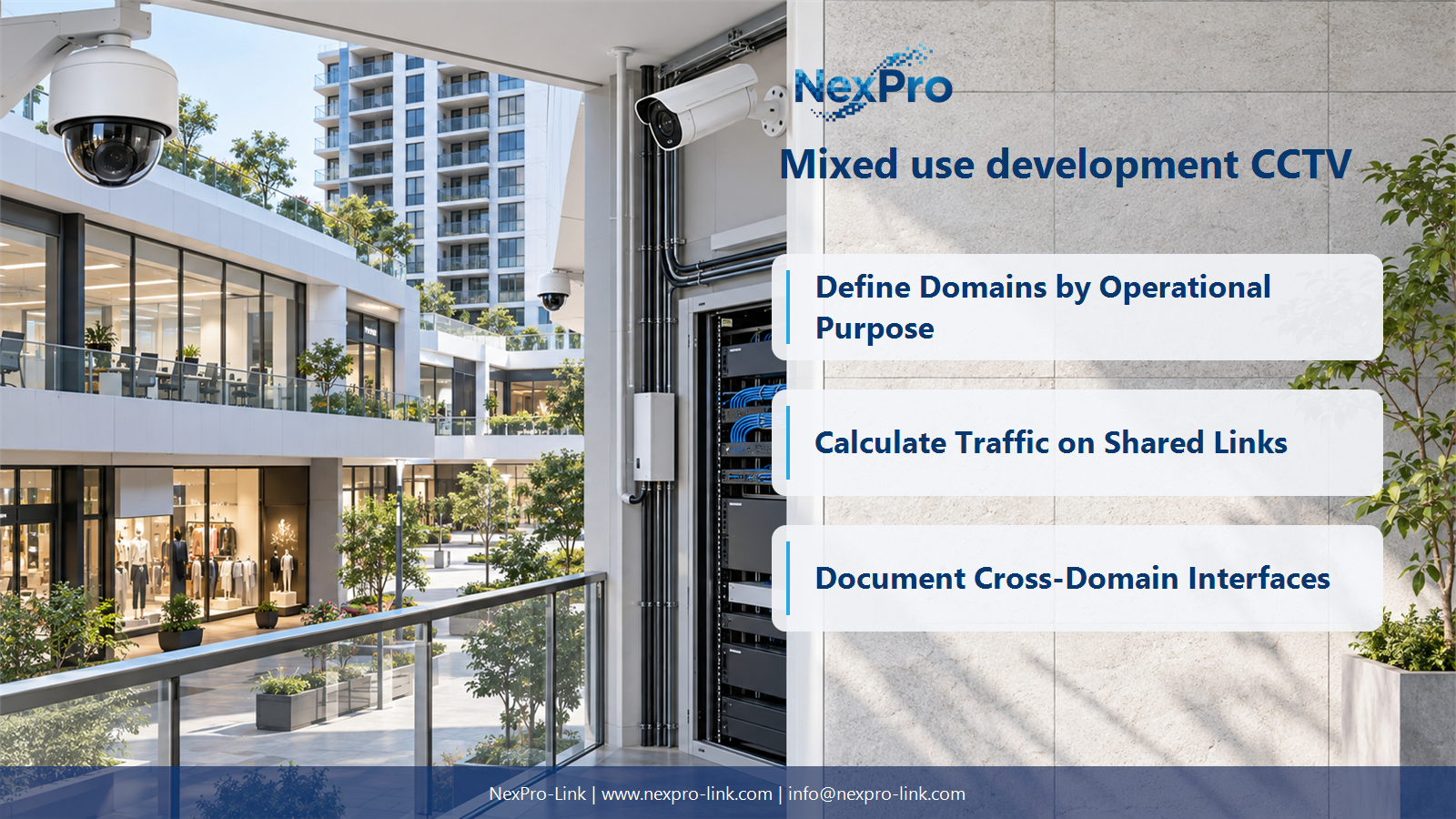
Plan mixed use development CCTV with practical guidance on define domains by operational purpose and keep storage ownership explicit. NexPro-Link project guide.
Section 01
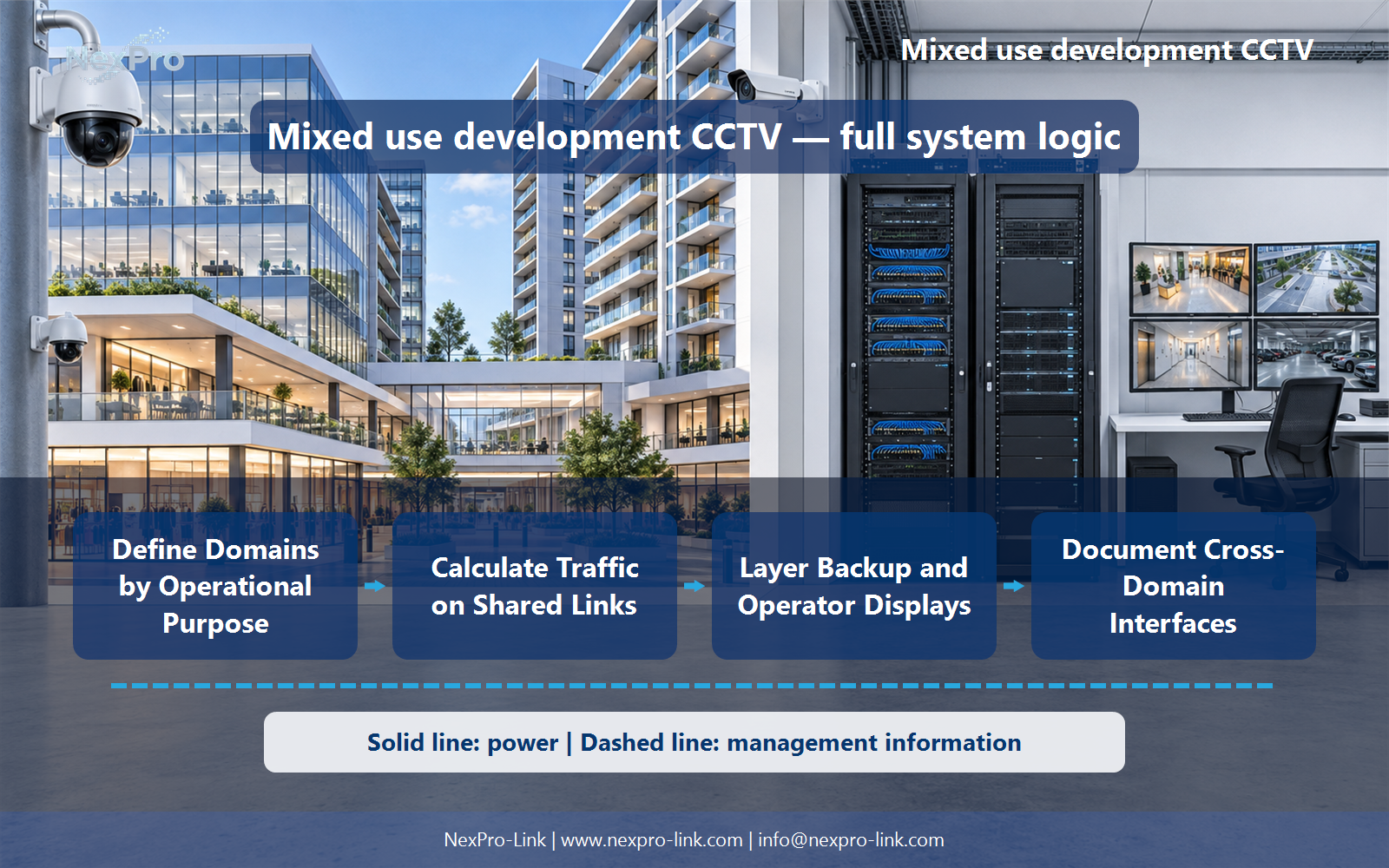
Define Domains by Operational Purpose
Separate retail, office, residential and shared services by their purposes, permissions and operational owners. A common development boundary does not make their video handling identical. Use those domains to guide recording, network and support arrangements.
Turn the answer into a working record using Domain, Purpose, Operator, Retention owner, Shared area.
| Decision area | Buyer question | Required output |
|---|---|---|
| Define Domains by Operational Purpose | How should a mixed-use CCTV system be divided? | Separate retail, office, residential and shared services by their purposes, permissions and operational owners. |
| Choose Local Recording and Central Oversight | Can one management platform coordinate separate recorders? | Yes when the selected platform supports the required devices and functions. |
| Calculate Traffic on Shared Links | How should backbone traffic be calculated for mixed-use sites? | Map where recording, live views and playback actually travel, then aggregate only the flows crossing each link. |
Section 02
Choose Local Recording and Central Oversight
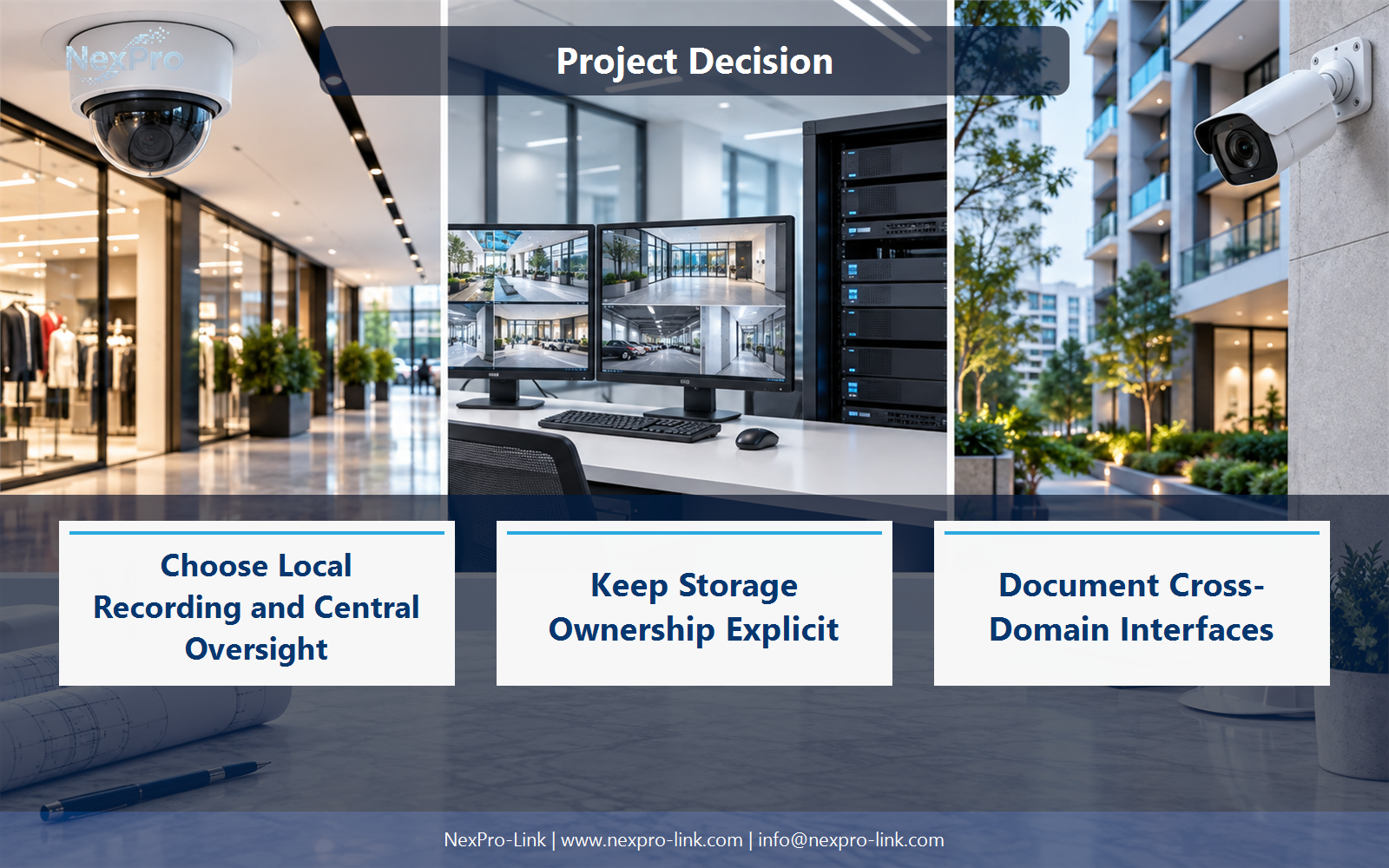
Yes when the selected platform supports the required devices and functions. Local recording can coexist with central authorized viewing. Define which actions are centralized and which remain with each domain instead of assuming all video must be stored in one shared pool.
Use Domain, Recorder, Central functions, Local functions to compare options on the same basis. Keep product capability, project assumption and operating responsibility in separate columns.
Section 03
Calculate Traffic on Shared Links
Map where recording, live views and playback actually travel, then aggregate only the flows crossing each link. Shared infrastructure may carry bursts from central investigations in addition to routine local recording. Size the relevant links and recovery paths separately.
The project output should make Link, Recording flow, Viewing flow, Peak, Recovery traceable from input to acceptance.
- Confirm the answer to: How should backbone traffic be calculated for mixed-use sites?
- Record the project fields: Link / Recording flow / Viewing flow / Peak / Recovery.
- Keep product capability, project assumptions and site responsibility in separate records.
Section 04
Keep Storage Ownership Explicit
It can centralize capacity but also concentrates administration, performance and failure dependencies. Supported volume ownership, retention and access controls must match the domains. A shared network volume is not a safe multi-recorder architecture merely because each recorder can connect to it.
Record Domain, Storage allocation, Writer, Retention, Access before selecting a product family. That makes later substitutions possible without silently changing the operational requirement.
Section 05
Layer Backup and Operator Displays
Protect the services agreed for each domain and the shared network nodes they depend on. Separate essential recording from large display loads. A failure in common infrastructure can affect several domains, so its power and recovery arrangement deserves explicit attention.
Review Shared node, Dependent domains, Backup, Display scope with the party that will operate or maintain the system.
Section 06
Document Cross-Domain Interfaces
Group equipment by domain and identify shared infrastructure as a separate scope with interfaces. Include camera, recording, PoE, storage, display, backup and cabling allocations. This allows supply and maintenance responsibilities to remain clear when different contractors deliver different parts of the development.
Use Domain, Item, Shared dependency, Quantity, Responsibility as the handoff between design and procurement.
Engineering references
These sources support the general planning principles. Always use the selected product's current datasheet and applicable project standards for final design.