Reconcile the tested identity and configuration with the actual packed unit, carton and destination tag. If a substitute enters after the bench check, reopen its affected workflows before shipment.
Section 01
Prepare the intended device combinations before shipment
Reconcile the tested identity and configuration with the actual packed unit, carton and destination tag. If a substitute enters after the bench check, reopen its affected workflows before shipment. Preserve remaining site tasks in the handover record. A sample report for one device is not evidence that an untested substitute was prepared identically.
Mixed camera and NVR bench preparation should use the intended device identities and agreed recording workflows. It can align configuration and expose some compatibility problems before export. Final focus, lighting, installed networking and environmental acceptance remain site activities, so the preparation record must identify both completed checks and remaining work.
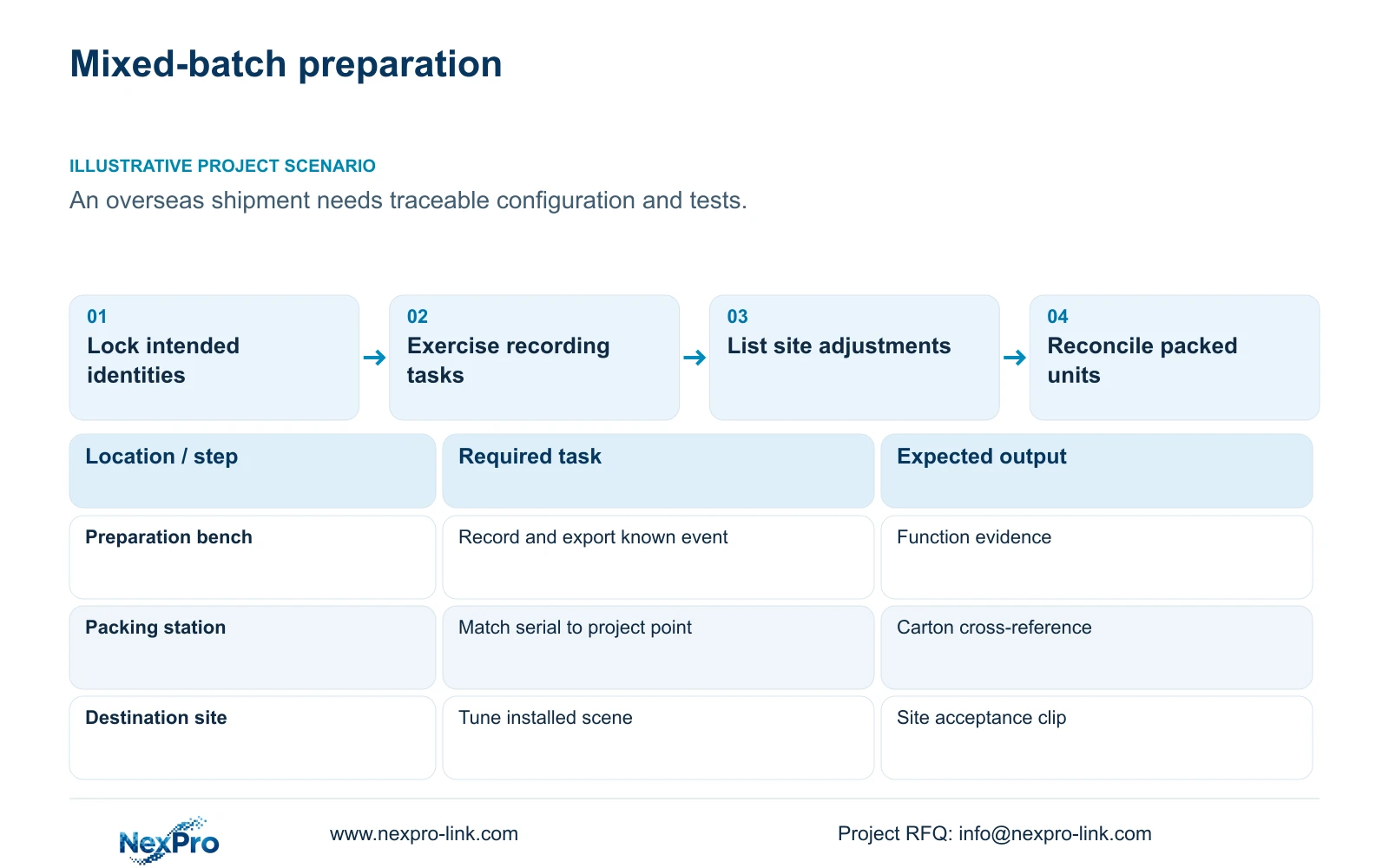
Illustrative project scenario: A contractor wants cameras and recorders prepared before an overseas shipment for the hypothetical CASE01 CNC factory. The plan contains 32 ordinary security views with suitable bullet and dome candidates, one local recorder and four access-switch groups. Assume the contractor provides a provisional point schedule and intends the local installer to complete final positioning.
Begin with exact camera and recorder models, firmware versions, disk identities, project tags and client requirements. If the actual shipment batch is available, tie records to its serial numbers. If only samples are tested, state that limitation. A successful demonstration using another recorder or firmware combination cannot silently become evidence for the delivered equipment.
Section 02
Test recording and client actions as separate functions
Define the bench sequence around the buyer's required actions: connect each intended stream type, record a known event, retrieve it and export a usable clip. Check channel names and time settings while following that sequence. Where audio or event search is required, add an explicit test rather than inferring support from successful live video.
ONVIF's profile framework concerns device and client functions for applicable configurations. It does not establish universal mixed-brand operation. For a retained third-party camera, record the connection method and separately check the required event, audio and playback workflow. Unsupported or untested functions should appear as deviations for buyer review.
CASE01 assumes streams within the selected recorder's supported 5MP-class modes. The NexPro-NVR4449-4K reference lists 49 channels, 320Mbps input and four SATA bays, with summary modes distinguishing 49×5MP from 9×4K. Check the actual mixed schedule against those boundaries. Channel count alone does not establish simultaneous decoding, RAID or unrestricted 8MP recording.
Section 03
Reserve scene-dependent adjustments for the local installer
Factory baseline settings should leave a clear local tuning list. Final view width, focus, exposure, illumination behaviour, privacy masking and detection regions depend on the mounting and scene. For the supplied 5MP bullet and dome references, preserve the listed 2880×1620 output and 2.8–12mm motorized lens range in the schedule without treating them as proof of installed detail.
Assign the supplier the delivered configuration record and point-labelled equipment where agreed. Assign the installer physical mapping, final scene adjustments and installed link checks. The owner should approve useful recorded evidence at each required role. This split prevents the phrase preconfigured from implying that every view can be installed without adjustment.
The bench can exercise a specified network arrangement, but it cannot establish the condition of the destination's installed cable, switch settings or upstream access controls. Record any temporary bench addressing and the approved migration method. The site team needs an authorised configuration handover, not credentials printed on cartons or copied into public test photographs.
Section 04
Choose the preparation boundary before adding interfaces
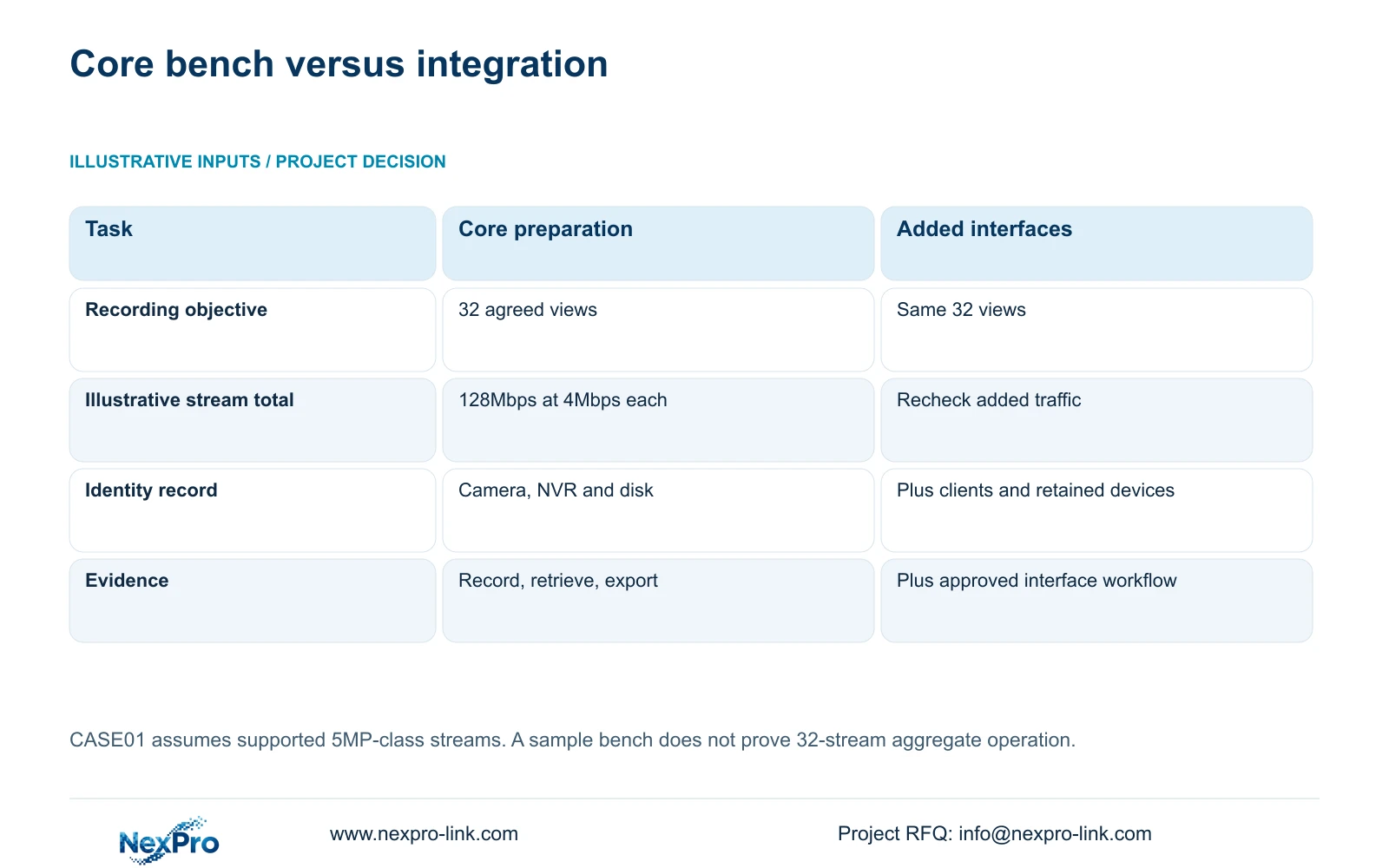
Use core recording preparation as the baseline, then add integration only for a defined owner task. The supplied scope matrix becomes useful when its rows identify the actual mixed-batch work. Assign every line to supplied, retained, installer-provided or optional, and name the person coordinating each interface.
Option B's decisive addition is interface evidence. A management client, retained device or additional server brings identities, permissions and dependencies that need their own checks. The original recording task remains unchanged. If access to the owner's platform is unavailable, mark the integration test incomplete rather than accepting it from a stand-alone bench preview.
For CASE01, the illustrative aggregate input is 32 × 4Mbps = 128Mbps. A smaller sample bench does not demonstrate that all intended streams have been exercised together. If aggregate-load testing is purchased, state the source count, stream settings and concurrent client tasks. Preserve that boundary when comparing suppliers' preparation charges.
| Decision | Option A: core preparation | Option B: added interfaces |
|---|---|---|
| Recording outcome | Known event recorded, retrieved and exported | Same sequence plus required integrated workflow |
| Device identity | Camera, NVR, disk and point records | Plus retained devices and client identities |
| Network and power | Specified bench path documented | Added interface dependencies documented |
| Access | Required viewing and export roles | Additional permissions exercised |
| Commercial boundary | Core tests and site-tuning list | Added tests and named interface owners |
Section 05
Control defects and substitutions before packing
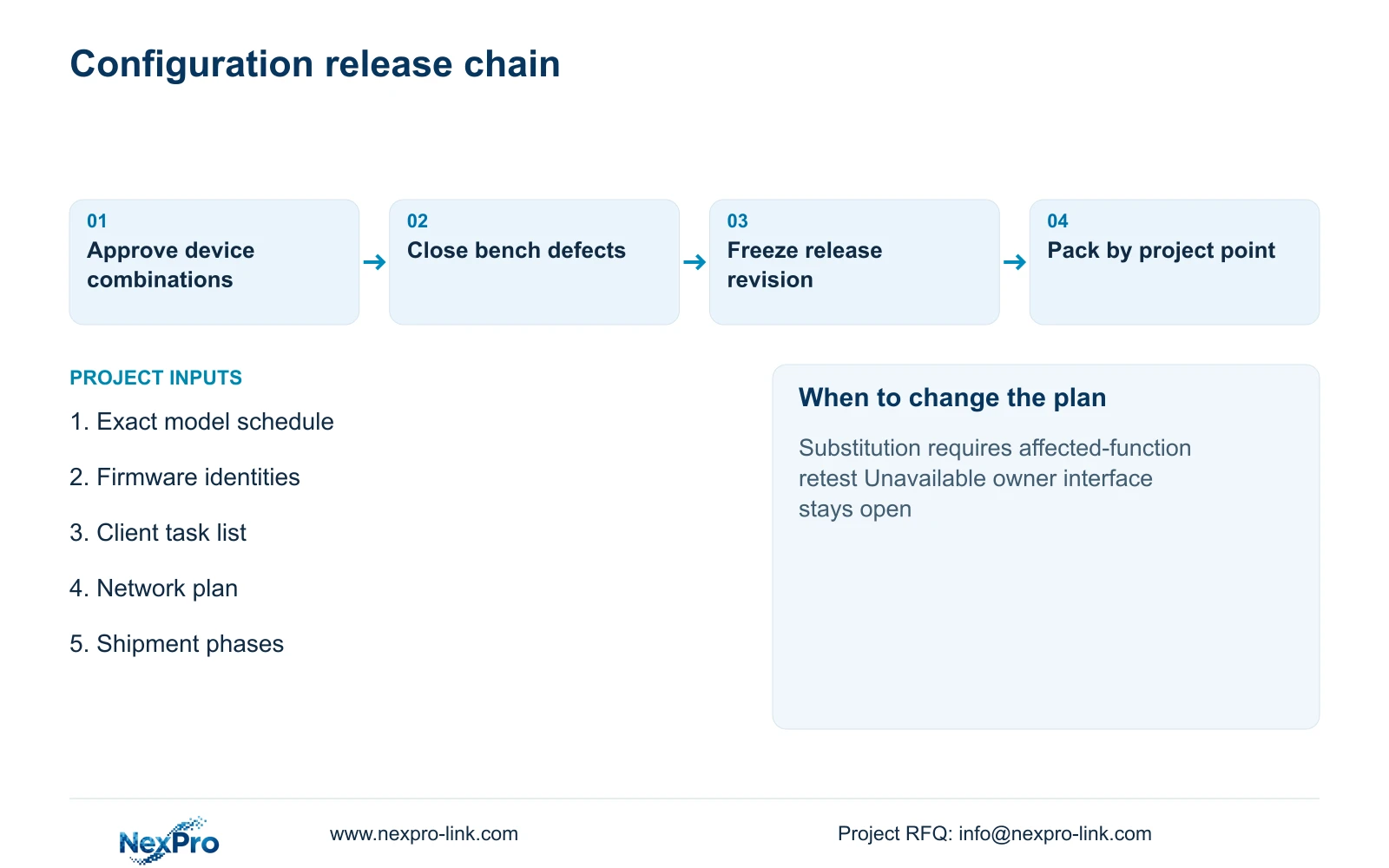
Recommend a recorded bench sequence on the intended equipment combinations, followed by a controlled site-tuning handover. Use defects to decide the next action: correct an approved setting, resolve an interface deviation or investigate an equipment fault. Retest the failed function and any shared functions affected by the remedy before closing it.
A later model or firmware substitution should reference the original approved combination. The engineer can then identify which results remain relevant. For example, a changed camera stream mode may affect recorder admission, while a different client version may affect export playback. Blanket repetition wastes effort; blanket acceptance leaves unsupported conclusions.
Do not erase a useful test configuration through an undocumented last-minute change. Capture the release revision after the agreed checks, and reconcile it with the packing schedule. The cost team should distinguish equipment, bench labour, sample testing and destination commissioning. Current matching quotations are needed before attributing savings to preparation or declaring one brand's package better value.
Section 06
Pack for configuration continuity and site discovery
The shipment handover should connect carton references, supplied serial numbers, project points and the released configuration revision. Include a test summary that describes conditions and exceptions, plus the local installer's remaining tasks. Keep original product identity readable even when the buyer orders project labels or private-label packaging.
NexPro-Link's OEM/ODM scope includes labels, manuals, barcodes and packaging options, while its BOQ support can help coordinate model matching and deviations. Use these options to make the equipment schedule easier to follow. Hardware branding does not establish permission to rename third-party software or change its ownership.
Before dispatch, the project manager should reconcile missing equipment, open functions and approved substitutions with the delivery phase. A recorder that is prepared but awaiting required camera interfaces is a partial package. State that status so the receiving team can sequence installation and acceptance without assuming every carton represents a complete, site-approved subsystem.
Section 07
Buyer questions
Can retained cameras be qualified without sending them to the bench? Their specifications can be reviewed, but the required workflow remains unverified without access to the actual combination or an authorised equivalent test. Keep the site compatibility check as an explicit outstanding item.
Should every camera receive identical image settings? Shared baseline settings may simplify preparation, but the approved role schedule should identify exceptions. Final scene tuning must reflect actual view width, movement and lighting.
What should happen after a late recorder substitution? Review admission limits, disk compatibility and required client functions against the replacement identity. Repeat the affected recording and export checks, then issue a new release revision.
Section 08
Specify the overseas preparation package
Send the exact camera and NVR schedule, required client and export tasks, approved network plan and shipment phases to info@nexpro-link.com. NexPro-Link can discuss bench preparation, interface exceptions and point-labelled packing.
Engineering references
These sources support the general planning principles. Always use the selected product's current datasheet and applicable project standards for final design.