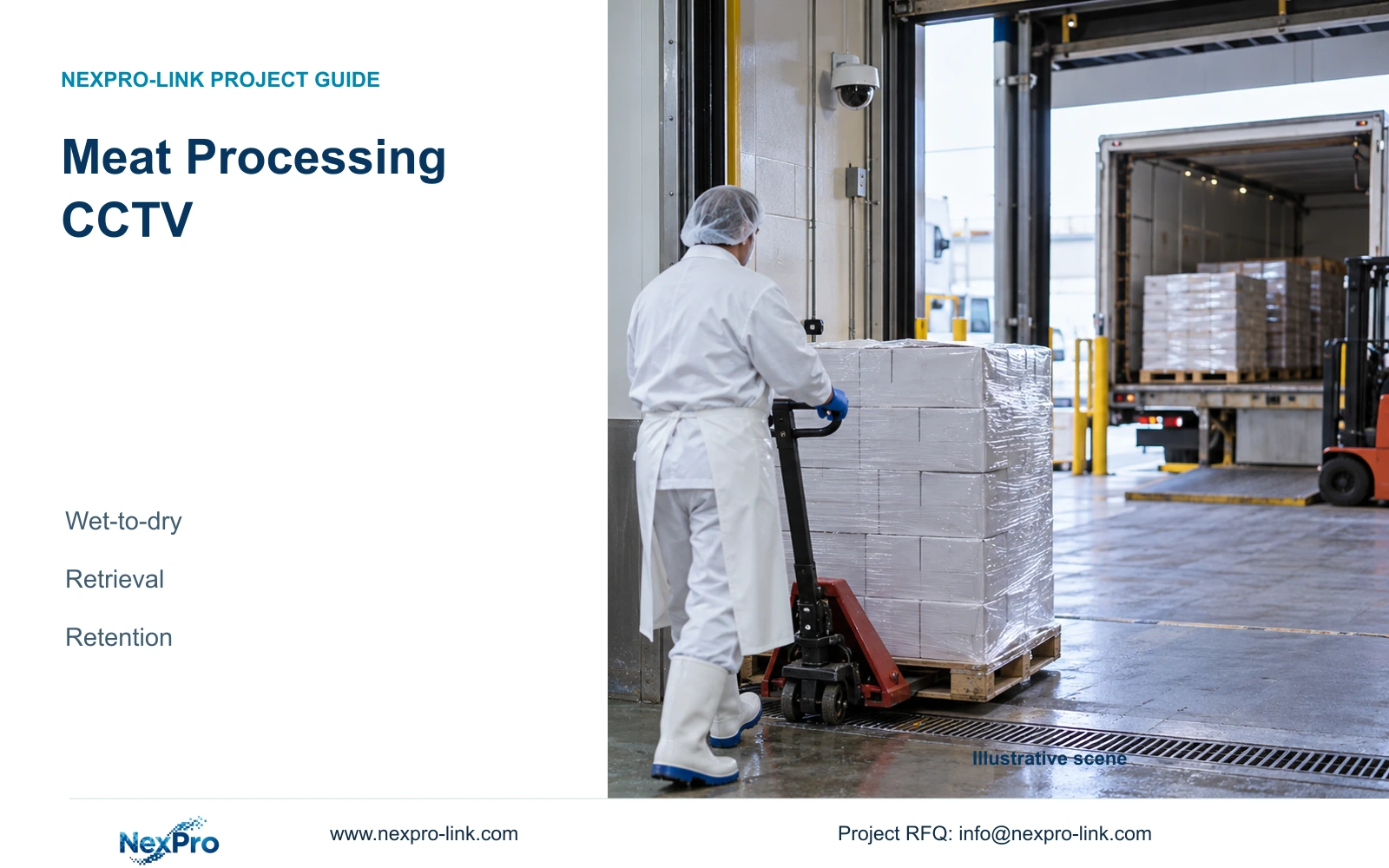
Meat-processing transfer footage needs both environmental qualification and reliable retrieval. Separate wet-area assemblies from dry-area cameras, then size retention without reducing the accepted recording quality.
Section 01
Define the transfer at the actual wet-to-dry boundary
Meat processing CCTV should split environmental requirements at the actual wet-to-dry boundary and preserve consistent time and location references across the transfer. Specify the permitted handover action first, then choose suitable cameras on each side. Footage supports access and movement investigation; it does not replace food-processing records.
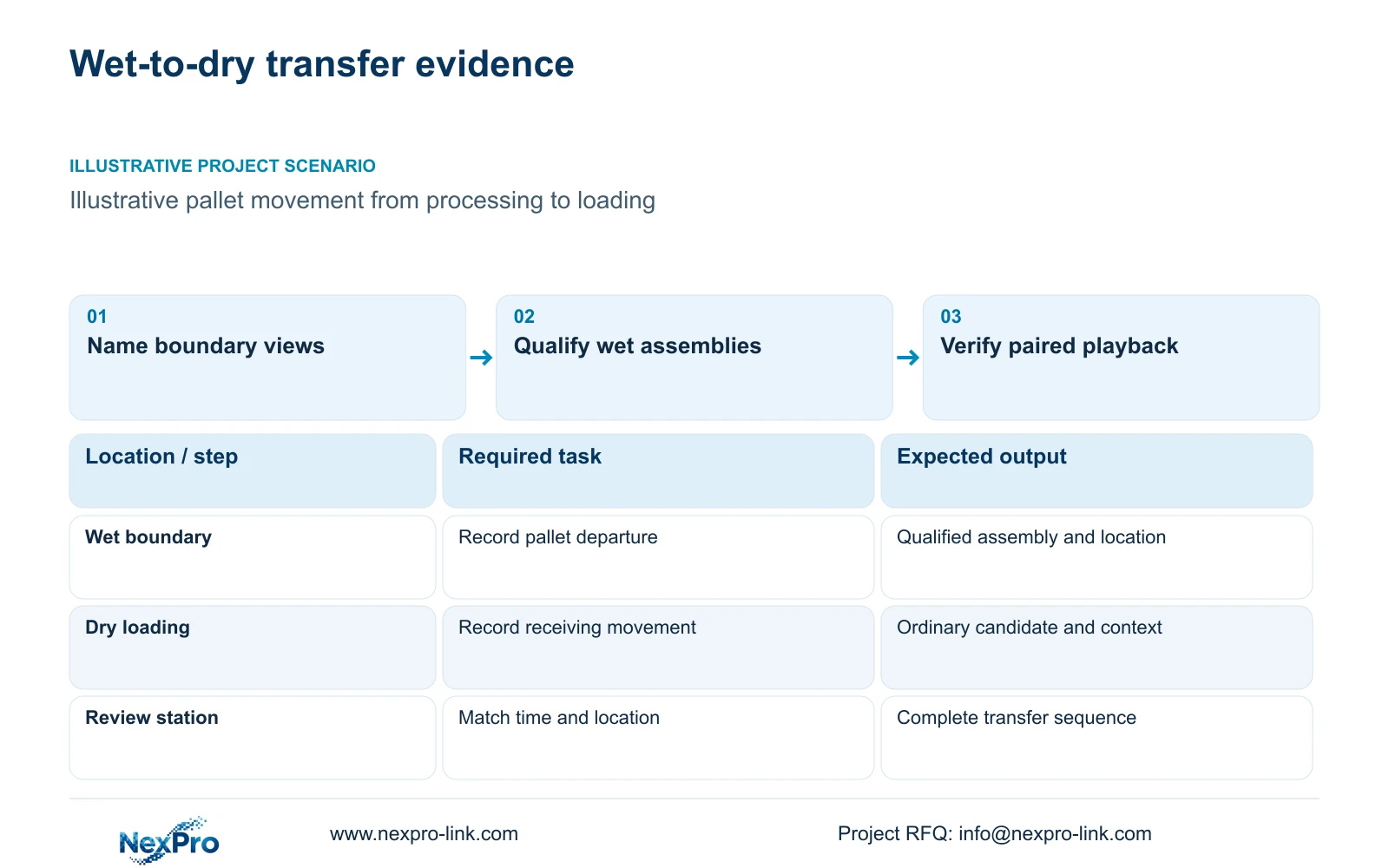
Illustrative project scenario: Pallet transfers cross wet processing and dry loading zones during each shift. Assume the owner wants to reconstruct which load left the processing boundary and entered the dispatch route. Use named boundary and loading views, with enough overlap or recognisable movement context to connect the sequence without assuming automatic pallet identification.
Overlay the handover route on the hygiene and cleaning drawing. Identify the physical boundary, the required target plane and camera exposure during sanitation. The useful output is a location schedule with ordinary candidates, separately qualified wet-area assemblies and installation owners. Do not infer one uniform indoor specification from the fact that both views are inside the building.
Section 02
Separate wet-area assemblies from dry-area camera candidates
For a dry loading position, the BL2812M or DM2812M 5MP reference may be considered after checking its view and environmental fit. The supplied specifications list IP66, -20 to +60°C, 25fps, 2.8–12mm motorized lenses and the listed 2880×1620 output. These fields do not qualify an assembly for every cleaning method or establish chemical resistance.
At the wet-side boundary, obtain cleaning conditions for the camera, cable entry, support and accessible connections. A housing quotation must identify the complete configuration and the evidence supporting those conditions. Treat an unresolved assembly as a specialist line rather than applying the ordinary camera's ingress field to every accessory.
A dry-side relocation is worth evaluating when it avoids direct exposure and still shows the transfer. Check door obstruction, pallet height and the viewing angle before accepting it. If one relocated camera loses either the departure action or loading context, retain complementary views instead of reducing quantity solely because the field appears wider.
Section 03
Include cleaning access and retrieval ownership
The local installer should propose a service route that does not require an improvised approach through active operations. The facility should approve the access and cleaning-release procedure. Keep the camera assembly, penetration materials and maintenance method attached to the same location record so replacement work does not lose the original environmental boundary.
Assign camera names that match dispatch references and document the time basis used by the recording system. During acceptance, follow a representative transfer from the wet-side view to loading playback. Confirm that an authorised reviewer can find both clips from the same event reference and recognise any timestamp discrepancy.
Locate recorders and switches in suitable accessible rooms. Where recording is distributed, retain a map from each view to its recorder and power node. The supplied CASE03 example uses two 24-camera nodes; that architecture is useful background, but it does not determine the quantities or recorder layout of the separate 32-camera retention exercise below.
Section 04
Compare retention without changing recording quality
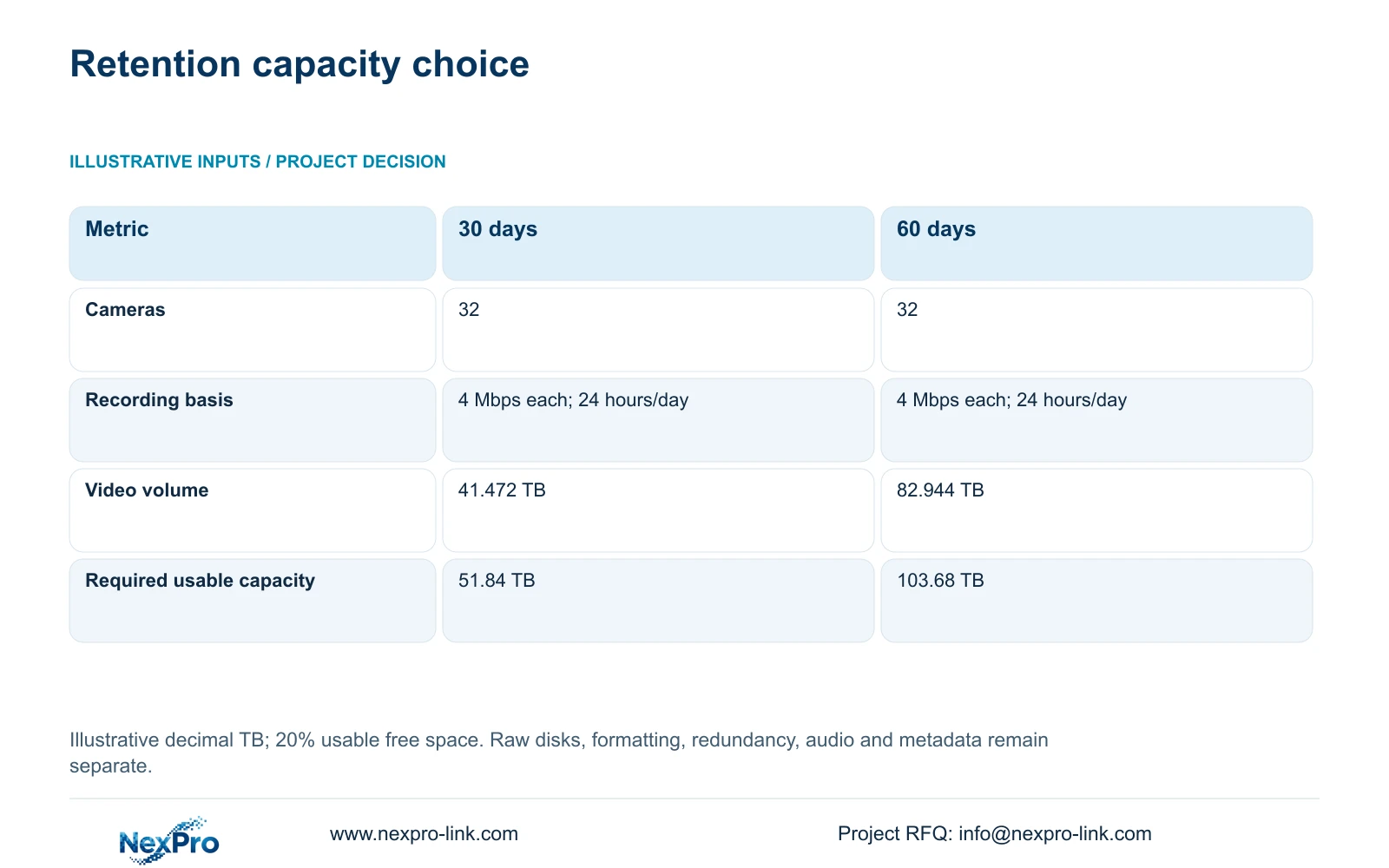
The illustrative storage exercise uses 32 cameras at an average 4 Mbps each, recording 24 hours/day. Compare 30 and 60 days while retaining 20% of usable space as free space. Use video_TB = cameras × Mbps × 10^6 × 86400 × days / 8 / 10^12, then required_usable_TB = video_TB / 0.8.
For 30 days, video data is 41.472 decimal TB and required usable capacity is 51.84 TB. For 60 days, the corresponding results are 82.944 TB and 103.68 TB. Doubling retention doubles the video volume under these unchanged assumptions. It provides no evidence of a compression advantage for any brand.
These usable targets are not raw disk specifications. Formatting overhead, any supported redundancy arrangement, hot spares and recorder limits require separate treatment; audio and extra metadata are excluded. CASE03 already applies 95% formatting allowance and 20% reserve in its recording budget, so that reserve must not be added again when using its node figures.
| Metric | 30-day option | 60-day option |
|---|---|---|
| Cameras | 32 | 32 |
| Average bitrate and schedule | 4 Mbps each; 24 hours/day | 4 Mbps each; 24 hours/day |
| Video data | 41.472 decimal TB | 82.944 decimal TB |
| Required usable capacity | 51.84 TB | 103.68 TB |
| Free-space reserve | 20% of usable capacity | 20% of usable capacity |
Section 05
Choose retention and environmental scope independently
Recommend qualified wet-side assemblies and ordinary dry-side candidates, with retention set by the owner's investigation window. A longer retention period does not solve an obscured or unsuitable boundary view. Conversely, upgrading a wet-area housing does not preserve older footage unless the storage design supports the chosen period.
The NexPro-NVR4449-4K reference lists four SATA bays with up to 18 TB per bay and 320 Mbps input. Its published summary distinguishes 49×5MP from 9×4K. Assess the installed compatible disks, supported stream modes and each node's demand before accepting it; neither the channel count nor multiple bays proves RAID or the required simultaneous playback.
Compare proposals using the same wet-to-dry actions, average quality basis and usable retention target. The cost team should separate specialist assemblies, storage changes and local cleaning-access work. Keep a required platform or environmental feature in every comparable bid, and obtain current matching quotations before drawing a price conclusion.
Section 06
Release a transfer-led BOQ and acceptance sequence
Build the BOQ around named transfer points. For each, identify the supplied camera or specialist assembly, local mount and penetration scope, recording node and approved maintenance owner. Add retention and recording hours to the recorder schedule rather than hiding them in a general security note.
NexPro-Link's BOQ & Tender Support can help match ordinary equipment and show technical deviations. Project labels and packing can preserve wet-side and dry-side identities through delivery. The local project team remains responsible for hygienic installation and the qualification of specialist assemblies.
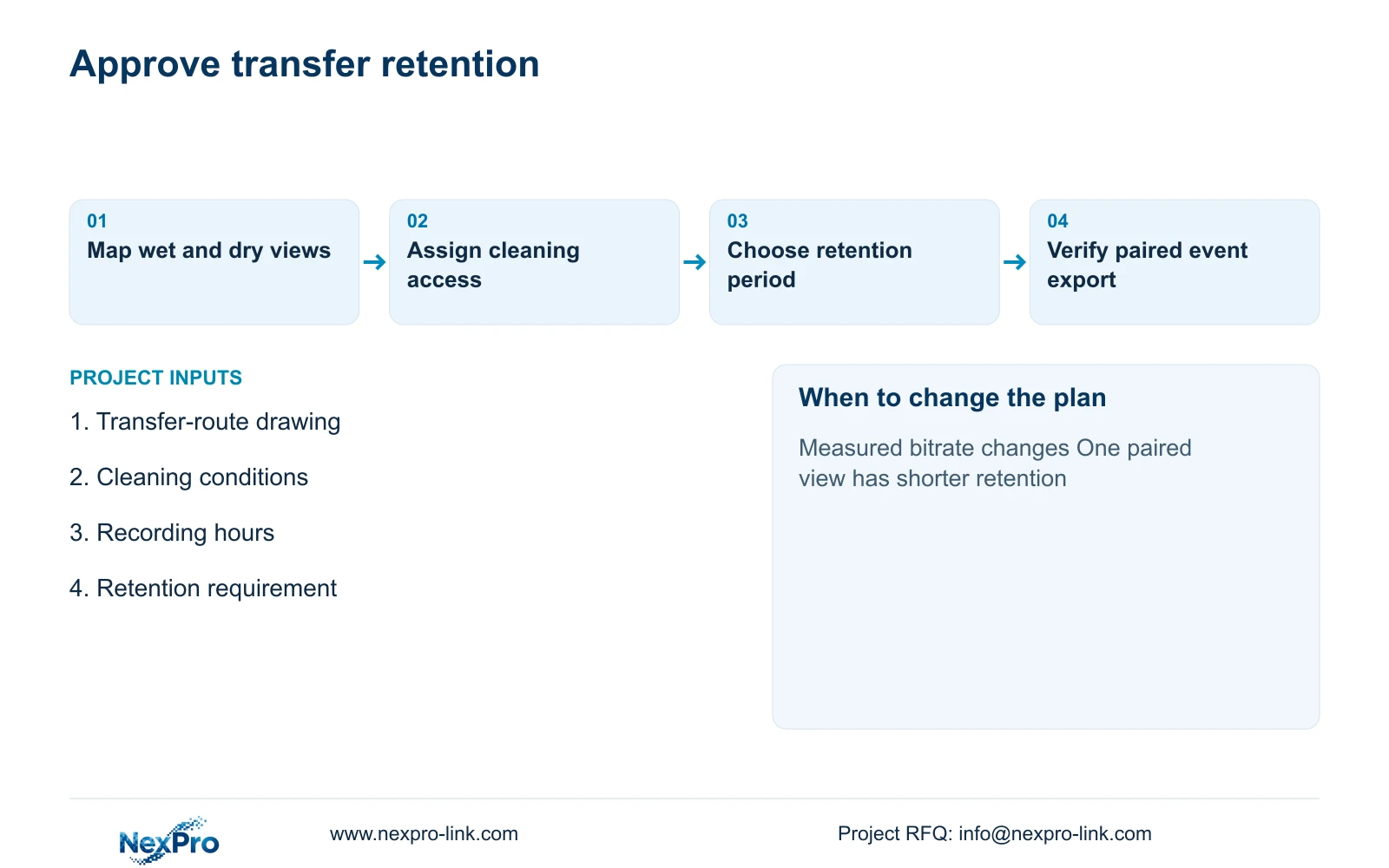
Before closing acceptance, demonstrate the complete transfer in recorded playback, verify location names and clock alignment, and check the installed storage against the approved assumptions. If the cleaning method, recording hours or measured bitrate changes, update the affected rows and capacity calculation before treating the original quotation as unchanged.
Section 07
Buyer questions
Can the 32-camera calculation be used for the 48-camera reference? Only after recalculating the camera count and node allocation. The 32-camera exercise compares retention; CASE03 is a separate 48-camera architecture with its own per-node disk budgets.
Can event recording reduce the disk quantity? It may change video volume, but the buyer must first accept the risk of missing context outside detected events. Use a representative recording schedule and measured bitrate rather than applying an assumed saving to the continuous-recording example.
Should wet-side and dry-side views have identical retention? Use the same period where both are needed to reconstruct one transfer. Different periods can leave only half of an older event available. Any exception should be an explicit owner decision.
Section 08
Price a complete wet-to-dry transfer record
Send the transfer-route drawing, wet-area cleaning conditions, camera recording schedule and required investigation period to info@nexpro-link.com. NexPro-Link can discuss the environmental split and recorder-storage scope on a comparable basis.
Engineering references
These sources support the general planning principles. Always use the selected product's current datasheet and applicable project standards for final design.