Evaluate general auxiliary equipment as the object, and state salt-mist and vibration protection separately from the applicable classification scope.
Section 01
Define Auxiliary Equipment
Evaluate general auxiliary equipment as the object, and state salt-mist and vibration protection separately from the applicable classification scope.
Auxiliary equipment, in this context, means the information and communication hardware that supports ship administration and operations without controlling the vessel. That includes file and application servers, ship-office workstations, printers, LAN switches, routers, IP telephones, general CCTV recording that is not part of a safety function, and environmental logging. The same label does not include navigation displays, propulsion control, steering gear, fire detection, or emergency lighting. Those systems need separate treatment even when they sit in the same rack.
The first task is to write down which loads are in scope and which are out. A scope table keeps the boundary visible and prevents a general UPS from drifting into a safety role.
PoE endpoints need one note. If a switch powers phones, cameras, or access points, those endpoints are already inside the switch input. Add them again and the load total is double counted. The schedule should record each device once, at the point where it draws power.
| Decision area | Project question | Required output |
|---|---|---|
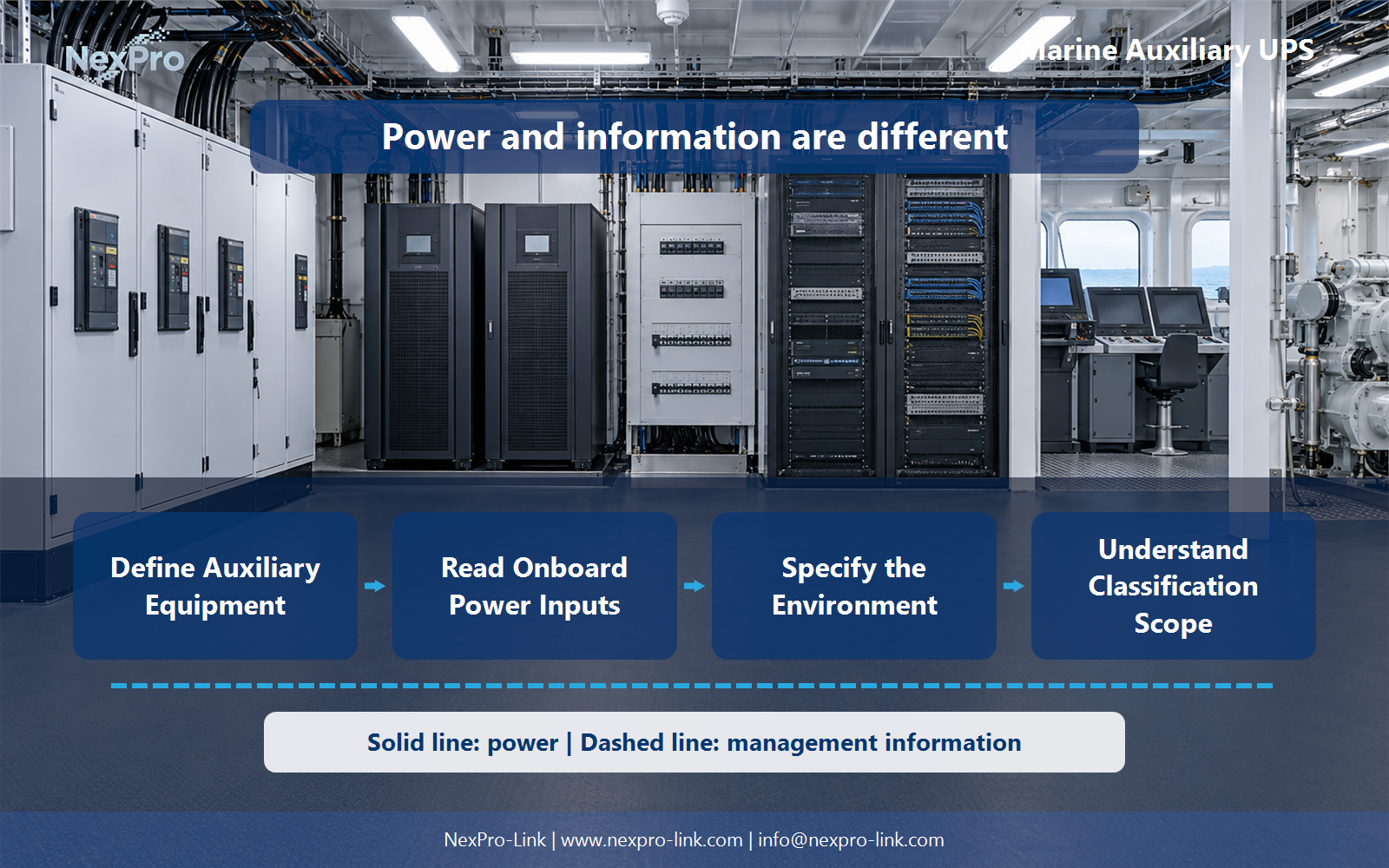
| Define Auxiliary Equipment | Which auxiliary shipboard loads can be evaluated as an IT UPS package? | Scope table: auxiliary IT / network / specialist systems / exclusions |
| Read Onboard Power Inputs | Why are the actual onboard supply requirements essential? | Interface schedule: source / voltage / frequency / output / configuration |
| Specify the Environment | Does a rugged enclosure prove marine suitability? | Environment table: location / vibration / corrosion / temperature / access |
Section 02
Read Onboard Power Inputs
A ship is not a shore office. Voltage, frequency, source behavior, and distribution all come from the vessel's own electrical arrangement, and they can differ from a building installation. The UPS has to match what the auxiliary feeder actually delivers.
Use the installation's specified voltage, frequency, source behavior, and distribution arrangement. Do not assume 230 V at 50 Hz, or any other shore-office figure, without checking the drawings. Electrical compatibility sits with the selected equipment configuration, not with a nominal wattage read from a datasheet.
An interface schedule records the boundary in one place.
The voltage and frequency above are teaching inputs for the scenario, not a claim that every vessel uses them. Real projects take the figures from the single-line diagram and the equipment schedule.
Section 03
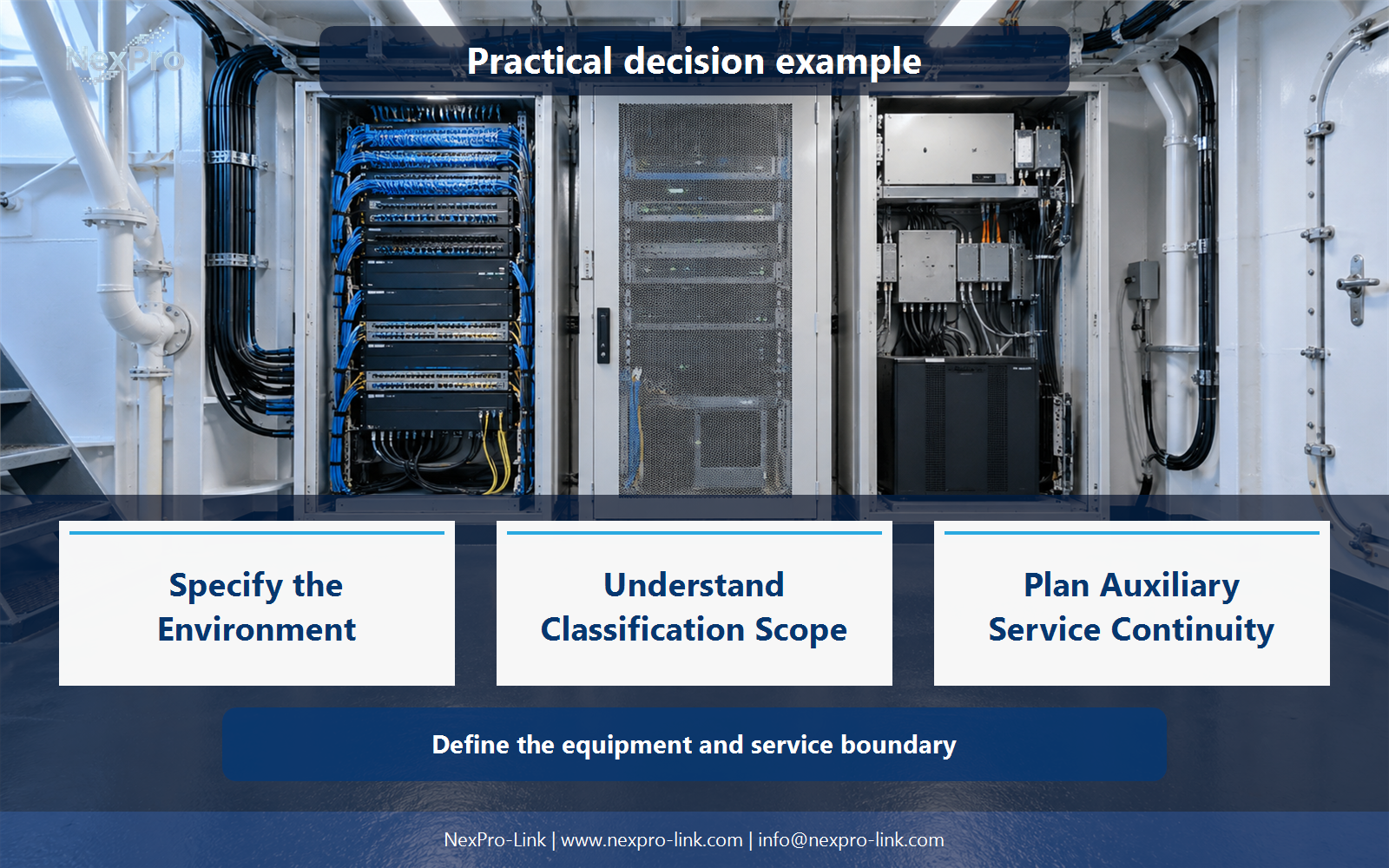
Specify the Environment
A rugged enclosure does not prove marine suitability. Vibration, corrosion, temperature, and installed location are separate considerations, and each one has to be defined before a supplier can respond.
Salt mist is the obvious marine condition, but it matters less in a sealed, air-conditioned electronics room below deck than it does on an open bridge wing. Vibration depends on where the cabinet is fixed and how the ship moves in service. Temperature depends on ventilation and heat load, not on the label printed on the enclosure. The task is to describe the application boundary instead of asking for a generic "marine" or "rugged" product.
A single environmental test result is not blanket suitability for every onboard location. The environment table keeps each condition tied to the place where the equipment actually lives.
- Confirm the answer to: Does a rugged enclosure prove marine suitability?
- Draw electrical power as a solid path and management information as a separate dashed path.
- Keep external services and specialist approvals outside the UPS equipment claim.
Section 04
Understand Classification Scope
A classification statement should identify the actual equipment or arrangement, the applicable scope, and any conditions of use. Approval stays tied to the specified application. A class notation for a switchboard does not transfer to the UPS bolted beside it, and a general commercial series is not automatically class approved.
For a project decision, record configuration, installation, conditions, and the applicable requirement in a scope record. That record keeps the equipment inputs and the intended service outcome aligned.
Where the requirement is not yet confirmed, say so in the record. Leaving the field open is more useful than assuming an approval that has not been reviewed.
Section 05
Plan Auxiliary Service Continuity
Runtime and maintenance come from the agreed auxiliary-service objective. The objective might be to hold the included loads through a generator start, or to allow an orderly shutdown, or to bridge a short transfer between feeders. Each objective produces a different runtime and a different maintenance arrangement.
Identify alternate sources and available access. Do not assume battery replacement can happen without interruption, and do not assume the UPS guarantees every external shipboard dependency. A generator that is down for maintenance is outside the UPS, no matter how healthy the battery is.
A battery energy estimate is a planning number. It is not a measured runtime guarantee, and it does not replace the discharge curve, temperature derating, aging, or rate conditions of the installed battery.
Section 06
Prepare the Marine RFQ
When the decisions above are made, NexPro-Link needs the results in a form a supplier can work from. Provide the authorized auxiliary loads, the power interfaces, the environment, and the required classification scope. NexPro-Link can then discuss equipment supply options against those inputs.
A general commercial UPS series should not be presented as automatically class approved or suitable for every marine system. The RFQ keeps the equipment request inside the defined boundary.
Engineering references
These sources support the general planning principles. Always use the selected product's current datasheet and applicable project standards for final design.