
Group records capture, indexing and back-office dependencies so stopping and restarting is recoverable. Plan the project from the document-processing equipment and records-service recovery objective.
Section 01
Map the Records Workflow
Which parts of a document workflow should be protected? Identify capture stations, indexing services, storage and the network path between them. A record may exist in several processing states, so the outage response should preserve the ability to identify incomplete work rather than assume every scanned item is already stored and indexed. Insurance operations and records-platform teams can use that boundary to build the workflow: capture / queue / index / storage / confirmation and prepare document-processing equipment and records-service recovery objective before selection.
Group records capture, indexing and back-office dependencies so stopping and restarting is recoverable.
The working question is simple: Which parts of a document workflow should be protected? Record the answer as a service requirement before comparing UPS ratings or battery options.
| Decision area | Project question | Required output |
|---|---|---|
| Map the Records Workflow | Which parts of a document workflow should be protected? | Approved service objective |
| Separate Storage from Processing | Why can protected storage still leave interrupted work? | Defined load and dependency boundary |
| Define Recovery and Retention Separately | Does a long data-retention period require equally long UPS runtime? | Reviewed power-path decision |
Section 02
Separate Storage from Processing
Processing queues and application state may sit on other hosts or workstations. Protecting the storage chassis alone does not keep those stages available. Use the dependency map to decide which services continue and which finish or stop during the battery interval.
Keep the load list, operating state and supporting dependencies in the same schedule. This makes omissions visible before runtime or capacity is discussed.
- Confirm the answer to: Why can protected storage still leave interrupted work?
- Separate measured demand, nameplate limits and committed growth.
- Identify the owner of each external service or approval.
Section 03
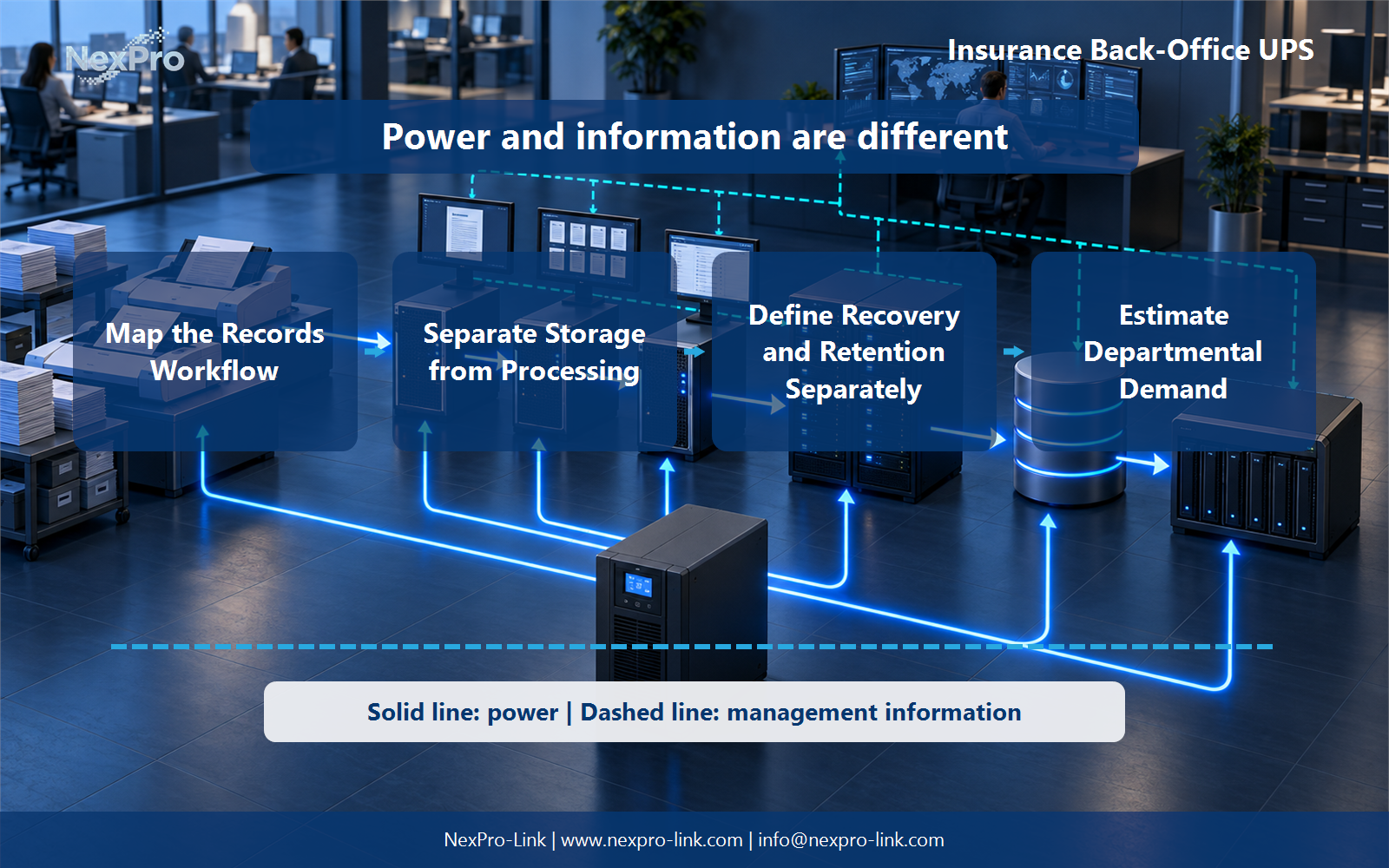
Define Recovery and Retention Separately and Estimate Departmental Demand
No direct conversion exists. Retention describes how long records are kept, while runtime describes the power interval needed for a chosen continuity or shutdown objective. Explain both requirements without treating years of records retention as a battery-duration calculation.
Count the nominated servers, storage, network and required workstations using consistent operating assumptions. Exclude unnecessary office peripherals from a controlled-shutdown group. Check peak and restart states separately so a low average workload does not conceal a capacity limit.
Draw power delivery as a solid path and management information as a separate dashed path. That distinction prevents an alarm or software command from being mistaken for an electrical protection function.
Section 04
Coordinate Batch Shutdown
Define the order for stopping new work, completing queues, preserving state and shutting down dependencies. Assign acknowledgement and timeout behavior through the IT team's approved process. For a project-specific decision, record job intake, processing, database and storage in the sequence table. This keeps the equipment inputs and intended service outcome aligned.
Assign the action, acknowledgement, timeout and escalation owner before commissioning. The useful battery interval is the time needed for this approved sequence plus reserve, not an arbitrary marketing duration.
Section 05
Connect the Workflow to Procurement
Provide the protected equipment and the service-specific stop or bridge objective, plus installation and communication constraints. NexPro-Link can discuss a defined power package. Record-retention compliance and application recovery remain responsibilities of the institution's systems and governance, not automatic attributes of a UPS series.
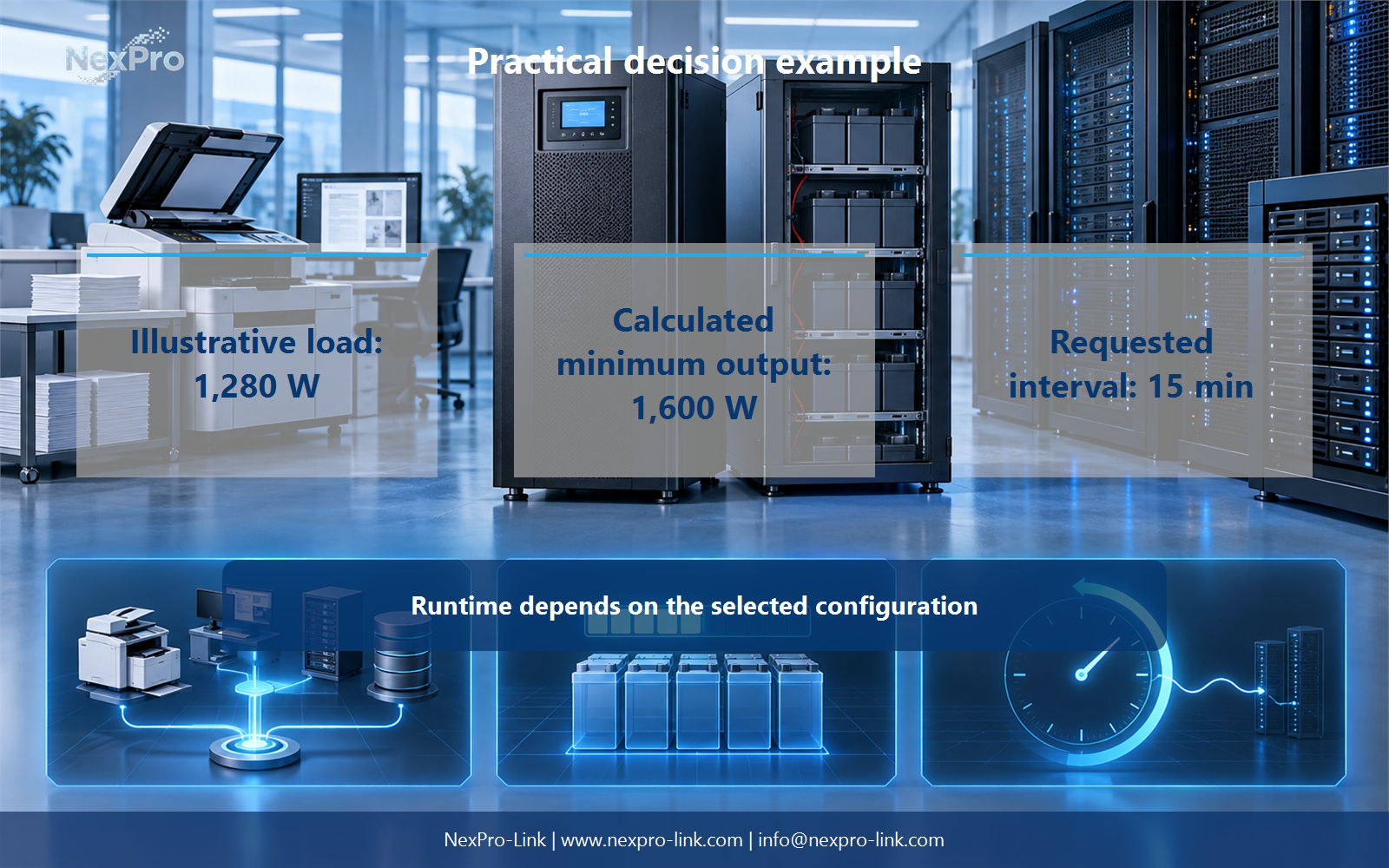
For the article's practical example, the stated teaching inputs are: Illustrative load: 1,280 W. Calculated minimum output: 1,600 W. Requested interval: 15 min. Runtime depends on the selected configuration. Treat these figures as planning assumptions, then replace them with measured or manufacturer-supported project data.
Engineering references
These sources support the general planning principles. Always use the selected product's current datasheet and applicable project standards for final design.